How Exhaust Pipe Diameter Affects Performance by Engine Type
Exhaust pipe diameter affects performance by influencing exhaust velocity and backpressure: small engines are often matched with about 2.0-2.25 inches, many street V8s with about 2.5 inches, and turbo setups often use about 2.5-3.0 inches. Pick the wrong size and you can lose low-end torque, cap top-end power, or create drone. This guide matches diameter to engine size, RPM band, and naturally aspirated or turbo use.
Why pipe diameter changes performance

Pipe size changes how fast exhaust leaves the engine. A smaller tube keeps gas speed up, which helps scavenging at low and mid RPM, while a larger tube reduces restriction at high RPM. The tradeoff is direct: too much restriction adds backpressure, but too much diameter slows the gas column and weakens low-speed response.
Scavenging matters because moving exhaust helps pull spent gases out of the cylinder as the intake charge starts to enter. That works best when velocity stays in the right range. If the pipe is oversized for the engine and RPM band, pulse energy drops and the engine can feel softer off idle or on tip-in.
Diameter stops helping once the engine no longer needs the extra flow area. On common street engines, that point often arrives before people expect it, especially with stock manifolds, mild cams, or factory converters. A larger pipe may add noise and drone before it adds useful power.
Flow area, gas speed, and backpressure
Inside diameter, or ID, is the flow-relevant measurement. A pipe with the same outside diameter can flow very differently if wall thickness changes, because the real passage gets smaller. Weld beads and crushed bends also cut into flow area, so the number stamped on a box is not the whole story.
Backpressure is not a goal. Too much can hold hot exhaust in the cylinder and raise temperatures. Too little restriction from an oversized system can lower exhaust velocity and hurt low-end torque. The right pipe size balances flow with enough speed to keep the engine responsive.
How scavenging depends on velocity
Scavenging gets stronger when exhaust pulses stay coherent through the pipe. Mandrel bends help because they maintain consistent diameter through turns, which keeps the pulse moving. Crush bends narrow the pipe at bends, so they reduce flow compared with mandrel bends and can make the whole system look smaller than it really is.
That matters most on street engines with a narrow useful RPM band. A system that is technically large enough on paper can still feel wrong if bends, mufflers, or converter outlets choke the flow. Size alone is only part of the decision.
How do you measure exhaust pipe size?
Measure inside diameter when you can, because that is the number that affects flow. If you only have access to the outside, measure the outer diameter with calipers and subtract the wall thickness to estimate ID. Standard exhaust tubing is about 0.065 to 0.095 inches wall, so OD and ID are not interchangeable.
A quick estimate subtracts 0.15 inches total from OD. That is only a rough shortcut, but it helps when you are matching replacement tubing, clamps, or adapters. Always confirm whether the part is listed by OD or ID before buying.
Using outer diameter and wall thickness
OD is easier to measure with calipers, especially on an installed system. The wall thickness changes the real opening, and thicker tubing reduces ID even if the outer size looks right. If the tube is welded, the bead can also pinch the passage at the joint.
- Measure the pipe’s OD at a straight section.
- Check wall thickness if it is listed by the tubing maker.
- Estimate ID by subtracting wall thickness from both sides.
- Compare that ID to the target size for engine type and use.
- Confirm the converter outlet and flange sizes before ordering parts.
Why weld beads and crush bends matter
Weld beads are easy to overlook. They can create a small step inside the pipe that interrupts flow, especially near flanges, reducers, and aftermarket joins. Crush bends are worse in tight areas because they flatten the tube at the bend and reduce effective area right where flow is already turning.
Say your caliper shows a 2.50-inch OD tube with heavier wall thickness than expected. The actual ID may be meaningfully smaller than a typical 2.5-inch system, so the car can behave like it has a smaller exhaust. That is why OD alone can lead you to the wrong replacement size.
Sizing by engine and use
Engine displacement, horsepower, and RPM range should drive the choice together. Displacement gives you the engine’s basic air demand, horsepower is a rough proxy for exhaust mass flow, and RPM tells you whether you need stronger low-speed velocity or more top-end flow. A street car and a track car with the same peak power often need different pipes.
Forced induction changes the logic again. Turbocharged engines use exhaust energy to drive the turbine, so the system has to support that energy without creating unnecessary restriction after the turbo. Naturally aspirated engines rely more on pulse timing and scavenging, so they are more sensitive to gas speed and bend quality.
Displacement as the starting point
Small 4-cylinder engines under 2.0L are often paired with 1.5-1.75 inch pipes. Naturally aspirated V8s from 5.0L to 7.0L are often suggested 2.5-3.0 inch pipes. Those are starting points, not automatic answers, because cams, headers, converters, and RPM band can move the target up or down.
A 200 HP street car does well with a 2.0-2.25-inch exhaust. That size supports ordinary street use without throwing away too much low-speed response. A 300 HP engine example uses a 2.5-inch single exhaust as ideal, which is why many stock-to-mild performance builds end up there.
Horsepower and RPM band
Horsepower is useful because it gives you a quick flow target. For 100-150 HP, recommended pipe diameter is 1.5-1.75 inches. For 300-350 HP, recommended pipe diameter is 2.5-2.75 inches. For 600+ HP, recommended pipe diameter is 4.0 inches and up.
RPM band changes the answer inside each horsepower band. A low-RPM street engine often prefers a slightly smaller pipe for velocity and response. A high-RPM engine with headers and a cam that moves the power band upward can use more diameter because the exhaust volume at peak power is higher.
Naturally aspirated versus turbocharged
Naturally aspirated engines are usually sized for scavenging and drivability first. Turbocharged engines need enough area to reduce post-turbine restriction while still preserving energy where the system can use it. That is why a turbo build is not the same setup with a larger pipe.
Suppose a 2.0L turbo car makes about 320 HP and is used mainly on the street. A 2.5-inch system is a common starting point, but a very free-flowing downpipe, a restrictive converter outlet, or a track-only RPM band can justify stepping up. If the car feels lazy at low speed, going one size smaller can sometimes improve response without hurting the top end much.
Exhaust diameter sizing table
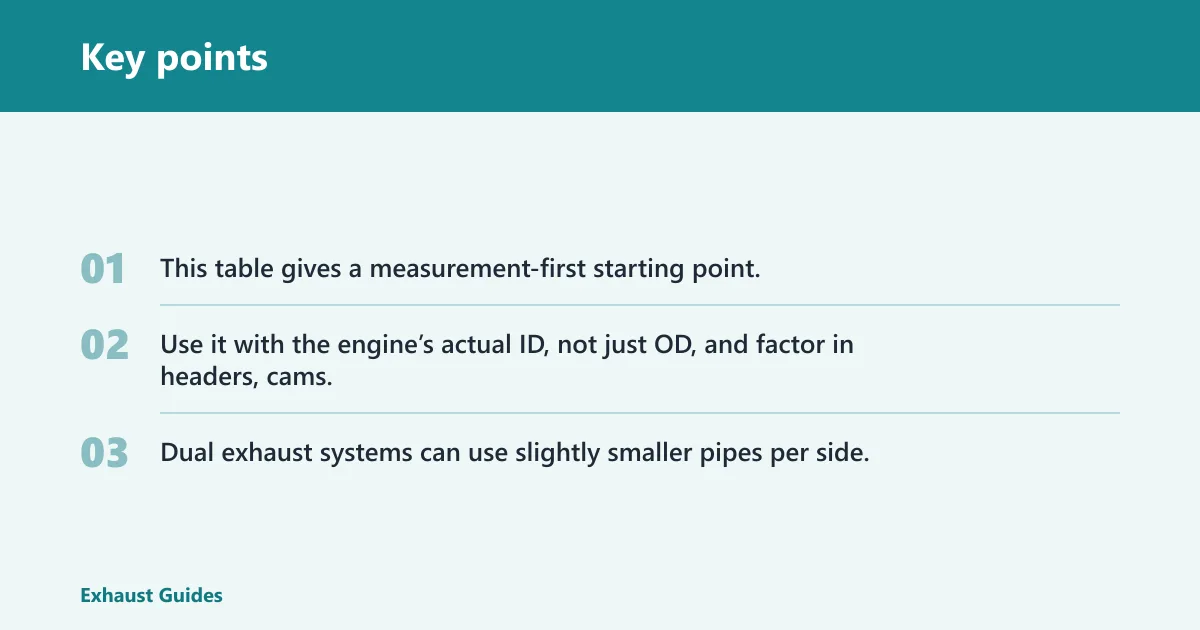
This table gives a measurement-first starting point. Use it with the engine’s actual ID, not just OD, and factor in headers, cams, converter size, and fitment limits. Dual exhaust systems can use slightly smaller pipes per side, so split systems do not need the same diameter as a single pipe carrying all the flow.
| Engine type | Aspiration | Horsepower band | Intended use | Recommended pipe ID | Common mistake |
|---|---|---|---|---|---|
| Small 4-cylinder under 2.0L | NA | 100-150 HP | Daily street | 1.5-1.75 inches | Go one size larger only if the engine revs high and has headers; otherwise a larger pipe can soften low-speed torque. |
| 4-cylinder or inline-6 street build | NA | 200 HP | Street with mixed driving | 2.0-2.25 inches | Go one size smaller if the current system drones or feels weak below midrange, especially with stock manifolds. |
| V6 or mild V8 | NA | 300-350 HP | Street and occasional spirited use | 2.5-2.75 inches | Go one size smaller if the cam is mild and the car spends most time below 4,000 rpm; go larger only for sustained high-rpm use. |
| Street V8 | NA | 300 HP | Daily street | 2.5 inches single | Do not jump to 3.0 inches just because the engine makes 300 HP; that often adds noise before it adds power. |
| High-output V8 | NA | 600+ HP | Track or drag | 4.0 inches and up | Use larger only when the engine really moves that much air; a mild street V8 rarely needs this much pipe. |
| Turbo 4-cylinder or turbo V6 | Turbocharged | 300-350 HP | Street and highway | 2.5-2.75 inches | Go smaller if you need better spool and the turbo outlet is already close to the target size; go larger for higher sustained boost and track use. |
| Large turbo V8 | Turbocharged | 600 HP | Drag or high-load use | 4.0-inch duals | Do not copy a NA size chart here; a 600 HP drag car with long tube headers may need full 4.0-inch duals. |
Can an exhaust pipe be too big?
Yes. An exhaust can be too big when the pipe area outruns the engine’s airflow demand and RPM band. That usually shows up as weaker low-speed torque, slower response, and more drone, while the top end may not improve enough to justify the loss. Bigger is not automatically faster.
The problem is not only power. Oversized pipes often make a street car less pleasant because the engine loses some pulse energy in the lower rev range. If the car spends most of its life below the torque peak, a smaller pipe can be the better tool.
Signs the pipe is oversized
A few common signs point that way: lazy launch feel, softer midrange than expected, little gain after a larger exhaust swap, and more cabin boom at cruise. If the current setup already has a large ID, mandrel bends, and a high-flow converter, one more size up may do very little.
Look at logs or real-world behavior, not just the catalog size. If boost builds later than expected on a turbo car, or a naturally aspirated car loses crispness after the exhaust change, the pipe may be too large for the use case. That is especially common on mild street engines with stock manifolds.
Where bigger stops helping
Bigger stops helping when the extra area no longer reduces restriction enough to matter, but still lowers gas speed. On many common street builds, that happens before the jump from 2.5 inches to 3.0 inches pays off. The exact cutoff depends on displacement, camshaft, headers, converter size, and where the engine lives in the rev range.
Fitment limits that change the answer
Fitment matters because the best size on paper still has to clear the car. Ground clearance, hanger space, flange size, and catalytic converter outlet size can all force a different choice. A pipe that fits the engine may not fit the chassis without a bad bend or an ugly reducer.
Use the existing converter outlet and flange as hard limits. If the converter outlet is smaller than the target ID, the system cannot really act like the larger size until that section changes too. The same is true if the floor pan leaves no room for a true round tube at the chosen diameter.
Mandrel bends versus crush bends
Mandrel-bent pipes maintain consistent diameter through bends, so they are the better choice when performance matters. Crush-bent pipes reduce flow by narrowing at bends, and that loss can matter as much as stepping down a size in a straight section. A well-sized mandrel system often behaves better than a larger crush-bent one.
For a street build, the right answer is often the smallest pipe that still meets the horsepower target and clears the car. That approach keeps velocity up, limits drone, and usually leaves more room for future changes like headers or a higher-flow converter.
Frequently asked questions
How does exhaust affect performance?
Exhaust affects performance by changing how fast gases leave the cylinders and how much restriction the engine sees. A properly sized pipe helps scavenging and keeps backpressure in check. Too small can choke flow; too large can slow gas speed and hurt low-end torque.
What size exhaust pipe do I need for 300 HP?
If the car is a street build with a mild cam and modest RPM use, stay near the smaller end unless headers and converter flow justify more.
Does a larger exhaust always add horsepower?
No. Larger diameter can help only while the engine still needs more flow area. Past that point, the gains taper off and may disappear, especially on street cars. The wrong size can trade away low-end response, increase drone, and deliver little or no extra peak power.