Best Loud Exhausts for Motorcycles (2026): Research Shows
The loudest motorcycle exhaust is usually a straight-through full system or a short slip-on with minimal packing and the smallest removable baffle; for most riders, the best choice is the loudest setup that still fits your commute and stays legal where you ride. Weak picks waste money, add drone or rasp, and can bring tickets or fast fatigue. This guide ranks loudest-by-goal options, from maximum volume to the best-sounding street setup and the least-annoying loud exhaust.
Quick comparison
| Product | Badge | Best for | Price | ||
|---|---|---|---|---|---|
 |
JFG RACING Slip On Exhaust Motorcycle Muffler Pit Dirt BikeJFG RACING | Our pick | Universal slip-on · 1.5-2 inch | $36.99
Price as of 17 Oct 2026
|
View |
 |
Slip On Line For Ho&nda CBR650R CB650R CBR650F CB650FPWNGYTES | Also great | CBR650R slip-on · titanium carbon | $130.00
Price as of 17 Oct 2026
|
View |
 |
Bassani Road Rage 2-into-1 System Short 15.5"BASSANI | Also great | Road Rage system · 15.5 inch | $1,088.95
Price as of 17 Oct 2026
|
View |
Use this as a sound-and-fitment filter, not a volume contest. The right pick depends on whether you want maximum bark, a deeper street tone, or less drone on long rides.
How we chose
This ranking weighs sound intensity against real use. Fitment, clearance, noise-control hardware, and fueling risk matter more than a big claim on the box.
It also separates slip-on mufflers from full exhaust systems. A slip-on replaces only the muffler section, usually installs more easily, often costs less, and may work with stock headers. A full system replaces headers and muffler together, changes flow more, and is more likely to need fueling changes.
Sound works in layers: idle volume, throttle bark, cruising drone, tone depth, and crackle. A loud pipe that sounds sharp at idle but harsh at 70 mph is a poor street buy.
Noise-control hardware matters too. Removable dB killers and baffles can change whether a bike feels tolerable on a commute or punishing at highway speed.
JFG RACING slip-on: best for budget loudness
- Fits dirt, street, scooters, ATVs
- Aluminum alloy body for lightness
- Easy installation design
This is the budget pick for riders who want a louder slip-on without paying full-system money. The universal 1.5-2 inch fit makes it appealing for dirt bikes, scooters, ATVs, and some street bikes, and the aluminum alloy body keeps weight down.
Its main strength is simplicity. A slip-on is the easier-fit option, and this one is built around that idea.
The drawback is exact fitment. Universal slip-ons are not exact-fit parts, so you need to verify inlet diameter, mounting point, and clearance before buying. Expect more work if your bike needs reducers, a bracket change, or sealing help.
PWNGYTES CBR650R slip-on: best sounding street pick
- Deeper, more powerful sound profile
- Lightweight titanium and carbon fiber
- Mandrel-bent tubing for smooth flow
This is the best street choice in the list if you want a deeper tone rather than raw volume. Based on the listed spec set, it is aimed at the CBR650R and related Honda fitments, with titanium and carbon fiber materials that suit a lighter, cleaner-looking setup.
It stands out because a model-specific slip-on usually fits better than a universal pipe, which helps with sealing and alignment. The mandrel-bent tubing also points to smoother flow than a generic universal can.
The drawback is that it is not a universal answer. If your bike is not in the fitment range, it is the wrong purchase. It also keeps the limits of a slip-on: louder, yes, but still not the same flow change as a full system.
Bassani Road Rage 2-into-1: best for track-only loudness
- Reverse cone megaphone for volume
- Increased flow via 1 3/4 inch pipe
- Includes mounting hardware and heat shield
This is the loudest and most committed option here. A 2-into-1 system with a short 15.5 inch megaphone design is built for aggressive flow and a hard-edged sound profile, which makes it the right kind of loud for riders who care more about track use than neighbor-friendly cruising.
It also includes mounting hardware and a heat shield, which matters because full systems add installation and clearance issues. The larger system change is also why tuning risk is higher than with a slip-on.
The drawback is obvious: cost and street tolerance. At this level, drone, heat, and compliance checks matter more, and a full system is more likely to need fueling changes.
What is the loudest exhaust for a motorcycle?
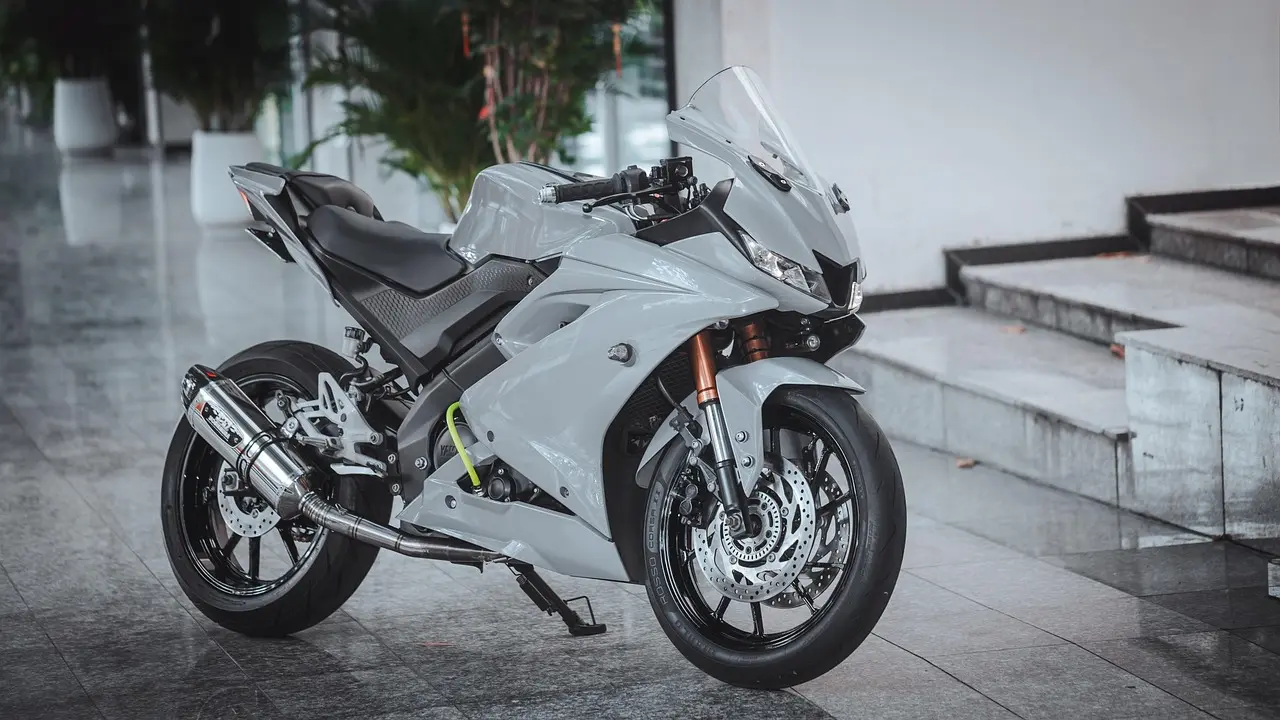
The loudest motorcycle exhaust is usually a straight-through full system with minimal packing, or a very short slip-on with a small removable baffle. That setup gives the most volume because it reduces internal restriction and leaves less material to absorb sound. It also raises the chance of drone, rasp, and legal trouble.
Slip-on muffler vs full exhaust system
A slip-on muffler replaces only the muffler section. It is usually simpler to install, less expensive than a full system, and often works with stock headers. Many slip-ons also use a removable dB killer or baffle, which lets you trade volume for more tolerable street use.
A full exhaust system replaces headers and muffler together. It changes flow more, is more likely to need fueling changes, costs more, and is better suited to riders chasing maximum sound and performance together.
When louder is only louder
More volume does not always mean better sound. A short can with little packing can be loud and still sound thin, metallic, or harsh. If your use includes commuting or highway riding, too much sound often turns into fatigue faster than it turns into enjoyment.
Picture a rider with a 650-class street bike choosing a short universal can with no baffle for a daily 45-minute ride. The bike may sound dramatic at idle, then become tiring at steady throttle because the same setup creates drone at the speeds that matter most.
When a full system makes sense
A full system makes sense when sound, flow, and tuning are part of the same goal. Track-only riders and aggressive sportbike owners often accept the higher cost and tuning risk because the system can deliver more volume and stronger response than a slip-on.
For street use, that same choice can be too much. The extra flow is useful, but it also increases the chance that noise-control parts and fueling changes become necessary.
Loud exhaust matrix
Use this matrix to separate maximum volume from the best real-world choice. The scores run from 1 to 5, where 5 is highest sound, highest risk, or hardest fitment.
| Rider type | Best loud setup | Sound intensity | Drone risk | Fitment difficulty | Street tolerance | Tuning risk | Simple recommendation |
|---|---|---|---|---|---|---|---|
| Commuter | Slip-on with dB killer installed | 3 | 2 | 2 | 4 | 1 | Choose depth over peak volume |
| Cruiser | Longer slip-on with baffle | 3 | 2 | 2 | 4 | 1 | Keep the deep tone and reduce harshness |
| Sportbike | Model-specific slip-on or short full system | 4 | 3 | 3 | 3 | 2 | Pick crisp bark without constant drone |
| Track-only | Short full system with minimal restriction | 5 | 4 | 4 | 1 | 4 | Go loudest and tune for it |
Do you need a dB killer or baffle?
For most loud street bikes, yes. A dB killer or baffle lowers volume, softens sharp edges in the note, and often cuts drone enough to make the bike more usable day to day. If your goal is maximum volume for track use, you may remove it; for street use, keeping it installed is usually the smarter default.
What each insert changes
A dB killer is a removable noise-reduction insert. It lets you switch between louder and more restrained sound, and it is common in universal slip-ons. It can affect legal compliance and comfort, especially on bikes that already produce a hard exhaust note.
A baffle does a similar job but often aims more at reducing harshness and volume while keeping a deeper tone. Riders who complain about drone or rasp usually want a baffle more than they want an open pipe.
How they affect drone and crackle
Removing the insert usually increases throttle bark and crackle, but it can also raise cruising drone. That tradeoff matters most on highways and on bikes with short mufflers, where the exhaust note can bounce off surfaces and become tiring.
Suppose a rider swaps from a baffled slip-on to an open insert for weekend use. The bike may sound stronger at low speed, but the same change can make steady 60 mph cruising feel louder inside the helmet and more fatiguing on longer rides.
When to keep one installed
Keep the insert installed if you ride in neighborhoods, near hospitals or schools, or on long highway stretches. It also helps if your bike already has a sharp tone, because sharper bikes often feel louder than the same measured volume would suggest.
Will it fit your bike?
Maybe, but you need to check diameter, length, and mounting before you buy. Universal loud exhausts commonly target pipe diameters from 38-51mm, but fitment still depends on how the inlet matches your bike, how the can clears bodywork or luggage, and whether the bracket lands where it should.
Exhaust inlet diameter
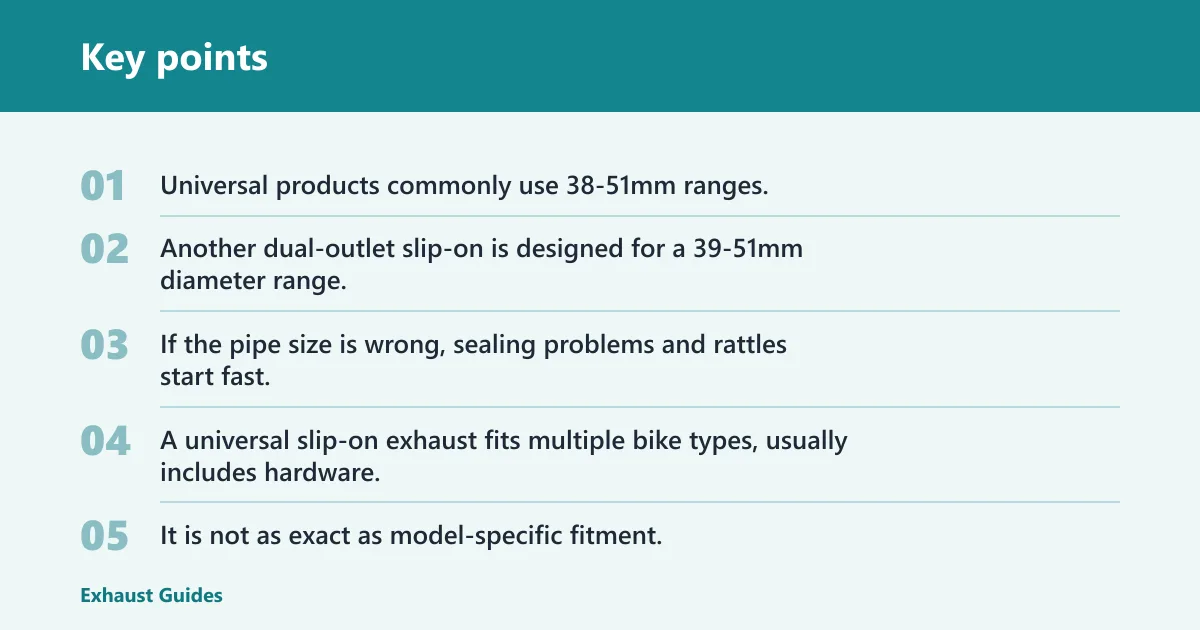
Inlet diameter is the first filter. Universal products commonly use 38-51mm ranges, and one listed universal muffler is designed for a 51mm connection with a removable dB killer. Another dual-outlet slip-on is designed for a 39-51mm diameter range. If the pipe size is wrong, sealing problems and rattles start fast.
Universal slip-on exhaust fitment
A universal slip-on exhaust fits multiple bike types, usually includes hardware, and may require modification or welding. It is not as exact as model-specific fitment. That matters because a slightly loose fit can create leaks, while a slightly long can can hit a pannier, shock reservoir, or rear body panel.
One featured muffler has a 365mm overall length, and another universal exhaust option is listed at 390mm overall length. The dual-outlet exhaust has a 295mm overall length. Those length differences change clearance and the final sound character, especially on short-tail sportbikes.
Installation hardware and clearance
Look for springs, clamps, hooks, reducers, and mounting brackets. The DREAPATS option includes a DB Killer, springs, hooks, clamps, and a connected pipe, which is the kind of hardware list that can make a universal part more workable. Even then, you still need to verify bodywork and luggage clearance.
A common first-timer mistake is buying a straight-through muffler for volume alone and discovering it clashes with the bike’s mounting points and riding style. If the pipe is 51mm but the bike needs a reducer or bracket adjustment, the “easy install” claim disappears quickly.
Which one should you buy?
Start with the rider goal, not the volume claim. If you commute, choose the quietest loud setup you can live with, ideally a slip-on with a baffle or dB killer in place. If you ride a cruiser, favor deeper tone and less drone. If you want maximum sound on a sportbike, a model-specific slip-on is the safer middle ground. If the bike is track-only, the Bassani-style full system is the right direction, but only if you are ready for tuning and a louder neighborhood footprint.
Budget matters too. The JFG RACING slip-on is the value buy, but it demands more fitment checking. The PWNGYTES CBR650R slip-on is the better street-sound choice if your bike matches. The Bassani full system is the loudest and most committed, but it is also the least forgiving on cost, noise, and tuning risk.
What should you check before buying a universal motorcycle exhaust?
Check inlet diameter, total length, bracket location, bodywork clearance, and whether the kit includes reducers or mounting hardware. A universal exhaust is only useful if it seals properly and fits the bike’s path from header to tail without touching luggage, swingarm travel, or rear plastics.
Noise legality and compliance
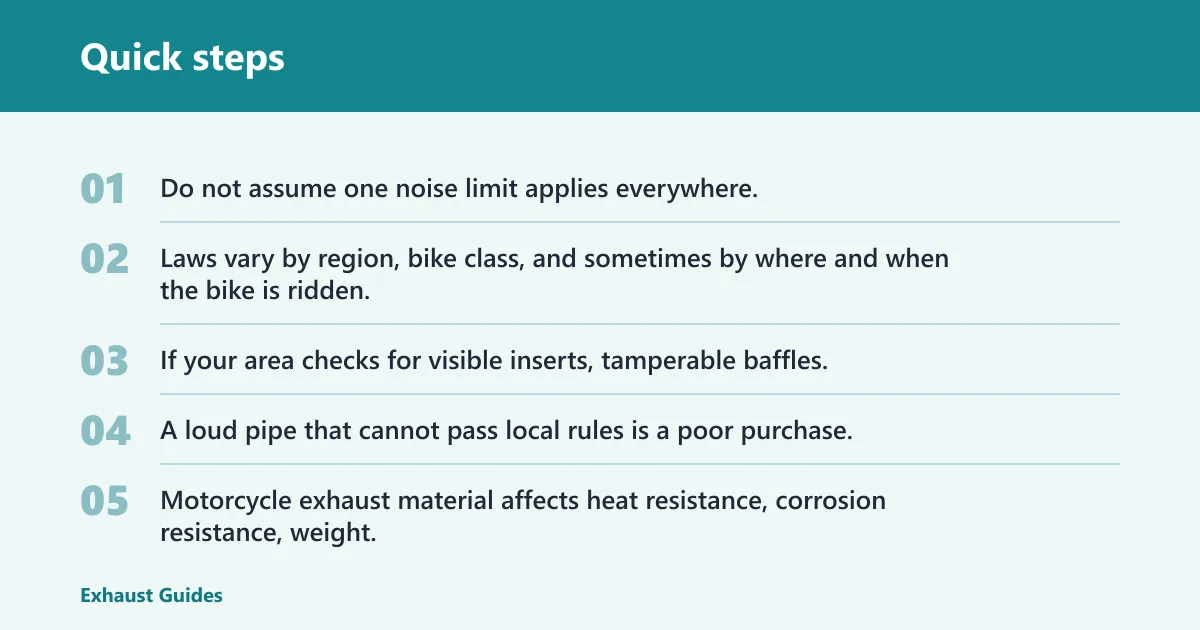
Do not assume one noise limit applies everywhere. Laws vary by region, bike class, and sometimes by where and when the bike is ridden. If your area checks for visible inserts, tamperable baffles, or modified emissions equipment, confirm that before you buy. A loud pipe that cannot pass local rules is a poor purchase.
Materials and heat resistance
Motorcycle exhaust material affects heat resistance, corrosion resistance, weight, and appearance. Aluminum bodies are often lighter and cheaper. Stainless steel connectors resist corrosion well. Carbon-fiber styling can look sharp and resist heat on the outer shell, but it is not the same as metal strength. Titanium-style options usually appeal to riders who want light weight and a more premium look.
If you ride in wet weather or store the bike outside, corrosion resistance matters more than styling. If you care about weight and heat management, lighter materials have a clear advantage, but they often cost more.
Sound characteristics that actually matter
Idle volume tells you little by itself. Throttle bark matters when you accelerate away from a stop. Cruising drone matters on the highway. Tone depth separates a deep, usable note from a tinny one. Crackle can sound exciting at first, then become tiring if the exhaust is too short or too open.
That is why the “loudest” exhaust is not always the best loud exhaust. The best street pick usually balances bark, depth, and drone control better than the loudest full system.
How to make a motorcycle muffler quieter
The fastest ways are to reinstall or upgrade the dB killer, fit a baffle, check for exhaust leaks, and use a longer muffler if the system allows it. On some bikes, a quieter insert gives enough relief without changing the whole pipe. If the exhaust is still harsh, the can may simply be too short for street use.
Frequently asked questions
How loud can a motorcycle exhaust
There is no single universal number that applies everywhere. Legal limits vary by place, and enforcement often depends on local rules and how the bike is modified. The practical check is simple: if the exhaust is obviously louder than stock and lacks a removable insert, verify your local rules before buying.
Is it legal to have a noisy exhaust?
Sometimes, but not everywhere and not in every form. A noisy exhaust may be legal in one area and illegal in another, especially if it removes required noise-control hardware or changes emissions-related parts. Check local law, inspection rules, and whether a dB killer or baffle is required for road use.
Which loud exhaust sounds best without needing major mods?
A model-specific slip-on usually gives the best balance. It is simpler to fit, less likely to need tuning than a full system, and often sounds deeper than a cheap universal can. For riders who want louder sound without major changes, that is the safer starting point.
Do I need a dB killer or baffle for a loud exhaust?
For street riding, usually yes. A dB killer or baffle reduces harshness, cuts drone, and makes long rides more tolerable. If you ride track-only and want maximum output, you may remove it, but the bike will usually be louder, sharper, and less comfortable for normal road use.
Will a loud exhaust fit my bike’s pipe diameter?
Only if the inlet matches or can be adapted cleanly. Universal loud exhausts commonly sit in the 38-51mm range, but you still need to match the bike’s pipe size, check the available reducers, and confirm clearance. A bad diameter match can cause leaks, rattles, or poor sealing.