
How to Tell If a Resonator Is Bad by Sound and Location
A bad resonator usually causes a hollow drone at a narrow RPM band, a tinny rattle, or a hissing leak near the center of the exhaust. If the noise changes with tap tests or pipe movement, the resonator is a strong suspect. Ignoring it can hide an exhaust leak, heat damage, or a loose section that may fail completely. This guide shows how to tell resonator failure from muffler, pipe, hanger, and catalytic converter problems by sound, location, and engine speed.
What a resonator does
An exhaust resonator is an inline exhaust component tuned to reduce selected sound frequencies. It usually sits in the mid-pipe or rear exhaust section, where it cuts drone and sharp tones more than it lowers total volume. A failing resonator often changes the character of the sound before it makes the car much louder.
Many systems place the catalytic converter upstream of the resonator, followed by the resonator and then the muffler near the tailpipe. That order matters because a noise heard at the center or rear of the car may come from several different parts, not only the resonator.
What does a bad resonator sound like?
A bad resonator can sound like a hollow drone at a certain RPM, a metallic buzz or rattle from a loose internal piece, or a sharp hiss if the case or seam has cracked. The key clue is that the sound often changes with engine speed or load instead of staying constant.
Idle rasp and sharp hiss
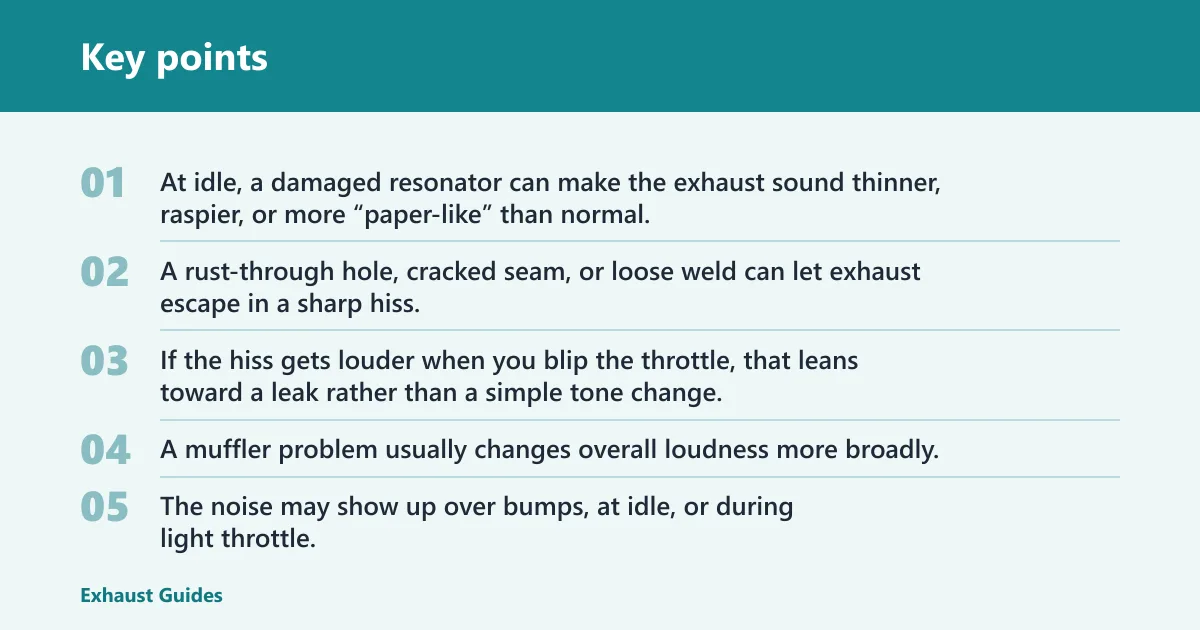
At idle, a damaged resonator can make the exhaust sound thinner, raspier, or more “paper-like” than normal. A rust-through hole, cracked seam, or loose weld can let exhaust escape in a sharp hiss. If the hiss gets louder when you blip the throttle, that leans toward a leak rather than a simple tone change.
Highway drone and cabin boom
Cabin drone is a low-frequency boom felt inside the vehicle, often most noticeable at a narrow highway speed or RPM band. That pattern is a classic sign that the resonator is no longer canceling the right frequencies, or that it has been removed. A muffler problem usually changes overall loudness more broadly.
Metallic rattle and loose internals
A metallic rattle often points to broken internal baffles, loose packing, or a section inside the resonator moving around. The noise may show up over bumps, at idle, or during light throttle. If tapping the case with a gloved hand changes the sound, the resonator is more suspicious than the tailpipe section alone.
Say your car is quiet at idle but starts booming at 2,000 to 2,500 rpm on the highway. That pattern fits resonator-related drone more than a muffler leak, because the tone changes in a narrow range instead of getting louder everywhere.
Resonator diagnosis matrix
This matrix helps separate a bad resonator from nearby exhaust faults. Use it after the exhaust is cool, then compare the noise location, the sound quality, and whether the symptom changes with idle, acceleration, or steady cruise.
| Symptom | Most likely cause | Quick check | Next action |
|---|---|---|---|
| Idle rasp | Exhaust leak at the resonator case, seam, or nearby weld | Listen near the center of the exhaust after a cold start, then inspect for soot, wet marks, or a visible crack once cool | Repair the leak or replace the damaged section if the noise is centered on the resonator |
| Highway drone | Resonator ineffective, deleted, or internally damaged | Note whether the boom appears only at one RPM band or speed range and fades outside it | Inspect the resonator and compare it with the muffler before replacing parts |
| Metallic rattle | Broken internal baffle, loose packing, or hanger contact | Tap the case lightly when cool and check for movement or contact with nearby pipes | Replace the resonator if the rattle comes from inside the canister, or fix the hanger if the pipe is touching |
| Sharp exhaust hiss | Crack, rust-through, or loose clamp at the resonator or pipe joint | Look for soot lines around seams and joints, then feel for puffing only after cooldown | Tighten or replace the clamp, or repair the weld if the leak is external |
| Volume increase after resonator delete | Expected change from removal, or another exhaust fault now easier to hear | Compare the sound to the pre-delete setup and check whether the new noise is only louder or also rough, rattly, or hissing | If the tone is simply louder, that is expected; if a new rattle or hiss appears, inspect the rest of the exhaust |
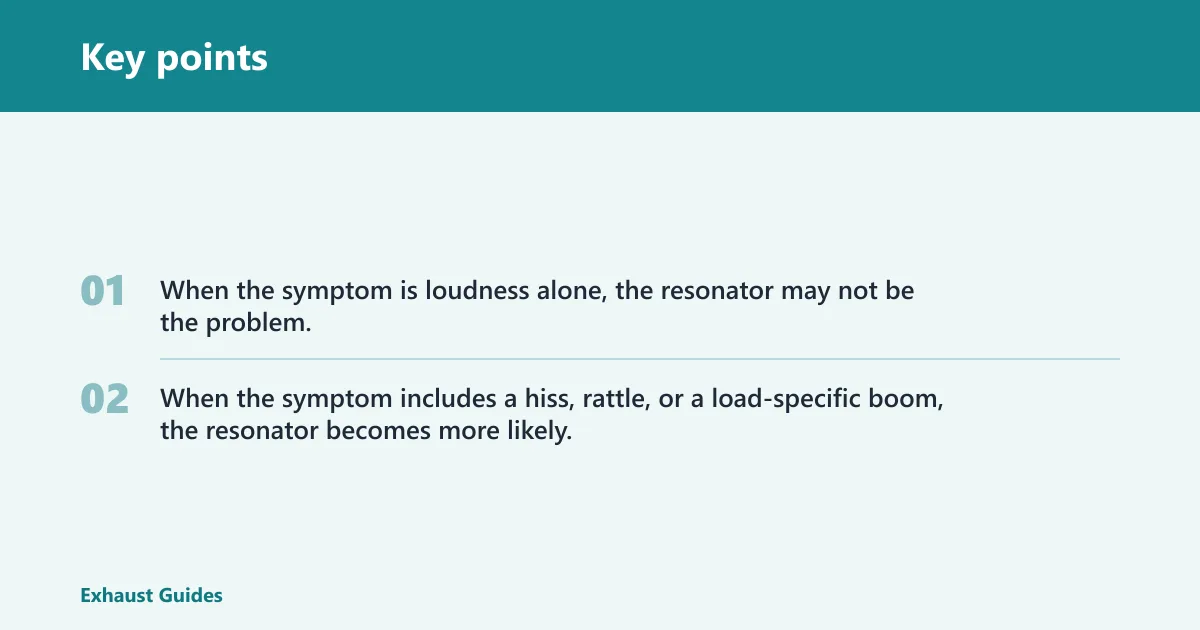
When the symptom is loudness alone, the resonator may not be the problem. When the symptom includes a hiss, rattle, or a load-specific boom, the resonator becomes more likely. That difference is what keeps a loud muffler, cracked pipe, or failing hanger from being misread as a bad resonator.
How do you inspect the resonator safely?
Inspect only after the exhaust has cooled enough to touch nearby metal briefly without risk. A hot exhaust can burn skin fast, and heated metal can hide leaks because parts expand and close gaps. Start at the mid-pipe and work outward so you do not miss a leak that sounds like resonator damage.
-
Park and let it cool.
Set the parking brake, shut the engine off, and wait until the exhaust is touch-safe. A cool inspection lets you check seams, hangers, and joints without missing details caused by heat shimmer or expansion.
-
Inspect the resonator case.
Look for rust-through, cracks, dents, soot streaks, and separated seams along the canister and end caps. A pinhole leak can make a sharp hiss, while a crushed or split case can change the exhaust tone even if it is not fully open.
-
Check clamps and welds.
Look at factory welds and aftermarket clamps on both sides of the resonator. Loose clamps and cracked welds can buzz under load or leak only when the pipe vibrates, so a clean-looking joint is not enough by itself.
-
Examine hangers and contact points.
Check rubber hangers for tears, collapse, or missing material. Also look for shiny marks where the pipe may be hitting the body, subframe, or heat shield. That contact can sound like a failed resonator even when the resonator is intact.
-
Move the pipe gently.
With the engine off and cool, wiggle the exhaust by hand. If the noise changes when the pipe moves, the source may be a loose joint, hanger, or cracked weld instead of an internal resonator fault.
A common first-timer mistake is to assume a loose heat shield is the culprit when the real issue is a buzzing resonator under light throttle. A loose hanger can let the exhaust touch the floor pan, and that contact can sound almost identical to a rattling resonator until the pipe is moved by hand.
Could it be the muffler, pipe, or catalytic converter?
Yes. A muffler, exhaust pipe, or catalytic converter can make very similar noise, so location and RPM behavior matter. The resonator usually changes drone and tone in the center or rear section, while a muffler fault tends to raise overall exhaust volume near the tailpipe.
Resonator vs muffler sound
The muffler is the final noise-control component near the tailpipe, and it usually reduces overall volume more than a resonator. If the car is suddenly loud everywhere, especially near the rear, the muffler may be failing. If the main complaint is a narrow-band boom or a tinny note, the resonator is more likely.
Exhaust pipe cracks and joint leaks
An exhaust pipe can crack, corrode, or separate near welds and joints, and that leak can mimic a bad resonator. A crack upstream or downstream of the resonator can transmit the same drone and rasp through the system. Inspect both sections, not only the resonator shell, because the symptom may be coming from a pipe seam instead.
Catalytic converter noise that points upstream
A broken or clogged catalytic converter can make similar noise, and it sits upstream of the resonator in most systems. If the noise changes with engine load, gets worse under acceleration, or seems to start closer to the engine bay, rule out the converter first. A rattling converter substrate can sound like debris in the exhaust.
Suppose a sedan starts rasping only when climbing a hill at low rpm, then smooths out at cruise. That load change points upstream or toward a restriction, so the catalytic converter and front pipe deserve a look before the resonator is blamed.
Will removing the resonator cause problems?
Removing the resonator usually makes the exhaust louder and can increase drone, especially at highway speed. That change is expected after a delete. Problems start when the sound becomes harsh, rattly, or leaky, because that points to damage or a poor install rather than the delete itself.
Expected sound change after a delete
After a resonator delete, the exhaust often gains volume and more cabin boom at one or two RPM bands. That is normal for many systems because the resonator was tuned to reduce those frequencies. If the only change is louder sound, the delete is probably doing what it was meant to do.
When the new noise points to another fault
If the car also develops a sharp hiss, metallic buzz, or a smell of exhaust in the cabin, do not blame the delete alone. Those signs suggest a leak, cracked weld, or hanger issue that needs attention. A delete changes tone; it should not create a ticking leak or loose-part rattle.
-
Compare before and after tone.
Drive the car at the same speed and RPM range where the old resonator used to drone. If the sound is simply louder and deeper, the delete is the likely reason. If a new hiss or rattle appears, inspect the joints and nearby supports.
-
Check for expected drone.
Listen for a steady boom at highway speed or under light throttle. A resonator delete often creates this. If the drone is far harsher than expected, another exhaust component may be loose or damaged.
When to repair or replace the part
Repair or replace the resonator when rust-through, a crack, a separated seam, or internal failure is confirmed. If the noise is traced to the muffler, pipe, hanger, clamp, or catalytic converter, fix that part instead. The right repair depends on the source, not on where the sound is loudest.
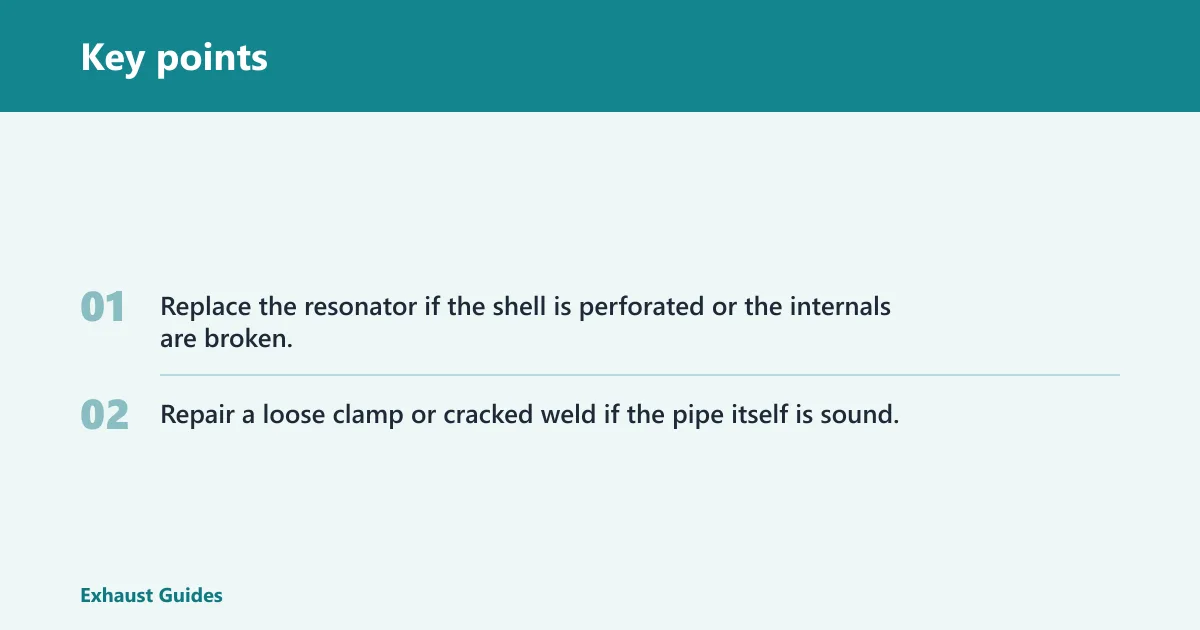
Replace the resonator if the shell is perforated or the internals are broken. Repair a loose clamp or cracked weld if the pipe itself is sound. If the exhaust is contacting the body, restore hanger support first, because a new resonator will not stop a pipe from knocking against metal.
Frequently asked questions
What does a resonator guitar sound like?
A resonator guitar sounds bright, metallic, and louder in the upper mids than a standard acoustic guitar. That has nothing to do with the exhaust part, except for the shared name. In automotive use, a resonator is an exhaust piece that filters sound frequencies, not a musical instrument.
Does a resonator make a car quieter?
Yes, but its main job is usually to reduce certain exhaust frequencies and drone rather than cut every decibel. A muffler usually has a bigger effect on total loudness. If your car is only booming at one RPM band, the resonator may be the part doing the most work there.
Will a resonator quiet my exhaust?
It can, especially if the problem is drone or a harsh tone from the mid-pipe section. It will not fix a cracked pipe, loose hanger, or damaged muffler. If the exhaust is already leaking, a resonator alone will not make the system quiet again.
Can a bad resonator cause drone at highway speed?
Yes. Highway drone is one of the most useful clues because it often shows up at a narrow speed or RPM range, then fades outside it. That pattern fits a resonator that has rusted through, lost its internal structure, or been deleted without a replacement that controls the same frequencies.
How can I tell if the noise is the resonator or the muffler?
Start with location and tone. Noise near the center of the car, especially a narrow-band boom or rasp, points toward the resonator. Noise near the tailpipe with a broad increase in loudness points more toward the muffler. If possible, inspect both parts after cooldown and check for leaks, rust, and loose seams.
How do I tell if the resonator is leaking or damaged?
Look for soot, cracks, rust-through, or separated welds, then compare that with the sound. A leak often makes a sharp hiss or tick that changes during acceleration. Internal damage more often makes a rattle, buzz, or drone without a visible hole.