How Much Does It Cost to Repair a Muffler Exhaust Leak?
Expect about $20–$60 for a temporary patch, about $80–$250 for a weld repair, and about $150–$600 for a muffler replacement, with higher prices if rust or hangers are damaged. A bad exhaust leak can waste fuel, fail inspection, and let fumes enter the cabin. Below, you’ll see what each repair should cost, what raises the price, and how to spot an inflated quote.
Typical cost range


For a muffler leak, the price usually follows the repair method, the exact leak point, and how much corrosion surrounds it. Minor muffler repairs can cost $30-$500 or more, while muffler replacement can cost $75-$750 or more. Labor, not parts, often drives the total when the leak sits in a hard-to-reach rear section.
Broader pricing data shows the spread clearly. CostHelper readers reported $40-$300 for muffler repairs, with an average reported muffler repair cost of $138. For replacement, readers reported $80-$647, and the average reported muffler replacement charge was $280. A professional muffler shop may charge about $150-$1600 for exhaust leak repair, which is why quotes can look far apart for the same complaint.
Muffler leak cost matrix
| Leak location | Typical shop action | Parts cost band | Labor time band | Red flags that force replacement |
|---|---|---|---|---|
| Muffler seam | Patch or weld if metal is sound | $20-$80 | 0.5-1.2 hours | Rust flakes through the shell, widened seam split, multiple nearby holes |
| Muffler body hole | Weld-in patch for a small pinhole; replace if corroded | $20-$150 | 0.5-1.5 hours | Soft metal, large perforation, hole at a seam edge |
| Hanger/bracket area | Reattach or weld support, then inspect the shell | $15-$100 | 0.5-1.0 hours | Bracket torn from rust, muffler shell bent or cracked near the mount |
| Tailpipe joint | Clamp, weld, or replace the joint section | $25-$200 | 0.4-1.4 hours | Pipe wall is thin, joint will not hold a clamp, adjacent pipe is rusted through |
| Flange/gasket near muffler | Replace gasket or flange hardware | $5-$40 | 0.4-0.9 hours | Flange face is warped, bolt holes are rotted, studs snap during removal |
| Welded section repair | Cut out damage and weld in a section | $40-$180 | 0.8-2.0 hours | Corrosion extends beyond the cut zone or the pipe is too thin to weld reliably |
| Full muffler replacement | Replace muffler assembly | $75-$750+ | 0.8-2.5 hours | Rust is widespread, shell is holed in more than one place, hanger failure has distorted the unit |
That table is the practical split most owners need. A small seam leak can be cheap if the surrounding steel is still solid. Once rust spreads beyond the leak point, replacement often becomes the smarter money move because the patch only delays the next failure.
Say your muffler has one small pinhole near the rear canister and the rest of the shell is firm. A weld-in fix may be the least expensive durable answer. Say the same muffler has two holes, a loose hanger, and flaky rust along the seam. Replacement is usually the better call because the repair area will keep opening up.
Can you repair a small exhaust leak?
Yes, if the damage is localized. Small cracks, pinholes, and a clean joint leak can often be repaired instead of replacing the muffler. Temporary sealants and patches are short-term only, though, and they do not restore strength to rusted metal or a broken hanger area.
Sealants and patches for pinholes or hairline cracks
Temporary products make sense only when the leak is tiny and the surrounding metal still holds shape. They can reduce noise and fumes for a short period, but they are not a structural fix for larger damage. Use them as a stopgap, not as the final repair on a rusted muffler or pipe.
A common first-timer mistake is treating a patch as a permanent fix on thin, flaky steel. That usually leads to the leak returning, sometimes at the edge of the patch. If the muffler shell crumbles when touched or the crack keeps spreading, patching is money lost.
Weld-in repair for localized damage
Weld-in section repair is usually the least expensive real fix when the damage is localized. It works best on a clean, reachable section where the surrounding pipe or muffler shell still has enough metal to hold a weld. This is often cheaper than replacing the whole component and more durable than a clamp-only patch.
For a small crack near a tailpipe joint or a single hole in a muffler shell, welding can make sense. If the rust extends past the visible opening, the shop may charge for a weld only to find the next weak spot soon after. At that point, replacement is the better value.
When a patch is only a short-term move
Use a patch only when the leak is small, the vehicle needs a temporary fix, or the damaged area is not structural. Do not expect a sealant to hold on a muffler with widespread rust, broken mounts, or a seam that has opened along a long section. Those cases need welding or replacement.
What changes the repair bill?
Three things push the bill up fast: rust, access, and the exact leak location. A rear muffler usually costs less to diagnose than a hidden flange near the catalytic converter or a pipe section tucked above suspension parts. Aftermarket parts can be dramatically cheaper than OE parts, and labor rates add up quickly when the shop has to cut, weld, or remove rusty hardware.
Rust, access, and leak location
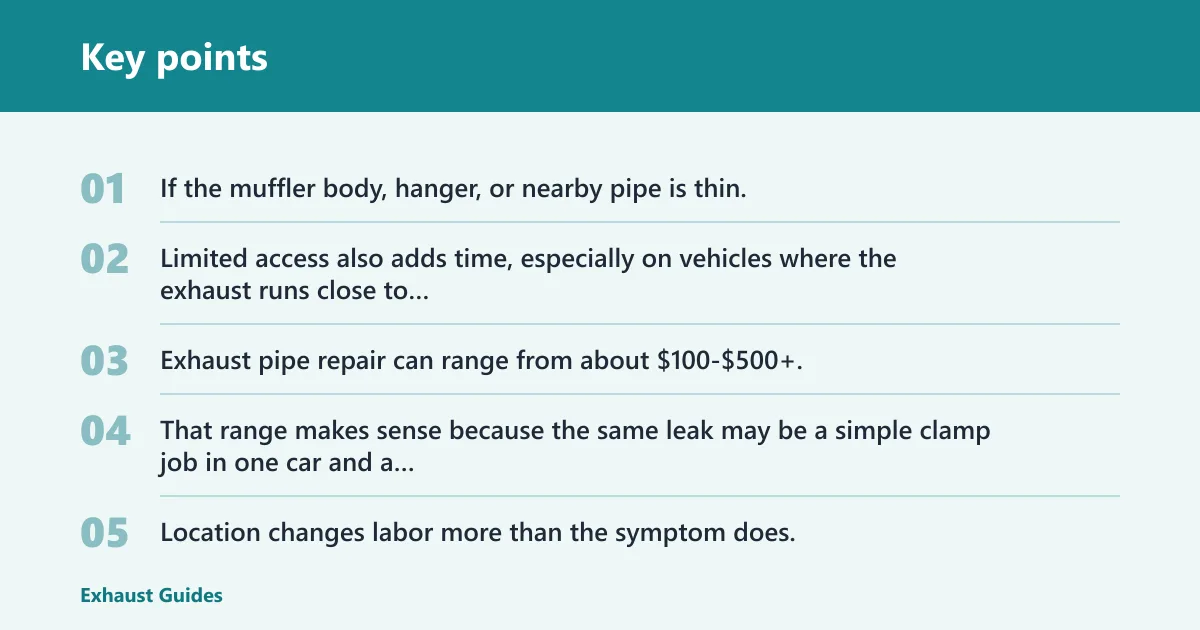
Corrosion is the biggest wildcard. If the muffler body, hanger, or nearby pipe is thin, the shop may not be able to patch it safely. Limited access also adds time, especially on vehicles where the exhaust runs close to heat shields, suspension pieces, or the floor pan.
Exhaust pipe repair can range from about $100-$500+, depending on damage severity and location. That range makes sense because the same leak may be a simple clamp job in one car and a cut-and-weld job in another. Location changes labor more than the symptom does.
Aftermarket vs OE parts
Part choice can change the total quote a lot. Aftermarket parts can lower the bill, while OE parts can push the total much higher. The difference is easy to see in real-world pricing examples: a 2011 Chrysler 200 muffler and intermediate pipe assembly could total about $625 using OE parts, or about $190 using aftermarket parts.
The same pattern shows up elsewhere. A 1998 Chevrolet K1500 muffler and tailpipe assembly could total about $913 using factory parts, or about $202 using aftermarket parts. A 2006 Toyota Corolla muffler and tailpipe assembly could total about $457 using factory parts, or about $128 using aftermarket parts. If your quote is high, check whether it is built around OE parts by default.
Labor rate and shop minimums
Many pricing examples use about $100/hour as a labor estimate, and that can be a useful baseline for judging a quote. A gasket job can be short; labor time can be as low as 0.4-0.9 hours for some gasket jobs. Even then, a shop minimum can make a short job cost more than the raw time suggests.
Expect the bill to rise if the tech has to remove broken bolts, cut rusted hardware, or diagnose a leak that is not obvious. A quick gasket replacement is one thing. A corroded flange with snapped studs is another.
Vehicle layout and adjacent damage
Vehicles with tight exhaust routing often cost more to repair because the exhaust is harder to reach and more likely to damage nearby parts during removal. If the leak sits beside a rusty flange, broken hanger, or bent bracket, the shop may need to replace related hardware at the same time. That is where a low estimate turns into a much larger one.
Repair vs replacement by component
Use the component itself to judge the quote, not just the symptom. A muffler leak, a pipe leak, and a flange gasket leak should not be priced the same way. The correct fix depends on whether the damage is local or widespread.
Muffler
Mufflers usually sit near the rear of the vehicle, and common failure modes are rust-out or holes. Small isolated damage can sometimes be welded, but a rusted shell often needs replacement.
For the muffler itself, replacement usually makes more sense when the metal around the hole is soft, the seam is split across a wide section, or the hanger area has pulled away. In those cases, a patch may only buy a short delay.
Exhaust pipe
Exhaust pipe repair can range from $100-$500+ because the damage may be simple or it may involve replacing a longer section. If the pipe is only cracked near one end, a weld or clamp may be enough. If the pipe is rusted through along a long section, a replacement section is often the safer fix.
Exhaust flange gasket
An exhaust flange gasket is often a low-cost repair part. Competitor pricing examples put it at about $5-$12 in some jobs, and the leak often appears at pipe, catalytic converter, or manifold junctions. A Chrysler 200 catalytic converter flange gasket job could total about $62 using factory parts, which shows how a cheap gasket can still lead to a meaningful labor charge.
When the flange face is warped or the bolts are badly rusted, a gasket alone may not solve the leak. The shop may need new hardware or a flange repair. If the mating surfaces are damaged enough that they cannot seal, replacement is smarter than chasing a leak with fresh gaskets.
Hanger, bracket, and welded section damage
Broken hangers and cracked welded sections often sit in the middle ground between repair and replacement. A weld-in section repair is usually the least expensive durable fix when the damage is confined to one small area. If the support point has torn metal away from a rusted muffler shell, the entire component may need to go.
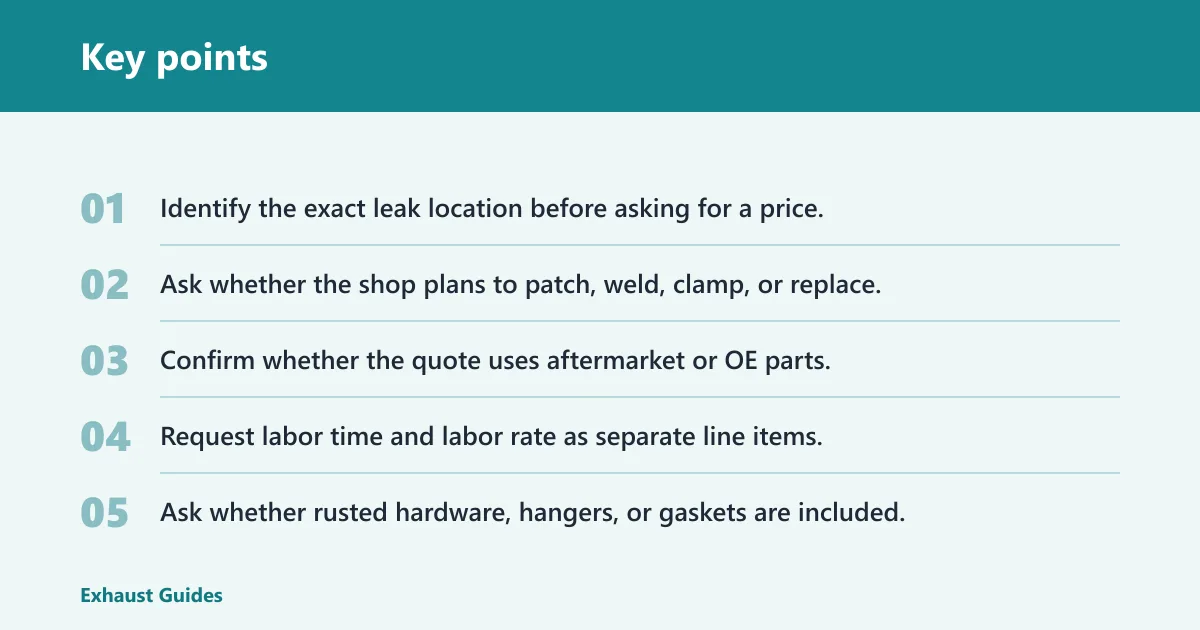
- Identify the exact leak location before asking for a price.
- Ask whether the shop plans to patch, weld, clamp, or replace.
- Confirm whether the quote uses aftermarket or OE parts.
- Request labor time and labor rate as separate line items.
- Ask whether rusted hardware, hangers, or gaskets are included.
- Check whether the quote includes a warranty on parts and labor.
What should a shop quote include?
A useful quote should list the part, the method, and the labor. If the estimate only says “exhaust leak repair,” ask for details. You need to know whether the shop is charging for a gasket swap, a welded section, a clamp repair, or a full muffler replacement.
Parts line item
Parts should be listed separately, including whether they are aftermarket or OE. That matters because the same repair can swing from a low-cost fix to a much higher total depending on the part choice. If the quote does not say what part is being used, ask before approving work.
Labor time and rate
The estimate should show the labor rate and the number of hours billed. A gasket job might only need 0.4-0.9 hours, while a rusted section repair can take much longer. If the total looks high, check whether the labor time matches the actual task.
Weld, clamp, or gasket method
Method matters because it changes durability. A clamp or sealant can be fine for a temporary or very minor leak. A welded repair is better for localized damage. A gasket replacement is the right fix when the leak is at a flange joint and the mating surfaces are still usable.
Warranty and replacement notes
Ask whether the shop expects replacement if the repair area fails during disassembly. Rust can turn a small job into a bigger one the moment the bolts come out. A fair quote should explain that risk up front so you are not surprised by a higher bill after teardown.
What makes exhaust leak repair costs go up?
Repair costs rise when the leak is in a rusted area, the exhaust is hard to reach, or the shop finds damage beyond the original leak point. OE parts can also push the quote higher. If the muffler or pipe is eaten through, a repair stops being a repair and becomes a replacement job.
Suppose a flange gasket looks like the only problem during the inspection. Once the bolts are removed, one stud snaps and the flange face is pitted. That turns a low-cost gasket job into a more expensive repair because the hardware and mating surface both need attention.
Will an exhaust leak fail inspection or emissions testing?
It can. A visible leak, loud exhaust, or fumes entering the cabin can trigger inspection failure in many places, and an exhaust problem can also lead to warning lights or emissions trouble if the leak affects sensor readings. The exact result depends on local rules, but leaving the leak alone adds risk.
Some leaks are minor and still drive normally, but that does not mean they are harmless. Exhaust fumes in the cabin are a safety concern, especially if the leak is near the front of the system or the floor pan. If you smell fumes inside the car, treat it as more than a noise problem.
Frequently asked questions
How much does it cost to repair a muffler exhaust leak?
Minor muffler repairs can cost $30-$500 or more, so the final number depends on how far the corrosion has spread.
Is an exhaust leak expensive to fix?
Not always. A small gasket or localized weld repair can be cheap, especially if the metal around it is still solid. It gets expensive when the leak sits in a rusted pipe, a broken hanger area, or a muffler that needs full replacement instead of a quick repair.
Can a small exhaust leak be repaired instead of replacing the muffler?
Yes, if the leak is a pinhole, hairline crack, or a single bad joint and the surrounding metal is still healthy. A weld-in fix is often the least expensive durable choice. If the shell is thin, flaking, or holed in more than one place, replacement is the better answer.
How much do shops charge for exhaust leak repair?
A professional muffler shop may charge about $150-$1600 for exhaust leak repair. That wide spread reflects labor time, rust, and whether the work needs welding or replacement. A short gasket job can stay near the low end, while corroded sections and OE parts push the bill higher.
Can a muffler leak be fixed with welding or do I need replacement?
Welding is a good option when the leak is localized and the surrounding metal is still solid. Replacement is smarter when the muffler shell is rusted through, the seam is split over a large area, or the hanger area has failed. Once the metal is thin, welding rarely lasts.