What Size Exhaust Tip Sounds Best on a Harley?
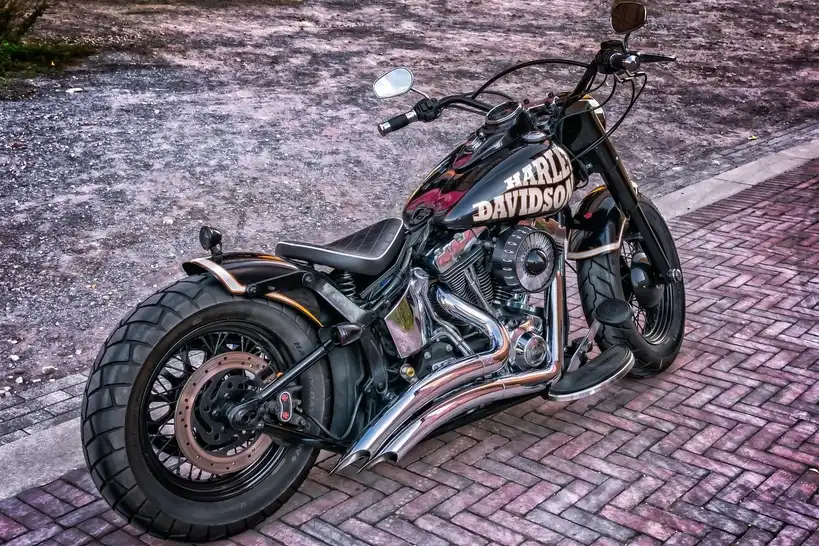
On many Harley baggers and cruisers, a 4.0- to 4.5-inch slip-on or muffler body is often the practical range for the lowest note. A bigger tip alone rarely changes tone much, and the wrong baffle can add drone. Pick the wrong diameter and you get a harsh note, poor fitment, or a hollow sound that costs money to undo. This guide explains tip size, muffler body diameter, baffle choice, and fitment rules by Harley model.
What size sounds best?


The short answer is 4.0 to 4.5 inches for most Harley riders who want a lower, fuller note without turning the bike into a drone machine. That size range matches common Harley slip-on mufflers, which usually replace only the mufflers, not the stock head pipes.
A 4.5-inch body often gives a fuller sound because it leaves more room for packing and baffle tuning. A 4.0-inch body can still sound deep, but it may lean a little tighter and sharper if the baffle is more open.
Why bigger is not always deeper
Outlet diameter and body diameter are not the same thing. A larger outlet can make the bike louder, but it does not automatically create a deeper note. Tone comes from the whole package: pipe length, baffle design, packing, and how the muffler body is built.
That is why the biggest-looking tip is often the wrong goal. A large opening with a poor baffle can sound busy, hollow, or tinny, especially at steady cruise where drone matters most.
Tip size, muffler size, and full systems
Before buying, separate three things: the exhaust tip, the slip-on muffler body, and the full exhaust system. A tip is the visible outlet. A slip-on changes the muffler section. A full system replaces more of the exhaust path and changes the bike much more than a tip swap.
What a Harley slip-on changes
Harley slip-ons usually change sound more than performance. They are often a bolt-on move, and they are commonly the cheapest way to change exhaust note, with many listed in the $300 to $800 range. The sound change is usually deeper, not dramatic power gain.
On Touring models, slip-ons are a common choice because they keep the stock head pipes in place. That matters for fitment and cost. It also means the result depends heavily on the baffle, not only on tip diameter.
What a 2-into-1 changes
A 2-into-1 Harley system uses a single collector design. It typically gives the strongest midrange torque and usually needs a tune afterwards. These systems are full-system changes, not just mufflers, and they commonly cost $700 to $1,300.
Sound changes here are more pronounced than with slip-ons. The collector and merged header shape affect both note and power, so a 2-into-1 is a different buying decision from a slip-on.
What true duals change
True duals give each cylinder its own head pipe and muffler. Stock Harley Touring models do not have true duals. A true dual setup is a full-system conversion, and it usually trades some low-end torque for stronger top-end breathing and a classic staggered Harley beat.
That makes true duals a style-and-sound decision as much as a performance one. They are not the same thing as a larger tip or a larger slip-on body.
Harley exhaust size decision table
Use this table to match muffler body size to sound goal, drone risk, visual scale, fitment use case, and whether a tune is usually needed. It is a practical size rule, not a brand chart.
| Body size | Expected tone | Drone risk | Visual scale | Typical fitment use case | Tune usually needed? |
|---|---|---|---|---|---|
| 3.5-inch | Tighter and more restrained; can sound crisp rather than deep | Lower than larger bodies if baffle is conservative | Smaller, cleaner look on compact builds | Sportier styling, riders who want less volume | No, for slip-on use only |
| 4.0-inch | Deep enough for many Harleys, with a balanced tone | Moderate if the baffle is too open | Balanced and common on many bikes | Good all-around slip-on size for Touring and cruisers | No, for slip-on use only |
| 4.5-inch | Fuller, lower note; often the sweet spot for Harley riders | Moderate to higher if the outlet is large and the baffle is wrong | Larger, more filled-out look | Best fit for riders chasing a deeper Harley tone | No, for slip-on use only |
| 5.0-inch | Can get loud without sounding much deeper | Higher, especially on steady highway runs | Very large and visually dominant | Style-first builds, not the safest pick for low rumble | No, for slip-on use only |
If the goal is a classic low rumble, the table points to 4.0 or 4.5 inches. A larger body may look more aggressive, but the sound can stop getting deeper long before it stops getting louder.
Do bigger tips sound deeper?
Usually they sound louder first. A bigger Harley exhaust tip can add volume and change the edge of the note, but it does not guarantee a deeper tone. On many bikes, the baffle does more work than the outlet diameter.
That is why a 4.5-inch body with the right baffle can beat a 5.0-inch body with a poor one. The wrong baffle can make the exhaust hollow, harsh, or droney even when the opening looks expensive.
Deeper tone versus more volume
Deeper tone comes from how the exhaust pulses are controlled, not from opening the outlet as much as possible. A quiet baffle can deepen the note by smoothing the pulse and trimming sharpness. A loud baffle can do the opposite.
So the question is not only “how big?” It is also “how is the sound shaped after it leaves the pipe?” That is the part many big-tip setups miss.
Where drone starts to show up
Drone tends to show up when the exhaust is loud enough to create a steady cabin-frequency buzz at cruise. On Harley touring and bagger setups, that often happens when the outlet is large but the baffle does little to control resonance.
Suppose a rider swaps to a 5.0-inch body because it looks more aggressive. The bike may sound louder in the driveway, then turn tiring at highway speed because the note is flatter and the drone is more obvious.
Why outlet shape matters less than baffle choice
Straight, slash-cut, and round outlets change the look and can trim the edge of the sound a little, but they rarely matter as much as baffle design. A slash cut may aim sound differently. A round outlet may look cleaner. Neither one fixes a poor baffle.
If the goal is a deeper Harley tone, start with body size and baffle choice first. Outlet shape comes after that.
Which size fits your Harley model?
Fitment is highly sensitive on Harley bikes. A 2017-up Touring exhaust will not fit a 2016 Touring, so year matters as much as model family. Before buying, confirm the exact chassis, the year break, and whether the part is for slip-ons or a full system.
Touring models and 2017-up fitment
Harley Touring bikes are the most common fitment target for slip-ons. They also show the clearest year differences. A 2017-up Touring exhaust will not fit a 2016 Touring, so do not assume a part listed for one year group will carry over.
For Touring riders, the 4.0- to 4.5-inch range is the most practical starting point for a deeper note. That is especially true if the goal is a full sound change without a full-system install.
Softail fitment checks
Softail fitment depends on the exact frame, exhaust routing, and heat-shield layout. The size rule still helps, but the mounting points can differ from Touring bikes enough to make a part non-interchangeable even when the diameter looks right.
Check whether the part is a slip-on, a muffler body, or a complete system. That distinction matters more than brand wording on the box.
Sportster fitment checks
Sportster riders often want a deeper note without the bulk of a large touring muffler. A 4.0-inch body can be a better visual match on a smaller bike, while a 4.5-inch body may look oversized depending on the model and year.
On smaller platforms, the wrong diameter can dominate the bike visually and still fail to deliver the deeper sound the rider expected. Measure before you buy.
Exhaust baffles and hardware
Baffles shape the note more than the tip alone. They can reduce volume, deepen tone, and control drone. Quiet baffles are reversible, which makes them useful when you want a calmer exhaust without committing to a permanent change.
Baffle choice and tone
One Vance & Hines quiet baffle is designed to reduce volume while deepening tone. That is the right idea to look for if you want a low rumble rather than a sharp bark. Baffle choice should match your riding speed, not only your parking-lot preference.
A common first-timer mistake is choosing the largest outlet available, then trying to correct the noise with cosmetics. The better order is body size first, baffle second, outlet shape third.
Clamps, brackets, and re-tightening
Slip-on installs commonly use exhaust clamps and brackets. Two clamps and a bracket per side is a common hardware pattern on many Harley slip-ons. Re-tightening after heat cycles is normal, because fresh hardware can settle.
Check alignment before final tightening. A small leak or a crooked muffler can ruin the sound as much as the wrong size can.
Gaskets and O2 port plugs
Some Harley systems use exhaust port gaskets, and fitment varies by year. A Harley exhaust port gasket kit is listed for 2010-2011 spherical port and earlier-style systems. If the setup uses an unused sensor opening, O2 sensor port plugs may be needed.
An O2 sensor port plug kit listed here uses 18mm x 1.5 thread. That matters on pre-closed-loop Harley models where the port is present but not used by the new exhaust configuration.
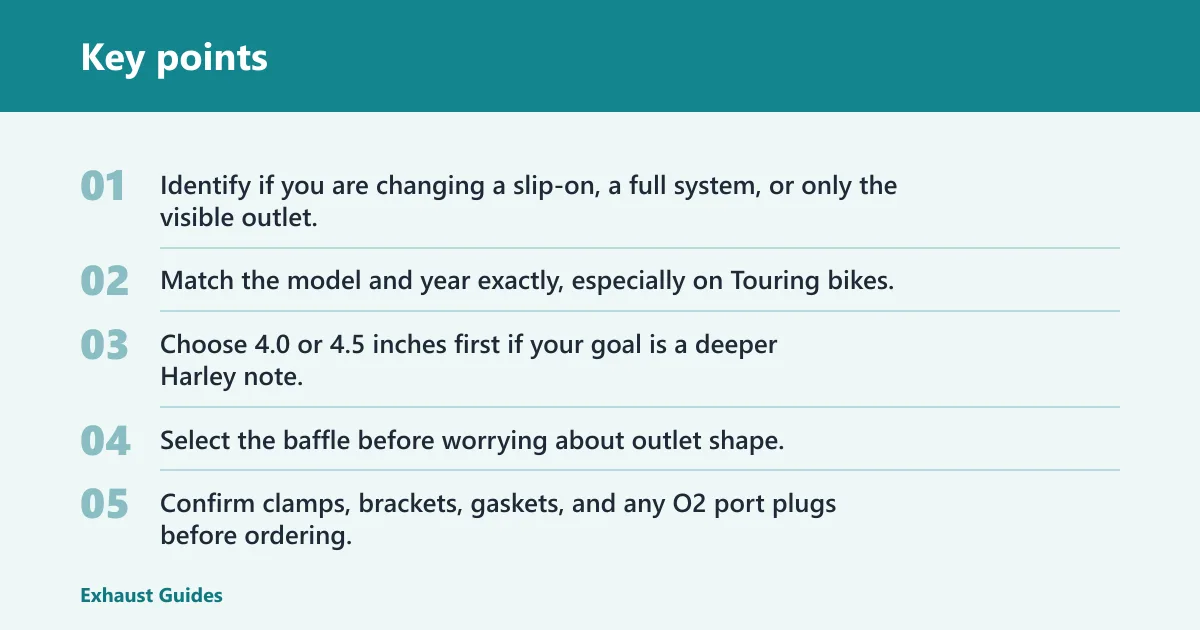
- Identify if you are changing a slip-on, a full system, or only the visible outlet.
- Match the model and year exactly, especially on Touring bikes.
- Choose 4.0 or 4.5 inches first if your goal is a deeper Harley note.
- Select the baffle before worrying about outlet shape.
- Confirm clamps, brackets, gaskets, and any O2 port plugs before ordering.
- Plan for a tune only when the exhaust system change calls for it, especially on 2-into-1 setups.
Picture a Touring rider choosing between a 4.0-inch and a 4.5-inch slip-on. The 4.0-inch unit may sound a little tighter and stay a bit quieter on the highway. The 4.5-inch unit usually gives the fuller, lower note that better matches the Harley sound most riders want.
Frequently asked questions
What size exhaust tip sounds deepest on a Harley?
For most Harley riders, a 4.0- to 4.5-inch slip-on or muffler body gives the deepest practical note. A bigger tip alone usually changes volume more than tone. If the baffle is wrong, a larger opening can sound hollow instead of low.
Does a 4.5-inch exhaust tip sound louder than a 4-inch on a Harley?
Usually, yes, but only by a modest amount if the rest of the muffler is similar. A 4.5-inch body often sounds fuller and a bit louder than a 4-inch body, yet the bigger difference is often tone quality and drone control, not raw volume.
Will a bigger Harley exhaust tip make my bike sound deeper or just louder?
Most of the time, it makes the bike louder first. Deeper sound comes more from the muffler body and baffle than from the outlet size alone. A larger tip can help, but it will not fix a thin-sounding or droney setup by itself.
What size slip-on mufflers are most common on Harley Touring bikes?
On Harley Touring bikes, 4.0- to 4.5-inch slip-on mufflers are often considered the sweet spot. They fit the typical bagger look and usually give the deeper note riders want without the extra drone risk that often comes with very large bodies.
Does exhaust tip size change Harley performance or only sound?
On a slip-on, tip size mostly affects sound and appearance. It does not usually create a meaningful performance gain. A 2-into-1 system changes performance much more, often with stronger midrange torque and a tune afterward.
Do I need a tune after changing Harley exhaust tips?
Not usually for slip-ons alone. A 2-into-1 Harley system typically needs a tune afterwards, and any full-system change deserves a closer look. If you are only changing mufflers or tips, confirm the exact system before assuming a tune is required.