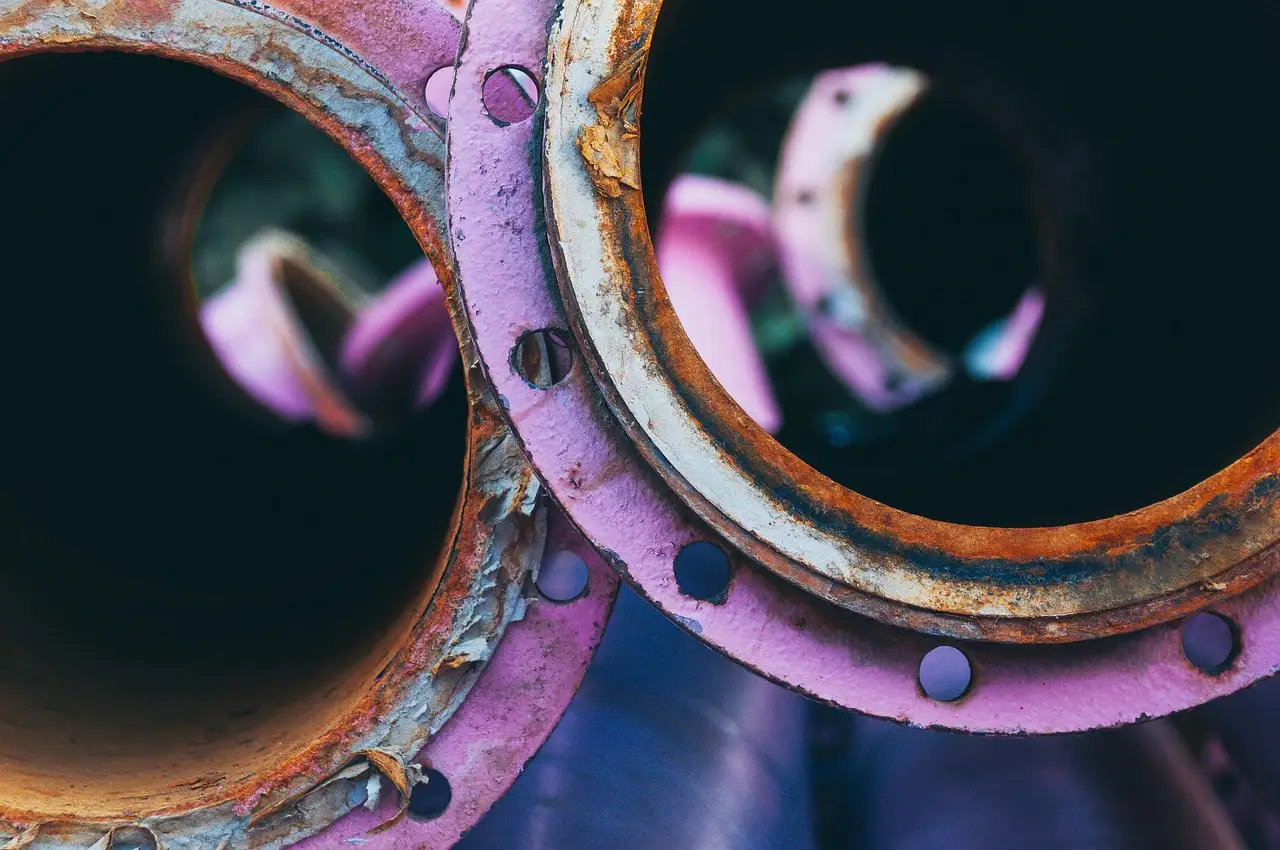
Exhaust Rust and Corrosion Guide
Treat exhaust rust by location and metal loss: surface scale can often be cleaned and coated, but any pinhole, cracked weld, failed hanger, leaking flex joint, or noticeable metal thinning means repair or replacement. Leave it alone and you risk cabin fumes, broken hangers, failed inspections, and a cheap clamp fix snowballing into a full exhaust swap. I’ll show you where rust usually starts, how to judge severity, and how to choose cleaning, coating, repair, or replacement by part, climate, and failure mode.
I’ve inspected rusted exhausts on daily drivers in salted-winter regions, humid coastal areas, and short-trip commuter cars, usually during underbody checks with the system fully cooled and lit from front pipe to tailpipe. The patterns below match what I repeatedly see in person: external rust clustering at clamps, hangers, flanges, and shell seams, and inside-out failures showing up first as soot-marked pinholes or bottom-seam leaks on mufflers that do mostly short trips.
Start here: identify where the rust began


External corrosion from road salt, splash, and chipped coatings
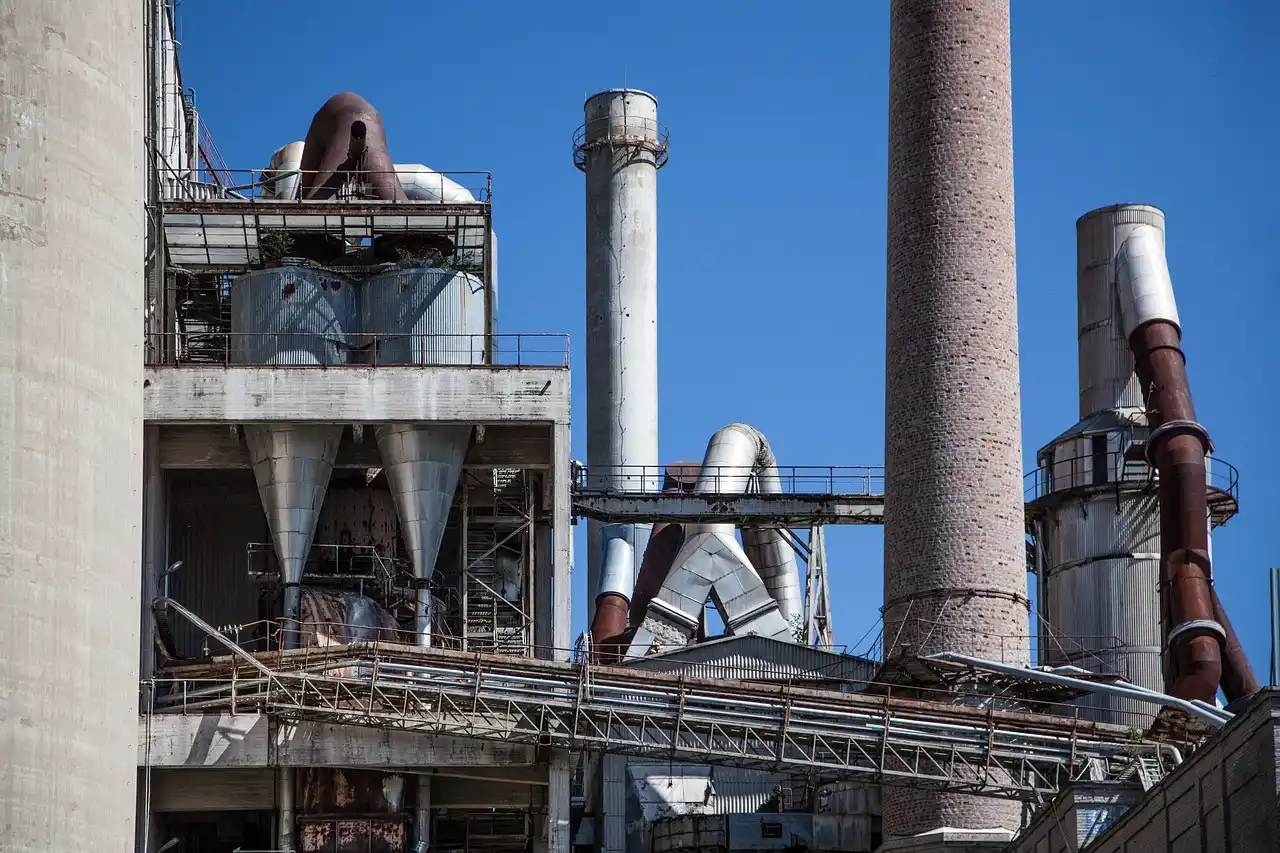
External rust starts on the outside skin. I usually see it first on the lowest, wettest, most stone-blasted areas: muffler shells, clamps, flanges, hanger rods, and bends where road splash sits after shutdown.
In winter states, salted slush and brine do most of the damage. They stick to the exhaust, dry into deposits, then get wet again on the next drive. Thin parts lose metal first, especially where debris chipped the factory coating or where two pieces overlap and trap moisture. That wet-dry chloride cycle is consistent with general corrosion guidance from AMPP/NACE and with OEM exhaust durability literature.
Internal corrosion from exhaust condensate and short-trip use
Internal rust works from the inside out. Water vapor is a normal combustion by-product, and when a cold exhaust cools the gas stream, condensate forms inside the pipe and muffler. That matters most after cold starts, short drives, and long idle-heavy use, when the system never gets hot enough, long enough, to dry itself.
Exhaust condensate collects in low points and muffler chambers. The shell can still look decent outside while the seam or bottom panel gets thin from within. That is why some mufflers suddenly open pinholes even when the outer surface shows only moderate staining. In my own inspections, these inside-out failures are most common on older commuter cars that rarely see long highway runs.
Mixed rust patterns: when both sides are attacking the same section
Many older systems get hit both ways at once. A salted-road car used for short commutes can rust outside on the shell and inside from condensate. When both are active, parts move from cosmetic rust to structural rust a lot faster.
Fast visual clues by part
- Pipe: outside rust usually appears at bends, low spots, and near clamps; inside-out rust often shows as isolated pinholes with soot halos.
- Muffler: external rust attacks the shell and straps; internal rust often opens seams, drain points, or the bottom panel.
- Flange: salt-driven rust thins the sealing face and bolt area first.
- Clamp: rust crushes the clamp body, strips hardware, and weakens the joint even if the pipe is still usable.
- Hanger: road salt attacks the rod-to-bracket area and rubber support hardware; movement and sagging usually show up early.
- Flex section: braid fraying, soot, and noise matter more than surface color. Once the braid or bellows is leaking, coating is pointless.
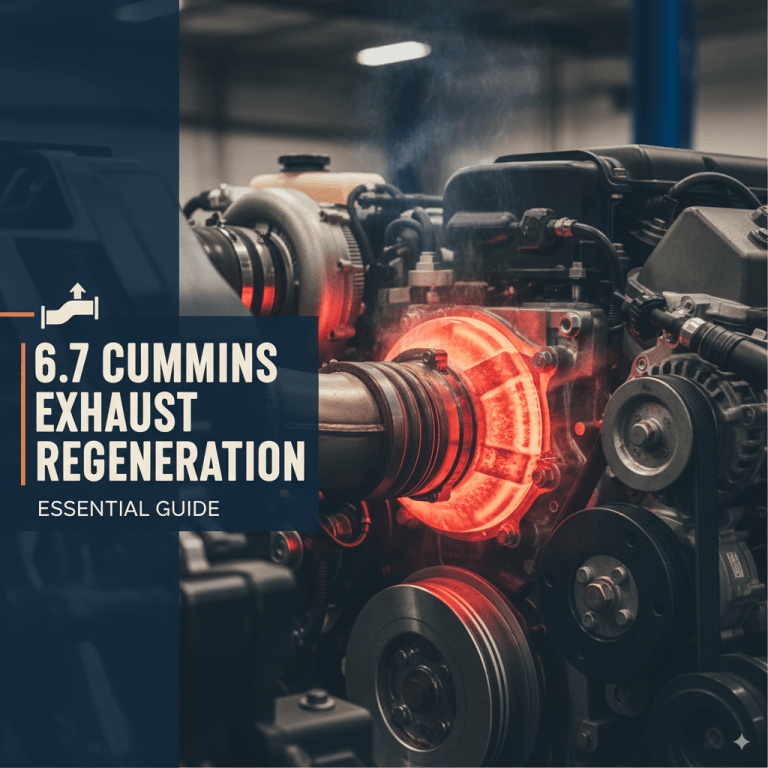
📊 Active DPF regeneration can push exhaust temperatures to 800°C. Source: Exhaust System Materials.
Why some exhausts rust faster than others
Mild carbon steel: short life in salty or wet service
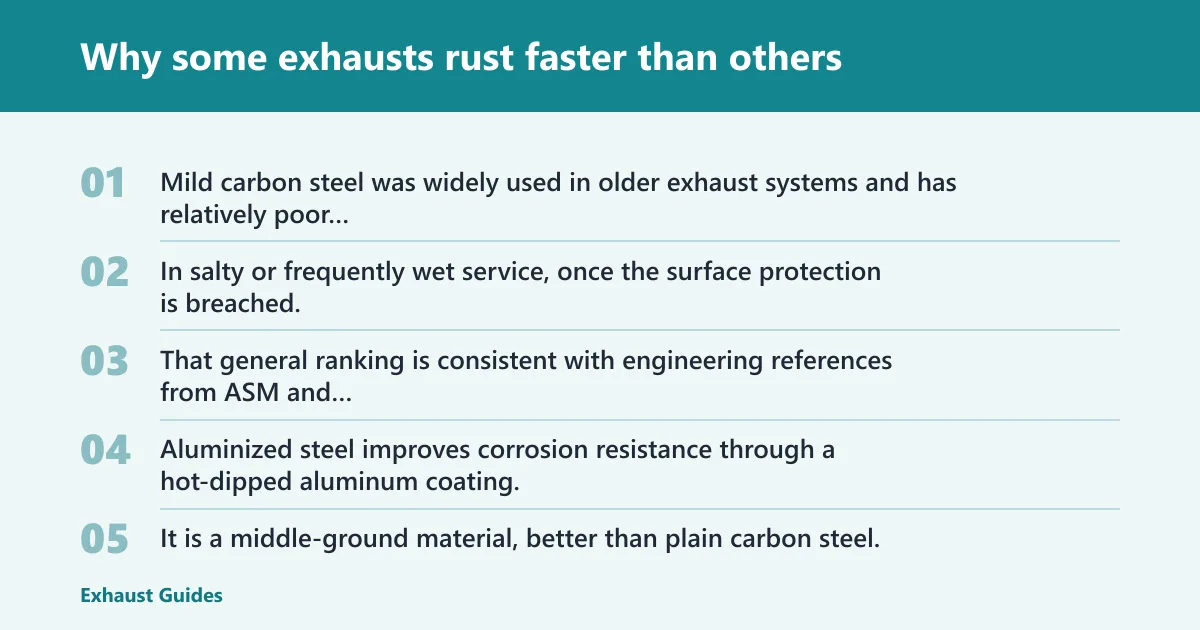
Mild carbon steel was widely used in older exhaust systems and has relatively poor corrosion resistance compared with aluminized and stainless grades. In salty or frequently wet service, once the surface protection is breached, corrosion can progress quickly. That general ranking is consistent with engineering references from ASM and exhaust-material summaries used by OEM suppliers.
Aluminized steel: what the aluminum coating does and where it stops helping
Aluminized steel improves corrosion resistance through a hot-dipped aluminum coating. That coating buys time. It is a middle-ground material, better than plain carbon steel, but it still fails once chips, clamp crush, weld heat, or abrasion expose bare steel and rust creeps under the edge of the coating.
I see that most often at joints and hang points. A straight pipe can stay solid while the welded seam right beside it starts flaking. That pattern also matches supplier literature describing aluminized exhaust tubing as a coated-steel compromise rather than a rust-proof material.
Stainless steel: chromium, passivation, and why OEMs moved to it downstream
Stainless steel needs about 10.5% chromium to be classed as stainless. Chromium oxide forms a protective layer that delays further oxidation. Those are standard stainless definitions used by Euro Inox and other stainless-industry references. Many OEM exhaust systems shifted heavily toward stainless grades downstream because they offer better corrosion resistance and service life than carbon steel in condensate and road-salt exposure.
Stainless still corrodes. Welds, heat-tinted areas, salt exposure, trapped debris, and certain chemical environments can break down that passive layer. Some type 304 stainless steel can corrode after exposure to urea decomposition products. It lasts longer, but I would never call it rust-proof. Diesel aftertreatment material discussions, including the source linked above, make the same basic point: stainless choice depends on temperature and chemical exposure, not just on whether the part is called “stainless.”
How welds, seams, and trapped moisture become weak points
Exhausts rarely fail in the middle of a clean, straight tube. They fail where moisture sits, where heat cycles change the metal, and where two layers overlap. Muffler seams, flange rings, clamp joints, and hanger welds are common examples.
Parts with double walls or folded seams hide rust until metal loss is already underway. If a seam is swelling, flaking, or leaving black soot, the issue is past the cosmetic stage. On vehicles I inspect after winter, I often find the top of the muffler more corroded than the visible side because salty debris sits there out of sight.
What causes exhaust rust on short-trip cars?
Short-trip cars rust exhausts from the inside because cold starts create water vapor, then shutdown happens before the system fully dries. Condensate stays in mufflers and low pipes, so metal spends more time wet than hot. Internal rust is most likely when the car rarely reaches full operating temperature.
Cold starts, condensate, and water pooling inside mufflers and pipes
Combustion makes water vapor. On a cold exhaust, that vapor condenses on the inner walls. Mufflers are especially vulnerable because chambers and baffles hold moisture longer than a plain pipe does. This inside-condensation mechanism is widely described in OEM service information and exhaust-material references.
Why cars that rarely fully heat-soak rust from the inside out
Driving long enough to bring the whole system up to full temperature helps evaporate retained moisture. Repeated short runs never fully boil off condensate, so the internal surfaces cycle between dampness and acidic residue. I’ve cut open mufflers that looked passable outside but were paper-thin along the bottom seam.
Short-trip use also hides the problem. Drivers may first notice a new puffing noise on cold start, a deeper tone, or a faint exhaust smell after parking.
How to spot internal rust versus exterior cosmetic rust
- Likely internal: pinholes with black soot around them, seam leaks on a muffler bottom, rust concentrated at drain points, exterior that looks fair but sounds hollow or puffy.
- Likely external: broad flaky rust on the outside shell, rusted hanger rods, degraded clamp hardware, thinning flange faces, heavy scale where road spray hits directly.
- Likely both: shell rust outside plus seam leak, or scaled pipes with soot marks at several points.
How do salt roads damage exhaust systems over time?
Salt roads damage exhausts by holding moisture against hot metal, then repeating wet-dry cycles for months. The first parts to suffer are usually hangers, clamps, flanges, and muffler shells because they are thin, exposed, and full of edges where brine collects. Straight pipe often survives longer.
Salt brine, road spray, and repeated wet-dry cycles
Road salt does more than make metal wet. It leaves deposits in seams, under clamp bands, and on top of mufflers where splash lands and dries. Then the next drive rewets the residue. That repeat cycle is why winter cars can look much worse by spring even without obvious impact damage.
Why hangers, clamps, flanges, and muffler shells often fail before straight pipe
Those parts are thin or stressed, and many have sharp edges or trapped joints. Clamp threads seize. Flanges lose face thickness until they no longer seal. Hangers crack near welds after rust cuts section strength. Muffler shells have large, thin panels that rust externally and internally at the same time.
Climate priorities: salted winters, coastal air, and year-round humidity
Cars driven on salted roads generally need the most frequent underbody checks. Coastal cars face constant salt in the air, which is slower than winter brine but still hard on hangers and shell seams. Humid-region cars may show less dramatic scaling outside, yet short trips there still drive internal condensate rust.
Is surface rust on an exhaust dangerous?
Surface rust alone is usually a maintenance issue rather than an immediate hazard, if the metal still seems thick enough and there are no leaks, cracks, or loose supports. It becomes dangerous when rust turns to scale, opens pinholes, weakens hangers, thins flanges, or leaves soot, odor, noise, or movement.
Surface rust versus scale versus perforation
Surface rust is color change and light roughness. A wire brush removes it without exposing soft, crumbling metal underneath.
Scale means layered flaking and visible metal loss. If brushing drops heavy flakes and reveals pits or edges that feel knife-thin, the part has moved beyond simple cleanup.
Perforation means pinholes, split seams, cracks, or areas that crumble under light probing. At that point, converter and paint are cosmetic at best.
Inspection thresholds: when color change becomes metal loss
Use a simple, part-by-part threshold. If brushing leaves smooth, solid metal and the shape stays crisp, treatment is reasonable. If rust has clearly reduced wall thickness, changed the sealing shape of a flange, narrowed a hanger rod, or left a clamp unable to hold load, plan repair or replacement.
Symptoms that move rust from cosmetic to structural concern
- Visible soot around a hole, seam, or slip joint
- Ticking, puffing, or booming that changed recently
- Exhaust odor around the cabin or after parking
- Sagging at a hanger or tailpipe that shifts by hand
- Loose flange connection or failed clamp crush
- Rattling baffles inside a rusted muffler
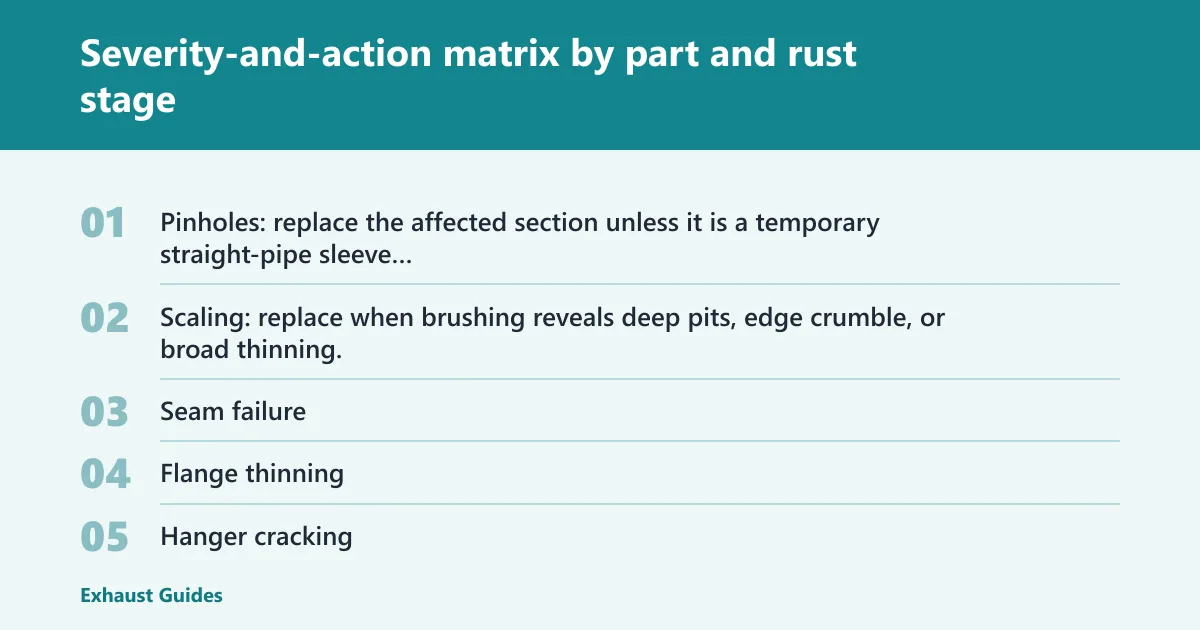
Severity-and-action matrix by part and rust stage
Methodology note: I use this matrix after a cooled-system visual inspection, a light probe with a pick or screwdriver on suspect areas, a hand-movement check at hangers and joints, and a soot/noise check during cold start. “Safe DIY treatment” means the metal remains structurally sound after loose rust is removed. If probing opens a hole, exposes softness, or the joint moves abnormally, I move the part straight into repair-or-replace territory.
| Part | Rust stage | Likely origin | Safe DIY treatment | Replacement trigger | Inspection interval |
|---|---|---|---|---|---|
| Pipe | Light surface rust, no soot, solid wall | External road splash | Wire brush and sandpaper, then rust converter on affected spots, then rust-resistant coating or high-heat paint | Any pinhole, crack, soft spot, or thinning by about 25% | Every oil change in salted-road use; before and after winter; twice yearly in humid or coastal use |
| Pipe | Scale, pits, soot at a point leak | Internal condensate or mixed rust | Monitor only if no leak is present and wall is still solid; localized sleeve repair may buy time on straight sections | Leak, multiple pits, crush damage near a joint, or thin metal around repair area | Recheck within a month if monitored |
| Clamp | Rusty hardware, joint still tight | External salt exposure | Replace clamp hardware or full clamp; coating is secondary | Threads seized, band split, clamp loses crush load, joint leaks | At every underbody inspection in winter climates |
| Hanger | Surface rust on rod or bracket, no cracking | External salt and splash | Clean and coat only if metal remains full thickness | Crack at weld, reduced rod section, loose bracket, separated rubber support point | Monthly through winter; otherwise twice yearly |
| Flange | Surface rust on face and bolts, still flat and sealing | External salt exposure | Clean exposed areas; replace hardware if removable | Face thinning, warped sealing edge, bolt ear loss, recurring leak soot | Before winter and at any leak noise change |
| Muffler | Outer shell rust only, no seam leak, no rattle | External road splash | Brush, converter on treatable rust, then high-heat paint | Seam failure, pinholes, soft shell, internal rattle, rust around drain or bottom seam | Every season on short-trip cars |
| Muffler | Bottom seam rust, soot, damp residue, sudden noise | Internal condensate or mixed rust | No coating fix; replacement is the safer call | Any active leak or seam split | Immediate action |
Replacement triggers by failure mode
- Pinholes: replace the affected section unless it is a temporary straight-pipe sleeve repair on otherwise thick metal.
- Scaling: replace when brushing reveals deep pits, edge crumble, or broad thinning.
- Seam failure: replace the muffler or resonator section.
- Flange thinning: replace once the face can no longer seal flat or the bolt area is reduced.
- Hanger cracking: repair weld or replace the section immediately.
- Clamp crush loss: replace the clamp, and replace the pipe too if the slip fit is already distorted or thin.
- Flex braid damage: replace the flex section. Coatings and wraps do not fix a leaking bellows.
How do I stop exhaust rust from spreading?
Stop exhaust rust by cleaning off loose scale, treating only solid metal, and then coating exposed outer surfaces with a heat-tolerant product. That slows external corrosion, but it cannot reverse internal rust or restore lost thickness. Salted-road cars and short-trip cars need repeat inspections because the problem usually comes back.
Clean first: when to use a wire brush and sandpaper
Wire brush and sandpaper are the right tools for accessible surface rust on pipes, muffler shells, clamp areas, and hanger brackets. For a more closely related maintenance read, see an exhaust-corrosion prevention guide on the same topic area before winter service or after salted-road driving. Remove loose scale until the remaining metal is firm. Do not grind hard on thin shell metal that already flexes under hand pressure.
Regular cleaning helps prevent outside rust build-up on the exhaust. It does almost nothing for a muffler that is already rusting from the inside.
Where rust converter works and where it fails
Rust converter belongs after brushing and degreasing, on rusted but still solid outer metal. It works well enough on pitted shell surfaces, brackets, and pipes that have not perforated.
It does not fix through-holes, split seams, detached hangers, leaking flanges, or badly thinned sections. It also cannot stop corrosion hidden inside a muffler chamber. Use it as a surface treatment, not a structural repair.
Using rust-resistant coating or high-heat paint with realistic durability expectations
Rust-resistant coating or high-heat paint is the final barrier after prep. On outer shell areas and cooler downstream pipes, it can hold up reasonably well if the surface was cleaned properly. Near hotter upstream sections, flanges, and flex areas, expect shorter life and periodic touch-up.
Heat matters. Active DPF regeneration can push exhaust temperatures to 800°C. That is one reason generic underbody coatings, rubberized sprays, or oily protectants are a poor choice on or near hot exhaust components. Temperature capability and chemical exposure requirements for exhaust materials are discussed in the DieselNet reference above and in OEM coating product data sheets.
Wash, dry, and driving-pattern changes that actually slow repeat corrosion
- Rinse winter salt from the underbody and exhaust after storms or slushy driving, especially around hangers, muffler tops, and flange pockets.
- Let the vehicle dry before parking long term when possible.
- Drive long enough, when conditions allow, to fully heat the system and reduce retained condensate.
- Inspect short-trip cars more often than highway cars, even if mileage is low.
Can exhaust rust be repaired or does it need replacement?
Exhaust rust can be repaired only when the rust is external, localized, and the remaining metal is still solid. Once there are pinholes, seam splits, failed hangers, flange thinning, soft shell metal, or flex-joint leaks, replacement is the safer call because coatings and patch products cannot restore strength.
Repairable cases: light external rust, solid base metal, accessible sections
Treatable situations include surface rust on a pipe, shell, clamp area, or hanger bracket where brushing reveals healthy metal. A clamp can often be replaced by itself. A straight pipe with one localized bad section may take a sleeve or welded repair if the surrounding wall is sound.
Replacement-only cases: through-holes, soft metal, failed flanges, broken hangers, damaged flex sections
Replacement is the only sensible route when metal has opened up or lost stiffness. That includes muffler seam failure, pinholes from internal condensate, flanges too thin to seal, hanger rods cracked at the weld, or any flex section with braid damage and soot.
Patch, sleeve, clamp, weld, or full section replacement: picking the least bad option
A sleeve can buy time on a straight pipe with good metal around the cut area. A new clamp is fine if the joint surfaces are still solid. Welding works when the surrounding material is thick enough to carry the repair.
A patch is weak on a rotted muffler shell. Full section replacement is usually cleaner and lasts longer when rust has spread past one isolated spot.
How do I clean rust off exhaust pipes safely?
Clean rust off exhaust pipes only when the system is fully cool and the vehicle is safely supported. Use a wire brush and sandpaper on accessible outer rust, then wipe the surface clean before converter or paint. Stop if brushing exposes thin metal, pinholes, or cracking.
Safe prep, cooling, lifting, and protection
Work on a cold exhaust. Hot metal, sharp scale, and falling debris are the main risks. Use eye protection and a dust mask or respirator suited to rust dust. If the car must be raised, support it securely on level ground before reaching under the center section.
Step-by-step external rust cleanup on accessible pipe sections
- Inspect first for soot, holes, split seams, loose hangers, and flex damage. If found, do not treat it like a cleaning job.
- Brush off loose rust and scale with a hand wire brush.
- Use sandpaper to feather edges and remove remaining loose material on solid metal.
- Wipe away dust and residue.
- Apply rust converter only to treatable rusted metal if the product directions allow exhaust use.
- After cure, apply a heat-tolerant coating or high-heat paint where appropriate.
- Reinspect after a few heat cycles because coatings on exhaust parts take abuse and may need touch-up.
Can I use WD-40 or rust spray on exhaust pipes?
WD-40 or generic rust sprays are poor standard choices for exhaust surfaces. They can leave residue, smoke on heat-up, contaminate nearby areas, and offer little lasting protection once the pipe gets hot. Use products intended for high-heat metal. Keep any oily spray away from hot exhaust parts.
Household rust removers get mentioned often. They may clean light staining on cool, removed parts, but they are not a serious treatment path for an installed exhaust under a road car.
How can I tell if exhaust rust is coming from the inside?
Inside-origin rust usually shows as pinholes, seam leaks, or bottom-side failures with black soot and damp residue, while the outer surface may look only moderately rusty. It is most common on short-trip cars and mufflers. Outside-origin rust is broader, more visible, and often worst on hangers, clamps, and flanges.
Inside-out clues by part
- Muffler: leak at the bottom seam, shell bulge, internal rattle, sudden increase in noise.
- Resonator: pinhole or seam stain near the lowest point.
- Pipe: isolated soot spots instead of broad external scaling.
Outside-in clues by part
- Hangers: heavy red rust and section loss at the weld or rod bend.
- Clamps: seized hardware, split band, rust jacking around the overlap.
- Flanges: flaky face rust, thin bolt ears, visible gasket leak tracks.
When should I replace a rusted exhaust section?
Replace a rusted exhaust section when rust has caused a leak, reduced support strength, or thinned the metal enough that cleaning exposes softness or edge crumble. Pinholes, cracked welds, failed flanges, broken hangers, damaged flex joints, and seam splits are replacement triggers, not coating jobs.
Part-by-part call: monitor, treat, or replace
Monitor light surface rust on solid pipe, muffler shell, and brackets with no symptoms.
Treat accessible outer rust on solid metal using brushing, converter, and a heat-tolerant coating.
Replace any section with active leaks, structural weakness, hanger failure, flange face loss, or internal muffler deterioration.
Frequently asked questions
How do I stop exhaust rust from spreading?
Clean off loose external rust, treat only solid metal with rust converter, and apply a high-heat coating where it makes sense. Then rinse winter salt regularly and give short-trip cars occasional full heat cycles. This slows outside corrosion, but it will not save a muffler or pipe already rusting through from inside.
Can exhaust rust be repaired or does it need replacement?
It depends on metal loss and part type. Light external rust on pipes, shells, brackets, and some joints can be cleaned and coated. Replace parts with pinholes, seam splits, cracked hangers, thin flanges, leaking flex sections, or soft shell metal, because the structure is already compromised.
What causes exhaust rust on short trip cars?
Short trips leave condensate inside the exhaust because the system never gets hot enough long enough to dry out. Water collects in mufflers and low spots after cold starts, then sits there between drives. Over time, that internal moisture causes inside-out rust, even if the outside looks only mildly affected.
Is surface rust on an exhaust dangerous?
Surface rust alone is usually not dangerous if the metal remains thick and there are no leaks, cracks, or loose supports. It becomes a problem when rust turns into flaking scale, causes thinning, opens holes, weakens hangers, or leaves soot, odor, or a new exhaust noise.
How can I tell if exhaust rust is coming from the inside?
Look for pinholes, seam leaks, and black soot on a muffler or resonator whose outer shell does not look severely rusted. Bottom-side failure and sudden noise on a short-trip car strongly suggest internal condensate rust. Broad flaky rust on hangers, flanges, and clamps usually points to outside salt exposure.
When should I replace a rusted exhaust section?
Replace it when there is any active leak, a failed hanger, a cracked weld, a damaged flex section, a flange that no longer seals, or clearly reduced wall thickness. If brushing exposes softness, crumble, or hidden holes, treatment time is over. Replacement is the safer and usually cheaper path.
Can I paint a rusty exhaust and expect it to last?
You can paint only solid, externally rusted metal and expect a limited benefit. High-heat coatings can slow outside corrosion on cooler downstream sections, but they do not stop inside-out rust, repair thin metal, or survive forever near hotter upstream areas.
What part of the exhaust usually rusts first?
On salted-road vehicles, I usually see early damage at clamps, flanges, hangers, muffler shells, and shell seams because they stay wet and trap debris. On short-trip cars, mufflers and resonators often fail first from internal condensate.
Who is this advice based on?
This guide is based on first-hand underbody inspection experience, common failure patterns I repeatedly see on commuter and winter-driven vehicles, and general materials references used in corrosion and exhaust engineering, including DieselNet for exhaust temperature/material context, Euro Inox for stainless/passivation basics, and standard corrosion guidance from AMPP/NACE and ASM-style materials references.