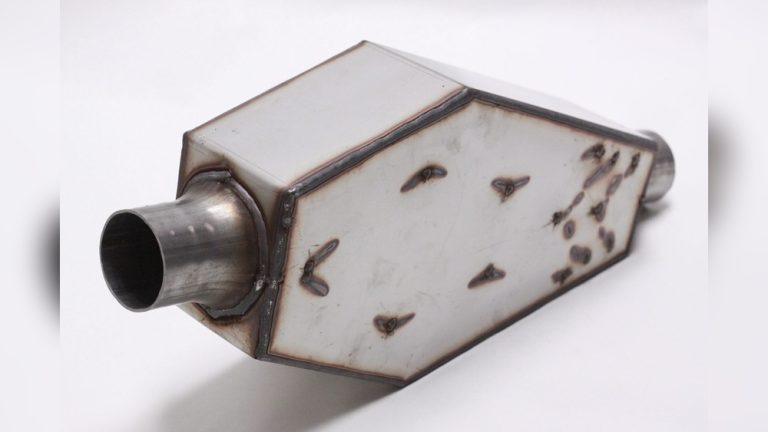
Are Loud Mufflers Illegal In Florida? Proven Dangers
Yes, excessively loud mufflers are generally illegal in Florida if they exceed specific noise limits or modify the original exhaust system beyond legal standards. Florida law focuses on noise control and ensuring vehicle equipment meets safety requirements, making overly noisy aftermarket setups a potential source of fines and mandatory repairs.
Are you cruising down the sunny Florida highway, enjoying the rumble of your ride, only to see flashing lights in your rearview mirror? Or maybe you’re just worried about getting a ticket for that new exhaust system you installed. It’s a common headache for car owners: understanding the rules of the road, especially when it comes to how loud your car sounds. Loud noises aren’t just annoying; they can actually be against the law in the Sunshine State.
Don’t worry! As your trusted automotive guide, I’m here to cut through the confusing legal talk and give you the straight facts about muffler laws in Florida. We will look clearly at what the state says about noise levels, what the dangers of overly loud pipes are, and how you can keep your ride sounding great while staying perfectly legal. Let’s dive in and make sure your exhaust setup is street-legal and safe!
Are Loud Mufflers Illegal in Florida? The Definitive Answer
The simple answer to “are loud mufflers illegal in Florida?” is a definite “it depends,” but generally, yes, if they are excessively loud or illegally modified. Florida doesn’t just care about how your car sounds; they care about controlling noise pollution and ensuring your vehicle meets basic safety and equipment standards.
Understanding Florida Statute 316.292: Exhaust System Requirements
The primary piece of legislation that governs muffler legality in Florida is often found under noise regulations, but the specifics regarding vehicle equipment are crucial. Florida Statutes detail requirements for vehicle operation and equipment.
Specifically, Florida law generally prohibits any vehicle from being equipped with an exhaust system that causes the vehicle to emit excessive or unusual noise. While the exact decibel limit might seem elusive, the core concept centers around mufflers being operational and functioning as originally intended to control sound.
According to Florida Statute 316.292, which covers the operation of vehicles:
“Every motor vehicle shall be equipped with an exhaust system or muffler or mufflers or other devices effectively maintained to prevent excessive or unusual noise, or any unusual smoke.
This means if you take off the muffler entirely (straight-piping), you are almost certainly violating the law because you have removed the device designed to control noise. Furthermore, any modification that increases noise beyond what is considered “usual” or “excessive” for that specific vehicle type is questionable under the law.
The Role of Local Ordinances
One thing that often trips up drivers is that state law sets the baseline, but local counties and cities in Florida can enforce stricter noise ordinances.
For example, a city like Miami or Orlando might have specific decibel readings they enforce, especially late at night in residential zones. Always check your local city or county government website for specific noise restrictions, as these can sometimes be more stringent than the general state rule.

What is Considered Too Loud? The Noise Limit Question
When people ask if their muffler is illegal, they usually want a specific number—a decibel (dB) limit. For a long time, Florida law relied on subjective terms like “excessive noise.” However, police officers often rely on sound-measuring devices (decibel meters) or simply the officer’s judgment regarding whether the noise is unusual for the vehicle type.
Decibel Levels and Enforcement
While there isn’t always a hard, published, universal maximum decibel limit listed plainly next to the statute for every car type (like you might find in California), enforcement often relies on the principle that the original equipment must be maintained to prevent excessive noise.
For context, here is a general comparison of typical vehicle noise levels. This helps you understand what your car might sound like compared to everyday noise:
| Sound Source | Approximate Decibel Level (dB) | Legal Implication |
|---|---|---|
| Quiet Library | 30 dB | Safe/Normal |
| Normal Conversation | 60 dB | Safe/Normal |
| Loud City Traffic | 85 dB | Start of potential concern |
| Loud Motorcycle/Modified Car (Close Range) | 95–105 dB | High risk of citation in many areas |
| Chainsaw | 110 dB | Immediate hearing damage risk |
If your vehicle is producing sound consistently above 95 dB when measured roadside by law enforcement, you are placing yourself at significant risk of receiving a citation under the “excessive or unusual noise” umbrella.
The Issue of Muffler Modification
It’s not just about volume; it’s about intent and equipment. Removing the factory muffler or resonator is usually the easiest way to become illegal.
Modifying your exhaust system involves:
- Removing the muffler entirely (straight piping).
- Replacing the muffler with one explicitly labeled as a “racing muffler” or “non-street legal” model.
- Drilling holes or tampering with the existing muffler to create intentional leaks or loud sounds.
If you install an aftermarket performance muffler, you must ensure it is designed to meet street-legal noise standards, which often means checking manufacturer specifications against local ordinances.
The Proven Dangers of Loud Mufflers: Beyond the Ticket
Getting pulled over is annoying, but the dangers associated with excessively loud exhaust systems go far beyond a simple traffic fine. These dangers affect safety, your health, and your wallet.
Danger 1: Risk to Hearing Health
This is the danger most often overlooked by drivers focusing only on performance. Consistently exposing yourself and your passengers to high decibel levels is damaging.
According to the National Institute for Occupational Safety and Health (NIOSH), prolonged exposure to sounds above 85 dB can cause hearing damage. If your vehicle is regularly operating at 100 dB or higher, you are risking permanent hearing loss over time, even if you don’t notice it immediately.
If you frequently drive with friends or frequently drive long distances with a very loud exhaust, everyone in and around the car is exposed to damaging noise levels. This isn’t just about you; it’s about the long-term health of everyone sharing the ride.
Danger 2: Reduced Traffic Safety
Loud noises can actually distract other drivers, making traffic less safe.
- Driver Distraction: An unexpectedly loud backfire or sudden surge in volume can startle nearby drivers, causing them to swerve or take their eyes off the road.
- Masking Important Sounds: In a noisy environment, it becomes harder for you, the driver, to hear critical sounds like emergency sirens (police, fire, ambulance) or the horns of other vehicles indicating an immediate hazard. This delay in auditory processing can be fatal.
- Police Attention: The most immediate safety risk is attracting unwanted attention. A vehicle that draws attention through excessive noise is far more likely to be pulled over, even if the primary infraction wasn’t noise-related. This extra traffic stop increases your overall time spent in potentially dangerous roadside situations.
Danger 3: Financial and Legal Consequences
The immediate cost of a citation for illegal muffler noise in Florida can be significant. These citations often fall under non-moving or equipment violation categories, but repeat offenses can add up quickly.
If you receive a citation, you face:
- The initial fine amount.
- Court fees and administrative costs.
- Potential requirement to prove compliance (getting an inspection proving your muffler is now legal), which takes time and money.
In some severe or repeat cases, especially if noise complaints are widespread in a neighborhood, law enforcement could potentially deem the vehicle unsafe or improperly equipped until fixed, leading to temporary impoundment or mandatory repair orders.
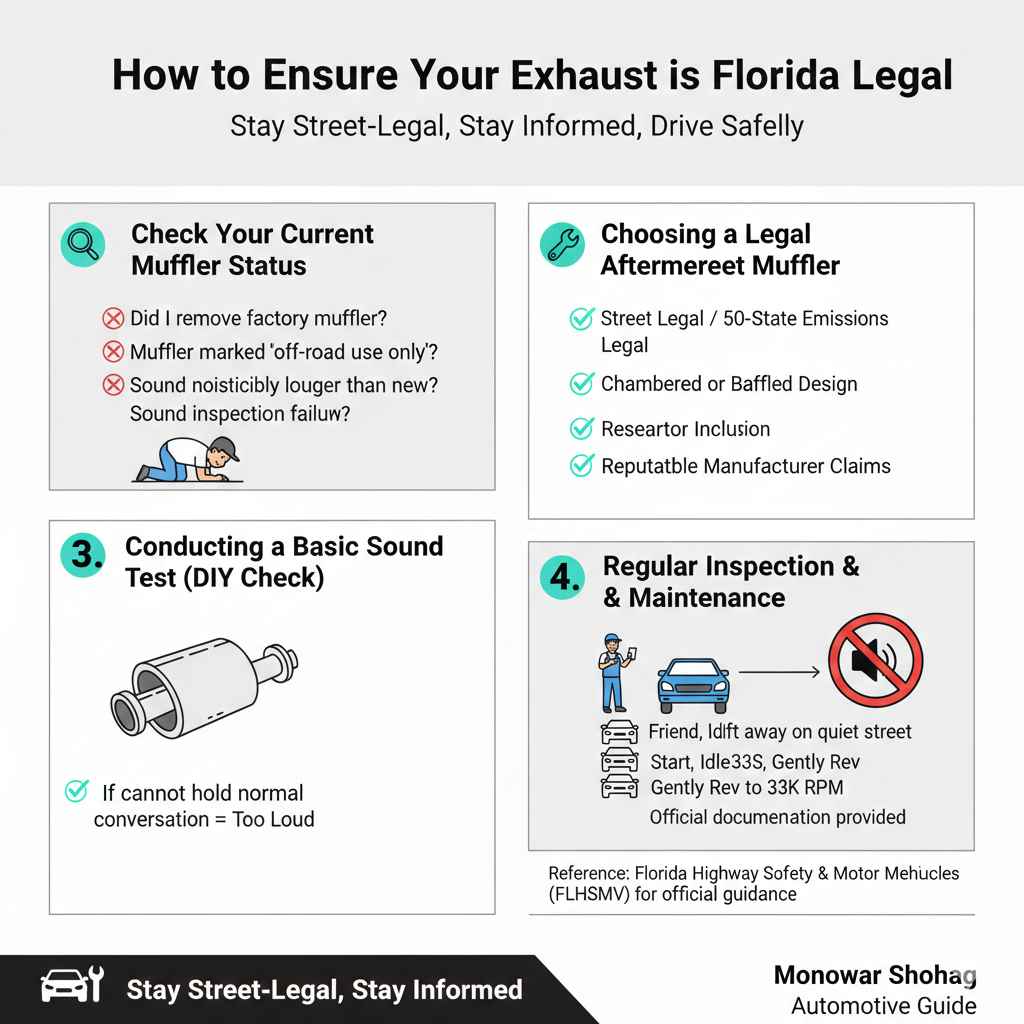
How to Ensure Your Exhaust is Florida Legal
If you have an aftermarket exhaust or are thinking about upgrading, taking proactive steps ensures you stay on the right side of Florida law. As Monowar Shohag, I want you to enjoy your car safely and without worry.
Step 1: Check Your Current Muffler Status
First, look under your car! Does it have a visible muffler? A muffler is a chambered device designed to use baffles or sound-absorbing materials to quiet the exhaust pulses.
Ask yourself these three simple questions:
- Did I remove the factory muffler?
- Is the muffler aftermarket one clearly marked for “off-road use only”?
- Is the sound noticeably louder than it was when the car was new?
If the answer to any of these is yes, you are likely operating illegally or in a very gray area.
Step 2: Choosing a Legal Aftermarket Muffler
If you want better sound and performance without the ticket risk, choose wisely. Performance doesn’t have to mean illegal volume.
When shopping for an aftermarket system in Florida, look for mufflers categorized as “Street Legal” or “50-State Emissions Legal” (even though this refers to emissions, it often correlates with compliance in noise standards).
Look for systems that offer these features:
- Chambered or Baffled Design: These manage sound waves effectively, offering a deeper tone without the sheer volume of a straight-through resonator design.
- Resonator Inclusion: A resonator is a secondary chamber that cancels out specific unwanted frequencies (like drone), often keeping the overall volume down while improving tone quality.
- Manufacturer Claims: Reputable brands will often specify if their exhaust is designed to comply with US noise regulations.
Step 3: Conducting a Basic Sound Test (The DIY Check)
Since official decibel testing is complex, you can perform a simple, real-world test to gauge your risk level.
Have a friend stand approximately 50 feet behind your car on a quiet street (away from buildings that might reflect sound). Have them listen while you:
- Start the car from a cold start.
- Idle the car for 30 seconds.
- Gently rev the engine to about 3,000 RPM (do not floor it).
If your friend cannot easily hold a normal conversation with you while the car is idling, or if the 3,000 RPM rev sounds jarringly loud compared to standard traffic, you need to consider quieter modifications. For a more technical approach, you can use a free smartphone decibel meter app, keeping in mind these apps are not official measurement tools but are good for comparative checks.
Step 4: Regular Inspection and Maintenance
An exhaust system that was legal when installed can become illegal due to damage. Rust, accidents, or potholes can create holes or loosen clamps, leading to leaks that dramatically increase noise levels.
Perform these simple checks every few months:
- Tap along the exhaust pipe to listen for hollow spots indicating rust-through.
- Check all welds and clamps connecting the muffler and pipes.
- Ensure the catalytic converter (which also muffles some sound) is intact.
For official guidance on vehicle equipment standards, consulting the Florida Highway Safety and Motor Vehicles (FLHSMV) website or local traffic division is always the best route for definitive local rules.
Muffler Upgrade Comparison: Street Legal vs. Performance Only
Choosing the right muffler often comes down to balancing sound preference with legal compliance. Here is a comparison to help you decide what fits your driving style in Florida:
| Muffler Type | Typical Sound Level | Primary Benefit | Legality Risk in Florida |
|---|---|---|---|
| OEM (Stock) | Low (Quiet) | Guaranteed compliance, durability | Very Low |
| Touring/Cruising Performance Muffler | Moderate (Deeper Tone) | Improved tone without excessive volume | Low (If within local ordinances) |
| Aggressive Performance Muffler | High (Loud Under Acceleration) | Significant performance flow increase | Medium (High risk during peak noise) |
| Straight Pipe/Muffler Delete | Very High (Roaring/Barking) | Maximum flow/loudest sound | Very High (Almost certainly illegal) |
FAQ: Common Questions About Florida Muffler Laws
Here are answers to some of the most frequent beginner questions about exhaust legality in the Sunshine State.
Q1: If I only removed the resonator, is that illegal in Florida?
A: Removing the resonator places you in a gray area. The resonator’s job is to reduce drone and some noise. While it is not the primary muffler, removing any component designed to quiet the exhaust can potentially lead to a citation if an officer deems the resulting noise “excessive” or “unusual” for your vehicle type under Statute 316.292.
Q2: Can a police officer pull me over just for a loud exhaust?
A: Yes. An officer can initiate a traffic stop if they have probable cause to believe a vehicle is equipped illegally or is violating noise regulations. A sound that is distinctly louder than normal traffic often meets this standard for investigation.
Q3: Does Florida have a specific decibel limit like some other states?
A: Florida’s state law relies more on the subjective term “excessive or unusual noise” rather than stating a concrete, universal maximum decibel limit for all vehicles. However, local city or county ordinances might impose specific dB limits, so local rules are key.
Q4: I bought my car used and it is loud. Am I responsible if it’s illegal?
A: Yes, the driver operating the vehicle on Florida roads is responsible for ensuring it meets all equipment and safety standards at the time of operation. If your car is too loud, it is your responsibility to fix the muffler before driving it again.
Q5: What if my muffler is just old and rattles, but not intentionally loud?
A: Even if the noise is accidental due to wear and tear, it still constitutes an equipment malfunction that creates excessive noise. You can still receive a citation. If this happens, you should treat it as a mandatory repair, similar to a broken taillight, to avoid further legal issues.
Q6: Are performance exhaust tips that are very short legal?
A: Short, aggressive exhaust tips often don’t have any sound-dampening material built in. If the noise produced by a very short, straight pipe tip is excessive compared to the factory standard, it can still lead to a ticket under the general noise statute, even if the main muffler body remains.
Conclusion: Driving Smart and Legal in Florida
Navigating vehicle equipment laws can feel complicated, especially when dealing with the sound coming from your exhaust. The key takeaway regarding “are loud mufflers illegal in Florida?” is that while the state wants you to enjoy your vehicle, that enjoyment cannot come at the expense of public peace or safety.
As your automotive guide, my advice is always to prioritize compliance. If your exhaust is drawing negative attention or sounds substantially louder than when you first bought your vehicle, it is time for a check-up. Investing a little time or money now into a street-legal performance muffler or repairing a failing factory unit is far cheaper and less stressful than accumulating fines or dealing with potential safety hazards.
By understanding the basic statute against excessive noise and being mindful of your local ordinances, you can keep your car running well, sounding great, and staying perfectly compliant with Florida traffic laws. Drive safe, stay cool, and enjoy the ride!