Proven Answer: Are Gen 1 And Gen 2 Mufflers The Same?
The short answer is: No, Gen 1 and Gen 2 mufflers are usually NOT the same, even if they look similar or are for the same car model. Differences in mounting points, pipe diameter, and baffling design are common between generations, meaning swapping them often leads to fitment issues or poor performance. Always check part numbers specific to your vehicle’s year.

As an Amazon Associate I earn from qualifying purchases.
Welcome! If you own a car and are looking at exhaust parts, you’ve probably run into the “Gen 1 vs. Gen 2” puzzle. It’s frustrating when you need a simple replacement muffler, but the parts diagrams show two different versions for slight model year changes. Will the muffler from the first generation (Gen 1) fit your second generation (Gen 2) car? This question trips up many everyday car owners.
Don’t worry! As your friendly automotive guide, I’m here to break down exactly why these parts differ and what you need to look for. We will simplify the confusion around generational changes, ensuring you buy the right muffler the first time. By the end of this guide, you’ll understand the key differences and feel confident checking compatibility for your ride.
Why Do Manufacturers Change Muffler Designs Between Generations?
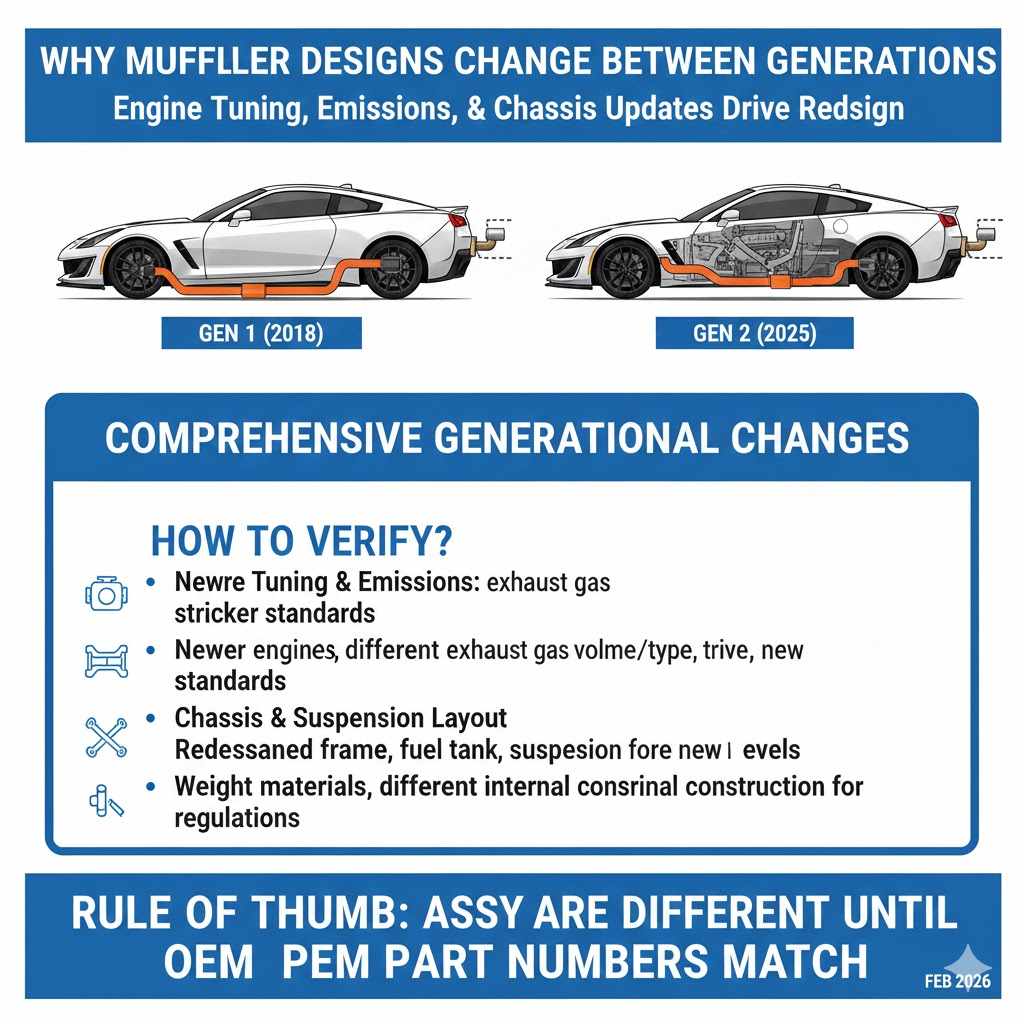
Automakers rarely leave things completely alone when they redesign a vehicle, even if the car looks similar from the outside. These generational changes—often happening every 5 to 8 years—involve significant under-the-hood and under-the-car updates that directly affect the exhaust system.
Think of a vehicle generation as a whole new blueprint. When engineers redesign a car from the ground up (going from Gen 1 to Gen 2), they change more than just the body panels. They focus heavily on:
- Engine Tuning and Emissions: Newer engines often produce different types or volumes of exhaust gas, requiring mufflers designed to handle new flow rates or meet stricter emissions standards.
- Chassis and Suspension Layout: Changes to the frame, fuel tank location, or rear suspension geometry force the exhaust pipe routing to change significantly.
- Weight Reduction and Noise Levels: Manufacturers constantly try to save weight and meet stricter noise regulations, leading to different internal muffler construction (baffles or packing materials).
Because of these comprehensive changes, assuming a muffler is interchangeable just because the car name is the same is risky. We need to look deeper at the specifics.
The Three Critical Differences Between Gen 1 and Gen 2 Mufflers
When experts talk about muffler incompatibility between generations, they are usually pointing to three main physical differences. If any one of these elements doesn’t match perfectly, the part will either not fit on the hangers or will bolt up incorrectly to the pipe leading to it.
1. Mounting Bracket Location and Style
The hangers are the metal arms welded onto the muffler body that connect it to rubber isolators mounted on the car’s frame. Even a slight shift in the car’s underbody structure will move these mounting points.
For example, a Gen 1 car might have its rear axle shifted one inch further back than the Gen 2 model. If the Gen 1 muffler has a bracket located at that one-inch mark, it will not line up with the Gen 2’s hanger bracket.
Key things to check on mounting points:
- Number of Brackets: Does Gen 1 have two main brackets, while Gen 2 only uses one?
- Bracket Angle: Are the brackets welded straight out, or are they angled slightly upward or downward?
- Weld Quality: Aftermarket parts might use different bracket weld designs than OEM parts.
2. Inlet and Outlet Pipe Dimensions (Diameter and Length)
This is often the biggest hurdle. While the muffler body itself might look identical, the pipes sticking out of it rarely line up perfectly between generations.
- Pipe Diameter: Newer engines often require better exhaust flow. If the Gen 2 engine is more powerful, its connecting pipe might be 2.25 inches in diameter, while the Gen 1 used 2.0 inches. Trying to connect a 2.25-inch pipe to a 2.0-inch muffler inlet will result in a severe bottleneck, hurting performance and making connection impossible without specialized adapters.
- Pipe Length and Bends: The pipe length dictates where the muffler body sits under the car. If the Gen 2 pipe is two inches shorter than the Gen 1 pipe, the Gen 1 muffler will hang too far back and likely hit the bumper or chassis.
3. Internal Baffling and Acoustic Tuning
Even if you somehow managed to bolt a Gen 1 muffler onto a Gen 2 car using custom piping, the sound would likely be wrong—or worse, the performance would suffer.
Mufflers work by using internal chambers (baffles) or sound-absorbing material (packing) to cancel out sound waves. Automakers spend millions tuning the sound profile for each generation to meet specific customer expectations and legal limits.
A Gen 1 muffler might be designed for a lower-revving engine with a deeper tone. The Gen 2 muffler, perhaps designed for a turbocharged engine, will have a completely different internal maze engineered to handle higher exhaust gas velocities and produce a quieter, more refined sound. Swapping them means swapping the acoustic signature, potentially resulting in drone or loud booming.
Checking Compatibility: A Step-by-Step Guide for Beginners
To avoid buying the wrong part, follow this systematic approach. This process relies on verified data rather than guessing.
Step 1: Confirm Your Exact Vehicle Specifications
You cannot rely solely on the general model name (e.g., “Civic”). You need the exact year, engine size, and trim level.
Use your Vehicle Identification Number (VIN). Most parts databases (and dealerships) can look up the exact Original Equipment Manufacturer (OEM) part number using the VIN. This is the most accurate method.
- Locate your VIN (usually on the driver’s side dashboard visible through the windshield, or on the driver’s side door jamb sticker).
- Visit a reliable parts supplier website or contact a dealership parts department.
- Input the VIN and search for the “Muffler Assembly” or “Muffler (Rear).” Note the OEM part number for your Gen 2 vehicle.
Step 2: Find the Gen 1 Equivalent Part Number (If Applicable)
If you are trying to use a known good part from a friend who owned the previous generation, find that part number too. Cross-reference these two numbers.
If the OEM part numbers are different (which is highly likely), the parts are structurally incompatible, regardless of visual appearance.
Step 3: Examine Aftermarket Cross-Reference Charts
If you are buying an aftermarket muffler (like one from Flowmaster or MagnaFlow), these companies create specific fitment guides. These guides explicitly list which model years an aftermarket part is designed for.
For example, a guide might list: “Part #XYZ fits 2010–2015 (Gen 1) models,” and then list a separate part for “Part #ABC fits 2016–2021 (Gen 2) models.”
Reputable aftermarket suppliers adhere strictly to generational boundaries unless they explicitly market a universal or performance-matched replacement.
Step 4: Measure the Critical Dimensions (If Buying Used or Unsure)
If you found a used muffler locally and want to see if it fits your car, you must measure key physical attributes. Compare these measurements to the specifications listed for your correct Gen 2 muffler.
Tools Needed:
- Tape Measure (or measuring tape)
- Caliper (for precise pipe diameter checks)
Measurements to take on the unknown (Gen 1) muffler:
- Inlet Pipe Diameter (where it connects to the mid-pipe).
- Outlet Pipe Diameter (where the tailpipe attaches).
- Distance Between Mounting Brackets (measure center-to-center distance on the mounting tabs).
- Overall Length/Width of the Muffler Body (to ensure ground clearance).
Table of Common Generational Fitment Issues
This table summarizes typical incompatibility points you’ll find when comparing a Gen 1 and Gen 2 muffler on many popular vehicle platforms:
| Component | Gen 1 Muffler Characteristic | Gen 2 Muffler Characteristic | Compatibility Risk |
|---|---|---|---|
| Pipe Diameter | Often smaller (e.g., 2.0 inches) | Often larger (e.g., 2.25 inches) due to better flow requirements. | High (Performance bottleneck or connection failure) |
| Mounting Points | Specific distances determined by older chassis structure. | Relocated due to new fuel tank or suspension geometry. | Very High (Will not hang straight) |
| Baffle Design | Tuned for older engine mapping and sound profile. | Tuned for updated engine mapping and stricter acoustic regulations. | Medium (Wrong sound/potential drone) |
| Overall Shape | May be flatter or wider to fit around older components. | May be narrower or taller to avoid new catalytic converter placement. | Medium (Physical obstruction) |
Case Study: Why Swapping Mufflers Is Usually a Bad Idea
Let’s look at a generalized example using a hypothetical popular sedan model to illustrate the real-world consequences of ignoring generation differences. We’ll call it the “AutoSedan.”
The AutoSedan Gen 1 ran from 2010–2015. The AutoSedan Gen 2 ran from 2016–2021.
The Scenario:
You own a 2017 AutoSedan (Gen 2). Your friend has a leftover, brand-new stock muffler from his old 2014 AutoSedan (Gen 1) that he never installed.
What You Discover When Trying to Install the Gen 1 Muffler:
- The Pipe Won’t Connect: The Gen 2 mid-pipe coming from the catalytic converter is a 2.25-inch slip fit. The Gen 1 muffler inlet is only 2.0 inches. You would need a specialty reducer clamp to force the connection, which rarely seals well and can cause exhaust leaks.
- It Scrapes the Ground: The body of the Gen 1 muffler is shaped slightly differently because the fuel tank was moved up slightly in the Gen 2 chassis design. The Gen 1 unit sits about an inch lower than designed, causing it to hang too close to the ground or drag on the suspension cross-member.
- Loud Drone: When you finally get it installed with a lot of effort, the sound is terrible. The Gen 1 unit creates a very loud, booming drone right at highway cruising speed (around 2,000 RPM), something the factory Gen 2 muffler was specifically engineered to eliminate.
This illustrates why the official compatibility charts exist. Manufacturers aren’t trying to make your life difficult; they are accounting for complex engineering changes under the car. For performance and safety, sticking to the correct generation part is crucial. For more technical insight into exhaust flow dynamics, resources like those at the Society of Automotive Engineers (SAE) often detail the specific design goals for different model years.
Performance Implications: Beyond Just Fitment
If you are looking to upgrade your muffler, the difference between generations matters even more. Performance mufflers are finely tuned to work with the engine’s specific volumetric efficiency.
Flow Characteristics and Backpressure
Backpressure is the resistance to exhaust flow. An engine needs a certain amount of controlled backpressure to work optimally, especially naturally aspirated ones. Turbocharged engines, common in newer generations, often require less backpressure.
| Generation | Typical Engine Type | Muffler Tuning Goal | Risk of Using Wrong Gen Muffler |
|---|---|---|---|
| Gen 1 (Older) | Larger displacement, often naturally aspirated (N/A). | Maintain moderate backpressure for low-end torque. | If using a Gen 2 performance muffler (too free-flowing), you might lose low-end power. |
| Gen 2 (Newer) | Smaller displacement, often turbocharged or direct-injected. | Minimize backpressure for high-RPM horsepower and turbo spool. | If using a Gen 1 muffler (too restrictive), you choke the turbocharger and reduce power. |
Always match your muffler to the design goals of your engine. A modern, highly efficient Gen 2 engine will not breathe properly through an older, more restrictive Gen 1 muffler.
Maintenance Considerations: OEM vs. Aftermarket Mufflers
Whether you stick with the Original Equipment Manufacturer (OEM) part or choose an aftermarket option, the generation rule still applies. However, aftermarket options introduce one extra variable: the installation style.
OEM Mufflers
OEM mufflers are designed for a precise, bolt-in fit on a specific generation. They are usually the safest bet for quiet operation and guaranteed fitment if you match the part number.
Aftermarket Mufflers
Aftermarket companies usually offer two types of replacement mufflers:
- Direct-Fit Replacement: These are engineered specifically to match the mounting points, pipe size, and angle of either the Gen 1 OR the Gen 2 vehicle. Always ensure the product description specifies your generation.
- Universal Mufflers: These are generic, straight-through or chambered units. They are cheap but require extensive cutting, welding, and custom fabrication of hangers to fit them correctly under any car. This is generally not recommended for beginners attempting a direct replacement.
If you purchase a direct-fit aftermarket muffler for your Gen 2, confirm it is listed for the Gen 2 model years. If the product listing just says “fits 2010-2021 AutoSedan,” proceed with extreme caution and contact the seller to confirm generation-specific fitment, as listed cross-compatibility can sometimes be inaccurate.
When Might Gen 1 and Gen 2 Mufflers Be the Same? (The Rare Exception)
While rare, there is one scenario where parts might overlap, usually only within the middle of a generation run, not between distinct Gen 1 and Gen 2 model breaks.
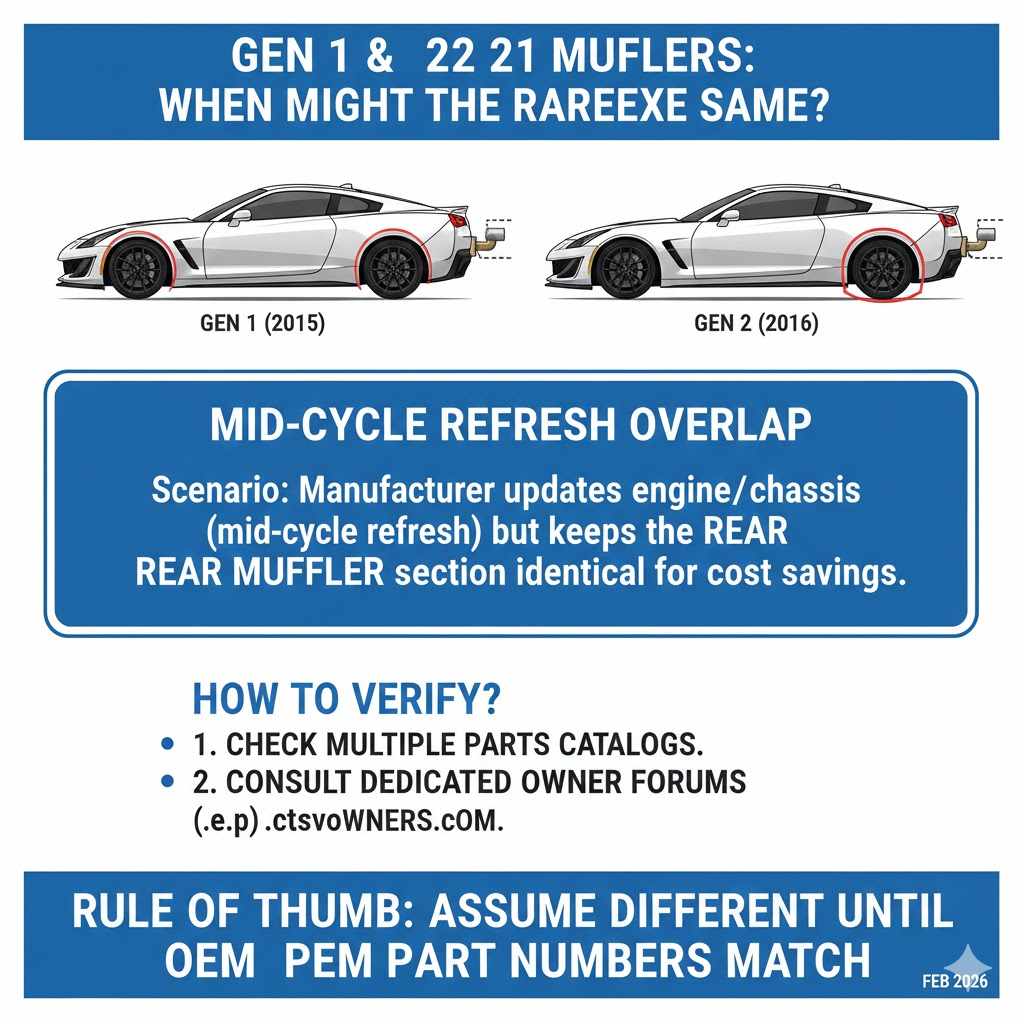
If a manufacturer significantly updated an engine or chassis mid-cycle (a “mid-cycle refresh” or facelift), sometimes they only update the front half of the exhaust system (like the manifold or catalytic converter) but keep the muffler section under the rear seat identical for cost savings.
If you are looking at two model years that are very close—say, a 2015 and a 2016—and both fall within what some enthusiasts consider the “late Gen 1” or “early Gen 2” transition period, there is a slight chance of overlap. However, this usually requires checking multiple parts catalogs or consulting dedicated owner forums, like ctsvowners.com might do for specific high-performance models, to find concrete proof of shared part numbers.
The rule of thumb remains: Assume they are different until verified otherwise by matching OEM part numbers.
Frequently Asked Questions (FAQ) About Exhaust Generations
Q1: If my Gen 1 muffler visually looks identical to the Gen 2 muffler, can I just use it?
A: Even if they look identical externally, the internal baffling or the exit pipe length is almost certainly different. It’s not worth the risk of poor performance or improper hanging. Always verify dimensions or part numbers.
Q2: Can I use a universal muffler instead of a generation-specific one?
A: Yes, but it requires cutting and welding. Universal mufflers don’t bolt right in. This is an upgrade path that requires welding skills and tools. For a simple replacement, always choose a direct-fit model labeled for your specific generation and year.
Q3: How do I know if my muffler is causing a performance problem?
A: If your car feels sluggish, doesn’t rev up freely, or you hear a loud booming drone at cruising speeds, an incorrect or failing muffler might be the cause. A restricted muffler acts like a cork in the engine’s ability to exhale.
Q4: Are Gen 1 and Gen 2 exhaust pipes (mid-pipe/resonator) the same?
A: Generally, no. Since the Gen 2 chassis often moves the transmission or suspension components, the routing of the exhaust piping leading up to the muffler is usually updated, meaning the mid-pipes will also differ between generations.
Q5: If I buy a Gen 2 muffler for my Gen 1 car, will it cause damage?
A: Using the wrong generation muffler can cause problems. If the Gen 2 muffler is too restrictive for your Gen 1 engine, it can cause overheating or power loss. If it doesn’t mount correctly, it can rub against the drive shaft or frame, leading to premature failure or dangerous rattling.
Q6: What is the easiest way to guarantee I buy the correct replacement muffler?
A: The easiest way is to look up the OEM part number for your specific vehicle using the VIN. Then, when shopping aftermarket, find a product explicitly listing your exact year, make, and model as compatible.
Q7: Does this generational difference apply to catalytic converters too?
A: Absolutely. Catalytic converters are tied directly to the engine management system and emissions standards. A Gen 1 catalytic converter will almost certainly have different upstream/downstream sensor bungs, flow requirements, and mounting points compared to a Gen 2 unit.
Conclusion: Confidence in Your Exhaust Choice
Navigating automotive parts can feel like learning a secret language, but the core concept behind Gen 1 versus Gen 2 mufflers is straightforward: engineering evolves. Automakers rarely keep major components like mufflers identical across significant model redesigns because the chassis, engine tuning, and safety requirements all change.
As your trusted guide, my final advice is to always prioritize exact fitment over perceived similarity. Invest the extra few minutes needed to confirm your VIN or check the manufacturer’s cross-reference charts. By focusing on pipe diameter, mounting bracket location, and confirmed part numbers, you eliminate the guesswork.
Choosing the right muffler guarantees your car sounds the way it should, performs efficiently, and remains safely mounted under the vehicle for years to come. You now have the knowledge to confidently select the correct exhaust component for your vehicle, regardless of its generation!
Related pick: Check today's price on Amazon