Are Loud Mufflers Illegal New York: Essential Guide
Yes, excessively loud mufflers are illegal in New York State. New York Vehicle and Traffic Law strictly regulates noise levels. If your muffler makes your car too loud, you risk getting a “ticket” or a mandatory repair notice. Keep your exhaust system quiet and compliant to avoid fines and hassles.

FortisArc
2.25" ID Center/Center Single Chamber Muffler Pair…
- Dual Pack Value: Two high-performance mufflers for enhanced exhaust upgrades on trucks and pickups.
- Aggressive Acoustics: Single-chamber design with internal baffles delivers a deeprumbling tone for an authoritative road presence.
- Durable Construction: Aluminized steel core with silver spray finish resists corrosion and extends lifespan in harsh conditions.
As an Amazon Associate I earn from qualifying purchases.
When you hear that deep rumble from a passing car, you might love it or hate it. But if you live in New York, you might wonder if that rumble is actually breaking the law. Dealing with car noise can be confusing, especially when you just want to enjoy driving your vehicle. Many car owners are unsure about the exact rules regarding exhaust volume in New York State. Don’t worry; understanding these rules is simpler than you think. We will walk through exactly what the law says, what noise levels are acceptable, and how to keep your exhaust system sounding great without getting a ticket. Let’s clear up the confusion so you can drive with confidence.
Understanding New York’s Stance on Loud Mufflers
It is a common question: Are loud mufflers illegal in New York? The short answer, as stated above, is yes, if they exceed established legal limits. New York State takes vehicle noise seriously to maintain quality of life for residents. This isn’t just about being grumpy neighbors; it’s about public safety and environmental concerns established by law.
As your automotive guide, Monowar Shohag, I want to make sure you understand the specific laws. You don’t need to be a lawyer to keep your car street-legal. We focus on clarity so you can maintain your vehicle safely and legally.
The Law: New York Vehicle and Traffic Law (VTL)
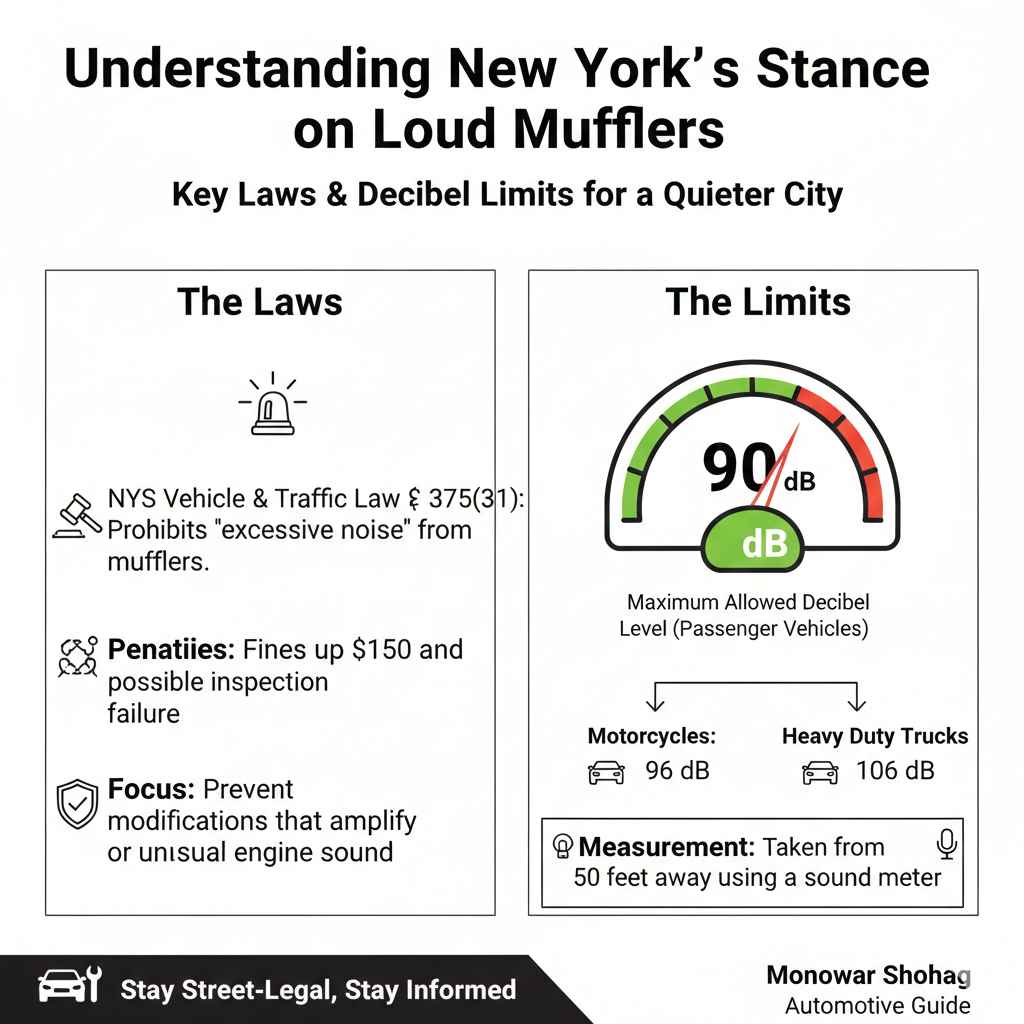
The primary legal foundation governing vehicle noise in New York comes from the Vehicle and Traffic Law (VTL). Specifically, Section 387 addresses exhaust systems and noise levels. This law focuses on preventing vehicles from being equipped with devices that make excessive noise.
What Does VTL Section 387 Say?
The VTL generally states that a vehicle must be equipped with a muffler or other device that lessens or muffles the sound of its exhaust to prevent excessive or unusual noise. The law is written to prohibit modifications that make the exhaust system louder than necessary for proper operation.
Key takeaways from the VTL regarding mufflers include:
- Muffler Requirement: Every vehicle must have a muffler in good working order.
- No Excessive Noise: The muffler must prevent the escape of excessive or unusual noise.
- No Bypassing: It is illegal to remove or bypass the muffler or install straight pipes that defeat the muffler’s purpose.
For more detailed information directly from the source, you can always refer to the official New York State laws. Understanding these foundational laws helps set the stage for what constitutes a “loud” muffler.
Measuring Loudness: Decibel Limits in New York
The term “too loud” needs a specific number to be truly meaningful. New York law doesn’t just say “quiet”; it sets measurable standards. While the law is enforced by police officers who rely on their judgment, there are generally accepted standards relating to decibel (dB) readings.
While specific decibel limits can sometimes be interpreted differently based on vehicle type and year, the general enforcement standard aims to keep noise below comparable factory levels, often aligning with standards used by the Department of Environmental Conservation (DEC) or national guidelines.
Decibel Ranges Explained for Beginners
To give you a simple frame of reference, here is how different noise levels relate to everyday sounds. This helps put the legal limits into perspective:
| Sound Level (Decibels) | Example Sound | Legal Implication in NY |
|---|---|---|
| 30–40 dB | Quiet library, whisper | Very safe and legal |
| 60–70 dB | Normal conversation, office noise | Generally acceptable for standard traffic noise |
| 85–90 dB | Lawnmower, heavy city traffic | Where enforcement often begins to focus |
| 100+ dB | Loud motorcycle, power tools | Highly likely to draw attention and risk a ticket |
If your vehicle’s exhaust frequently measures above 90 dB during normal acceleration, you are definitely pushing the limits of what is considered legal in New York State.
When Does a Muffler Become “Illegal”?
You might have replaced your muffler for better performance or a deeper sound, only to get pulled over later. Here are the three main ways your exhaust system might cross the legal line in New York:
- Exceeding Decibel Limits: The exhaust system is simply too loud, even if it looks stock. This is common with aftermarket performance mufflers that are not designed for street legality.
- Missing or Damaged Muffler: If the muffler has rusted out, fallen off, or was intentionally removed (e.g., “muffler delete”), it is automatically illegal because it fails to muffle the sound.
- Improper Modifications: Installing devices specifically designed to amplify noise, like certain cut-outs or excessively loud resonators, violates the spirit and letter of VTL 387.
Remember, the key word is excessive. A slightly louder exhaust than stock is often overlooked, but a system that aggressively shouts over normal traffic will attract unwanted attention.
Practical Steps: How to Check if Your Muffler is Legal
If you are unsure about your current exhaust setup, don’t wait for a police officer to tell you. Taking proactive steps builds confidence and keeps your ride street-legal. Here is a simple, beginner-friendly approach to inspecting your system.
Step 1: Visual Inspection of the Exhaust System
You don’t need to lift the car immediately. Start with a walk-around. Look underneath your car while it’s safely parked (engine off!).
- Look for Rust and Holes: Are there any visible holes in the muffler body or the pipes leading to or from it? Even small pinholes can cause surprisingly loud leaks.
- Check Mounting Hardware: Are the pipes hanging low or vibrating against the chassis? Rattling parts can sound like a loud exhaust leak.
- Identify Aftermarket Parts: Do you recognize the muffler? If it’s a small, performance-style canister that looks much different than the large stock unit, it is a prime suspect for being too loud.
Step 2: The “Sound Test” (Self-Assessment)
This test requires a friend and a safe, private location, like an empty parking lot. Do not do this on a residential street.
- Have your friend stand about 50 feet away from the back of the car.
- Start the car and let it idle. Ask your friend if the sound seems significantly louder than a typical car idling.
- Have your friend stand near a sidewalk or building edge (where sound reflects) and ask them to judge the volume again.
- Have a second friend drive by slowly (5–10 mph) and then accelerate slightly (without speeding). Does the sound seem jarring or overly aggressive compared to other vehicles?
If both friends agree it sounds excessively loud at idle or under light acceleration, it’s time to consider modifications.
Step 3: Professional Decibel Testing (The Definitive Check)
The most certain way to know is to have a professional shop or inspection station measure the noise output. Some repair shops or specialized inspection centers have calibrated sound meters. While this isn’t a state-mandated inspection unless prompted by a violation, paying a small fee for a reading can save you a larger ticket later.
When searching for inspection locations, sometimes municipal maintenance garages or specialized auto tuning shops might be willing to provide a quick decibel check using calibrated equipment recognized by the Environmental Protection Agency (EPA) standards as a reference point for comparison.
Tools You Might Need for Simple Checks:
- Flashlight (for visual inspection underneath)
- A friend or two (for the sound test)
- Duct tape (temporarily for very small leaks, but never a permanent fix!)
- A smartphone sound meter app (useful for rough estimation, but not for court evidence)
Muffler Upgrades and Maintaining Compliance in New York
Many drivers want to upgrade their mufflers for better engine breathing or a different sound. The key is choosing parts designed with street legality in mind. Performance doesn’t have to mean illegal noise.
Choosing Street-Legal Aftermarket Mufflers
When shopping for a new muffler, always look for descriptions that specifically mention compliance with US street regulations or CARB (California Air Resources Board) compliance, as these often meet stricter national standards that New York generally follows.
Here are characteristics of performance mufflers that are usually safe:
- Chambered or Baffled Design: These use internal structures to manage sound waves effectively while improving flow, often resulting in a deeper, but not overwhelmingly loud, tone.
- Resonators Included: Many performance systems include a resonator—a secondary chamber designed to cancel out specific, annoying frequencies (like drone) without significantly restricting flow.
- OEM+ Sound Profile: Look for mufflers advertised as “mild tone” or “subtle enhancement” rather than “race loud.”
The Problem with “Muffler Deletes”
A “muffler delete” involves cutting out the factory muffler and replacing it with a straight piece of pipe. While this is the cheapest way to increase exhaust volume, it is one of the fastest ways to violate VTL 387 in New York. The factory muffler is specifically engineered to meet legal noise standards. Removing it leaves you with zero sound dampening, guaranteeing excessive noise.
Table: Aftermarket Muffler Choices and Noise Implications
| Muffler Style | Typical Sound Level | Legality Risk in NY | Best For |
|---|---|---|---|
| OEM Replacement (Stock Style) | Very Low (Quiet) | Very Low | Quiet, reliable commuting |
| Chambered/Absorptive Performance | Medium (Deeper Tone) | Low to Medium (Depends on size) | Mild performance gains, respectable sound |
| Straight Pipe/Muffler Delete | Extremely High (Very Loud) | High (Almost always illegal) | Track use only, not street driving |
| High-Flow Racing Muffler | Medium to High | Medium (Needs careful measurement) | Enthusiasts seeking a balance |
Dealing with Exhaust Leaks
Sometimes, your muffler isn’t illegal because of what it is, but because of how it’s attached. A crack in a pipe or a failed gasket creates an exhaust leak. This leak is often louder than the muffler itself and can quickly lead to a “failure to maintain required equipment” citation.
How to Address a Leak Safely:
- Safety First: Never work under a car supported only by a jack. Use sturdy jack stands rated for your vehicle’s weight.
- Locate the Leak: With the engine running (and you standing far away from the exhaust stream), listen carefully. You might hear a distinctive “ticking” or “puffing” sound, especially near joints or clamps.
- Temporary Fixes: For a very small crack, high-temperature exhaust repair putty or specialized muffler wrap can provide a temporary seal until you can get to a shop.
- Permanent Repair: A professional mechanic will typically cut out the damaged section and weld in a new piece of pipe, or replace the entire failing component (like the muffler or resonator).
What Happens If You Get a Ticket for a Loud Muffler in New York?
Receiving a citation for an illegal exhaust is frustrating, especially if you thought your setup was fine. Understanding the consequences helps you prepare for the next steps.
The Appearance Ticket vs. the Violation Order
In New York, you might receive two types of notifications:
- Appearance Ticket: This requires you to appear in court on a specific date to answer the charge.
- Fix-It Ticket (or Warning Notice): Often, for non-moving equipment violations like a loud muffler, an officer might issue a ticket that is dismissed if you have the necessary repair verified by an inspection within a set timeframe (usually 30 days). This is often called a “blue envelope” violation.
Regardless of the ticket type, the goal is to fix the issue.
The Court Process and Penalties
If you have to go to court, be prepared. The judge will generally ask if you have corrected the violation. If you have proof of repair (a receipt from a certified mechanic showing the installation of a legal muffler) and the car passes inspection, the ticket is often dismissed, though you may still have to pay court administrative fees.
If you do not fix the issue and plead guilty or are found guilty, you face fines. Fines vary by jurisdiction (town, city, or state court), but they can range from $50 up to several hundred dollars, plus mandatory surcharges.
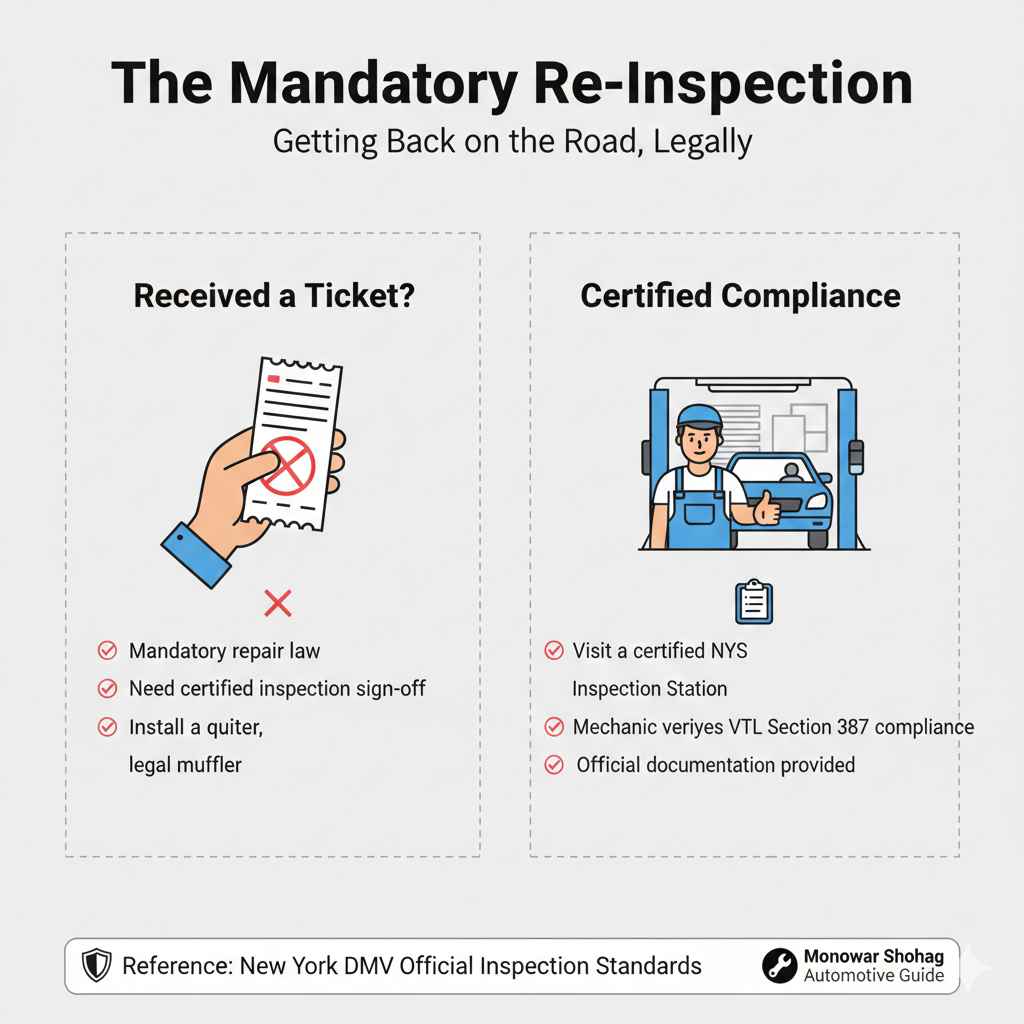
The Mandatory Re-Inspection
If you receive a ticket under New York’s mandatory repair law framework, you will need a certified inspection station to sign off that your vehicle now complies with VTL Section 387. This often requires installing a quieter, legal muffler if you previously had an illegal setup.
For reference on safety and equipment regulations, the New York DMV provides official inspection standards that mechanics follow, which include exhaust system compliance.
Frequently Asked Questions (FAQ) for New York Drivers
Q1: Can I just put a universal, cheap muffler on my car to pass inspection?
A: While a cheap muffler will technically muffle sound, it might not meet the required flow characteristics, potentially causing performance issues. For reliability and to avoid repeat tickets, it is best to install a muffler that is specifically designed and rated for street use on your vehicle type.
Q2: Does my motorcycle have different muffler laws than my car in New York?
A: Yes and no. The VTL Section 387 applies to all motor vehicles, including motorcycles. Motorcycles are often scrutinized more closely because aftermarket modifications are very common. If your motorcycle is excessively loud, it is illegal, regardless of whether it has two wheels or four.
Q3: If I install a brand-new, expensive performance muffler, can I still get a ticket?
A: Yes. If the performance muffler is excessively loud, even if new and expensive, it violates the VTL against excessive noise. The legality is based on the resulting sound level, not the price tag of the part.
Q4: What is the difference between a muffler and a resonator?
A: A muffler reduces the overall volume of the exhaust sound. A resonator is typically smaller and placed before or after the muffler. Its job is to cancel out specific, irritating sound frequencies (like high-pitched drone) to create a smoother sound profile, even if the muffler itself is somewhat loud.
Q5: Is it illegal to remove the catalytic converter in New York?
A: Yes, absolutely. Removing a catalytic converter is illegal under both federal environmental law (Clean Air Act) and New York State law, as it is a required emission control device. This carries much stiffer penalties than just a loud muffler.
Q6: Do cops in New York use a handheld decibel meter when pulling people over?
A: Sometimes, yes. While officer judgment based on hearing is often the initial trigger, officers can use calibrated sound level meters to establish evidence if they choose to pursue the citation rigorously in court.
Q7: If my muffler is only loud when I accelerate hard, is that still illegal?
A: Yes. The law prohibits “excessive” noise, which includes noise generated during normal operation or acceleration. If the sound level spikes significantly above ambient traffic noise when you press the gas pedal, it can be deemed illegal.
Conclusion: Driving Quietly and Confidently in the Empire State
Navigating vehicle equipment laws in New York doesn’t have to feel like a guessing game. The core message about are loud mufflers illegal in New York is clear: any modification that results in excessive or unusual noise violates Vehicle and Traffic Law Section 387. This means your stock muffler is legal until it rusts or leaks, and most aftermarket mufflers are legal as long as they keep the volume within reasonable bounds.
As your trusted automotive guide, my advice is always to err on the side of caution. If you love a deeper tone, invest in reputable, street-legal performance parts that include resonators or advanced baffling technology. Always inspect your system regularly for leaks, as a small hole can turn a legal sound into a violation ticket overnight. By being proactive with maintenance and choosing your parts wisely, you can enjoy your vehicle performance while respecting New York’s noise regulations. Drive safe, drive smart, and keep that rumble legal!
Related pick: Check today's price on Amazon