Why Does My Exhaust Smell Stronger After Rain?
Your exhaust often smells stronger after rain because wet roads, damp air, and road spray can push fumes toward the cabin or make an existing leak, rust spot, or crack easier to notice. This guide shows the most likely causes, quick checks, and when to stop driving.
Why rain makes exhaust odor stand out

Rain usually changes how you notice an exhaust problem, not whether the problem exists. Weather conditions around the car can affect how fumes and odor move, underbody spray can change the path of escaping exhaust, and wet pavement can reflect smell toward open windows or the cabin intake. A short-trip exhaust that never fully heats up can make that effect more noticeable after rain.
Humidity changes how odors travel
Moist air does not create exhaust gas. It can make an existing smell easier to detect because weather conditions around the car can affect how fumes and odor move near the vehicle. If the odor gets stronger after rain but fades as the car dries, that points to a pre-existing source that wet weather exposes.
Wet weather can expose an existing exhaust issue
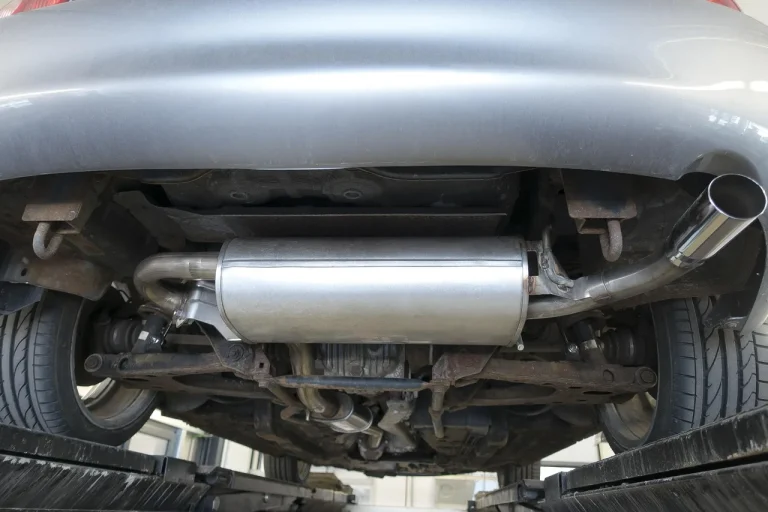
The first mechanical suspect is an exhaust leak. Common leak points often include the flex pipe, flange, manifold gasket, muffler seams, and tailpipe joints. Small leaks can sound like ticking on cold start and can smell stronger when moisture, temperature change, or underbody spray makes the escaping fumes easier to notice.
Why short trips make the effect worse
Short-trip driving leaves more condensation in the exhaust system. If the car is shut off before the exhaust gets fully hot, moisture can stay in the pipes and muffler, then mix with soot and road residue. After rain, that leftover moisture can make odor linger longer, especially after repeated cold starts.
Exhaust leak signs after wet weather
An exhaust leak can become more obvious after rain because water changes the way sound and fumes move around the underbody. Look first at the flex pipe, manifold gasket, flange connections, muffler seams, and tailpipe joints. If the smell is strongest near the front of the car, under the cabin floor, or beside the rear bumper, those are useful clues.
What ticking, soot, and fumes mean
A ticking or puffing sound on cold start often points to escaping exhaust before the system heats and expands. Black soot around a joint, rust trail, or flange is another clue. If you can smell exhaust near the cabin or underbody while the car is idling, treat that as more than a weather nuisance.
Why a leak can smell stronger near the cabin
Exhaust fumes can move into the cabin through floor openings, the HVAC intake, or small pressure changes around the body. At idle and in traffic, the car moves less air under its own motion, so fumes can hang around the vehicle longer. A leak near the manifold or front pipes is especially important because it sits closer to the HVAC intake path.
- Start with a cold visual check. Look under the car before the engine fully warms up. Focus on the flex pipe, flange joints, manifold area, muffler seams, and tailpipe connections for soot, rust holes, missing hardware, or fresh wet marks that do not match road splash.
- Listen at idle. With the car parked safely outdoors, start it and listen for a light ticking, puffing, or sharp chuffing sound. Those noises often show up before the leak becomes large enough to leave obvious soot.
- Check smell location. Stand near the front, middle, and rear of the car, staying clear of moving parts and hot surfaces. A smell that is strongest near one joint or under one floor section helps narrow the source.
Water in the exhaust system
Some condensation is normal, especially after short trips and wet weather. Water vapor from the tailpipe does not automatically mean trouble. The concern starts when moisture is trapped, drainage is blocked, or corrosion inside the muffler or tailpipe lets the exhaust smell get stronger instead of fading after the system dries.
Normal condensation versus trapped moisture
Visible vapor on a cool, damp day is often normal. That vapor should thin out as the exhaust heats up. A persistent odor after the car dries may point to a leak, trapped water in the muffler, or corrosion. If the car keeps smelling like exhaust after the visible vapor is gone, the issue is more likely a leak, trapped water in the muffler, or corrosion that has opened a path for fumes.
Blocked drainage, rust, and muffler corrosion
Tailpipes and mufflers are designed to shed condensation. If drainage is blocked, water can sit in the exhaust system longer than it should. Rust flakes, soft seams, or pinholes in the muffler can let exhaust smell change after rain because water and heat cycles have weakened the metal.
When visible vapor is harmless
Vapor alone is usually harmless when it disappears quickly, there is no ticking or puffing, and the odor fades as the car warms up. If the white plume lingers but smells like plain steam rather than exhaust, the issue may be normal condensation. The warning sign is a persistent fuel-like, sulfur-like, or burned smell that keeps returning.
Can the catalytic converter cause it?
Yes. A failing or overloaded catalytic converter can amplify sulfur or rotten-egg odor, and wet weather may make that smell easier to notice. If the smell repeats after dry weather too, the converter deserves attention.
Sulfur or rotten-egg odor
A strong rotten-egg or sulfur smell often points toward the catalytic converter or fuel-control problems that are stressing it. Rain does not create that odor, but wet conditions can make it easier to notice. If the smell repeats after dry weather too, the converter deserves attention.
P0420-related clues
A P0420 fault code usually means the catalyst efficiency is below the expected range. That may come with a check engine light, reduced fuel economy, or a smell that seems sharper after cold, wet starts. The code does not prove the converter is the only issue, but it does move the converter higher on the list.
When reduced efficiency shows up after rain
A marginal converter may not process exhaust as cleanly when the system is still cold, damp, or splashed from below. That can make odor more obvious right after rain or after short trips. If the smell is sulfur-like and the vehicle also has a drivability complaint, the problem needs a proper scan and inspection.
Exhaust smell and the cabin air intake
The cabin air intake can pull outside air into the vehicle, and that air can carry exhaust odor if the source is near the front of the car or trapped in traffic. Fresh-air HVAC mode, idle, and slow traffic often make the smell stronger because the vehicle is less able to push fumes away from itself.
Why fresh air mode can pull in fumes
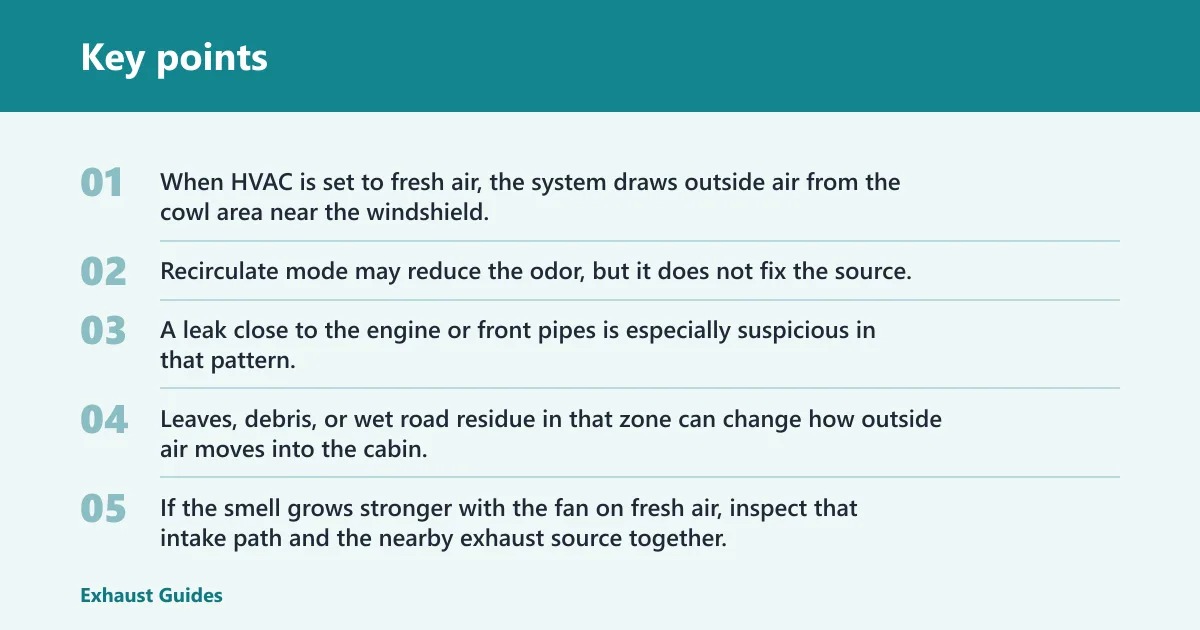
When HVAC is set to fresh air, the system draws outside air from the cowl area near the windshield. If exhaust fumes are drifting up from below or pooling near the front of the car, the intake can bring them into the cabin. Recirculate mode may reduce the odor, but it does not fix the source.
Why idle and traffic make it worse
At idle and in traffic, exhaust flow and vehicle motion change, and fumes can linger around the car instead of being carried away. That is why a cabin smell may be strongest when stopped at a light, creeping in traffic, or waiting in a parking lot. A leak close to the engine or front pipes is especially suspicious in that pattern.
Why the windshield cowl area matters
The windshield cowl sits close to the cabin intake on many vehicles, so that area matters when you are tracking odor entry. Leaves, debris, or wet road residue in that zone can change how outside air moves into the cabin. If the smell grows stronger with the fan on fresh air, inspect that intake path and the nearby exhaust source together.
Rain-triggered exhaust smell triage
This table helps separate a harmless wet-weather clue from a problem that needs inspection. Start with the symptom pattern, then match it to the likely cause and the next check. The goal is to sort temporary moisture, airflow effects, and real exhaust faults without guessing.
| Symptom pattern | Likely cause | Next check |
|---|---|---|
| Smell only during or after rain | Wet roads, underbody spray, or humidity exposing an existing leak | Inspect flex pipe, flange joints, manifold gasket, muffler seams, and tailpipe joints for soot or wet traces |
| Smell lasts after drying | Exhaust leak, rust-through muffler, trapped moisture, or failing catalyst | Check for persistent odor, corrosion, and any check engine light or P0420 code |
| Smell strongest at idle | Leak near the front of the exhaust or fumes entering through airflow paths | Listen for ticking at cold start and sniff near the front of the car, away from hot parts |
| Smell with HVAC fresh air on | Cabin air intake pulling fumes from outside | Switch to recirculate briefly; inspect the cowl area and source of fumes under the car |
| Visible condensation only | Normal short-trip moisture or a cold exhaust on a damp day | Watch whether vapor fades as the exhaust warms and whether any odor remains after that |
| Sulfur or rotten-egg odor | Catalytic converter problem or fuel-control issue | Check for P0420-related symptoms, drivability changes, and reduced conversion efficiency |
When to stop driving and get it checked
Stop and inspect soon if the smell stays after the car dries, comes with ticking, or shows up every time the engine starts cold. Treat the odor as urgent if fumes enter the cabin, the smell is strongest at idle or with HVAC on fresh air, or you notice a sulfur smell with drivability symptoms.
An exhaust odor inside the cabin may be a safety issue and is worth a closer inspection before driving much more. Carbon monoxide is not something to guess about. If the smell is strong enough to make you roll the windows down, turn off the HVAC, or avoid sitting in the car, the vehicle needs a closer look before more driving.
- Reduce exposure first. If fumes are entering the cabin, switch off fresh air, open windows only if needed for ventilation, and avoid long idle periods. This is a short-term move so you can get the car to a safer place.
- Check the smell pattern. Note whether the odor happens only after rain, after every drive, or mainly at idle. That pattern helps separate wet-weather exposure from a steady exhaust fault.
- Inspect the likely source. Look at the exhaust leak points, drainage areas, and the cabin intake path. If you see soot, rust holes, muffler damage, or repeated sulfur odor, arrange a professional inspection soon.
Suppose a hatchback smells faintly of exhaust only after a storm, but the smell disappears once the car sits in the sun for an hour. That pattern leans toward wet-weather exposure or moisture trapping. If the same hatchback smells stronger at every stoplight the next day, the issue has moved beyond rain as a clue.
Frequently asked questions
Why does my exhaust smell stronger after rain?
Rain often makes an existing exhaust problem easier to notice. Wet roads, humidity, and underbody spray can move fumes toward the cabin or reveal a leak, corroded seam, or weak gasket. If the smell fades when the car dries, moisture is probably acting as a clue, not the root cause.
Is it normal for exhaust smell to change after wet weather?
It can be normal for the odor to seem different in damp weather, especially after short trips. What is not normal is a smell that stays strong after drying, repeats at every stop, or enters the cabin. Those patterns point to a leak, corrosion, or airflow issue that needs inspection.
Can rain make an exhaust leak smell worse?
Yes. Rain can make a leak easier to detect because wet weather changes how fumes move around the car. Common leak points are the flex pipe, flange, manifold gasket, muffler seams, and tailpipe joints. A small leak may smell stronger even when the damage itself has not changed.
What does after rain smell like in a car?
If you mean exhaust odor, it may smell like burned gas, a sulfur note, or a sharp metallic exhaust smell. If the odor is only visible vapor without a lasting smell, that can be normal condensation. A persistent smell inside the cabin deserves a closer look than a brief puff at startup.
Why can you smell rain coming in a vehicle?
You usually are not smelling rain itself. You are smelling outside air, wet road residue, or fumes that are entering through the cabin intake or open airflow paths. If the odor is strongest with HVAC on fresh air, the intake near the windshield cowl may be pulling in the smell from outside.
Does humidity make exhaust fumes easier to notice?
Yes. Humidity can change how odors travel and how noticeable they feel, without being the source of the problem. If the odor tracks with weather but returns in dry conditions too, the exhaust system needs attention.