How to Tell If an Exhaust Manifold Gasket Is Blown
A blown exhaust manifold gasket usually shows a ticking cold-start leak, soot at the manifold joint, and a noise change when you probe near the flange. Check for cracked manifolds and warped faces before you buy parts. Ignoring it can raise noise, trigger lean codes, and turn a simple seal job into a broken-stud repair. Trace the leak source step by step, then separate gasket failure from flange leaks, cracks, and warpage.
What you’ll need

- Includes feeler gauge for flatness checks
- Ground edges for engine surface inspection
- Heat-treated S50C steel construction
- Flashlight
- Inspection mirror
- Gloves and eye protection
- Penetrating oil
- Torque wrench
- Machinist straightedge and feeler gauges
- Socket set and extensions
- Pick or small brush for cleaning gasket surfaces
- New exhaust manifold gasket or flange gasket, matched to the engine side
How do you tell if an exhaust manifold gasket is blown?
A blown gasket usually gives you cold-start ticking, a hot exhaust smell near the engine bay, and soot at the manifold joint. Watch the pattern, not one symptom alone. If the noise changes with heat or load, and the soot sits exactly where the manifold meets the head, the gasket moves up the list.
Cold-start ticking and tapping
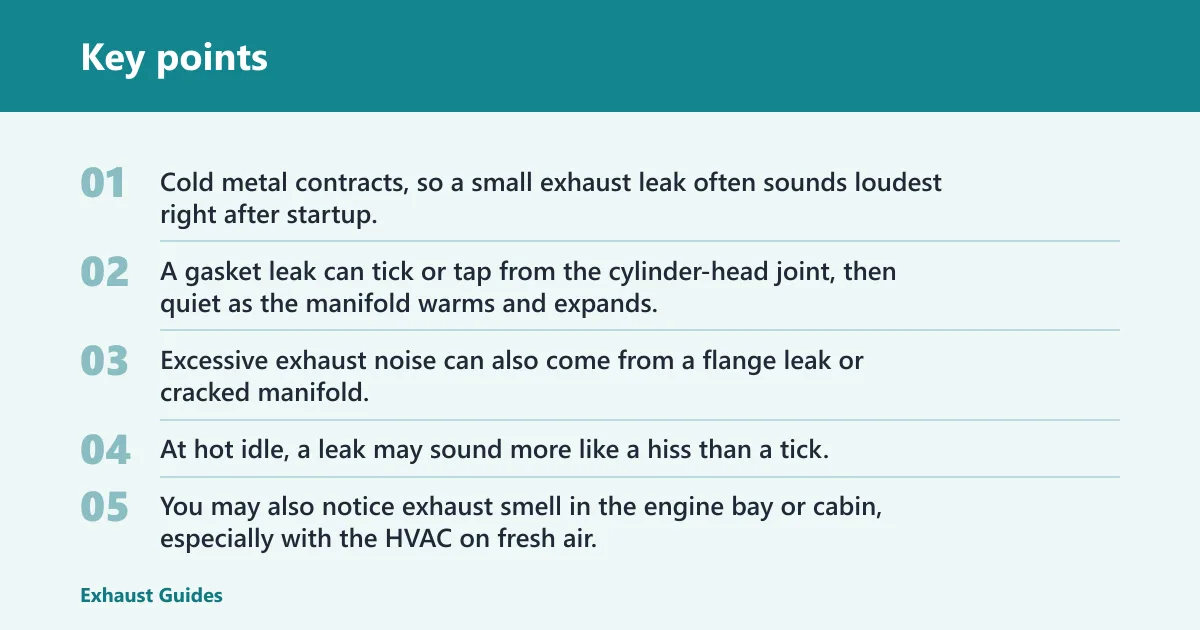
Cold metal contracts, so a small exhaust leak often sounds loudest right after startup. A gasket leak can tick or tap from the cylinder-head joint, then quiet as the manifold warms and expands. Excessive exhaust noise can also come from a flange leak or cracked manifold.
Hot idle hissing and exhaust smell
At hot idle, a leak may sound more like a hiss than a tick. You may also notice exhaust smell in the engine bay or cabin, especially with the HVAC on fresh air. Treat that smell cautiously and avoid lingering around the fumes while you inspect.
Soot, burn marks, and noise changes
Look for black soot at the manifold joint and a change in noise as the engine heats up or is put under load. If the leak gets quieter as the manifold expands, the seal is often opening and closing with temperature.
Manifold gasket diagnostic matrix
| Symptom | Likely leak source | Quick confirmation check | Next action |
|---|---|---|---|
| Cold-start ticking | Exhaust manifold gasket | Listen right after startup, then again after warm-up; note whether the tick fades as the manifold expands | Inspect gasket joint, then check for soot and flange witness marks |
| Hot idle hissing | Flange leak or gasket leak | Check the pipe-to-manifold joint and the head seam separately with the engine idling | Confirm exact source before removing the manifold |
| Exhaust smell | Leak near the manifold, flange, or a nearby crack | Sniff around the engine bay and cabin intake area; look for staining at the closest joint | Inspect the nearest sealing face and heat-shield area first |
| Visible soot at the flange | Exhaust flange gasket or clamp joint | Look for soot around the pipe-to-manifold connection and any clamp or gasket there | Replace the flange gasket if that joint is the source |
| Noise changes with load or temperature | Warped manifold, loose fastener, or crack | Compare cold and hot idle, then inspect studs and the manifold face after removal | Check for warping, damage, or broken studs before installing parts |
Is it the flange, not the gasket?
Yes, often it is. A flange leak near the pipe-to-manifold joint can sound and smell like a bad manifold gasket, and the clamp at that joint may use a gasket that should be replaced. If the soot is centered on the flange or clamp, do not order a manifold gasket first.
Flange soot and witness marks
Look for soot at the pipe-to-manifold joint, then check for bright or clean witness marks where the parts have moved against each other. A flange leak usually stains the joint itself, while a manifold gasket leak often leaves marks along the head seam. The location of the residue matters more than the noise.
Clamp, gasket, and joint checks
If the clamp is loose, bent, or rusted through, the joint may leak even with a fresh gasket. Replace the gasket under the clamp if the design uses one, and make sure the pipe sits fully in place before tightening. On some layouts, the pipe needs to move farther than it first appears.
Could the manifold itself be cracked or warped?
It could. A cracked manifold, a warped mounting face, or broken studs can imitate a gasket leak and keep a new gasket from sealing. Check the manifold for cracking or damage after removal, and use a straightedge and feeler gauges to check the face for warp.
Crack checks on the manifold body
Inspect around runners, welds, and bolt ears for hairline cracks, rust trails, and soot at the crack path. Hot cracks often open when the manifold expands, which is why a leak can seem worse after warm-up. If the crack reaches the sealing face, a gasket swap alone will not fix it.
Warping, broken studs, and heat shield access
Use a machinist straightedge across the sealing face in more than one direction, then check for gaps with feeler gauges. If the face rocks or leaves a visible gap, the manifold needs repair or replacement. Also check for loose, stretched, or broken studs, and remove the heat shield if it blocks a clear inspection.
What if the leak still is not obvious?
If the symptoms point in several directions, start with the least invasive confirmation. Exhaust leaks at the manifold area can overlap, especially on V-engines with tight access and multi-piece gaskets. Some engines use two or three gasket pieces, so the exact layout changes the repair path.
- Recheck the sound cold. Restart the engine cold and listen for the first 30 to 60 seconds, then compare it with hot idle. A leak that fades with heat points more strongly toward a sealing or warpage issue.
- Separate the joints. Inspect the head seam, the manifold body, and the pipe flange one at a time. If the evidence sits only on the clamp joint, start there instead of removing the manifold.
- Plan for access limits. On V-engines and tight bays, remove the heat shield and any blocking brackets before forcing the manifold out. Rushed removal often breaks studs, which is slower than replacing a gasket.
Common mistakes
- Assuming every tick is a manifold gasket. A flange leak, a cracked manifold, or a loose stud can sound similar.
- Skipping the cold-versus-hot comparison. A leak that quiets as the manifold warms points differently than a steady tick.
- Ordering parts from soot alone. Soot direction and the exact joint location matter.
- Removing fasteners dry. Soak penetrating oil on the fasteners for at least an hour, preferably overnight.
- Reusing a damaged flange gasket or bent clamp. The gasket under that joint should be replaced if the design uses one.
- Ignoring warpage. A new gasket will not seal a bent manifold face.
- Reinstalling without the torque wrench. Tighten the fasteners to the service-manual setting and use the engine-specific sequence.
Frequently asked questions
How to tell if an exhaust manifold gasket is bad
Look for a cold-start tick, soot at the manifold-to-head seam, and an exhaust smell near the engine bay. Then compare the head seam with the flange joint. If the sound fades as the engine warms, and the staining sits at the manifold face, the gasket moves to the top of the list.
How to tell if exhaust flange gasket is bad
Check the pipe-to-manifold connection for soot, black streaks, or a loose clamp. If the rest of the manifold seam looks clean but the flange is stained, the flange gasket is the likely source. Replace the gasket under that joint, then tighten the clamp only after the pipe is seated correctly.
How to check if exhaust manifold or gasket is bad
First compare cold-start noise with hot idle noise, then separate the manifold seam from the flange joint. Remove the heat shield if needed, inspect for cracks and broken studs, and use a straightedge and feeler gauges on the manifold face after removal. That sequence tells you whether the gasket, the manifold, or both need attention.
How do you know if your exhaust manifold gasket is bad?
You know it by pattern: ticking on startup, hiss at idle, exhaust smell, and soot at the seam where the manifold meets the head. A gasket leak often changes as parts heat and expand. If the evidence is at the flange or on a cracked manifold, the gasket is not the only issue.
What does a bad exhaust manifold gasket sound like?
It often sounds like a sharp tick or tap when the engine is cold, then a lighter hiss once it warms. The sound may rise and fall with throttle or load because exhaust pressure changes the leak opening. Excessive exhaust noise is a known clue, but the same sound can come from a flange leak.
What will a bad exhaust manifold gasket do?
It can make the exhaust louder, leak fumes near the engine bay, and leave soot around the joint. In some cases it can also contribute to lean running or noise that changes with temperature. If the manifold face is warped or cracked, the leak can return unless that defect is fixed too.