How to Make a Motorcycle Exhaust Louder
Start with leak checks, then remove the baffle or a removable dB killer, then move to a slip-on, and only fit a full system if you want the biggest volume jump and can handle jetting or ECU tuning. A bad setup can cause harsh drone, overheating, poor throttle response, and fines for noise-limit violations. This guide compares loudness, tone change, legal risk, and fueling steps for each option.
What changes sound at idle, cruise, and full throttle?



Less restriction, less packing, leaks, and intake or fueling changes all affect how loud a motorcycle sounds. The biggest jump in exhaust noise usually comes at wide-open throttle, while idle and steady cruise are more sensitive to fitment, packing condition, and drone than to peak output. U.S. motorcycle exhaust rules also require compliant mufflers and prohibit bypassing emission controls in many cases. EPA Air Enforcement FAQs
How exhaust noise usually builds
At idle, a louder setup often sounds deeper rather than dramatically louder. At cruise, resonance and cabin-like drone can become the main complaint. At full throttle, the volume jump is easiest to notice because exhaust gas flow rises sharply and the muffler has less time to absorb pulses.
What changes the note most
A slip-on changes the rear end of the system. A full exhaust changes headers, mid-pipe, and muffler, which is why it usually changes tone more dramatically. Intake mods can add roar under load, but they usually do not replace the exhaust note; they complement it.
What you’ll need
- Basic hand tools matched to your bike’s fasteners
- Hex keys, sockets, and torque wrench
- Penetrating oil for stubborn clamps or bolts
- Replacement exhaust gaskets, clamps, or crush rings if the system calls for them
- Muffler packing material if the can is repackable
- Service manual and torque specs
- Soapy water or another leak-check method
- Flashlight and heat-resistant gloves
- Fuel tuner access if your bike is fuel-injected and the setup needs it
Should you remove the baffle or dB killer?
Remove them only if you want more sound and the muffler is built for it. A baffle is an internal noise-control part, while a dB killer is usually a removable outlet insert. Either can raise volume, but both can also increase drone, sharpness, and legal risk if the bike is then outside local sound limits. 40 CFR Part 205
What each insert does
Baffles and dB killers both reduce exit noise, but they are not the same part. A baffle is part of the muffler’s internal layout. A dB killer is usually a removable insert at the outlet. Some aftermarket mufflers use both. Others use neither and rely on packing alone.
When removal is reversible or permanent
Reversible means the part can go back in without damage and without new leaks. Removal becomes messy when rivets, welds, or drilled holes are involved. Once the outlet is altered, restoring stock tone may require new hardware or a different can.
Noise, heat, and legality tradeoffs
Expect more sharpness and a stronger pulse at idle, more drone at cruise, and the biggest jump near full throttle. Street legality depends on local noise and emissions rules. A louder exhaust is not automatically legal just because the bike still runs clean. Many states and municipalities set specific sound and equipment requirements. NHTSA noise pollution overview
How do you make a motorcycle exhaust louder, step by step?
Start with leak checks, then move from the cheapest reversible changes to the bigger hardware swaps. The usual order is slip-on, repacking, removable insert removal, and finally a full system with fueling changes if needed. That sequence limits cost and helps you avoid fixing the wrong problem first. How to find and fix an exhaust leak
1) Check for exhaust leaks first
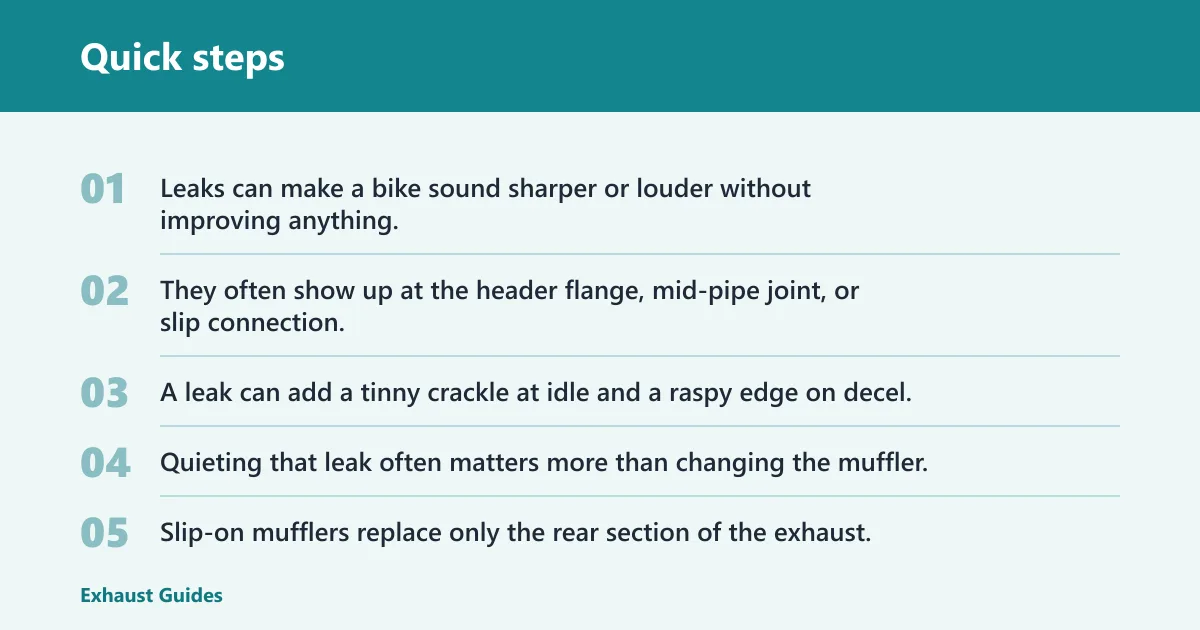
Leaks can make a bike sound sharper or louder without improving anything. They often show up at the header flange, mid-pipe joint, or slip connection. A leak can add a tinny crackle at idle and a raspy edge on decel. Quieting that leak often matters more than changing the muffler.
2) Try a slip-on muffler
Slip-on mufflers replace only the rear section of the exhaust. They are usually the easiest loudness upgrade because the job is straightforward and reversible, and the result is often a deeper tone with a modest to moderate volume increase. On some bikes the change is mostly character, not raw loudness. Motorcycle exhaust guide
3) Service or replace muffler packing
Muffler packing is the sound-absorbing material inside many cans. It burns out or wears over time, and repacking can restore a quieter, more controlled tone. This is useful when the bike has turned metallic, hollow, or overly sharp from age rather than from a new modification.
4) Remove a removable baffle or dB killer
If the can is designed for it, removing the insert can take the bike from mildly louder to clearly loud. Expect the strongest change under load, plus more drone on longer rides. If the outlet is no longer serviceable afterward, the change may be effectively permanent.
5) Move to a full exhaust system
A full exhaust system includes headers, mid-pipe, and muffler. It is usually louder and more aggressive than stock, and it can change the sound at all throttle positions. The low-end pulse often gets stronger, and the top end can sound far more open.
6) Add a high-flow air filter if you want intake changes too
A high-flow filter or intake kit mostly changes intake noise rather than exhaust volume. It can make the bike sound throatier under load, but it is not a substitute for exhaust work if the goal is a bigger pipe note. It is best treated as part of a matched package with fueling.
7) Tune fueling on injected bikes when needed
Fueling changes do not make the bike louder on their own. They shape how the new exhaust sounds under load and whether it feels crisp or rough. On fuel-injected bikes, a tune or ECU flash may be needed after a full exhaust or exhaust-plus-intake setup to avoid lean running, surging, popping, or hot running. ECU flash tuning vs fuel manipulator
How loud is each mod?
The roughest way to compare exhaust changes is by dB direction, not exact numbers. A leak fix can lower unwanted harshness, a slip-on is usually a small-to-moderate increase, insert removal is moderate-to-large, and a full system is the biggest jump. Legality risk rises with every step, especially if emissions equipment is removed. Motorcycle emissions information
| Mod type | Typical volume change | Tone change | Install difficulty | Reversibility | Tuning need | Common risk or failure mode |
|---|---|---|---|---|---|---|
| Fix exhaust leaks | Can reduce unwanted sharpness more than it adds volume | Smoother, less raspy | Low to moderate | High | None | Missed gasket, loose clamp, cracked header |
| Slip-on muffler | Small to moderate | Deeper or cleaner, sometimes only slightly louder | Low | Usually high | Sometimes | Poor fitment, leaks, hanger stress |
| Repack muffler | Restores lost quieting; may reduce harshness | Less tinny, more controlled | Moderate | High | None | Packing burns out again over time |
| Remove baffle | Moderate to large | More open, more drone risk | Low to moderate | Varies | Sometimes | Permanent changes, hot outlet, legal trouble |
| Remove dB killer | Moderate | Sharper, louder edge | Low | Often high | Sometimes | Harsh volume, lost hardware, borderline street legality |
| Full exhaust system | Large | Louder and more aggressive | Moderate to high | Lower | Often yes | Fitment errors, heat, lean running, resonance |
| High-flow air filter | Small direct exhaust change; more intake noise | More intake roar under load | Low to moderate | High | Sometimes | Dirty filter service, combined fueling shift |
| Fuel tuner | No direct volume gain | Can smooth or sharpen the sound under throttle | Moderate to high | High | Built for the change | Bad map, poor throttle response, extra complexity |
What are the safety and legal issues?
Keep emissions compliance, local sound limits, and rider safety in the same decision. A louder exhaust can create hearing fatigue, hot metal burn risk, and unwanted attention from police or inspections. Straight-piping or drilling a can is usually a poor street choice because it often adds harshness more than usable performance, and it can violate noise or emissions rules. CDC hearing loss from loud noise
Emissions compliance matters
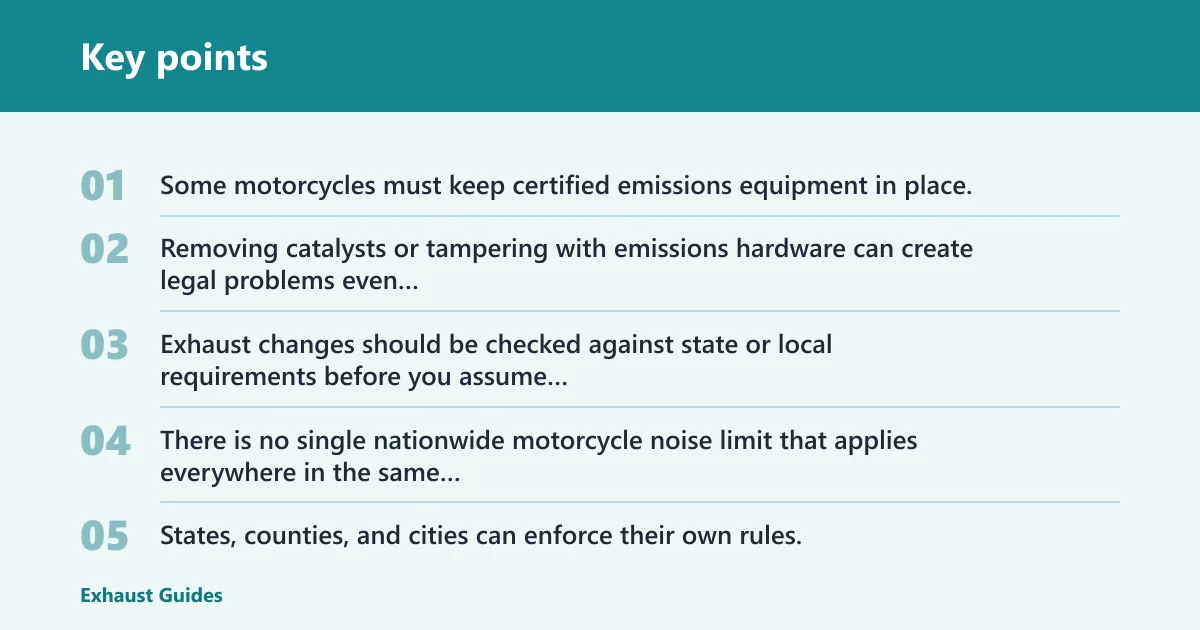
Some motorcycles must keep certified emissions equipment in place. Removing catalysts or tampering with emissions hardware can create legal problems even if the bike still runs well. Exhaust changes should be checked against state or local requirements before you assume the setup is street-legal.
Sound limits vary by location
There is no single nationwide motorcycle noise limit that applies everywhere in the same way. States, counties, and cities can enforce their own rules, and some use decibel-based limits while others focus on equipment standards or “excessive noise” language. That is why a setup that passes in one place may fail in another.
Hearing fatigue and burn risk are real
Riding behind a loud exhaust for long periods can be tiring even if it does not seem extreme at first. The tailpipe, headers, and muffler skin also stay hot enough to burn skin after shutdown. Keep clear of the exhaust when parking, loading, or working on the bike.
Why drilling, cutting, or straight-piping is usually a poor street choice
Those shortcuts often create a loud, harsh note without a clean engineering benefit. They can also make drone worse, increase legal exposure, and leave you with a setup that is hard to reverse. A proper slip-on, repack, or full system is usually a better path than permanently modifying the can.
What should you avoid?
Avoid drilling mufflers or cutting parts before checking fitment, leak points, and legal limits. A drilled can may get louder, but it can also sound uneven and become permanently harder to manage. Start with reversible changes and only move to irreversible ones if you know the tradeoffs. How to find and fix an exhaust leak
Do not ignore packing wear, loose joints, or fueling issues after major exhaust changes. Do not assume a freer exhaust is automatically safe for street use. Many loud systems sound impressive for a short ride but become fatiguing, droney, or noncompliant in real traffic.
Street use versus track use
Track-only setups can run freer and louder than most street bikes. Street use has tighter noise and emissions limits. A straight-pipe style setup may sound dramatic, but it is often a poor choice for public roads because of heat, drone, and legal risk.
How different bikes change the same mod
Harley and Indian riders often notice bigger low-frequency changes from muffler swaps, while sport bike owners may hear more top-end bite and less bass. Dirt bikes can sound especially sharp because of lighter mufflers and different exhaust layouts. The same mod can feel mild on one bike and excessive on another.
Frequently asked questions
How do I make my motorcycle exhaust louder?
Start with the rear of the system: check for leaks, then try a slip-on, then remove a removable baffle or dB killer if the muffler allows it. For the largest jump, fit a full exhaust system and tune the bike if it is fuel injected. Local noise rules still matter.
What makes motorcycle exhaust louder?
Less restriction, worn muffler packing, leak noise, and freer intake or fueling changes all affect sound. The biggest difference usually shows up under throttle, while a leak often adds a sharper idle and decel note. That is why the first check should be the joints, not just the muffler.
Will a slip-on make my bike louder?
Usually yes, but the size of the change depends on the bike and the can. Slip-ons replace only the rear section of the exhaust, so they often change tone more than outright volume. They are still the easiest DIY loudness upgrade for many riders.
Can a full exhaust make my motorcycle louder?
Yes. A full exhaust swap includes headers, mid-pipe, and muffler, so it usually makes the bike louder than stock and more aggressive in tone. On fuel-injected bikes, plan for tuning afterward if the new system changes fueling enough to affect running quality.
Do air filter changes affect exhaust sound?
They can change perceived sound, mainly by increasing intake roar under load. A high-flow filter or intake kit is not a major exhaust-volume mod by itself. It works best as part of a matched setup with exhaust and fueling changes.
Related guides
- slip-on vs full exhaust
- exhaust leaks
- muffler repacking
- high-flow filters
- fuel tuning
Sources
- EPA: Motorcycle emissions information
- EPA: Air enforcement FAQs
- NHTSA: Noise pollution overview
- Electronic Code of Federal Regulations: Part 205
- CDC: What noises cause hearing loss?
- RevZilla Common Tread: How to find and fix an exhaust leak
- RevZilla Common Tread: Motorcycle exhaust guide
- RevZilla Common Tread: ECU flash tuning vs fuel manipulator