Which Exhaust Gasket Material Is Best for Your Vehicle?
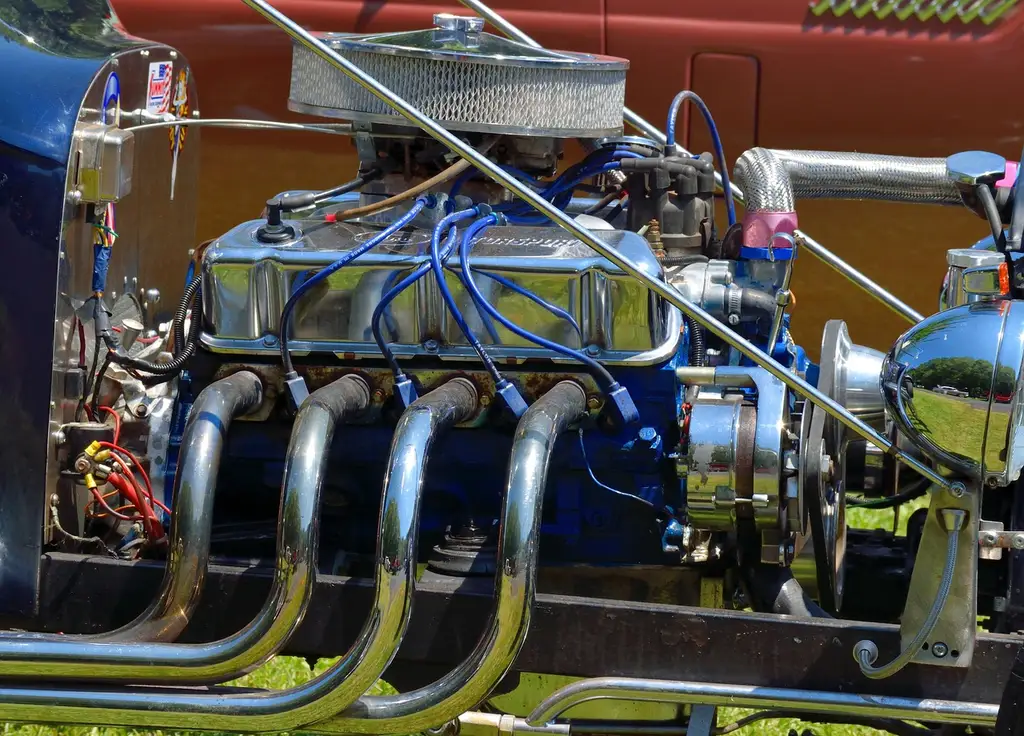
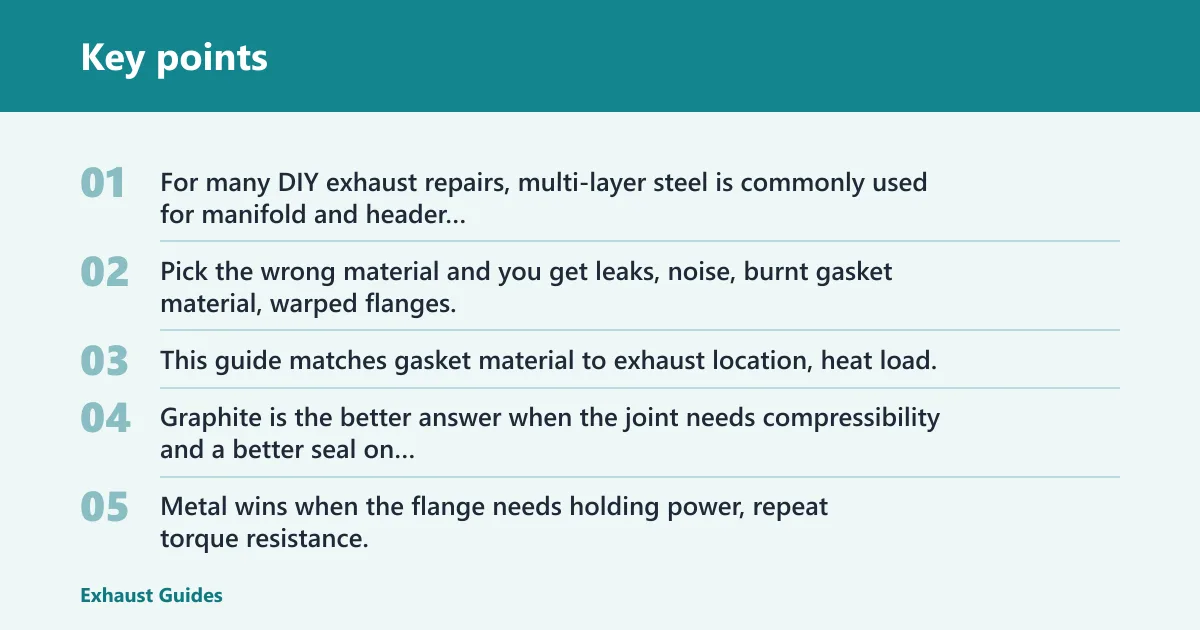
For many DIY exhaust repairs, multi-layer steel is commonly used for manifold and header flanges, graphite or reinforced composite is often a good fit for flat low-to-medium heat joints, and a donut gasket suits tapered pipe connections. Pick the wrong material and you get leaks, noise, burnt gasket material, warped flanges, and repeat labor. This guide matches gasket material to exhaust location, heat load, and flange condition so you can choose the right seal on the first repair.
Exhaust gasket material comparison


| Material | Best use | Strengths | Common failure mode | Reuse potential |
|---|---|---|---|---|
| Graphite exhaust gasket | Flat flanges, composite or sandwich builds, higher-heat joints with good clamp load | Low creep relaxation, good heat sealing, conforms better than rigid metal | Crushes or erodes if the flange is badly warped or bolts are uneven | Low to moderate |
| Multi-layer steel (MLS) | Manifold and header flanges, durable repairs, performance and diesel joints | Multiple steel layers, strong holding power, good resistance to blowout | Can leak if the faces are rough, pitted, or under-clamped | Low |
| Ceramic-fiber gasket | Very hot joints where cut-to-fit sheet material helps | Flexible, easy to cut, one competitor example is rated to 2100°F | Can compress or fray if the joint shifts a lot | Low |
| Non-asbestos gasket sheet | Custom exhaust repairs, chemical sealing, oil and heat exposure | Available in 0.8 mm, 1.0 mm, and 1.2 mm thicknesses; easy to trim | Fails if thickness choice is wrong for clamp load or flange flatness | Low |
| Copper gasket material | Hot metal-to-metal exhaust joints where durability matters | High-temperature metal option with good durability | Needs very good surface finish and clamp load; can leak on uneven flanges | Moderate |
| Aluminum gasket material | Some OEM replacement exhaust gaskets with vehicle-specific fitment | Heat and pressure resistance, exact fit when the part number is right | Not forgiving on misalignment or thermal movement | Low |
| Perforated steel core gasket | Manifold and flange applications that need reinforcement | Bonded facing with steel core for mechanical support | Outer facing can fail if the flange rocks or the joint shifts | Low |
| RTV gasket maker | Borderline sealing help, not a universal gasket replacement | High-temperature silicone formulation; one competitor example lists intermittent temperature rating up to 700°F | Blows out if asked to replace a missing gasket where a formed seal is required | Not reusable as a gasket |
Graphite vs metal at a glance
Graphite is the better answer when the joint needs compressibility and a better seal on faces that are not perfect. Metal wins when the flange needs holding power, repeat torque resistance, and resistance to blowout under high vibration. The trade-off is simple: graphite seals better on imperfect surfaces; metal survives harsher mechanical loading.
MPRC Seals describes graphite filler materials as giving low creep relaxation. That matters when a joint heat-cycles and the bolts slowly lose load. MPRC Seals also describes multi-layer steel as multiple sheets of carbon or spring steel, which explains why MLS holds shape better in high-clamp locations.
Ceramic, non-asbestos, and RTV in context
Ceramic-fiber gasket paper is the cut-to-fit option for very hot exhaust work. One competitor’s exhaust gasket paper is rated to 2100°F, and that sheet is 1/8 inch thick and measures 7 inches by 10 inches. It suits custom fabrication better than a fixed OEM-style gasket, but it still depends on good clamp distribution.
Non-asbestos sheet material fills the middle ground. Terixe sheets come in 0.8 mm, 1.0 mm, and 1.2 mm thicknesses, and Anglekai sheets are listed in 0.031 in, 0.039 in, and 0.047 in thicknesses. RTV belongs in a support role. It can help seal a borderline joint, but it is not a universal replacement for a formed exhaust gasket.
Which material fits your exhaust joint?
The best gasket material depends on the joint geometry first, then the heat level. Manifold and header flanges need holding power and heat resistance. Flange joints with flat faces often want graphite or reinforced metal. Donut joints and slip connections need the gasket shape that matches the taper, not the highest temperature rating on the box.
Manifold and header joints
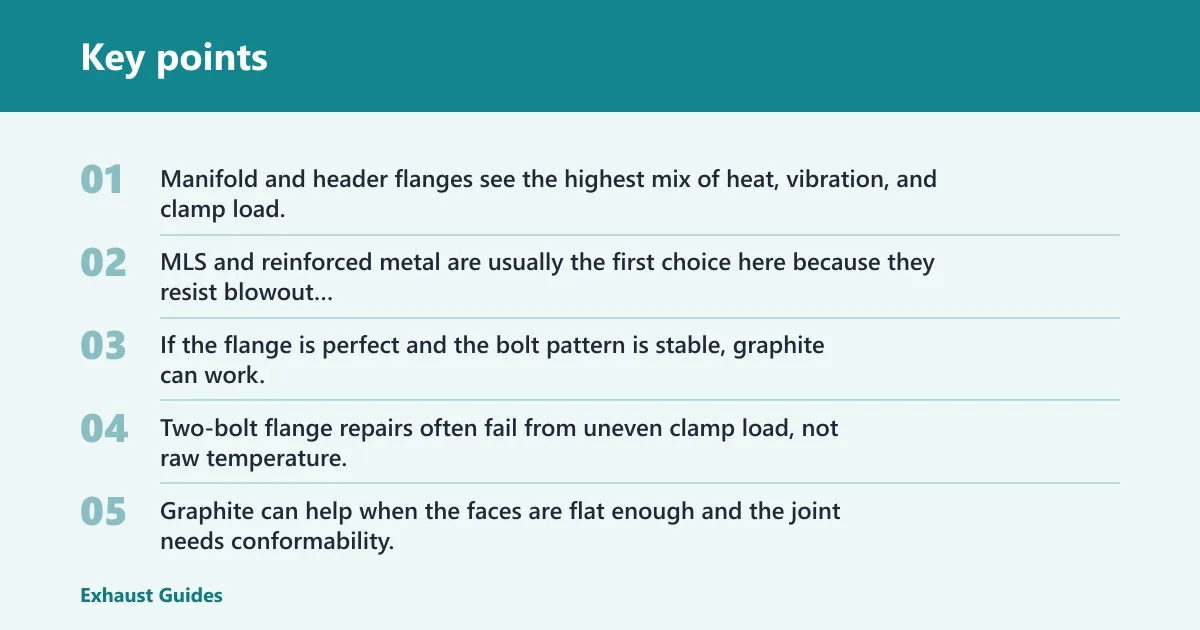
Manifold and header flanges see the highest mix of heat, vibration, and clamp load. MLS and reinforced metal are usually the first choice here because they resist blowout and maintain sealing force. If the flange is perfect and the bolt pattern is stable, graphite can work, but metal remains the safer default for durability.
Flange joints and two-bolt repairs
Two-bolt flange repairs often fail from uneven clamp load, not raw temperature. Graphite can help when the faces are flat enough and the joint needs conformability. A perforated steel core gasket is useful when the joint needs mechanical support and the flange can be torqued evenly. If the flange is warped, no material hides that for long.
Donut joints and slip connections
Donut joints use a different sealing strategy than flat flanges. The gasket must match the taper and allow a little movement without cutting itself apart. In those joints, a donut gasket is usually the correct answer, while a flat sheet, MLS, or thick rigid metal piece is the wrong shape for the job.
Suppose a 3.0L truck has a warped manifold flange and an old two-bolt gasket that keeps leaking after retorque. A graphite sheet may seal briefly, but the warp and clamp loss usually beat it. In that case, the real fix is flange repair or replacement, then an MLS or reinforced metal gasket.
Heat, movement, and flange condition
Heat rating matters, but it is only one part of the decision. A joint that stays flat and tight can use a less rigid material. A joint with vibration, thermal cycling, or a distorted face needs better holding power. The first thing that fails is often the weakest match between material and joint movement.
High heat with stable flanges
Stable flanges let you choose based on heat and sealing style. Ceramic-fiber sheet material works well where the joint is custom and the temperature is extreme. Graphite also belongs here because it tolerates heat while staying compressible. If the flange stays flat, the gasket does not have to fight movement as hard.
Warped faces and uneven clamp load
Warped faces favor materials that can conform without tearing. Graphite, if the warp is mild, usually beats rigid metal here. If the distortion is severe, even graphite can crush at the high spots and leak at the low spots. That is the point where flange repair matters more than gasket choice.
Vibration and thermal cycling
Vibration load is where MLS and reinforced metal earn their place. They resist movement better than soft sheet materials and are less likely to pump out under repeated expansion and contraction. On the other hand, if the bolts are small and the flange face is rough, a rigid gasket may never seat fully.
A common first-timer mistake is choosing a copper gasket because it sounds strongest, then installing it on a slightly warped flange with weak hardware. Copper can be a durable metal option, but it still needs surface quality and clamp load. The failure mode is usually leakage at the low spots, not a lack of heat resistance.
Exhaust gasket materials decision table
Use this table to match joint type, surface condition, temperature exposure, and vehicle segment to the most realistic material choice. The “do not use” column matters as much as the recommendation, because each material fails in a different way when the joint is wrong for it.
| Joint type | Surface condition | Temperature exposure | Vehicle segment | Best material choice | Do not use |
|---|---|---|---|---|---|
| Manifold flange | Flat, clean, even clamp load | High | Diesel truck | Multi-layer steel | RTV, because it can blow out and cannot replace the formed sealing surface |
| Header flange | Flat, bolt pattern stable | High to very high | Performance car | MLS or reinforced metal | Soft sheet material, because it can creep or crush under sustained load |
| Two-bolt flange | Mildly uneven | Medium | Daily driver | Graphite or perforated steel core | Rigid aluminum if the faces are not true, because it cannot conform well |
| Donut joint | Tapered pipe seat | Medium to high | Pickup or SUV | Donut gasket | Flat MLS or sheet gasket, because the shape mismatch causes leaks |
| Custom flange repair | Cut-to-fit, good clamp access | High | Motorcycle | Ceramic-fiber or non-asbestos sheet | Vehicle-specific aluminum if the part number does not match the flange |
| Borderline leak repair | Mostly sound, minor seep only | Medium | Daily driver | RTV plus the correct gasket, if the design allows it | RTV alone where the joint needs a formed gasket and mechanical support |
When is graphite the better choice?
Graphite is the better choice when the joint needs compression, the flange faces are reasonably flat, and the repair needs a material that seals without being fully rigid. Its low creep relaxation helps it stay loaded after heat cycles. That makes it a strong option for composite and sandwich gasket builds.
Low creep relaxation and sealing
Low creep relaxation matters because exhaust joints do not stay static. Heat expands the flange, then cooling relaxes it. A material that keeps its thickness better under load stays sealed longer. Graphite handles that cycle well when the joint is not abused by a badly warped face or missing hardware.
Composite and sandwich gasket builds
Graphite often appears in composite or sandwich constructions. That layered approach gives the gasket sealing material plus support material in one part. In practice, that helps when the joint needs both compliance and structure. It is a better fit than a pure soft sheet when clamp load is decent.
When graphite is the wrong pick
Graphite is the wrong pick when the flange is badly distorted, the joint sees repeated movement, or the design depends on rigid metal holding power. It can also be a poor choice on a sharp-edged seat that can cut the gasket as the pipe shifts. In those cases, mechanical reinforcement matters more.
When should you choose MLS or reinforced metal?
Choose MLS or another reinforced metal gasket when the exhaust joint needs holding power more than conformability. That usually means manifold, header, diesel, or performance applications with strong clamp load and high heat. Multiple steel layers resist blowout better than soft sheet material, especially when vibration is part of the job.
Multi-layer steel strength and durability
The same source describes multi-layer steel as multiple sheets of carbon or spring steel. That construction is why MLS is favored for durability and holding power. It is not the most forgiving option, but it is one of the best choices when the flange is true and the bolts can hold proper torque.
Perforated steel core support
FEL-PRO 3009 measures 12 x 28 x 3/64, and it uses a non-asbestos facing bonded to a perforated steel core. That kind of build gives the facing support so it does not simply collapse under clamp load. It is useful where mechanical reinforcement matters more than extra compressibility.
Copper and aluminum fitment limits
Copper can be a durable high-temperature choice, but it still depends on surface quality. Aluminum is used in some OEM replacement exhaust gaskets and can handle heat and pressure when the fitment is vehicle-specific. The limitation is simple: both materials are less forgiving when the flange is uneven or the wrong part number is used.
Choose graphite if… / Choose metal if…
Choose graphite if the flange is mostly flat, the joint needs some compliance, and the repair is on a composite or sandwich-style gasket path. Choose metal if the joint is high heat, high vibration, or critical to holding power. The best answer is the one that matches the failure mode, not the biggest temperature number.
Choose graphite
Choose graphite if the faces are clean and only mildly uneven. Choose it if the joint needs low creep relaxation after heat cycling. Choose it if you want a material that seals well without being fully rigid. Choose it if the repair is a flat flange or a composite gasket build.
Choose metal
Choose metal if the joint is manifold or header based. Choose it if the flange must resist blowout under vibration. Choose it if the surface is true and the hardware can maintain clamp load. Choose it if the vehicle is a diesel truck or performance build where repeat torque loss is a concern.
Choose ceramic-fiber, non-asbestos, or RTV
Choose ceramic-fiber when you need a cut-to-fit sheet for extreme heat. Choose non-asbestos when thickness options matter and the repair needs oil and heat resistance. Choose RTV only when the joint design allows sealant support, not when you are replacing a missing formed gasket. The right material still depends on the joint, not the label.
- Identify the joint type first: manifold, header, flange, donut, or slip connection.
- Check the flange face for warp, pitting, and uneven clamp marks.
- Match the material to movement: rigid metal for stable, loaded joints; graphite or sheet material for better conformity.
- Use thickness as a fit factor, not a bigger-is-better rule.
- Use RTV only as a helper where the joint design allows it.
- Replace hardware if clamp load has already been lost.
Frequently asked questions
Which exhaust gasket material is best for my car or truck?
For most cars and trucks, the best material depends on the joint, not the badge on the fender. Flat manifold and header flanges usually favor MLS or reinforced metal. Mildly uneven flange joints often do better with graphite. Donut connections need a donut gasket that matches the seat.
Is graphite better than metal for exhaust gaskets?
Graphite is better when the flange needs some compliance and the surfaces are not perfect. Metal is better when the joint needs stronger holding power and resistance to blowout. If the flange is flat and the load is stable, metal usually lasts longer. If the flange is imperfect, graphite seals more easily.
When should I use a multi-layer steel exhaust gasket?
Use MLS on manifold and header joints, especially where heat, vibration, and clamp load are high. It is a strong choice for diesel trucks and performance engines because it resists blowout better than soft sheet material. It is less forgiving, so it needs cleaner faces and better torque control.
Are non-asbestos gasket sheets good for exhaust repairs?
Yes, when you need a cut-to-fit material and the repair calls for moderate thickness control. Non-asbestos sheets are offered in 0.8 mm, 1.0 mm, and 1.2 mm thicknesses, and they are used for exhaust and chemical sealing with oil and heat resistance. They are not the best answer for badly warped flanges.
Do high-temperature RTV sealants work on exhaust gaskets?
RTV can help in borderline repairs, but it is not a replacement for every exhaust gasket. One competitor example lists an intermittent temperature rating up to 700°F, which sounds impressive, but sealant still cannot replace the mechanical function of a formed gasket in many joints. Use it only where the design allows sealant support.
What exhaust gasket material lasts the longest under heat and vibration?
MLS and other reinforced metal gaskets usually last the longest under heat and vibration because they resist blowout and hold torque better. Graphite can last well on flatter joints, but it is more dependent on surface quality. If the flange is warped or hardware is weak, no material gets a free pass.
Which gasket material is best for diesel or performance exhausts?
Diesel and performance exhausts usually favor MLS, reinforced metal, or perforated steel core designs. Those applications see more heat and movement, so durability matters more than easy cutting. Graphite can still work on some flat joints, but metal is the safer default when failure would mean repeat teardown.
How do I choose between a donut gasket and a flange gasket material?
Choose by joint shape first. A donut gasket fits tapered pipe connections and slip joints. A flange gasket fits flat mating faces. If you put a flat gasket where the joint needs a tapered donut seat, the leak usually returns quickly, even if the material itself is high quality.