Best Exhaust Leak Kits for Home Mechanics (2026): We Compared
For most home mechanics, a smoke machine is the first tool to buy for pipe, flange, manifold, and flex-pipe leaks; choose a combustion leak kit only if you suspect exhaust gases in the cooling system or a head-gasket fault. Pick the wrong leak type and you waste time, buy the wrong tool, and may keep driving with a leak that can create noise, fumes, and failed inspections. This guide shows how to match each kit to the exact leak, compare DIY smoke testers with combustion block-test kits, and decide what fits your budget and diagnosis path.
Quick comparison
| Product | Badge | Best for | Price | ||
|---|---|---|---|---|---|
 | Solary Automotive Smoke Machine Leak Detector – 12V DC EVAPSolary | Our pick | 12V DC · smoke machine · EVAP vacuum tester | $58.99 Price as of 28 Oct 2026 | View |
 | AutoLine Pro HyperSmoke™ Automotive Smoke Machine EVAPAutoLine Pro | Also great | Smoke machine · adjustable pressure · EVAP tester | $61.99 Price as of 28 Oct 2026 | View |
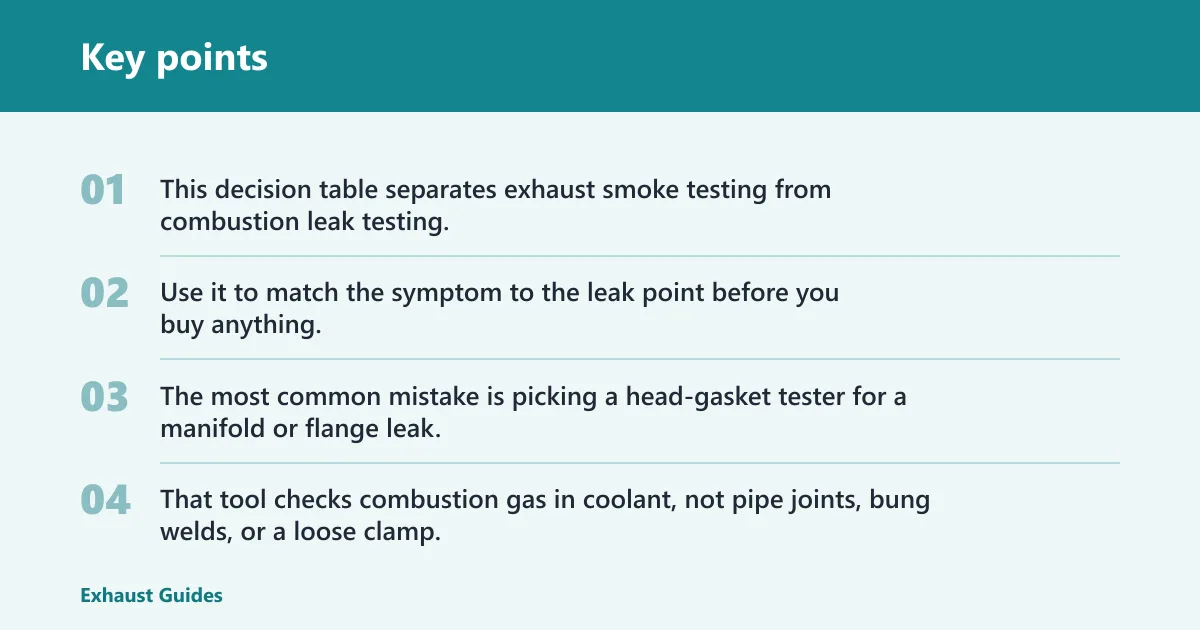
This decision table separates exhaust smoke testing from combustion leak testing, because they solve different problems. Use it to match the symptom to the leak point before you buy anything.
The most common mistake is picking a head-gasket tester for a manifold or flange leak. That tool checks combustion gas in coolant, not pipe joints, bung welds, or a loose clamp.
| Symptom | Likely leak point | Best tool category | Is smoke testing appropriate? | Common false-positive risks |
|---|---|---|---|---|
| Ticking on cold start near the engine bay | Exhaust manifold, gasket, or flange | Smoke machine leak detector | Yes, if the system is cool and sealed for low-pressure testing | Hot metal expanding after startup, loose heat shields, air escaping from an open tailpipe |
| Exhaust smell under the hood | Manifold, flex pipe, upstream joint | Smoke machine leak detector | Yes | Smoke exiting the tailpipe because the rear of the system is not capped |
| Noise at the center or rear of the car | Y-pipe, bung, clamp, mid-pipe joint, tailpipe connection | Smoke machine leak detector | Yes | False leaks from rusty seams, pinholes that only open hot, and poor adapter sealing |
| Coolant loss, white smoke, or overheating | Head gasket or block issue | Combustion leak tester | No, not as the primary test | Condensation in the cooling system, residual coolant vapors, contaminated test fluid |
| Check-engine light with EVAP or vacuum codes | EVAP lines, intake tract, vacuum hoses | Smoke machine leak detector | Yes | Cracked plastic fittings, uncapped ports, purge valve issues |
How we chose
The right kit depends on leak type, not brand hype. A smoke machine belongs on pipe, flange, bung, clamp, and joint diagnosis; a combustion tester belongs on suspected head-gasket or block failures.
Selection also depends on pressure control, smoke output, adapter fit, and how much consumable fluid the kit uses. Warmup time matters too, because a slow-starting unit can turn a quick check into a long setup.
We also looked at whether the kit can handle the small-diameter pipes and irregular connections common on home vehicles. If the adapter does not seal, the tester can create a false leak at the connection instead of finding the real one.
Solary Automotive Smoke Machine Leak Detector: best for mixed exhaust and underhood leak checks
- Built-in air pump needs no external air source
- Works for EVAP, vacuum, intake, and turbo leaks
- Portable, lightweight design is easy to store
The Solary unit fits home mechanics who want one smoke machine for EVAP, vacuum, intake, and exhaust checks. Its built-in air pump means you do not need an external air source, and it produces smoke in about 10 seconds.
Based on the manufacturer’s details and buyer feedback, this is the better fit when you need a portable tester for manifold, flange, and small pipe leaks on a cool exhaust system. The 12V DC setup also suits garage work where you want quick setup without a separate compressor.
The drawback is that it is still a smoke tool, not a combustion leak tester. It will not tell you whether a coolant loss problem is a head gasket issue, and it is only useful on exhaust leaks when the system can be sealed and tested at low pressure.
AutoLine Pro HyperSmoke: best for adjustable leak testing
- Adjustable pressure for different leak-testing jobs
- Includes cone and gas cap EVAP adapters
- OEM approved smoke fluid is included
The AutoLine Pro HyperSmoke is aimed at DIYers who want more control over pressure and a faster-starting smoke machine. It is described as including a built-in compressor, adjustable pressure, and instant warmup, which can help when testing different leak sizes or switching between EVAP and exhaust work.
It also includes cone and gas cap EVAP adapters, so it is easier to connect to some common diagnostic points. Based on published product details, that makes it a practical choice for mixed underhood diagnosis when adapter fit matters as much as smoke output.
The main drawback is that it is still in the smoke-machine category, so it will not diagnose combustion leakage into the coolant. It is also more capability than a one-off tailpipe check usually needs, so the extra control may go unused if you only inspect one simple joint.
Combustion leak testers: best for head gasket checks
Use a combustion leak tester when the fault path is between the cylinders and the cooling system. These kits check for exhaust gases in coolant, which is a different failure mode from a leaking flange, bung, or mid-pipe seam.
They are a poor match for external exhaust noise. If the leak is outside the pipe, a combustion tester can miss it entirely.
Block Tester BT-500: best for fast coolant-gas checks
The Block Tester BT-500 is the clearest example of this category. It uses blue-to-yellow indicator fluid when CO2 is detected, so the result is easy to read when you are checking for combustion gas in the cooling system.
Its strength is directness. If the coolant test changes color, you have evidence of a combustion leak path. Its weakness is scope: that color change does not diagnose an exhaust manifold crack, a flange leak, or a leaking tailpipe clamp.
RELD Head Gasket Tester Kit: best for European-made head gasket checks
The RELD kit is described as an EU-made head gasket tester kit and is positioned for quick head-gasket integrity checks. That makes it a fit when the question is whether combustion gas is entering the cooling system.
The drawback is the same one that applies to every combustion leak tester in this group. It can support a head-gasket diagnosis, but it cannot replace a smoke machine when the symptom is an exhaust odor or a visible leak around the pipework.
Gold Label Detailing Combustion Leak Detector Kit: best for heavier fluid capacity
The Gold Label Detailing kit includes 18 oz of fluid, which is useful if you want a heavier-duty combustion leak tester with more consumable on hand. It targets engine combustion leaks and block issues, so it belongs in the coolant-side diagnosis path.
The drawback is that it still does one job. More fluid does not turn it into an exhaust leak finder, and it will not isolate a bung, Y-pipe, or flange leak on the exhaust side.
Which one should you buy?
If your symptom is a ticking manifold leak, a smelly flange, or a hiss at a mid-pipe joint, buy a smoke machine first. If your symptom is coolant loss, unexplained overheating, or bubbles in the radiator, start with a combustion leak tester.
Picture a 2.5-inch exhaust with a cold-start tick near the manifold. A smoke tester can show whether the leak opens at the gasket or one of the nearby joints before the system heats and expands.
Suppose the car has white smoke, pressure in the cooling system, and no obvious external exhaust leak. In that case, a combustion test is the right first step, because a smoke machine cannot answer the coolant-side question.
Manifold, flange, bung, or Y-pipe leak
Choose a smoke machine. These leaks are external and usually show up as smoke escaping at a joint, weld, sensor bung, or flange. The test works best on a cool system with the exhaust sealed well enough to hold low pressure.
Head gasket or combustion leak
Choose a combustion leak tester. The Block Tester BT-500, RELD kit, and Gold Label Detailing kit all target exhaust gas in coolant, which is the fault mode you need to confirm before any head-gasket repair.
EVAP, vacuum, intake, or turbo leak
Choose a smoke machine, not a combustion kit. Solary and AutoLine Pro both cover these jobs, and the Solary listing specifically fits EVAP, vacuum, intake, and exhaust testing. Use the combustion tester only when coolant contamination or head-gasket failure is the question.
Adapter fit and pressure limits
Use the adapter that seals the pipe or port without stretching it open. For exhaust work, that means matching the pipe diameter, blocking the tailpipe or inlet side as needed, and keeping pressure low enough that smoke does not force past normal seals or create a fake leak.
What the right adapters need to cover
Adapters matter more than many buyers expect. A smoke machine can only reveal a leak if the system is sealed well enough for the smoke to stay in the pipework and escape through the real fault point.
Wzyblixo Turbo System Leakage Tester Kit: best for stepped adapter coverage
The Wzyblixo kit is a 9-piece turbo system leakage tester with stepped adapters from 1-3/8″ to 3-1/2″. That range helps when you need to test different turbo, cooling, or emissions connections without improvising a seal.
Its limitation is scope. It is designed around adapter coverage, so it is useful when the test port varies in size, but it is not a combustion leak tester and it is not the same thing as a dedicated exhaust smoke machine.
Pipe diameter ranges and stepped adapters
Stepped adapters help on tailpipe ends, larger downpipes, and odd transition pieces. They also reduce the chance of smoke escaping at the test connection instead of at the real leak.
A common first-timer mistake is using an adapter that fits loosely and then blaming the exhaust for the smoke loss. If smoke pours out at the setup point, the seal is wrong before the diagnosis starts.
Sealing problems that create false leaks
Clamp the adapter squarely and verify that open ports are capped. Air escaping through a loose cap, cracked vacuum line, or uncapped sensor port can look like a pipe leak when the real fault is the test setup.
Hot exhaust can create another false result. A leak that only opens after the pipe expands, or only under load, may stay hidden during a cold low-pressure test, so a clean smoke result does not always close the case.
What pressure should I use when smoke testing an exhaust system?
Use low pressure. Exhaust testing generally works best when the tester is just strong enough to move smoke through the pipe and let it escape at the fault point, not force it past seals or open joints that would stay closed in normal use.
That is why adjustable-pressure smoke machines are useful, and why a unit with a listed 19-23 PSI range still needs careful setup rather than maximum output. For exhaust work, the goal is controlled smoke, not a blast of air that creates a false leak.
Are built-in air pump smoke machines better than compressor-powered kits?
Built-in air pump smoke machines are easier to move, simpler to store, and faster to set up for home use. Compressor-powered kits can offer more control and often fit a wider diagnostic workflow, but they add hoses, noise, and another piece of gear to manage.
The Solary unit uses a built-in air pump, which is convenient for quick checks and portable work. The AutoLine Pro HyperSmoke uses a built-in compressor and adjustable pressure, which helps when you want tighter control across different tests.
When built-in pump units make more sense
Choose a built-in pump unit if you want a compact tester for occasional exhaust, EVAP, or vacuum work. It is usually the better fit when the job is a single car in a driveway or garage and storage space is limited.
When compressor-powered units make more sense
Choose a compressor-powered unit if you want more control over how the smoke is delivered or expect to switch between different diagnostic jobs often. The tradeoff is more setup time and a less compact package.
What is the best exhaust leak detection kit for a home mechanic?
For most home mechanics, a smoke machine is the first buy for exhaust leaks because it finds external faults at manifolds, flanges, bungs, Y-pipes, and clamps. Pick a combustion leak tester only when the symptom points to a head gasket or block issue rather than a pipe leak.
That split matters. A smoke tester solves the outside-the-engine problem; a combustion tester solves the coolant-side problem.
Do I need a smoke machine or a combustion leak tester for exhaust leaks?
You need a smoke machine for exhaust leaks at joints, pipes, flanges, and sensor bungs. You need a combustion leak tester only if you suspect exhaust gas has entered the cooling system or the engine may have a head-gasket fault.
Can a smoke machine find exhaust leaks in the manifold or flange?
Yes, if the manifold or flange leak is accessible and the system can be sealed for a low-pressure test. Smoke is especially useful for cold-start ticking, because it can show the leak point before heat expansion changes the fit of the parts.
What adapters do I need to test exhaust connections at home?
You need an adapter that matches the pipe diameter and seals without leaking at the test port. For larger or unusual connections, stepped adapters are the most practical choice, because they help cover different pipe sizes and reduce false results from a poor fit.
Frequently asked questions
How do I tell if a kit is for an exhaust leak versus a head gasket leak?
Look at the diagnostic target. Smoke machines are for external leaks in pipework, intake, EVAP, and turbo paths. Combustion leak testers are for checking whether exhaust gas has entered the coolant, which is the head-gasket or block-side problem.