How To Add Formal Charges: Essential Guide
Adding formal charges to resonance structures involves counting valence electrons around each atom. Calculate the difference between an atom’s valence electrons and the electrons it “owns” in the structure to find its formal charge. This helps determine the most stable and likely arrangement of electrons.
How To Add Formal Charges: An Essential Guide for Understanding Resonance
Ever looked at a molecule and felt a little lost about where its electrons are supposed to be? You’re not alone! Understanding how atoms share electrons in molecules can seem tricky, especially when they can be arranged in different ways. These different arrangements are called resonance structures. Figuring out which of these arrangements is the most likely one is where formal charges come in. Don’t worry, it’s not as complicated as it sounds! We’ll break it down step-by-step, just like checking your car’s exhaust for any hidden issues. By the end, you’ll feel confident in identifying and calculating formal charges, which will make understanding molecular behavior much easier.
What Are Formal Charges and Why Do They Matter?
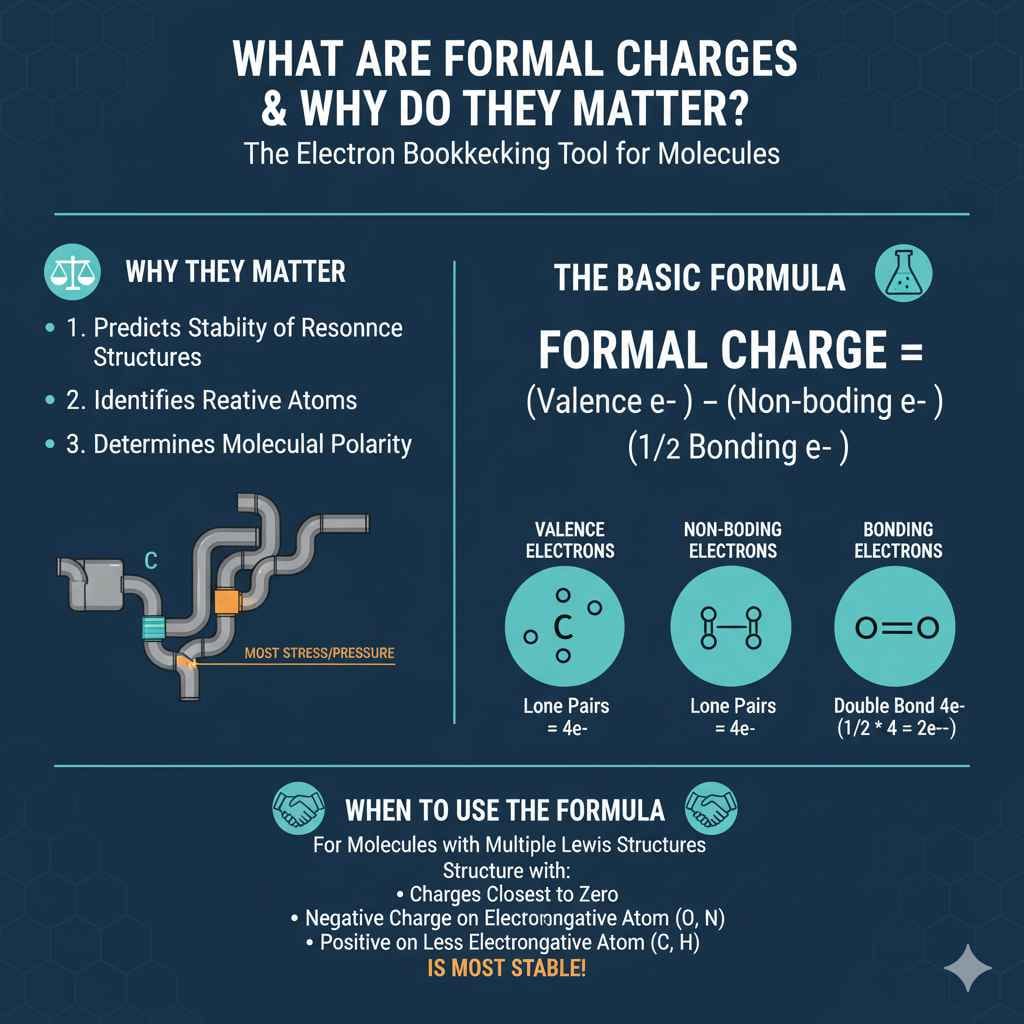
Think of a formal charge as a bookkeeping tool for electrons within a molecule. It helps chemists figure out how electrons are distributed among atoms in a molecule or ion. Why is this important? Well, it tells us which arrangement of electrons, among several possibilities (resonance structures), is the most stable and therefore the most likely to be found in reality.
Imagine you have a complicated exhaust system. You need to know which part is carrying the most stress or pressure to understand how it will perform. Formal charges do something similar for molecules. They help us predict:
The stability of different resonance structures.
Which atoms in a molecule are more likely to be involved in reactions.
The overall polarity of a molecule.
For beginners, it’s a crucial step in understanding the fundamental principles of chemical bonding.
The Basic Formula for Formal Charge
The formula for calculating formal charge is quite straightforward. It’s basically about comparing what an atom should have versus what it actually has in the structure.
Formal Charge = (Valence Electrons of the Free Atom) – (Non-bonding Electrons) – (1/2 Bonding Electrons)
Let’s break down what each part of this formula means:
Valence Electrons of the Free Atom: This is the number of electrons an atom has in its outermost shell when it’s not bonded to anything else. You can find this number on the periodic table, usually corresponding to the group number (for main group elements). For example, carbon is in Group 14, so it has 4 valence electrons. Oxygen is in Group 16, with 6 valence electrons. Nitrogen is in Group 15, with 5 valence electrons.
Non-bonding Electrons: These are the electrons in lone pairs that are only around a specific atom. They are not shared. You simply count them directly.
Bonding Electrons: These are the electrons involved in covalent bonds between atoms. Each single bond represents 2 bonding electrons, a double bond represents 4, and a triple bond represents 6. You count all the electrons in the bonds connected to the atom.
When to Use the Formal Charge Formula
You’ll typically use formal charges when you’re working with molecules that can be represented by multiple valid Lewis structures. These are known as resonance structures. The structure with the formal charges that are:
Closest to zero.
With negative charges on more electronegative atoms (like oxygen or nitrogen).
With positive charges on less electronegative atoms.
is generally considered the most stable and representative of the actual molecule. It’s like finding the smoothest running part of your car’s engine – that’s where the primary action is happening.
Step-by-Step Guide: How to Add Formal Charges to Resonance Structures
Let’s walk through the process of applying the formal charge formula. We’ll use a common example, like the nitrate ion ($NO_3^-$), to make it clear.
Step 1: Draw the Lewis Structure(s)
First, you need a valid Lewis structure for the molecule or ion. This involves:
Counting Total Valence Electrons: Add up the valence electrons for all atoms in the molecule. For ions, add electrons for negative charges and subtract for positive charges.
For $NO_3^-$: Nitrogen (N) has 5 valence electrons. Oxygen (O) has 6 valence electrons. There are three oxygen atoms, so $3 times 6 = 18$. The negative charge adds 1 electron.
Total valence electrons = $5 + 18 + 1 = 24$ electrons.
Connecting Atoms: Place the least electronegative atom (usually not oxygen or hydrogen) in the center and connect the other atoms with single bonds.
Nitrogen is central, with three oxygens around it.
Distributing Remaining Electrons: Place lone pairs around the outer atoms to satisfy the octet rule (aiming for 8 electrons around each atom, except for hydrogen which needs 2). Then, place any remaining electrons on the central atom.
Forming Multiple Bonds: If the central atom doesn’t have an octet, move lone pairs from outer atoms to form double or triple bonds until the central atom has an octet.
For $NO_3^-$, after following these steps, you might get a structure where N is bonded to two O atoms with single bonds and one O atom with a double bond. However, the double bond could be on any of the three oxygen atoms! This is where resonance comes in. The actual structure is a hybrid of these possibilities.
Here are three possible Lewis structures for $NO_3^-$:
(Imagine three structures here, each with N in the center, bonded to two O’s with single bonds and one O with a double bond. The double bond is positioned differently on each O, and lone pairs are distributed to satisfy octets.)
Step 2: Apply the Formal Charge Formula to Each Atom in Each Resonance Structure
Now, we’ll calculate the formal charge for every atom in each of these resonance structures.
Let’s label the atoms for clarity within one resonance structure:
(Imagine a structure: N in the center. Top O has a double bond to N, 2 lone pairs. Left O has a single bond to N, 3 lone pairs. Right O has a single bond to N, 3 lone pairs. The whole ion has a negative charge bracket around it.)
Central Nitrogen (N):
Valence electrons of free N = 5
Non-bonding electrons on N = 0 (no lone pairs on N)
Bonding electrons connected to N = 8 (1 double bond = 4, 2 single bonds = 2+2 = 4. Total = 8)
Formal Charge on N = $5 – 0 – (1/2 times 8) = 5 – 4 = +1$
Oxygen with Double Bond (O=):
Valence electrons of free O = 6
Non-bonding electrons on O = 4 (2 lone pairs)
Bonding electrons connected to O = 4 (1 double bond)
Formal Charge on O= = $6 – 4 – (1/2 times 4) = 6 – 4 – 2 = 0$
Oxygen with Single Bond (O-):
Valence electrons of free O = 6
Non-bonding electrons on O = 6 (3 lone pairs)
Bonding electrons connected to O = 2 (1 single bond)
Formal Charge on O- = $6 – 6 – (1/2 times 2) = 6 – 6 – 1 = -1$
So, in this specific resonance structure, the formal charges are: N (+1), O= (0), O- (-1), O- (-1).
You would repeat this calculation for the other two resonance structures. You’ll find that the charges will be distributed differently but the overall sum of the formal charges will always equal the charge of the ion (in this case, -1).
Step 3: Analyze the Formal Charges to Determine Stability
Once you have calculated formal charges for all atoms in all resonance structures, you can assess their stability.
Resonance structures with formal charges closest to zero are generally more stable.
Residue structures with negative formal charges on more electronegative atoms (like O, N, Cl) are more stable than those with negative charges on less electronegative atoms (like C, S).
Residue structures with positive formal charges on less electronegative atoms are more stable than those with positive charges on more electronegative atoms.
The sum of formal charges must equal the net charge of the molecule or ion.
For $NO_3^-$, all three resonance structures have the same set of formal charges: one atom with +1, one with 0, and two with -1. Since the number of double bonds and the positions of the charges are equivalent in terms of electronegativity (all oxygens), all three resonance structures contribute equally to the actual structure of the nitrate ion. The electrons are delocalized, meaning they spread out over all the atoms, making the actual bond lengths and strengths intermediate between single and double bonds.
Example: Carbon Dioxide ($CO_2$)
Let’s look at Carbon Dioxide ($CO_2$), a simple molecule.
1. Lewis Structure: Total valence electrons: C (4) + O (6×2) = 16. The most stable Lewis structure involves a double bond between C and each O: O=C=O.
2. Formal Charges:
Carbon (C):
Valence electrons = 4
Non-bonding electrons = 0
Bonding electrons = 8 (two double bonds)
Formal Charge on C = $4 – 0 – (1/2 times 8) = 4 – 4 = 0$
Oxygen (O):
Valence electrons = 6
Non-bonding electrons = 4 (two lone pairs)
Bonding electrons = 4 (one double bond)
Formal Charge on O = $6 – 4 – (1/2 times 4) = 6 – 4 – 2 = 0$
In $CO_2$, all atoms have a formal charge of zero in its Lewis structure. This indicates a very stable molecule, which makes sense as it’s a common and unreactive gas.
What to Do with Calculations?
The results of your formal charge calculations are key to understanding your subject.
They confirm your understanding of electron sharing.
They help identify the most stable arrangement of electrons.
They provide clues about molecular reactivity. For instance, atoms with significant positive or negative formal charges are often the sites of chemical reactions.
Common Pitfalls and How to Avoid Them
Even with a clear formula, beginners can sometimes stumble. Here are a few common issues and how to steer clear of them:
Miscounting Valence Electrons: Always double-check your initial count of total valence electrons for the molecule or ion. Forgetting to add/subtract electrons for ion charges is a frequent mistake.
Incorrectly Identifying Non-bonding vs. Bonding Electrons: Be very precise. Non-bonding electrons are the ones in lone pairs on that specific atom. Bonding electrons are all electrons involved in bonds connected to that atom.
Forgetting the “(1/2)” in the Formula: This is critical! You’re accounting for half of the bonding electrons that the atom shares in bonds.
Assuming Only One Lewis Structure is Correct: For many molecules, especially those with pi systems or multiple identical atoms bonded to a central atom, resonance is involved. You must consider all valid resonance structures.
Overlooking the Octet Rule: While formal charges are important, remember that Lewis structures should generally satisfy the octet rule for most atoms. Formal charges help you pick the best structure that does satisfy the octet rule, or get as close as possible.
By taking your time and carefully applying the formula to each atom and structure, you can avoid these common mistakes.
Tools and Resources for Formal Charge Calculations
While you can do these calculations by hand, modern tools can also be very helpful, especially for more complex molecules or for double-checking your work.
Periodic Table: This is your primary tool. Keep one handy to quickly find valence electron counts. You can find reliable periodic tables from educational institutions like the National Institute of Standards and Technology (NIST).
Online Lewis Structure Calculators: Many websites offer tools that can help you draw Lewis structures and even show formal charges. These are great for verifying your manual calculations.
Chemistry Software: For advanced students or researchers, molecular modeling software can visualize electron densities and formal charges in 3D.
When Formal Charges Don’t Tell the Whole Story
It’s important to remember that formal charges are a simplified model. While they are excellent for determining the most likely resonance structure, they don’t tell the entire story about electron distribution. Other concepts like electronegativity and resonance energy contribute to the true nature of chemical bonds.
For example, in molecules with only a few atoms, the formal charge rule is often dominant. However, with larger molecules or complex electron systems, factors like orbital overlap and inductive effects can also play significant roles in stability.
Formal Charges in Different Chemical Contexts
The concept of formal charges isn’t limited to just drawing resonance structures. It’s a foundational idea that pops up in various areas of chemistry.
Organizing Resonance Structures by Stability
When you have multiple resonance structures, you can rank them by stability using formal charges. A structure is considered more stable if it has:
Fewer atoms with non-zero formal charges.
More atoms with formal charges closer to zero.
Negative formal charges located on the most electronegative atoms in the molecule.
Positive formal charges located on the least electronegative atoms.
Let’s consider another example: the diazomethane molecule ($CH_2N_2$) which has resonance.
Possible resonance structures include:
1. $H_2C=N^+=N^-$ (Nitrogen on the right has a triple bond)
2. $H_2C^–N^+ = N^+$ (Nitrogen in the middle has a triple bond)
Let’s calculate the formal charges:
| Structure | Atom A (CH2) | Atom B (N) | Atom C (N) | Total Charge |
|---|---|---|---|---|
| $H_2C=N^+=N^-$ | 0 | +1 | -1 | 0 |
| $H_2C^- -N^+ = N^+$ | -1 | +1 | +1 | +1 |
| (Additional structure $H_2C=N=N$: Carbon has 4 bonds, both N have 2 bonds, etc. This isn’t a primary resonance form but illustrates the principle) |
In this case, the structure with formal charges of 0, +1, and -1 (in that order) is generally considered more stable than a hypothetical structure with charges -1, +1, +1, due to the negative charge being on a more electronegative atom (nitrogen compared to carbon in some hypothetical incorrect structures). The resonance hybrid of diazomethane is crucial for its reactivity.
Impact on Molecular Polarity
Formal charges can give you a preliminary idea about a molecule’s polarity. If the formal charges are evenly distributed and close to zero, the molecule is likely to be nonpolar. However, if there are significant positive and negative formal charges, especially if they are not canceled out by molecular geometry, the molecule is likely to be polar. For example, in water ($H_2O$), oxygen has a formal charge of -1 (in its typical Lewis structure), and the hydrogens have +0.5. This charge separation contributes to water’s high polarity.
Understanding Reaction Mechanisms
In organic chemistry and other fields, understanding formal charges helps predict where a reaction might start. A region with a significant negative formal charge is electron-rich and might attack an electron-deficient center (electrophile). Conversely, a region with a significant positive formal charge is electron-poor and might be attacked by an electron-rich species (nucleophile). This forms the basis for understanding many reaction mechanisms.

FAQ: Your Burning Questions About Formal Charges Answered
Here are some common questions beginners have about formal charges.
What is the main difference between formal charge and oxidation state?
Formal charge is a calculated charge assigned to an atom in a hypothetical way, assuming all bonding electrons are shared equally. Oxidation state, on the other hand, assigns electrons to the more electronegative atom in a bond, essentially treating bonds as ionic. Formal charges are more useful for determining the best Lewis structure and resonance forms, while oxidation states are more about electron redistribution in reactions.
Can an atom ever have a formal charge greater than +1 or less than -1?
Yes, it is possible, but it’s less common for typical resonance structures. For elements in the third period and beyond that can expand their octet, formal charges can sometimes be larger. However, for finding the most stable resonance structures, you generally look for the arrangement with formal charges closest to zero.