How to Protect Your Catalytic Converter From Theft
Protect a catalytic converter with two layers if you park outside regularly: an approved shield or cage plus a visible deterrent, and use a locked garage first. Skip those steps, and thieves can cut the converter in minutes, leaving you with a loud exhaust, a failed emissions test, and a repair bill that can run into the thousands. This guide ranks the best defenses by parking setup and vehicle type, from apartment lots to driveways, trucks, SUVs, and hybrids.
What makes your vehicle a target?

- Direct replacement design for easily accessible catalytic converters
- Made of reinforced aluminum material for corrosion resistance
- Backed by a lifetime warranty for replacement if broken
Catalytic converters hold valuable precious metals, including palladium, rhodium, and platinum, so thieves go after the easiest vehicle to reach. Higher-clearance trucks, SUVs, and 4x4s are easier to crawl under, and parking choice matters as much as the vehicle itself. The best protection starts with risk-aware parking, then adds physical barriers.
Why thieves want converters
Converters are mandatory on every new vehicle since 1975, and the theft motive is simple: the metals inside have resale value that changes with market prices.
Why high-clearance vehicles are easier targets
Some converters are relatively easy to remove, and 4x4s sit farther off the ground. That extra clearance gives thieves more room to work with saws and hand tools. Prius models are also common targets, especially some second-generation versions built from 2004 to 2009, because theft risk can vary by model year and the amount of precious metal in the converter.
Which parking situations increase risk?
Driveways, street parking, and open workplace lots all raise exposure because thieves can work fast and leave quickly. A trusted, secured, or indoor location is the strongest first line. Walls, barriers, and parked cars can make access harder by reducing the underbody space thieves need.
What you’ll need before you start
- Vehicle-specific catalytic converter shield or cage
- Anti-theft fasteners or security bolts matched to your vehicle
- VIN engraving kit or serial-marking service
- Wheel chocks or a parking plan for a secured space
- Motion-activated security light for driveway parking
- CCTV camera or alarm system for lot or street exposure
- Jack, jack stands, and the correct socket set for installation
- Vehicle manual or fitment chart for your make and model
Catalytic converter protection matrix
This matrix compares common protections by cost, install difficulty, and deterrence value across three parking setups. Use it as a buying and planning filter, then layer more than one defense when your vehicle sits high or stays outside.
| Measure | Typical cost | Install difficulty | Driveway parking | Street parking | Workplace/lot parking |
|---|---|---|---|---|---|
| Vehicle-specific shield/cage | High | Medium to hard | High value | High value | High value |
| Security bolts / anti-theft fasteners | Low to medium | Medium | Good with shield | Good with shield | Good with shield |
| VIN engraving / serial marking | Low | Low | Moderate | Moderate | Moderate |
| Security lighting | Low to medium | Low to medium | High value | Low value | Moderate |
| CCTV or visible camera | Low to high | Low to medium | High value | Moderate | High value |
| Alarm with tilt or motion trigger | Medium | Medium | High value | High value | High value |
| Parking in garage or secured bay | None to low | Low | Highest value | Best if available | Best if available |
Recommended layered setup for low-risk vehicles
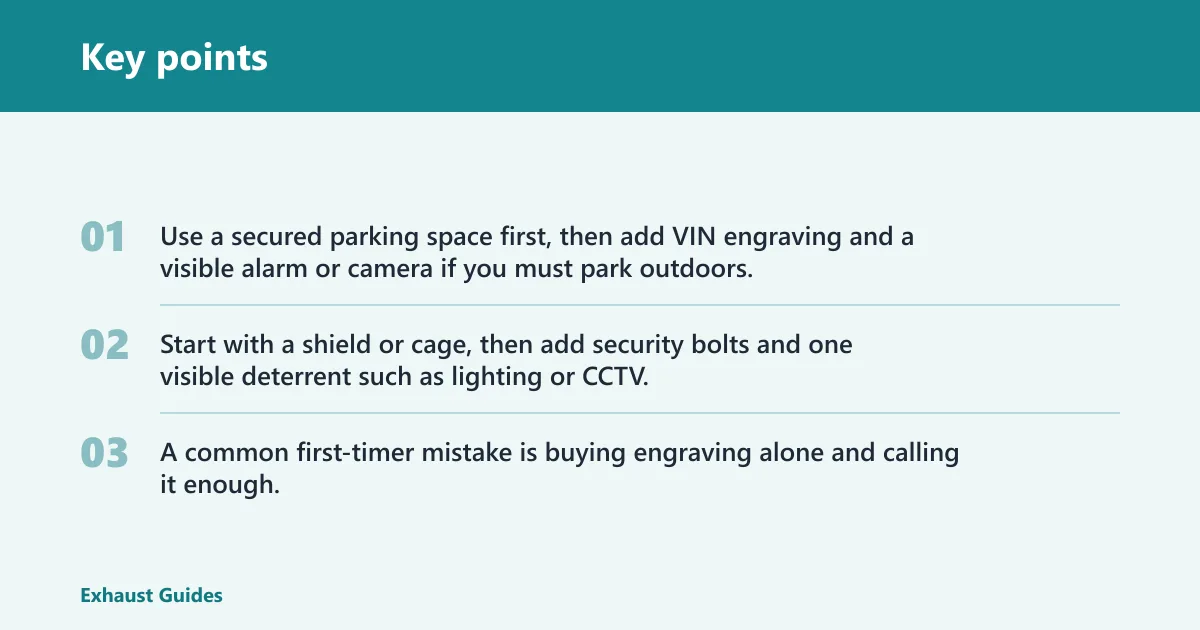
Use a secured parking space first, then add VIN engraving and a visible alarm or camera if you must park outdoors. A low-slung sedan that stays in a locked garage may not need a shield right away, but it still benefits from serial marking and an alarm if street parking happens even once a week.
Recommended layered setup for medium-risk vehicles
Start with a shield or cage, then add security bolts and one visible deterrent such as lighting or CCTV. A common first-timer mistake is buying engraving alone and calling it enough. It can help trace parts later, but it does not block a saw or speed up removal.
Recommended layered setup for high-risk vehicles
For higher-clearance vehicles, a shield plus anti-theft fasteners is often recommended, along with careful parking habits and some form of surveillance. If you cannot keep the vehicle indoors, treat a driveway, lot, or street space as a higher-risk area and use both physical and visible deterrents.
How should you protect your catalytic converter?
Start with the parking location, then add a shield or cage, then add fasteners and a visible deterrent. No single tool stops every thief, especially one carrying a power saw. A layered setup gives you the best chance of slowing the theft long enough to make the vehicle less attractive.
-
Park in the safest place.
Use a locked garage, secured indoor bay, or a trusted lot first. If you must park outside, choose a spot beside a wall, fence, curb, or another vehicle so the underbody is harder to reach. -
Fit a vehicle-specific shield.
Choose an underbody metal shield or cage made for your make and model. These coverings exist and can be quite expensive, but they are one of the better blocks against fast saw access. -
Swap in anti-theft fasteners.
Replace standard hardware with security bolts or anti-theft fasteners that are harder to remove with common tools. They work best when paired with a shield, because one weak point is easier to defeat than two. -
Add a visible deterrent.
Use lighting, CCTV, or an alarm where the vehicle sits outside. For driveway parking, a motion light aimed at the vehicle can make the area feel exposed. For lots, a camera or alarm raises the risk signal quickly. If you live in an apartment, park on the street, or use a workplace lot, make sure you have permission before installing cameras or alarms on shared property. -
Mark the converter.
Use VIN engraving or serial marking so the part is easier to identify later. Marking can deter resale to reputable buyers, but it should sit alongside a shield and parking discipline, not replace them.
How should you protect a high-clearance vehicle?
High-clearance vehicles need stronger protection because thieves can get underneath them more easily. Trucks, SUVs, and 4x4s should use a shield or cage first, then anti-theft fasteners, because the extra space under the vehicle gives cutting tools more room to work. Parking choice matters more here than on a low sedan.
Use the vehicle’s height against thieves
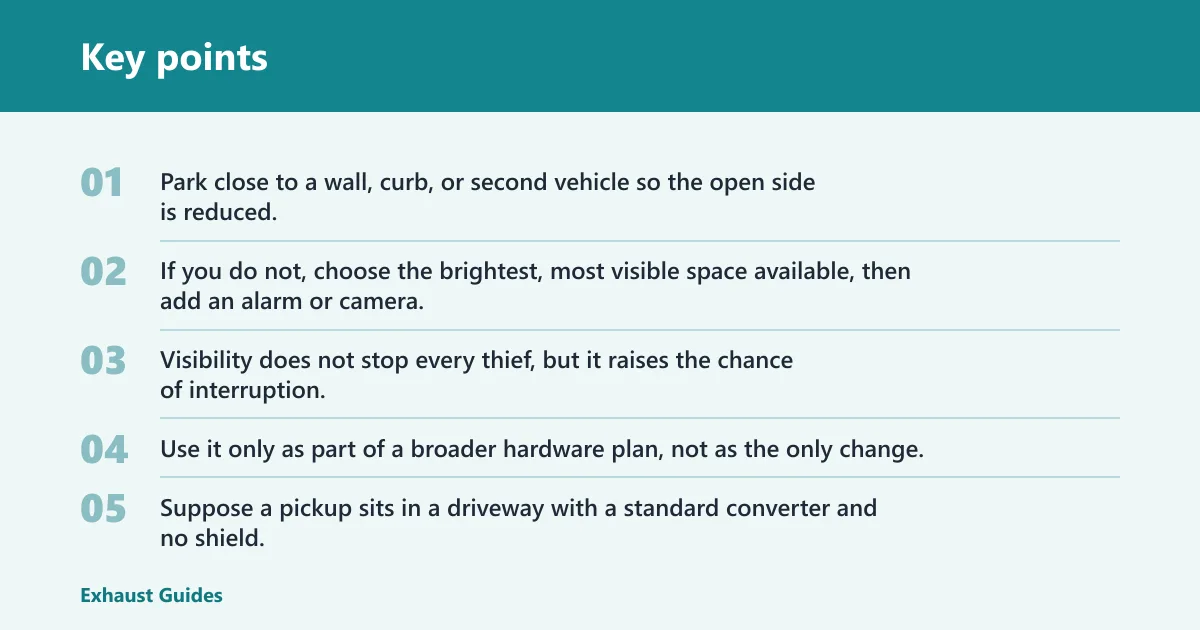
Park close to a wall, curb, or second vehicle so the open side is reduced. If you have a garage, use it. If you do not, choose the brightest, most visible space available, then add an alarm or camera. Visibility does not stop every thief, but it raises the chance of interruption.
When welding helps
For bolted-on converters, welding bolts shut can add removal difficulty and make basic hand-tool theft slower, but it should be done only by a qualified installer and only if the setup remains serviceable and legal for your vehicle and location. It is not a stand-alone solution, and it does little against a determined thief with a cutting tool. Use it only as part of a broader hardware plan, not as the only change.
Suppose a pickup sits in a driveway with a standard converter and no shield. That vehicle is easier to reach than a low sedan parked in a garage, so the better fix is a shield, anti-theft fasteners, and a better parking position combined.
What should you do if you park on the street or at work?
Street parking and open lots need the most visible deterrence because thieves have room to work quickly. Use a shield, then add lighting, CCTV, or an alarm. If the vehicle is a Prius, CR-V, truck, SUV, or 4×4, treat the space as higher risk and stack protections instead of relying on one device.
Street parking
Choose the brightest block face you can, ideally near cameras, foot traffic, or other parked cars. VIN engraving helps if a thief tries to resell the part later, but it will not stop the cut itself. For regular street parking, physical protection matters more than a marking-only approach.
Workplace and lot parking
Use a lot with active security first. If that is not available, pick spaces near entrances, cameras, or attendants. A motion alarm can help here because it increases perceived risk, and that matters in a space where a thief can otherwise work unnoticed. If you do not control the property, check whether you are allowed to install or mount any alarm or camera equipment before doing so.
Two quick decision rules
If you cannot garage the vehicle, prioritize a shield. If the vehicle is high-clearance, add security bolts too. If the parking area is shared, visible, or poorly lit, add CCTV, an alarm, or both. Use each layer to cover what the last one misses.
Common mistakes
Most failures come from treating one protection as enough. A shield without decent parking still leaves the vehicle exposed. Engraving without a barrier does the same. And a cheap alarm without a physical block may raise noise without stopping removal.
- Buying a universal part that does not fit your make and model.
- Relying on engraving alone and skipping the shield.
- Parking a high-clearance vehicle in the open when a garage is available.
- Using standard hardware that can be removed with common tools.
- Assuming lights or cameras stop thieves without any physical protection.
- Ignoring the difference between hand-tool theft and saw-based theft.
Picture a Prius left in an apartment lot with only a serial marking. The marker may help later, but it does nothing during the theft itself. Add a shield and a visible alarm, and the thief now has to spend more time, make more noise, and take on more risk.
Frequently asked questions
How can you protect your catalytic converter from being stolen?
Use a shield or cage, security bolts, and a parking spot that reduces access under the car. If the vehicle sits outside, add a motion light, CCTV, or an alarm. For higher-risk models and high-clearance vehicles, the physical barrier matters more than any single deterrent.
How can I protect my catalytic converter from theft?
Start by checking fitment for your exact make and model, then install a converter shield and anti-theft fasteners. If you park in a driveway or lot, add visible deterrents such as lighting or a camera. Marking the converter helps trace it later, but it should not stand alone.
How do I prevent my catalytic converter from being stolen?
Keep the vehicle in a locked garage or secured indoor location first. If that is not possible, park close to a wall or another vehicle and use hardware that slows removal. High-clearance trucks, SUVs, and 4x4s need the strongest setup because thieves can crawl under them more easily.
How do I protect my car from catalytic converter theft?
Match the defense to the parking setup. Garage parking may only need marking and an alarm, while street parking usually needs a shield plus visible deterrents. A low-slung car is less exposed than a tall one, but no car is fully safe without layered protection.
Is there a way to protect my catalytic converter from theft?
Yes. The best answer is layered protection: a vehicle-specific shield, anti-theft fasteners, better parking, and a visible deterrent such as lights or CCTV. Serial-number engraving can help trace stolen parts, but it works best when paired with a physical barrier.
How should I protect my catalytic converter from thieves?
Treat the problem like access control. Make the vehicle harder to reach, harder to cut, and easier to notice. For a driveway, use lights and a shield. For a workplace lot, use a camera or alarm. For a street-parking setup, choose the brightest and most visible space available.