How to Connect Exhaust Pipes Without Welding
You can connect exhaust pipes without welding by choosing the right clamp or coupler for the pipe condition: a sleeve or repair clamp for straight, same-diameter sections, a band clamp for slip joints, and a reducer or adapter when sizes differ by about 1/8 to 1/2 inch. A poor fit leaks exhaust, rattles, and can crack thin pipe. This guide shows a fit-first way to choose clamps, check diameter, and know when a clamp will hold and when a weld is the better fix.
What you’ll need


- Calipers for outside diameter measurement
- Steel tape or flexible tape as a backup check
- Replacement clamp or connector matched to pipe diameter
- Band clamp, U-bolt clamp, or saddle clamp as needed
- Exhaust sleeve connector for same-size straight joints
- Reducer sleeve for mismatched diameters
- Pipe expander for limited size correction
- Exhaust sealant rated for exhaust heat, if the joint calls for it
- Wire brush or abrasive pad
- Cutoff tool or hacksaw for damaged sections
- Safety glasses and gloves
Can you connect exhaust pipes without welding?
Yes. A clamp or coupler can make a serviceable exhaust joint when the pipe is round, clean, and sized correctly. The fit matters more than the clamp brand. If the ends are rusty, crushed, or badly mismatched, a clamp may only hide the leak for a short time.
Choose the connector by fit first
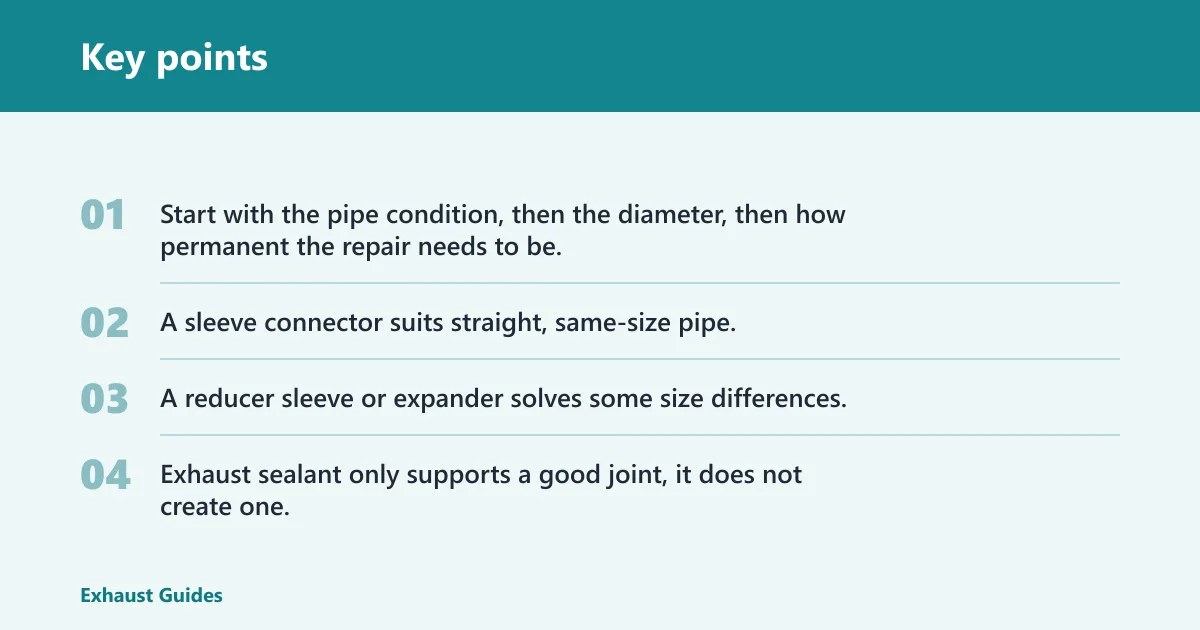
Start with the pipe condition, then the diameter, then how permanent the repair needs to be. A sleeve connector suits straight, same-size pipe. A band clamp works well on slip joints. A reducer sleeve or expander solves some size differences. Exhaust sealant only supports a good joint, it does not create one.
| Pipe condition | Size match | Recommended no-weld connector | Likely failure mode |
|---|---|---|---|
| Same-size clean pipe | Exact outside diameter match | Exhaust sleeve connector or band clamp | Leak if overlap is short or clamp is under-torqued |
| Same-size rusty pipe | Exact outside diameter match | Cut back to clean metal, then use sleeve connector | Leak or collapse from rust, pitting, or out-of-round ends |
| Different-size pipe | OD mismatch by a small amount | Reducer sleeve or expander, then clamp | Gap if the reducer does not match both ODs |
| Muffler slip joint | Male/female overlap present | Band clamp | Leak if insertion depth is short or the joint is dirty |
| Stainless system | Exact or near-exact match | Band clamp | Galling, deformation, or loose seal after heat cycling |
| Emergency roadside repair | Near match, limited tools | Band clamp with sleeve or temporary U-bolt clamp | Temporary seal only; may loosen as pipe heats and cools |
Measure the outside diameter first, then match the connector to the joint type and pipe condition. Use calipers on the pipe OD, since tape gives only a backup check. Round, clean, undamaged pipe gives the best seal. If the pipe is thin-wall, rusty, or out of round, cut back to better metal before clamping.
-
Measure the pipe OD.
Use calipers if available; a tape is a backup check, not the primary method. Measure the outside diameter on both pipes, because even a small mismatch of about 1/8 inch can change which clamp or sleeve fits. -
Inspect the joint.
Confirm whether the joint is straight overlap, slip-fit male/female, or a size change. If the ends are crushed, flared badly, or deeply rusted, plan on cutting back before you buy parts. -
Pick the connector.
Use a sleeve connector for same-size straight pipe, a band clamp for a slip joint, and a reducer sleeve for different diameters. Choose a U-bolt clamp only for temporary or semi-permanent joints on sound pipe. -
Clean the mating area.
Remove rust, scale, and grease from both pipe ends. Clean surfaces help a band clamp seal and reduce the chance that a saddle or U-bolt clamp will pinch a bad spot and still leak. -
Check insertion depth.
Slide the pipe far enough into the sleeve or slip joint to give solid overlap on both sides. If the connector does not cover the joint fully, shorten the repair or replace the damaged section. -
Tighten in stages.
Snug the clamp, align the pipes, then tighten to the recommended torque if the clamp lists one. Recheck after the first heat cycle, because exhaust heat can settle the joint and reduce clamp load.
How to make the joint fit
Fit quality decides whether the clamp seals or just squeezes the pipe. For slip-fit joints, both ends need clean contact and enough insertion depth. For same-size straight pipe, the sleeve must overlap evenly on both sides. For different sizes, use a reducer or expander instead of forcing the pipe together.
For example, a 2.25-inch pipe may need to join a 2.00-inch muffler inlet. A reducer sleeve that matches both outside diameters gives a better chance of sealing than overtightening a U-bolt clamp on the smaller pipe. Force usually bends the tube before it seals.
A common first-timer mistake is using sealant to cover a gap caused by short overlap. Sealant can fill tiny surface marks, but it cannot replace missing insertion depth or a mismatched diameter.
How do you attach a muffler without welding?
Most mufflers attach with a slip-fit joint and a band clamp, or with a sleeve connector when the outlet and inlet are the same size. The key is enough overlap, a round mating surface, and a clamp that fits the outside diameter exactly. If the inlet is damaged, repair the pipe first.
Use a band clamp on the slip joint
Slide the muffler inlet and pipe together until the overlap is even and secure, then place the band clamp over the joint. A band clamp spreads force around the full circumference, so it is commonly used for a better seal than a U-bolt on a slip joint. That matters on stainless and on joints that see heat cycling.
-
Mock up the muffler.
Fit the muffler on the hanger points before tightening the joint. Check tailpipe alignment and ground clearance so the clamp is not carrying weight it should not carry. -
Set overlap depth.
Insert the pipe until the joint has full contact on both sides of the clamp band. If the pipe bottoms out early or barely enters the muffler, use a different connector or a reducer. -
Tighten the band evenly.
Pull the clamp down gradually so the band seats squarely around the pipe. Uneven tightening can ovalize thin-wall pipe and start a leak. -
Recheck after heat.
Run the engine briefly, then let it cool and retighten if the clamp spec allows it. Heat cycling can relax a weak joint, especially on stainless or thin-wall tubing.
Common mistakes
The most common failure is trying to clamp damaged pipe. Rusty or thin-wall pipe can collapse under a U-bolt clamp, and out-of-round pipe does not give a steady sealing surface. If the pipe edge flakes when brushed, cut back farther before installing a connector.
- Choosing the wrong clamp style. U-bolt clamps are simple, but they can leak more easily on rusty or distorted pipe.
- Skipping OD measurement. Size mismatch leads to gaps that sealant cannot fix.
- Ignoring overlap. Slip joints need enough insertion depth or the clamp only squeezes the edge.
- Overtightening stainless. Stainless tubing can gall or deform if the clamp is cranked down too hard.
- Using sealant as the fix. Exhaust sealant is a helper, not a structural repair.
Do exhaust clamps work on rusty pipes?
Sometimes, but only if the rust is light and the pipe still keeps its shape. Heavy rust, pits, and flaking metal reduce clamp seal quality and can let the pipe crush under load. Cutting back to clean metal is usually the safer choice when the damage is more than superficial.
Do exhaust clamps need sealant? Not always. Use sealant only where the product is rated for exhaust heat and the joint already fits well. Do not use it to compensate for missing overlap, a crushed pipe, or a size mismatch.
How do you connect exhaust without welding on different pipe sizes?
Use a reducer sleeve when the outside diameters differ, or an expander when the smaller end only needs a limited increase to create a slip fit. The fit still has to be close. If the size jump is too large, the safer fix is to replace the section with the correct diameter.
-
Measure both ODs.
Write down the exact outside diameters before buying parts. Reducers and expanders are made for specific ranges, not broad guesses. -
Match the adapter.
Select a reducer sleeve that fits both sizes, or use an expander only within its stated range. If the gap exceeds that range, stop and cut in the correct pipe. -
Clamp the full overlap.
Center the adapter so both pipes seat fully inside the sleeve. A partial insertion leaves a leak path and weakens the joint.
Frequently asked questions
How do you connect two exhaust pipes without welding?
Measure both outside diameters, clean the ends, and choose a sleeve connector for same-size pipe or a reducer sleeve for a size change. A band clamp usually seals slip-fit joints better than a U-bolt clamp, especially when the pipe is round and the overlap is correct.
What is the best way to connect exhaust pipes without welding?
For most slip-fit joints, a band clamp is the best starting point because it applies even pressure around the pipe. For same-size straight sections, a sleeve connector gives a solid bridge. On stainless systems, band clamps are usually preferred because they reduce deformation.
Can you connect exhaust pipes without welding and still stop leaks?
Yes, if the pipe is clean, round, and matched to the connector size. Leaks usually come from short overlap, rust, ovalized pipe, or the wrong clamp style. Exhaust sealant can help at tiny surface imperfections, but it cannot rescue a poor fit.
How do you make an exhaust clamp seal better?
Clean both mating surfaces, use the correct clamp style, and confirm enough overlap before tightening. Recheck the joint after the first heat cycle. If the pipe is stainless, tighten only enough to seal; overtightening can deform the tube and make the leak worse.