
Fuel Trim Calculator: Read STFT and LTFT
A fuel trim calculator turns STFT and LTFT into a fault map. Near 0% is often typical; trims past about ±10% commonly point to a lean or rich condition. Miss the pattern, and you can chase the wrong parts, burn time, money, and scan-tool guesses. This guide shows how to read STFT and LTFT by bank and load, then match common trim patterns to likely causes.
How is this calculated?
Press Calculate to see the math with your numbers.
How STFT, LTFT, and bank readings reveal engine faults
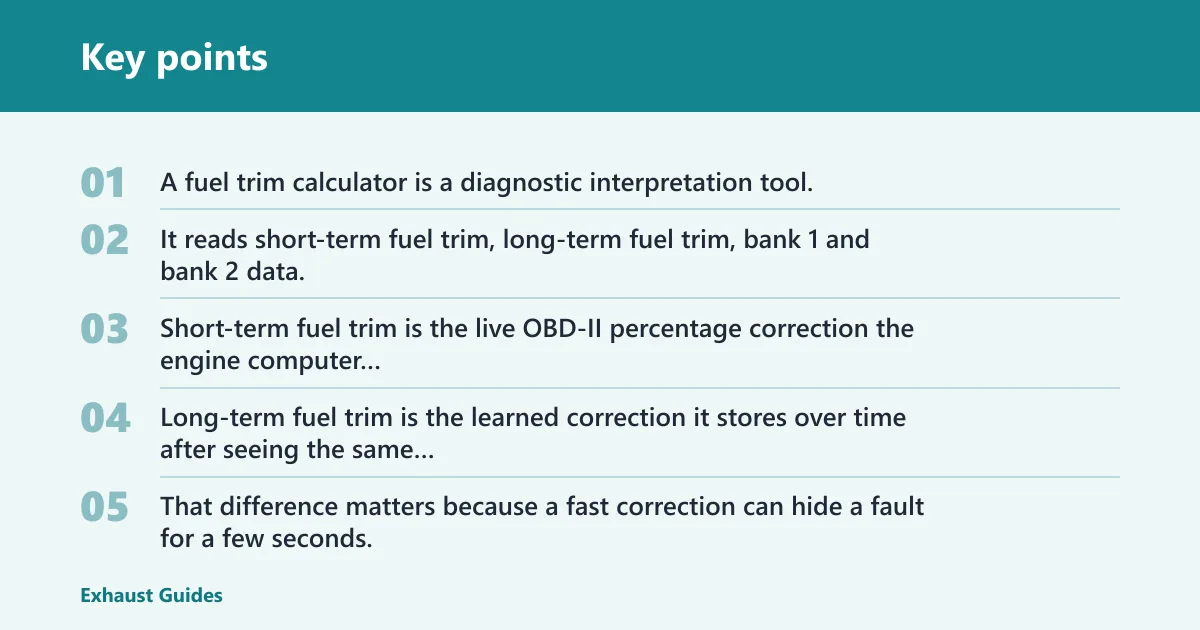

A fuel trim calculator is a diagnostic interpretation tool. It reads short-term fuel trim, long-term fuel trim, bank 1 and bank 2 data, then compares idle readings with a 2,500 rpm snapshot to help point you toward possible vacuum leaks, fuel delivery problems, sensor bias, or injector issues.
STFT vs LTFT
Short-term fuel trim is the live OBD-II percentage correction the engine computer applies right now. Long-term fuel trim is the learned correction it stores over time after seeing the same bias repeatedly. STFT moves fast. LTFT moves slowly.
That difference matters because a fast correction can hide a fault for a few seconds, while the learned trim shows what the computer has been carrying for miles of driving. When both stay biased the same direction, you have a real pattern, not random noise.
Bank-specific readings
Read bank 1 and bank 2 separately whenever the scan tool allows it. Inline engines usually have one bank, so the split is less useful there. V-engines can show one bank lean or rich while the other bank stays close to normal, which is a strong clue.
Why idle and cruise matter
Idle and 2,500 rpm reveal different faults. Vacuum leaks usually matter most at idle, because unmetered air has a bigger effect when airflow is low. Fuel pressure and delivery problems often look worse at higher rpm or under load, where the engine needs more fuel and the system has less margin.
How STFT and LTFT work
STFT and LTFT are both correction values, but they do different jobs. STFT reacts instantly to the upstream oxygen sensor or air-fuel sensor. LTFT records what the computer has learned after repeated STFT corrections. Positive fuel trim means the computer is adding fuel because the sensor feedback suggests a lean mixture. Negative fuel trim means it is removing fuel because the feedback suggests a rich mixture.
Short-term fuel trim as live correction
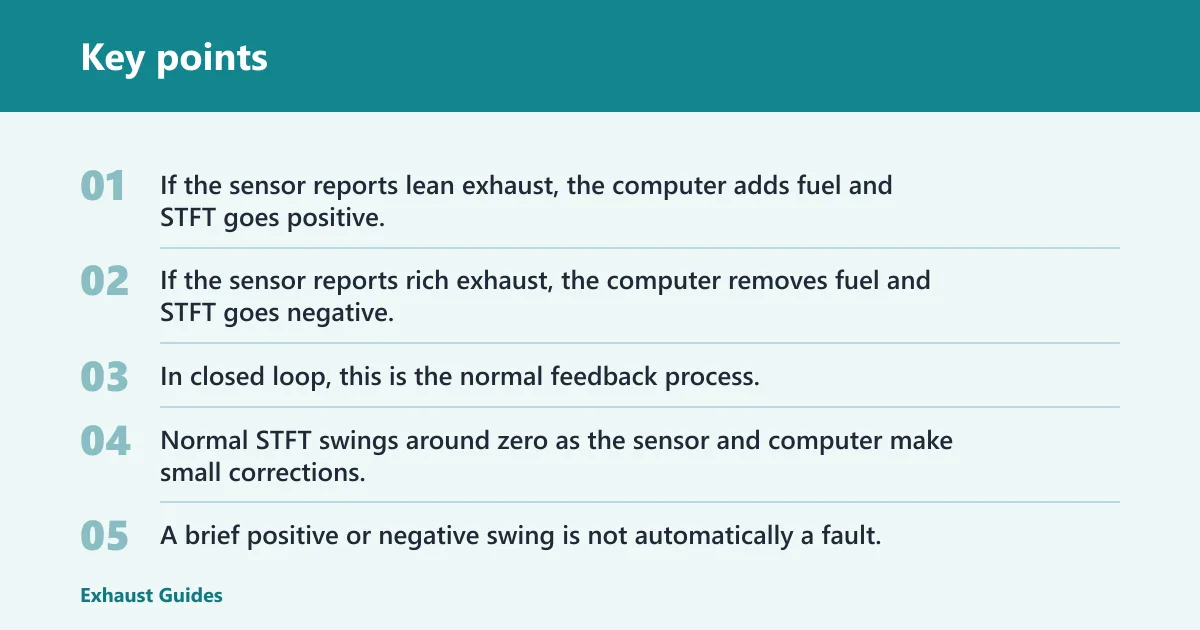
STFT is a live OBD-II percentage adjustment. If the sensor reports lean exhaust, the computer adds fuel and STFT goes positive. If the sensor reports rich exhaust, the computer removes fuel and STFT goes negative. In closed loop, this is the normal feedback process.
Normal STFT swings around zero as the sensor and computer make small corrections. A brief positive or negative swing is not automatically a fault. The important question is whether the trim stays biased, and whether the bias follows a pattern at idle, cruise, or one bank only.
Long-term fuel trim as learned correction
LTFT is the learned adaptation the computer stores after seeing the same correction trend over time. It updates gradually, not every second. If STFT keeps hovering positive for a long enough period, LTFT rises to carry some of that correction. The same happens in the negative direction.
For diagnosis, LTFT tells you whether the engine has been compensating for a persistent issue. Exact thresholds can vary by vehicle and scan tool, but trims near zero are generally considered normal, while sustained readings beyond about ±10% deserve attention. Some vehicles tolerate a little more, some less.
Positive and negative corrections
Positive fuel trim means the computer is adding fuel because it thinks the mixture is lean. That can happen from extra air entering the engine, low fuel pressure, MAF under-reporting, or an exhaust leak before the upstream sensor. Negative fuel trim means the computer is pulling fuel because it thinks the mixture is rich.
Do not treat positive trim as automatically a vacuum leak, or negative trim as automatically a bad sensor. The load pattern and bank split matter more than the sign alone.
Fuel trim interpretation table
Use this table as a text-only decision map. Start with the trim direction, then compare idle to 2,500 rpm and check whether one bank differs from the other.
| STFT | LTFT | Idle reading | 2,500 rpm reading | Likely cause | Next test |
|---|---|---|---|---|---|
| ±0% to about 5% | Near 0% | Stable, minor swing | Stable, minor swing | Normal pattern | No fault indicated; compare against other symptoms only |
| +10% to +25% | +10% to +20% | High positive at idle | Improves toward normal | Vacuum leak | Smoke test intake, hoses, brake booster, PCV lines |
| +10% to +20% | +10% to +20% | Near normal or mildly positive | Rises more positive under load | Restricted fuel delivery | Check fuel pressure, pump current, filter, regulator behavior |
| Positive or negative bias | Same direction on one bank | One bank differs from the other | Mismatch remains visible | MAF error | Inspect MAF contamination, wiring, intake leaks before the sensor |
| Negative on one bank | Negative on one bank | One bank rich | One bank stays rich | Injector imbalance | Run injector balance test, look for leaking injector, compare plugs |
| Positive | Positive or rising | Often worse at idle | May settle somewhat at higher rpm | Exhaust leak before upstream O2 sensor | Inspect manifold, gaskets, flex joint, and sensor bung for leaks |
Suppose bank 1 sits at +18% LTFT at idle and drops to +4% at 2,500 rpm, while bank 2 stays near +2% the whole time. That pattern points away from a whole-engine fuel problem and toward a bank-specific vacuum leak or intake leak on bank 1.
A common first-timer mistake is to see +15% trim and replace the MAF immediately. If the trim drops near zero when rpm rises, the stronger clue is usually unmetered air at idle, not a bad airflow sensor.
How to read bank 1 and bank 2
Bank 1 and bank 2 let you compare one side of the engine with the other. On a V-engine, a split between banks often tells you whether the fault is shared or localized. On an inline engine, a single bank means you rely more on load changes, sensor behavior, and freeze-frame data.
Inline engine patterns
An inline engine usually has one bank, so you cannot use bank-to-bank contrast. That makes idle versus 2,500 rpm even more important. If trims are high only at idle, suspect air entering after the MAF. If they climb with load, look harder at delivery pressure and volume.
V-engine bank splits
On a V-engine, one bank biased lean while the other bank stays normal often points to a bank-specific issue such as an intake leak on that side, an exhaust leak near that bank’s upstream sensor, or an injector problem on that bank. When both banks move together, think shared causes such as low fuel pressure or a MAF error.
What faults do positive and negative trims point to?
Positive trims point to lean feedback. Negative trims point to rich feedback. The useful part is the pattern. High positive trim at idle is very different from high positive trim under load, and one rich bank is very different from both banks rich at the same time.
High positive trim at idle
High positive trim at idle usually means unmetered air. A vacuum leak is the first check because idle airflow is low, so extra air has a larger effect. Look at PCV hoses, intake boots, brake booster lines, EVAP purge plumbing, and intake gaskets.
High positive trim under load
High positive trim that gets worse with rpm or load points more toward restricted fuel delivery. A weak pump, plugged filter, bad regulator, or supply problem can starve the engine when demand rises. A MAF that under-reports airflow can also create a lean correction across the load range.
High negative trim on one bank
High negative trim on one bank often points to that bank running rich. A leaking injector, an exhaust sensor bias, or a bank-specific wiring issue can do it. If the upstream oxygen sensor is slow or stuck rich, the computer may pull fuel even when the mixture is not truly rich.
How do you check fuel trim on an OBD-II scanner?
Use live data PIDs, save freeze-frame data, and compare idle with a 2,500 rpm snapshot. You are looking for the direction of correction, how fast it moves, and whether both banks agree. A scan tool that shows bank 1 and bank 2 separately gives the best picture.
Live data PIDs to watch
- Warm the engine enough for closed-loop operation.
- View STFT and LTFT for bank 1 and bank 2.
- Note idle values first.
- Hold the engine around 2,500 rpm and watch the trims settle.
- Record any bank split, large swing, or trim that stays beyond roughly ±10%.
Freeze-frame data to save
Freeze-frame data shows the operating snapshot captured when the fault set. That matters because fuel trim problems can be load dependent. If the code was stored at idle, the freeze-frame may support a vacuum leak. If it set during acceleration, fuel pressure or delivery becomes more likely.
Idle and 2,500 rpm comparison
Compare both speeds before ordering parts. A trim problem that fades at 2,500 rpm often points to a leak. A problem that worsens under load often points to delivery. If only one bank is biased, focus on that side first rather than chasing the whole engine.
Fuel trim root-cause tests
Once the pattern is clear, move to the test that matches it. Do not replace parts first. Fuel trim is useful because it narrows the fault before the wrench comes out.
Vacuum leak checks
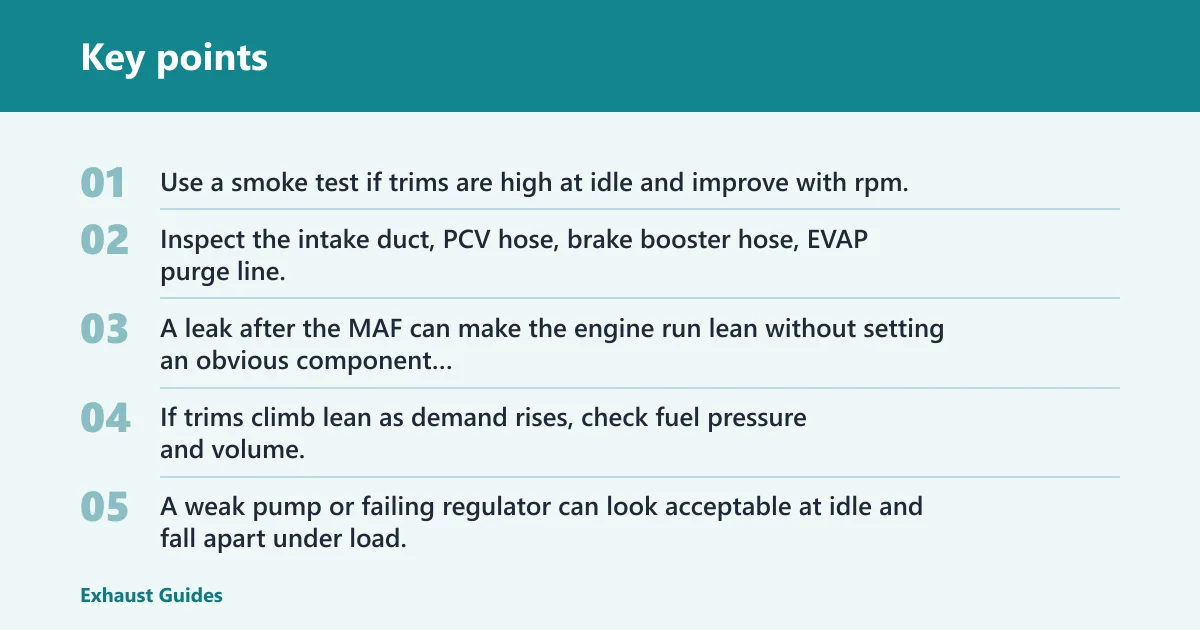
Use a smoke test if trims are high at idle and improve with rpm. Inspect the intake duct, PCV hose, brake booster hose, EVAP purge line, throttle body gasket, and intake manifold seals. A leak after the MAF can make the engine run lean without setting an obvious component code.
Fuel pressure checks
If trims climb lean as demand rises, check fuel pressure and volume. A weak pump or failing regulator can look acceptable at idle and fall apart under load. Do not stop at pressure alone if the system is returnless; look at command, supply, and volume behavior together.
MAF and sensor checks
A dirty or skewed MAF can under-report or over-report airflow. Under-reporting tends to drive positive trim because the computer adds fuel for air it did not expect. Over-reporting can drive negative trim. Inspect the sensor element, air filter path, and intake plumbing for contamination or leaks.
Injector and exhaust leak checks
For one-bank richness or one-cylinder imbalance, use an injector balance check and inspect spark plugs if the pattern points to a single cylinder. For lean-bank symptoms with no intake leak found, inspect the exhaust before the upstream O2 sensor. A leak there can pull in air and fool the sensor into reporting lean.
Frequently asked questions
How is long term fuel trim calculated?
Long-term fuel trim is built from repeated short-term corrections over time. When STFT keeps moving positive or negative in the same direction, the engine computer stores part of that correction as LTFT. The exact update strategy varies by vehicle, but the idea is always learned adaptation, not instant reaction.
How is short term fuel trim calculated?
Short-term fuel trim is the live correction the computer applies after reading the upstream oxygen or air-fuel sensor. If the sensor reports lean, STFT rises positive to add fuel. If it reports rich, STFT drops negative to remove fuel. It changes quickly in closed loop.
How to check long term fuel trim
Use an OBD-II scan tool with live data PIDs that show bank 1 and bank 2 LTFT. Check the engine warm, then compare idle with about 2,500 rpm. Save freeze-frame data if a code is present. A persistent bias near or beyond about ±10% deserves deeper diagnosis.
What is a fuel trim calculator?
In diagnostic use, a fuel trim calculator is a way to interpret STFT and LTFT as a pattern map. It helps you decide whether the engine is correcting for extra air, low fuel delivery, sensor bias, or a bank-specific problem. It is not a fuel-economy calculator here.
What should long term fuel trim be?
Long-term fuel trim should stay close to zero on a healthy engine, with minor movement depending on the vehicle and scan tool. Exact limits are not universal, but sustained readings beyond about ±10% often point to a real fault or a system adaptation that needs investigation.
Can a bad oxygen sensor change fuel trim?
Yes. A bad upstream oxygen sensor or air-fuel sensor can bias closed-loop feedback and make the computer add or remove fuel incorrectly. That can create misleading positive or negative trims even when the engine hardware is not the main problem. Sensor bias should be proven, not guessed.