Best Tip Shapes for Deeper Sound (2026): We Compared
For a deeper exhaust note, start with a larger-diameter round or slash-cut tip; avoid small, short tips if your goal is depth rather than volume. Pick the wrong shape and you usually get more bark, more drone, or no meaningful change at all. This guide compares tip shapes, explains why diameter matters more than styling, and matches common tip geometry to engine layout and sound goal.
For a deeper exhaust note, start with a larger-diameter round or slash-cut tip; avoid small, short tips if you want depth more than volume. Pick the wrong shape and you usually get more bark, more drone, or no real change at all. This guide compares tip shapes, explains why diameter matters more than styling, and matches common tip geometry to engine layout and sound goal.
Quick comparison
| Product | Badge | Best for | Price | ||
|---|---|---|---|---|---|
 |
Turn Down Exhaust Tip, 3” Inlet Black Stainless Steel,Tritrust | Our pick | 3" inlet · black finish · turn-down | $31.99
Price as of 17 Oct 2026
|
View |
 |
A-KARCK Exhaust Tip 4" Inlet, Polished Bolt On 4" Inlet 5"A-KARCK | Budget pick | 4" inlet · 5" outlet · polished | $26.99
Price as of 17 Oct 2026
|
View |
 |
Upower Square Exhaust Tip 2.5" Inlet 3" x 5.5" Outlet 9"Upower | Also great | 2.5" inlet · square angled cut · chrome | $26.99
Price as of 17 Oct 2026
|
View |
This is the fastest way to separate tone changes from cosmetic changes. The table below focuses on which shapes are most likely to lower perceived pitch, and which ones mainly change the way the note exits the car.
How we chose
We ranked shapes by expected effect on perceived pitch, not by appearance. We also weighed drone risk, fitment limits, and whether a design makes more sense on a turbocharged car, a naturally aspirated car, a truck, or a hidden-exit setup.
We compared the published specs of the listed products and the shape effects that are commonly tied to exhaust-tip geometry. We also separated outlet changes from muffler and resonator changes, because those parts do most of the real sound shaping.
The result is a practical guide: choose the smallest change that gets you the tone you want, then avoid shapes that add hollow volume without adding depth.
Resonated tip: best for smoother depth
Resonated tips are the strongest bolt-on choice for a deeper, smoother note. A resonated exhaust tip uses a perforated inner pipe wrapped in an outer shell packed with sound-absorbing material, and that layout is aimed at reducing harsh frequencies rather than simply making the exhaust louder.
That makes this shape the best match when you want less rasp, less metallic edge, and a lower perceived pitch without chasing a loud exterior note. The guide’s ranking puts resonated tips first for smooth depth, not because they transform the whole system, but because they do the most useful work right at the outlet.
Why the perforated inner pipe matters
The perforated inner pipe gives exhaust pulses a path through a packed shell instead of a bare, open exit. That extra internal path helps trim the sharp upper frequencies that make a system sound thin. The result is usually deeper by ear, even if raw volume does not rise much.
This is the shape to consider when the current note is raspy, tinny, or harsh at idle and light throttle. It is also the safest option when you want a subtle change that does not invite cabin boom.
When this shape works best
Choose a resonated tip when the main complaint is sharpness, not lack of loudness. It suits daily drivers, cars with a short rear overhang, and setups where you want a calmer exit note without replacing the muffler.
It is also a smart choice if your goal is to smooth out a freer-flowing exhaust that already has enough volume. The tip can soften the edge at the tailpipe without turning the car into a drone machine.
When not to buy this shape
Do not buy a resonated tip if you want the biggest possible exterior presence. It is built to smooth sound, and that means less bite at the outlet. It is also a poor fit if you need a tight, simple cosmetic look with minimal added length.
Dual-wall tip: best for subtle depth
Dual-wall tips are a modest but useful step toward deeper tone. They have two metal tubes with an air gap between them, and that gap can soften sharp vibrations before they leave the outlet. The sound change is usually smaller than with a resonated tip, but still useful.
This shape is best when you want a cleaner-looking tip and a slight drop in harshness without committing to a chambered design. Think of it as a mild tone shaper, not a major sound part.
How the air gap softens sharpness
The air gap between the two metal tubes reduces some of the direct metallic edge that a thin single-wall outlet can produce. That can make the exhaust note seem a little rounder and less brittle, especially on a system that already has decent muffling.
Because the change is subtle, dual-wall tips work best when the rest of the exhaust is already close to the target sound. They add polish to the note more than they add volume or true low-end depth.
Megaphone tip: best for maximum presence
Megaphone tips can add the most presence, but they also tend to add the most volume. A megaphone tip flares out gradually like a trumpet bell, and that flare can drop perceived pitch while letting more sound energy escape. It is the most attention-getting of the common shapes here.
That does not mean it is the deepest in a clean, refined sense. It means the exit note often sounds larger and more forceful, which some drivers prefer on muscle cars and similar setups.
Why the flared outlet can drop pitch
The gradual flare changes how the exhaust pulse exits, and the broader outlet can make the note seem lower and fuller. The tradeoff is that the same shape often raises the overall level of exterior noise. Depth and loudness often rise together with this design.
That is why megaphone tips are better for presence than for a quiet, smooth tone. They can make a car sound bigger, but they can also cross into boomier territory if the rest of the system is already loud.
Best engine types for this shape
Megaphone-style tips tend to work best on naturally aspirated V6 and V8 setups that already have a throatier exhaust note. Naturally aspirated engines usually respond more clearly to tip changes because their exhaust pulses are stronger and less muted at the tailpipe.
On a turbocharged car, the same tip can still change the exit sound, but the difference is usually less dramatic. The turbo turbine already reduces pulse intensity, so the tip has less raw energy to work with.
Turndown tip: best for hidden exits
Turndown tips are useful when you want the outlet to sit out of view or when you want the sound to spread differently near the pavement. A turndown exhaust tip curves down toward the pavement instead of pointing straight back, so it changes perceived cabin and exterior sound more than it changes true pitch.
This shape is often used on trucks and hidden-exhaust builds. It is practical, but it is not the first choice if your only goal is a cleaner, deeper note from the rear of the vehicle.
How downward exit direction changes perception
By aiming sound toward the ground, a turndown tip can change how the note reaches you and bystanders. That can reduce the direct rearward blast, but it can also make the tone seem less crisp. In some setups, the result is a little deeper by ear and a little less sharp outside the vehicle.
That effect depends heavily on ground clearance, pipe angle, and how close the outlet sits to panels or the bumper. It is a layout-driven change as much as a sound-driven one.
Truck and work-vehicle use cases
Turndown tips fit trucks, work vehicles, and hidden-exit builds where appearance and clearance matter more than a polished rear view. They are useful when the goal is to keep exhaust tucked away or to keep soot and heat away from a visible rear fascia.
They can also make sense when you want a bit less direct cabin harshness from the outlet position. Still, the muffler does most of the heavy lifting if the goal is a deep, controlled note.
Which tip shape deepens sound most?
Resonated tips deepen sound most when the goal is a smoother, lower, less raspy note. Megaphone tips can sound bigger and lower, but they usually add more volume and risk more boom. Dual-wall tips are subtle. Turndown tips change perception more than pitch. Intercooled tips sit in the middle and are usually a mild smoothing choice.
Exhaust tip shape decision matrix
| Shape | Expected effect on pitch | Effect on volume | Best engine type | Common failure mode | Fitment risk |
|---|---|---|---|---|---|
| Resonated tip | Most likely to sound deeper and smoother | Usually little change, sometimes a slight reduction in harshness | Naturally aspirated or turbocharged, especially if rasp is the problem | Too quiet or overly muted if the rest of the system is already tame | Moderate, because length and shell size can limit rear clearance |
| Megaphone tip | Can lower perceived pitch, but often with a larger note | Usually increases volume the most | Naturally aspirated muscle cars | Drone, boom, or a hollow rear note | Moderate to high, depending on flare diameter and bumper space |
| Dual-wall tip | Slightly deeper, mainly less sharp | Usually minimal change | Any street car needing a mild tone tweak | Little audible change, so the owner expects too much | Low to moderate |
| Intercooled tip | Mellower, sometimes a little less harsh | Usually small change | Light-duty street use where smoothness matters | Looks technical but does not deeply alter tone | Moderate, because shell shape can complicate fitment |
| Turndown tip | Often changes perceived sound more than actual pitch | Can feel quieter or less direct outside the car | Trucks and hidden-exhaust builds | Ground clearance or cabin boom near the rear axle | High if the outlet sits close to the pavement or suspension |
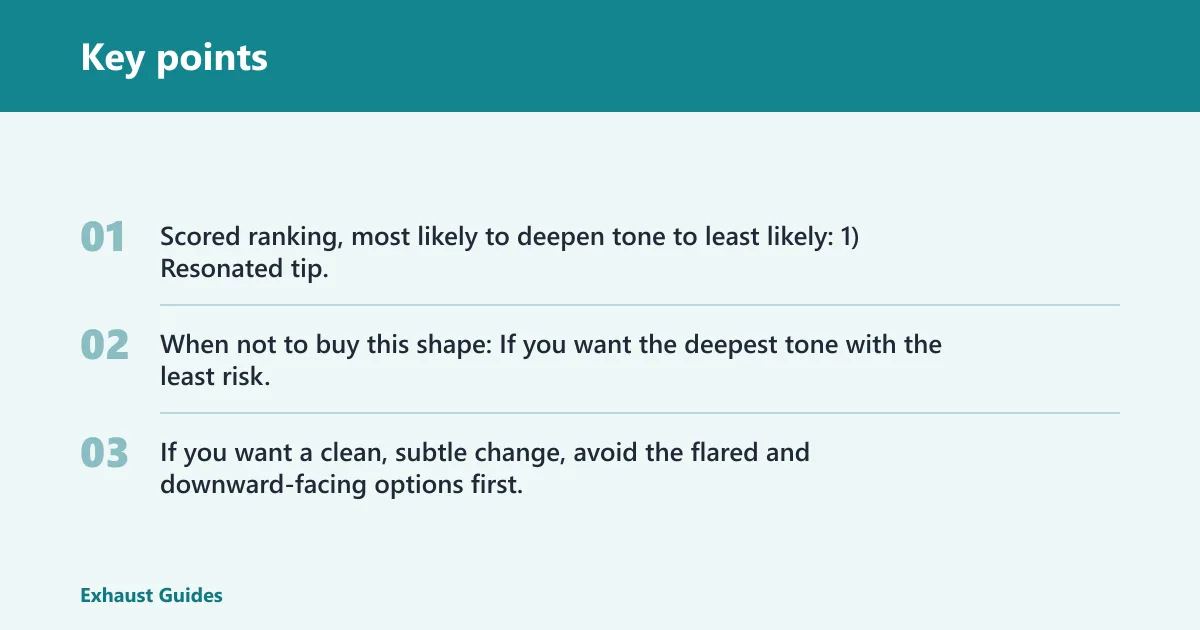
Scored ranking, most likely to deepen tone to least likely: 1) Resonated tip, 2) Megaphone tip, 3) Dual-wall tip, 4) Intercooled tip, 5) Turndown tip.
When not to buy this shape: If you want the deepest tone with the least risk, avoid megaphone and oversized turndown choices unless you already know the system needs more exterior presence. If you want a clean, subtle change, avoid the flared and downward-facing options first.
Does tip size affect sound?
Tip size can affect sound, but usually less than a muffler or resonator. Diameter, length, and outlet shape all influence how the exhaust note exits, yet they still do far less than a muffler or resonator. Bigger can sound deeper up to a point, but too much size can create a hollow or boomy note.
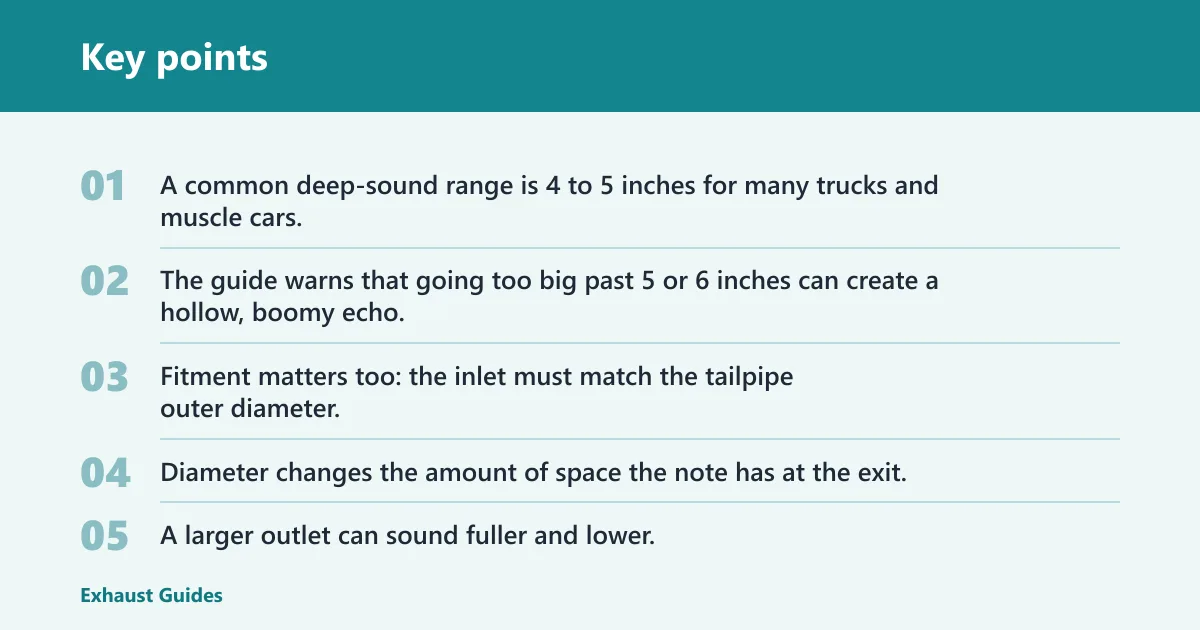
A common deep-sound range is 4 to 5 inches for many trucks and muscle cars. The guide warns that going too big past 5 or 6 inches can create a hollow, boomy echo. Fitment matters too: the inlet must match the tailpipe outer diameter, or the size change never works as intended.
Diameter
Diameter changes the amount of space the note has at the exit. A larger outlet can sound fuller and lower, especially when it stays within the common 4 to 5 inch range. Once the outlet gets too large, the note can lose focus and pick up an echo-like quality.
That is why a large tip is not automatically a better tip. It may increase presence, but it can also turn the rear note hollow.
Length
Longer tips generally deepen tone because the exhaust gas has more room to interact with the internal walls before exiting. On resonated tips, longer length also means more chamber volume and packing material to work with. Short tips change sound less because they give the gas less path length and less surface interaction.
That makes length useful when you want a modest drop in harshness without moving to a much larger outlet. It also matters when bumper depth or rear fascia clearance limits what you can install.
Why bigger is not always deeper
Once a tip gets too large, the sound can lose definition. Instead of a lower note, you may get a loud, hollow exit that sounds less controlled. That is the main reason to avoid chasing outlet size as the only variable.
Say your car already has a straight-through muffler and a 3.5-inch tip. Jumping to a very large outlet may not make it sound deeper at all; it may simply make the rear note boomier and more obvious from outside the car.
Will an exhaust tip change the sound?
Yes, but usually in a limited way. An exhaust tip can change the sound at the outlet by altering reflection, exit angle, and available chamber volume, yet it does not replace what a muffler or resonator does. If you want the biggest sound change, the muffler is still the main part to change.
Think of the tip as the final filter. It can soften rasp, add a little depth, or increase presence, but it will not turn a quiet system into a loud one by itself.
How to make exhaust sound better
The best path is to decide whether you want deeper tone, lower rasp, or more exterior presence. If you want deeper and smoother, start with a resonated tip or a longer, properly sized outlet. If you want more presence, a megaphone shape can do that, but it also raises volume.
Use fitment as a filter before buying. The inlet must match the tailpipe outer diameter, and rear fascia clearance can rule out flared or longer designs. If the tip is too large, or too close to the bumper, the result can be hollow, noisy, or simply impossible to install cleanly.
- Identify the current problem: rasp, thinness, lack of volume, or awkward exit position.
- Choose the shape that targets that problem without adding a new one.
- Confirm inlet diameter, outlet size, and total length against your tailpipe and bumper clearance.
- Prefer resonated or dual-wall when you want tone control, and megaphone when you want presence.
- Skip oversized outlets if the system already booms or drones.
Suppose a turbo sedan sounds flat at idle but turns harsh above 2,500 rpm. A resonated tip can smooth the edge better than a giant outlet can. The turbo already softens pulses, so a huge tip often adds more bulk than depth.
Which one should you buy?
For the deepest tone with the least risk, start with a resonated tip. It is the most reliable bolt-on choice for a deeper, smoother sound, and it is least likely to create a hollow rear note when sized correctly.
For turbocharged cars, keep expectations modest. Turbo cars usually change less from the tip alone because the turbine reduces exhaust pulse intensity. A resonated tip or mild dual-wall design is usually the safest first move.
For naturally aspirated cars, especially V6 and V8 setups, a megaphone tip can add more presence and perceived depth, but it also brings more volume. If you want the deepest note without the extra bark, choose resonated first and megaphone only if you are comfortable with more sound.
For trucks and hidden-exhaust builds, a turndown tip can make packaging easier and change how sound leaves the rear of the vehicle. It is practical, but it is not the strongest pick if the goal is a refined low note. In that case, a larger resonated or dual-wall tip usually makes more sense.
Budget matters too. If you want a low-cost, small change, dual-wall is the least dramatic but often the easiest to live with. If you want the clearest tone change, spend on a resonated design before chasing a larger outlet or a more extreme flare.
Product notes based on published specs and reviews:
A-KARCK 4-inch inlet 5-inch outlet tip: best for mild deepening
This is the practical pick for a modest tone change. The published dimensions include a 4-inch inlet, a 5-inch outlet, and a 12-inch length, which fits the common deep-sound range without going so large that the rear note should turn hollow on every vehicle.
It suits drivers who want a simple bolt-on change, a bit more depth, and a polished stainless look. The length helps give the exhaust gas more room before exit, which can help the note feel fuller than a short cosmetic tip would.
The honest drawback is that it is still a tip, not a muffler. If your exhaust is raspy or drone-prone, this will not fix the core problem. The published drainage hole may help with rust buildup, but it does not change that sound change will remain modest compared with a muffler swap.
Tritrust turn-down tip: best for hidden exit use
This is the right choice when you want a turn-down layout with easy bolt-on installation. The 3-inch inlet and black stainless finish make it a fitment-oriented option for tucked-away exits, work vehicles, and truck builds where the outlet should not point straight rearward.
Its downward exit direction can change perceived sound near the pavement and may feel less direct than a straight outlet. That can help in hidden-exhaust setups, but it is not the best route if your only goal is a deeper, cleaner rear note.
The drawback is simple: a turndown tip is not the best shape for maximum tone depth. It is more about packaging and exit direction than about reducing rasp or lowering pitch in a controlled way.
Upower square angled-cut tip: best for appearance-led fitment
This welded stainless tip is the most shape-forward option in the group. The 2.5-inch inlet, 3 x 5.5-inch outlet, and 9-inch length make it useful when you want a squared, angled-cut exit and a secure fit rather than a subtle sound tweak.
Based on the manufacturer’s specs and buyer feedback, it is better for a customized look than for the deepest tone. The angled cut and square outlet can change how the exhaust exits, but the sound effect is usually secondary to the styling effect.
The drawback is fitment sensitivity. A welded design demands more commitment, and the square shape may not suit every rear fascia or clearance situation. If your goal is a lower, smoother note, a resonated round tip is usually the better first buy.
What exhaust tips sound the best
Resonated tips sound the best for most drivers who want a deeper, smoother exhaust note without extra rasp. They trim harsh frequencies better than simple cosmetic tips and usually do it with less drone risk than a big flared outlet. If you want the most volume and presence, megaphone tips are louder, not better.
Does exhaust tip size affect sound?
Yes. Tip size affects how the exhaust note exits, and diameter and length both matter. A 4 to 5 inch outlet often works well for many trucks and muscle cars, but going too large past 5 or 6 inches can make the note hollow or boomy instead of deeper.
What muffler gives the deepest sound
A deeper exhaust note usually comes from a muffler designed to reduce high-frequency harshness and let lower frequencies remain. In practical terms, chambered and resonated mufflers are the common routes people look at for depth, while straight-through designs often prioritize flow and a louder, sharper sound.
Does an exhaust tip change the sound?
Yes. The outlet shape changes how sound exits, which can affect pitch, volume, and rasp at the rear of the vehicle. The effect is smaller than a muffler change, but it is real, especially with resonated, megaphone, or longer large-diameter tips.
What mufflers sound the best
The best-sounding muffler depends on the goal. For a deep, controlled note, many drivers prefer a design that calms harsh frequencies without killing the low end. For a louder or more aggressive note, a different muffler may fit better, but it may also add drone or rasp.
What is the best sounding exhaust system?

The best-sounding exhaust system is the one that matches the engine, cabin sensitivity, and desired volume. A system that sounds ideal on a naturally aspirated V8 can be too loud or too thin on a turbo car. Tip choice helps at the outlet, but the muffler and resonator determine the core note.