Best Exhaust System for a 6.7 Powerstroke
The best exhaust system for a 6.7 Powerstroke is usually a 4-inch system for towing and daily driving; choose 5-inch only for higher-horsepower single-turbo builds, and keep stock diameter if quiet cabin manners matter most. Pick the wrong size, and you can end up with drone, unwanted soot smell, or extra cost without any real gain. This guide breaks down the best exhaust by use case, turbo setup, and noise tolerance with a simple decision matrix.
For most owners, “best” means the best balance of sound, fitment, corrosion resistance, and the way the truck is actually used. On the 6.7L Powerstroke, that usually means a 4-inch street-legal DPF-back system for a stock-turbo or mildly tuned truck, not a bigger pipe just because it sounds tougher.
Top aftermarket exhaust picks for your truck


4-inch vs 5-inch at a glance
The core trade-off is simple. A 4-inch system usually gives the better mix of quiet operation, easier fitment, and towing comfort. A 5-inch system fits higher horsepower goals better, and it matters less when cabin noise is not a priority.
| Criterion | 4-inch exhaust | 5-inch exhaust |
|---|---|---|
| Best use | Daily driver, tow rig, mixed street use | High-horsepower, race-oriented, show-style builds |
| Sound | Quieter, more restrained tone | Louder, deeper tone |
| Drone risk | Very low compared with 5-inch | Higher, especially around 1,800–2,000 RPM |
| Fitment | Closer to factory routing, usually easier under a Super Duty chassis | More likely to need heat shield or spare tire attention |
| Horsepower support | About 600–650 HP | Required only for builds exceeding 700–900 HP |
| Typical buyer fit | Stock turbo, tuned stock turbo, towing focus | Built turbo, louder street truck, off-road-only setup |
Where each diameter fits
Ford’s 6.7L Powerstroke uses a Variable Geometry Turbocharger, so exhaust sizing is not only about raw flow after the turbo. Spool behavior, exhaust velocity, and cabin noise still matter, especially on a stock-turbo truck that spends time towing or cruising at steady RPM.
Competitor guidance for 2011–2019 Ford 6.7L Powerstroke owners places 4-inch as the optimal choice for most trucks, with 5-inch reserved for high-horsepower builds, show trucks, or race-oriented setups. That split still lines up with real ownership priorities on later trucks, daily comfort first, pipe size second.
What to avoid
A common mismatch is putting a 5-inch system on a quiet tow rig and then trying to fix the cabin noise later with mufflers, resonators, or extra bends. Another is paying for a large stainless system on a short-term truck that lives in a dry climate and will not see long service life.
Say your truck is a crew cab that tows a camper twice a month and spends the rest of the week on highway commutes. A 4-inch system is the cleaner fit, because the added tone stays more manageable when the cab is long and the truck runs steady RPM.
Does the VGT turbo change exhaust sizing?
Yes. The 6.7 Powerstroke’s Variable Geometry Turbocharger changes the way exhaust size should be judged, because the turbo itself affects spool, backpressure behavior, and how much you notice drone or response changes after the turbo. Bigger is not automatically better here.
Stock-turbo vs upgraded-turbo fit
On a stock turbo, a 4-inch exhaust is the safer choice for most trucks because it supports the engine without pushing noise and fitment problems up the list. The same logic holds for tuned stock-turbo trucks unless the power target has moved into built-engine territory.
Once the truck moves to an upgraded turbo and substantially higher output, the value of a 5-inch system rises. That is the point where the larger pipe is tied to the build, not just to the owner wanting a deeper sound.
What changes after a DPF delete or race pipe setup
A DPF delete race pipe is not the same thing as a street-legal DPF-back exhaust. The race pipe replaces factory aftertreatment parts in an off-road-only context, while a full exhaust on a street truck is usually chosen around the DPF-back layout, fitment, and sound control.
That matters because post-delete diameter choices can open the door to louder setups, but they also raise inspection, emissions legality, and resale concerns. A deleted truck may tolerate more sound, yet that does not make 5-inch the right answer for every off-road build.
Will a 5-inch exhaust drone in a crew cab?
It can. A 5-inch system has a higher risk of highway resonance, and the issue is most often noticed near 1,800–2,000 RPM in crew cab trucks. That is exactly where towing and long freeway runs can make a loud exhaust feel tiring.
Cab style and highway use
Crew cabs amplify cabin complaints because the rear seat area becomes part of the sound picture, and the longer interior can make resonance easier to notice. A regular cab is usually less sensitive, while a crew cab that tows often is the one most likely to expose drone.
Suppose the truck is a crew cab with a 5-inch straight-through system and a 70 mph cruise that lands near the drone band. The exhaust may sound good in town, then wear on passengers during a 3-hour tow because the same tone repeats at a steady engine speed.
Sound targets
If the goal is a quiet daily driver, 4-inch is the safer call. If the goal is a deeper, louder tone and you accept more cabin noise, 5-inch fits that brief better. Sound preference should be treated as part of the purchase, not an afterthought.
Do you need stainless steel or aluminized steel?
For long-term ownership, T409 stainless steel is the better choice because of corrosion resistance. Aluminized steel is cheaper up front, but it is more vulnerable in northern or coastal regions where salt, slush, and damp air shorten service life.
Aluminized steel for dry climates and lower cost
Choose aluminized steel when the truck lives in a dry area, the budget is tight, or the truck is not expected to stay in service for years. It can make sense on a work truck or a short-ownership build, especially when the rest of the truck does not justify premium exhaust spend.
T409 stainless steel for salt, snow, and long service life
T409 stainless steel fits trucks that face winter roads, coastal air, or long ownership. It also tends to hold resale appeal better, because buyers often prefer a system that looks cleaner and is less likely to show rust at the seams and joints.
Finish, corrosion, and resale tradeoffs
Material choice is not only about appearance. Rust resistance affects clamp life, hanger condition, and how often the truck needs exhaust work later. If the truck is a keeper, stainless is easier to justify. If it is a short-timer, aluminized often wins on cost.
Exhaust decision matrix
This matrix ties truck setup to the pipe that actually fits the job. It also flags common mismatches, because the wrong exhaust choice usually shows up as drone, extra cost, fitment hassle, or a system that is louder than the owner wanted.
| Truck setup | Towing frequency | Cab style | Horsepower target | Climate | Noise tolerance | Recommended diameter/material | Do not buy |
|---|---|---|---|---|---|---|---|
| Stock turbo, daily driver | Occasional | Any cab, especially crew cab | Stock to mild tune | Any, with salt favoring stainless | Low | 4-inch, T409 stainless if kept long term; aluminized in dry climates | 5-inch straight-through system |
| Tuned daily driver | Light | Crew cab or regular cab | Up to about 600–650 HP | Dry or moderate | Medium | 4-inch, stainless if winter roads matter | Race pipe or oversized 5-inch setup |
| Tow rig | Frequent | Crew cab | Stock turbo or mild tune | Snow or salt climate | Low | 4-inch, T409 stainless | 5-inch if cabin comfort matters |
| Built-turbo truck | Rare | Any | 700–900+ HP | Any | Medium to high | 5-inch, stainless preferred | 4-inch if the build is truly beyond that range |
| Off-road-only delete truck | Varies | Any | Build-dependent | Salt regions favor stainless | Varies | Race pipe plus appropriate downstream diameter | Calling a delete pipe “street legal” |
Practical fitment notes
Competitor fitment notes point to 4-inch systems following factory routing closely and clearing the spare tire without modification more often than 5-inch systems. Five-inch installs may need heat shield bending or spare tire repositioning, although that varies by kit and model year.
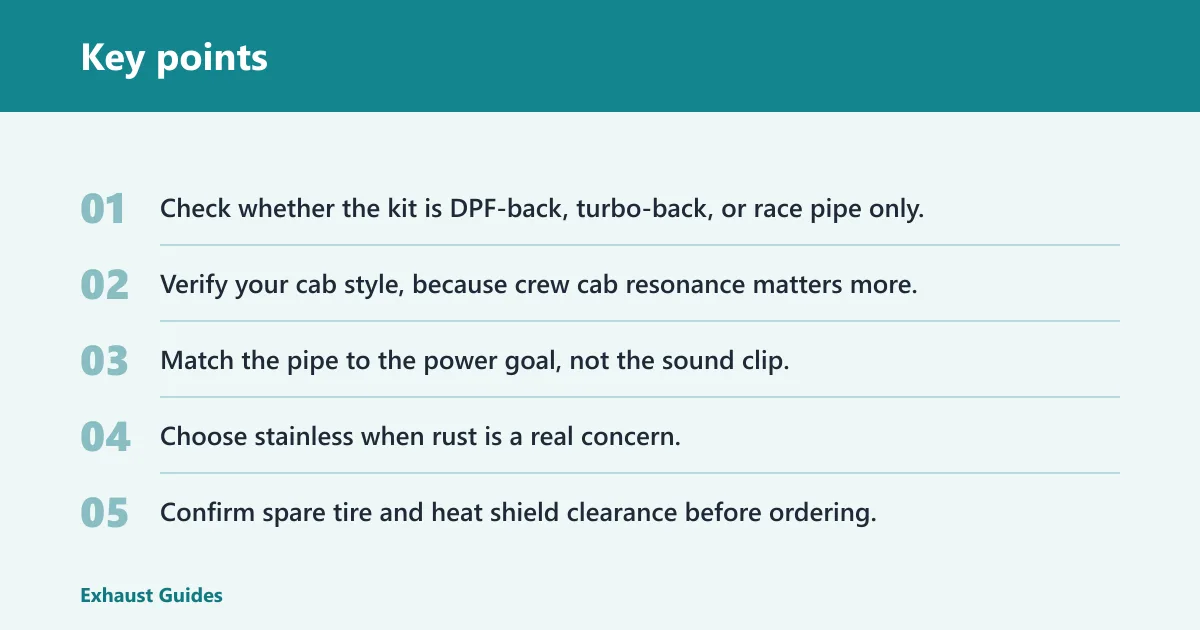
- Check whether the kit is DPF-back, turbo-back, or race pipe only.
- Verify your cab style, because crew cab resonance matters more.
- Match the pipe to the power goal, not the sound clip.
- Choose stainless when rust is a real concern.
- Confirm spare tire and heat shield clearance before ordering.
Choose 4-inch if or 5-inch
Choose 4-inch if your truck is a daily driver, tow rig, or stock-turbo setup that needs calm highway manners and easy fitment. Choose 5-inch if your build is louder, higher power, and less sensitive to cabin noise or install complexity.
Choose 4-inch
- You tow regularly and want lower drone risk.
- Your truck is stock turbo or mildly tuned.
- You drive a crew cab and care about highway comfort.
- You want the fitment path that usually stays closer to factory routing.
Choose 5-inch
- Your build is headed past 700–900 HP.
- You have a built turbo and want a louder, deeper tone.
- You do not mind more cabin resonance.
- You are working with an off-road-only setup where sound and flow matter more than quiet.
Frequently asked questions
Is a 4-inch exhaust better than a 5-inch exhaust on a 6.7 Powerstroke?
For most 6.7 Powerstroke trucks, yes. A 4-inch exhaust is the better fit for towing, commuting, and stock-turbo or mildly tuned setups because it is quieter, fits easier, and has less drone risk. A 5-inch system belongs on higher-horsepower builds where noise is less of a concern.
Does a 6.7 Powerstroke have an exhaust brake?
Yes, the 6.7 Powerstroke uses the VGT turbo to create exhaust braking effect. That is one reason exhaust sizing should not be treated like an old-school diesel with a fixed turbo. The turbo’s control strategy affects how the truck responds on descents and during towing.
Should I choose a race pipe or a full exhaust on a 6.7 Powerstroke?
Choose a race pipe only for off-road-only, emissions-delete contexts. Choose a full exhaust if you want a street-legal DPF-back setup that keeps the truck easier to register, inspect, and resell. The two are not interchangeable, and they should not be treated as the same purchase.
Which exhaust is best for towing with a 6.7 Powerstroke?
A 4-inch system is usually best for towing because it balances sound, fitment, and cabin comfort better than a 5-inch setup. Crew cab tow rigs are especially sensitive to drone, so the quieter diameter usually makes for a better long-haul truck.
Will a 5-inch exhaust drone in a 6.7 Powerstroke crew cab?
It can. Crew cab trucks are more likely to notice drone around 1,800–2,000 RPM, which often lines up with highway cruising and towing. That does not happen with every kit, but the risk is high enough that buyers should plan for it before choosing 5-inch.
Do I need stainless steel or aluminized exhaust on a 6.7 Powerstroke?
Choose T409 stainless steel if the truck faces snow, road salt, coastal air, or long-term ownership. Choose aluminized steel if the truck lives in a dry climate and you want to reduce upfront cost. The right choice depends more on corrosion exposure than on power level.