Are Valved Exhaust Systems Worth It? Sound, Drone, Cost
If you want selectable sound, lower cabin drone, or a quieter commute, a valved exhaust can be worth it even when power gains are modest. Pick the wrong setup and you can pay for noise, fitment, or valve failures without getting the sound control you wanted. This guide covers sound, drone, legality, performance, cost, and the fitment checks that decide whether a valved system makes sense for your car.
This guide is part of our Exhaust system performance guide series.
What a valved exhaust does

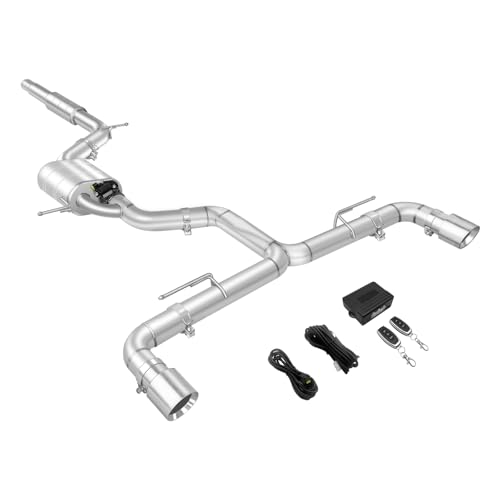

A valved exhaust adds an exhaust bypass valve that opens and closes a second path around part of the exhaust. In closed mode, gases take the quieter path through more attenuation. In open mode, more flow bypasses that restriction, so the car sounds louder and often sharper. The result is sound control, not automatic horsepower.
Open and closed sound modes
Closed mode usually routes exhaust through the muffler and, in some systems, a longer path that cuts cabin drone. Open mode sends more flow through the bypass, reducing muffling and increasing volume. The tone can change too, because the system may alter which chambers and pipe lengths the gases pass through.
That matters most on a daily driver. A quieter cold start, lower highway drone, and a louder sport setting can all live in one system if the valve logic is good and the rest of the exhaust matches the car.
Vacuum, electric, and electronic actuation
Valves are usually moved by a vacuum actuator, an electric motor, or an electronic control module. Vacuum systems can react quickly, but they depend on hoses, reservoir vacuum, and solenoids. Electric actuators avoid vacuum plumbing and are easier to package on newer cars, though the motor and geartrain add their own failure points. Electronic control integrates the valve with drive modes, throttle position, speed, or a manual switch.
Response speed is part of the appeal. A slow actuator can leave the car in the wrong mode for a few seconds, which may make a cold start louder than expected or leave the cabin droning at cruise.
Valved exhaust value matrix
Valved exhaust value depends on vehicle type, driving pattern, budget, and what you care about most. If sound control is the priority, the system can be strong value even with little performance change. If you want pure power per dollar, a simpler exhaust often wins.
| Vehicle type | Driving pattern | Budget | Priority | Sound benefit | Drone reduction | Performance upside | Complexity | Likely payback |
|---|---|---|---|---|---|---|---|---|
| Turbo daily driver | Mixed city and highway | Mid to high | Comfort plus sport sound | High | High | Low to moderate | Moderate | Strong if cabin comfort matters |
| Naturally aspirated daily driver | Mostly commuting | Mid | Selectable volume | High | Moderate | Low | Moderate | Good if you want quiet when needed |
| Track-focused car | Weekend and event use | High | Noise control for road use | Moderate | Moderate | Low to moderate | High | Good if track and street use share one car |
| Winter commuter | Short trips and cold starts | Low to mid | Cold-start control | Moderate | High | Low | Moderate | Good if you value neighbor-friendly operation |
| Budget build | Occasional weekend driving | Low | Sound per dollar | Moderate | Low to moderate | Low | High | Weak unless sound control is the main goal |
Do valved exhausts improve performance?
Sometimes, but not in the simple “more valve equals more horsepower” way. On street cars, a valved exhaust often changes where and how exhaust gas flows, which can affect backpressure and flow velocity. The gain depends on engine type, turbocharging, pipe size, muffler design, and whether the open path actually reduces restriction at the RPM range you use.
Turbo engines versus naturally aspirated engines
Turbo engines can benefit differently because the turbine already creates a major restriction upstream. On many turbo cars, the valve mainly changes sound and downstream restriction, so the power change may be small unless the rest of the exhaust is also restrictive. Naturally aspirated engines are more sensitive to exhaust tuning, but a valve still is not a guaranteed gain.
Suppose a turbo sedan uses a valved rear section and keeps the factory catalytic converter and midpipe. You may get a louder open mode and a quieter cruise mode, while peak power changes little. If the same money buys a better-flowing cat-back with no valve, power gains may be similar and the sound may be fixed.
Backpressure and flow path changes
Some drivers expect a valve to reduce backpressure everywhere. That is not how most systems work. Closed mode usually adds attenuation, and open mode may reduce restriction through a bypass, but the result depends on the muffler, resonator, pipe diameter, and catalytic converter. A valved muffler can also keep drone down without choking the whole system.
That is why a valve is best judged as a sound-control tool first. Performance can improve at specific RPM ranges, but it is not a universal horsepower add-on.
Are they worth it for daily driving?
For a daily driver, they can be worth it if you care about cold-start noise, highway drone, or keeping the car civil in neighborhoods. The value is highest when the same car has to do quiet commuting and also sound good on demand. If you rarely change modes, a simpler exhaust may make more sense.
Cold start noise and neighbor-friendly mode
Cold starts are where valve control helps most. Many engines run richer at start-up and sound louder before the catalyst and muffler warm up. A closed valve can keep that wake-up noise lower, which helps in garages, apartment lots, and early-morning departures.
Highway drone and commute comfort
Highway drone is the main comfort reason to buy one. Resonator tuning targets certain frequencies, and a valve can help by changing the exhaust path at cruise. On a commuter that spends long periods at one speed, that can be worth more than a small dyno change. If the drone is around 1,800 to 2,500 rpm in top gear, valve control can be especially useful.
Winter use and short-trip behavior
Winter and short-trip use add another angle. Road salt, slush, and cold cycles can stress linkages, connectors, and vacuum lines. Frequent short trips also mean more condensation in the exhaust, which is hard on actuators and welded joints. In those conditions, simple hardware can age better unless the valve design is sealed well.
A common first-timer mistake is choosing a permanently aggressive exhaust for track-day noise and then realizing the early-morning neighborhood crawl is where a valved setup would have been worth it. A valved setup helps only if the closed mode is genuinely quiet enough.
Cost, install, and legality
How much a exhaust system costs depends on the valve type, control hardware, and labor. A simple non-valved axle-back is cheaper than a valved cat-back, and a retrofit with a control module, wiring, or vacuum plumbing adds more. The more the system has to integrate with factory electronics, the more the labor bill can climb.
Parts cost by actuation type
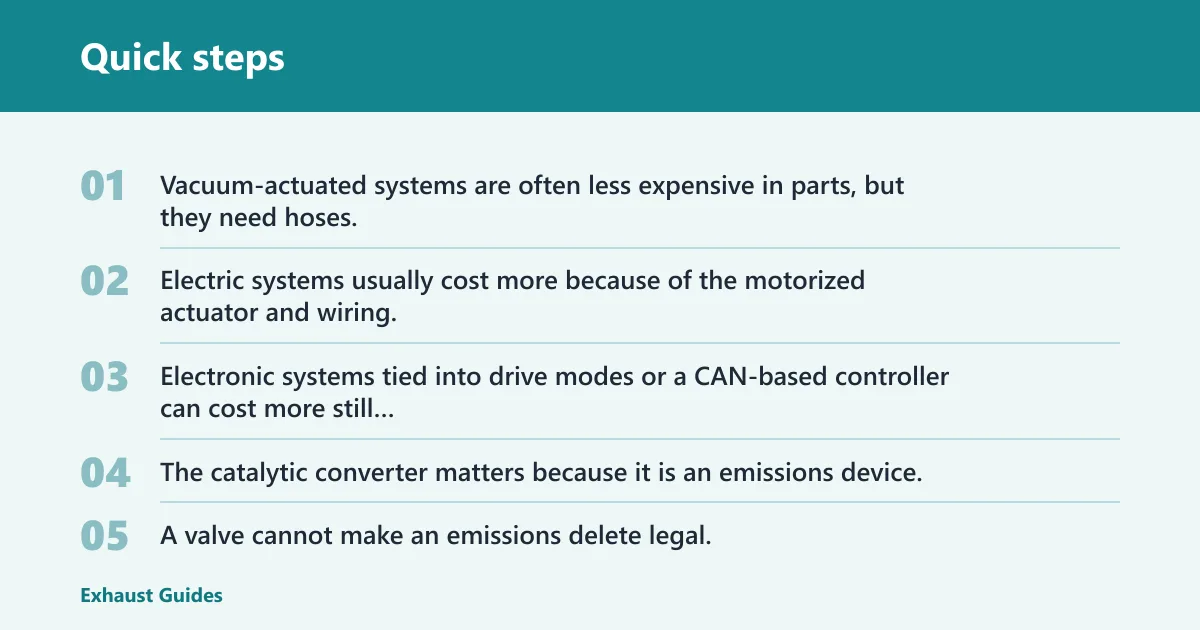
Vacuum-actuated systems are often less expensive in parts, but they need hoses, solenoids, and a vacuum source. Electric systems usually cost more because of the motorized actuator and wiring. Electronic systems tied into drive modes or a CAN-based controller can cost more still because they need a control module, programming, or adapters.
| System type | Typical parts complexity | Control hardware | Install labor | Cost pressure |
|---|---|---|---|---|
| Vacuum-actuated valved exhaust | Medium | Valve, hoses, solenoid, vacuum source | Medium | Lower parts cost, more plumbing |
| Electric valved exhaust | Medium to high | Valve motor, harness, switch or controller | Medium | More expensive hardware, simpler plumbing |
| Electronic drive-mode integrated system | High | Valve motor, control module, coding or adapter | High | Highest retrofit complexity |
Catalytic converter and street legality
The catalytic converter matters because it is an emissions device, while a muffler is mainly for sound attenuation. A valve cannot make an emissions delete legal. In many places, the cat must stay in place, and the exhaust layout must remain street legal for inspections or enforcement. A valved exhaust can still be illegal if it removes emissions equipment or allows a bypass that violates local rules.
Check whether the valve is before or after the catalyst. A valve placed downstream of the cat usually affects sound more than emissions, though legality still depends on local rules and the parts installed.
Common problems and failure signs
Valved systems add moving parts, so failures show up in the valve, actuator, wiring, or control logic. Common issues include a stuck valve, rattle, carbon buildup, vacuum leaks, slow response, and fault codes. When the valve fails, the exhaust may stay loud, stay quiet, or switch unpredictably.
Stuck valve and slow response
A stuck valve can come from carbon buildup, corrosion, a bent linkage, or an electric motor that has worn gears. Slow response often points to vacuum loss, a weak actuator, or a control signal problem. If the valve takes several seconds to change mode, the system is no longer doing its job well.
Rattle, carbon buildup, and vacuum leaks
Rattle usually means play in the flap shaft, loose hardware, or a worn bushing. Carbon buildup can prevent full movement, especially on short-trip cars that run cool and soot up more often. Vacuum leaks can leave a vacuum actuator partially open or closed, and the driver may hear hissing, notice inconsistent mode changes, or feel no change at all.
Fault codes from ECU integration
On electronically controlled systems, the ECU or exhaust control module may monitor valve position, actuator current, or a feedback sensor. If the valve does not match the commanded mode, the system can set a fault code and ignore manual commands. In some cars, the module may default to one mode so the exhaust remains usable when a fault is present.
- Confirm where the valve sits relative to the catalytic converter and muffler.
- Check whether the system uses vacuum, an electric motor, or ECU-based control.
- Verify local emissions and noise rules before buying.
- Ask whether the kit includes the control module, wiring, and mounting hardware.
- Plan for inspection of hoses, fasteners, and valve movement over time.
Picture a commuter car with a 2.0-liter turbo engine, a valve downstream of the resonator, and a weekend setting that is much louder than the driver expected. If the valve sticks halfway open, the cabin can drone at 70 mph, and a scan tool may show a position or actuator fault before any mechanical damage is obvious.
Frequently asked questions
Are valved exhaust systems worth it?
They are worth it when selectable sound and lower cabin drone matter more than maximum power per dollar. For a daily driver, that can be a smart trade. For a budget build chasing performance alone, a simpler exhaust often makes more sense.
Do exhaust valves improve performance on street cars?
Sometimes, but the effect is not universal. Turbo cars often see more sound change than power change unless the rest of the exhaust is also restrictive. Naturally aspirated cars can be more sensitive to exhaust tuning, yet the gain still depends on pipe size, muffler design, and RPM range.
How much does a exhaust system cost?
Cost depends on whether the system is vacuum-actuated, electric, or electronically controlled, plus whether you need a control module and installation. A plain exhaust is usually cheaper. A valved system costs more because of the valve hardware, wiring or plumbing, and additional labor.
Should I get a valved exhaust for daily driving?
If you want quiet cold starts, less highway drone, and the option for louder driving on demand, yes, it can be a good daily-driver choice. If you rarely change modes or you want the simplest, least expensive setup, a non-valved exhaust may be better.
Which valve is bigger intake or exhaust?
On engines, exhaust valves are often larger in number but smaller in diameter than intake valves, though exact sizes vary by engine design. If the question is about engine valves rather than exhaust-system valves, the intake valve is usually larger in diameter because it must admit a fresh charge efficiently.