Exhaust Flange vs Gasket vs Clamp Explained
An exhaust flange lines up the joint, the gasket seals it, and the clamp or bolts carry the load; in many leak repairs, start with the gasket, then replace the flange or fasteners if the faces are warped, pitted, or stripped. Leave the damaged part in place and the leak usually returns, along with heat damage and broken hardware. This guide explains each part, how to identify it, and which one usually fails first in real repairs.
This guide is part of our Exhaust system components guide series.
| Factor | flange | gasket | clamp | Winner |
|---|---|---|---|---|
| Main job | Aligns and joins the pipes | Seals between flat faces | Holds the joint together | All three, each does one job |
| Most common failure | Warped face, crack, corrosion | Blowout, crush, burn-through | Loose fit, distortion, seized hardware | Gasket first in many leaks |
| Best repair when service matters | Reusable if face is flat and threads are sound | Replace if removed or damaged | Useful for serviceable joints and repair styles | Clamp for temporary or service-friendly fixes |
| Need for precise fit | Needs correct bolt pattern and flat mating faces | Needs correct shape and compression | Depends on pipe diameter and joint type | Flange on fit, gasket on seal |
What each part does


The three parts work as one system, not as interchangeable names for the same hardware. The flange sets position, the gasket seals the joint face, and the clamp or bolts keep enough load on the connection for the seal to hold under heat and vibration.
Exhaust flange: the alignment and connection point
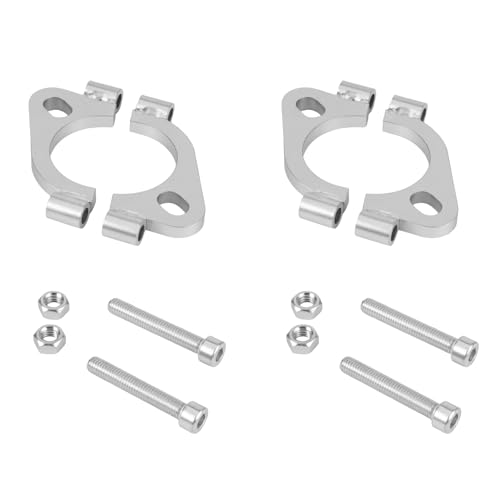
An exhaust flange is the bolted connection point where two pipe sections, or a pipe and a manifold, meet. It can be a 2-bolt or 3-bolt style, and it often is welded to the pipe section behind the face. The face must stay flat for the joint to seal.
If the flange is bent, rusted thin, or welded crooked, the gasket cannot fix it. That is why a leak at a flange is not always a gasket problem.
Exhaust gasket: the sealing layer between faces
The gasket sits between flat mating faces and is the part most likely to fail first when sealing goes wrong. It is compressed between the two surfaces, and a bad crush or uneven load can let exhaust gas escape. Common failure is blowout, especially when the faces do not sit flat.
Gaskets also come in vehicle-specific shapes and sizes. Match the pattern, not just the pipe diameter.
Exhaust clamp: the part that holds the joint together
An exhaust clamp holds a joint together without welding in some designs. That includes repair clamps and split flange styles. It is used when replacement or serviceability matters, but it still depends on the pipe diameter and the joint type being correct for the connection.
A clamp is not a cure for bad faces. It can keep a repair together, but it cannot fix a cracked flange, a crushed sealing surface, or pipes that do not meet squarely.
📊 A V-band flange uses a single clamp for a 360-degree seal. Source: Flangewelding.
When do you need a gasket?
You need a gasket when the joint uses two flat faces that are meant to compress against each other. That is the normal setup on many bolted exhaust flanges. If the faces are not flat, the gasket cannot seal evenly, and the leak usually returns.
Flat mating faces and compressed sealing surfaces
A bolted flange joint relies on even load across the face. On a 2-bolt or 3-bolt connection, the gasket fills the gap between the faces and seals when the hardware pulls the parts together. If the gasket is missing, torn, or crushed, exhaust gas takes the path of least resistance.
Say your 2-bolt flange leaves a sooty ring on one side after a cold start. That usually points to uneven compression, not a random tailpipe leak.
When a bolted joint can run without one
Some joints do not use the same flange-and-gasket setup. A V-band flange uses a single clamp for a 360-degree seal and is often gasket-free. It seals by clamping the two matching halves together with precise alignment, so it is a different joint style, not a version of a 2-bolt or 3-bolt flange.
Why a bad seal turns into an exhaust leak
An exhaust leak can come from poor gasket sealing, and it can get worse from warping or misalignment. Noise is the first clue for many people, but sealing loss also means hotter gas escaping near nearby parts. That can leave soot, loosen fasteners, and make removal harder next time.
2-bolt vs 3-bolt flanges
2-bolt and 3-bolt flanges are standard on most automotive applications. Identify them by bolt count and face pattern, then confirm the matching hardware and gasket shape. The 2-bolt style commonly uses M10 bolts, while the 3-bolt option commonly uses M8 bolts.
How to identify the bolt pattern
Count the fasteners first. A 2-bolt flange has two opposing bolts. A 3-bolt flange has three bolts arranged around the face. Then match the hole spacing, center opening, and sealing face to the part on the vehicle. The wrong bolt pattern will not clamp evenly, even if the pipe diameter looks close.
Typical hardware conventions
The guide recommends an M10 bolt with 2-bolt flanges and an M8 bolt with the 3-bolt option. The recommended tensile grade is 8.8 or higher. That matters because exhaust joints see heat cycling, corrosion, and repeated load changes that can loosen weak hardware quickly.
What changes during a 2-bolt to 3-bolt swap
Swapping from 2-bolt to 3-bolt changes the face pattern, hardware count, and often the gasket shape. It can improve sealing if the replacement parts are designed for that joint, but it is not a universal upgrade. Fit still depends on vehicle layout, pipe size, and the mating flange style.
A common first-timer mistake is buying a 3-bolt gasket because the pipe diameter matches, then finding the hole pattern does not line up. The seal fails before the engine ever warms up.
What is a split flange clamp?
A split flange clamp is a repair-oriented clamp used to hold a flanged joint together when the connection is meant to remain serviceable. It can help on split flange and repair clamp applications, but it must match the pipe diameter and the joint style. It is for a specific repair path, not every exhaust leak.
Repair clamp use cases
Use a split flange clamp when the flange faces are still usable, the pipe ends are sound, and you need a serviceable connection without welding. It is common in repair work where replacing the whole section would be more invasive than re-clamping a sound joint.
Serviceability without welding
Clamped repairs are attractive because they can be removed later. That matters when the exhaust section may need to come apart again. But if the flange face is pitted, the pipe edge is cracked, or the joint is distorted, the clamp only delays the real fix.
Pipe diameter and joint-type limits
Clamp selection depends on pipe diameter and joint type. A clamp sized wrong can crush one side of the joint, leave the other side loose, or walk out of position as the exhaust heats and cools. Matching the style is as important as matching the size.
Exhaust joint decision table
| Symptom | Inspection clue | Likely failed part | Whether reuse is safe | Recommended next step for 2-bolt | Recommended next step for 3-bolt | Recommended next step for split-flange |
|---|---|---|---|---|---|---|
| Soot at one edge | Face is dry on one side and black on the other | Gasket | Flange may be reusable if flat | Replace gasket and check bolt tension | Replace gasket and inspect all three bolt holes | Re-seat clamp; replace gasket if the design uses one |
| Leak returns after tightening | Face shows a low spot, warp, or pitting | Flange | Reuse is unsafe if the face is not flat | Replace flange and gasket together | Replace flange and gasket together | Replace damaged half or the full clamp assembly |
| Clamp will not hold load | Hardware bottoms out, slips, or is seized | Clamp or bolts | Reuse is unsafe if threads are damaged | Replace bolts and gasket; inspect flange face | Replace bolts and gasket; inspect flange face | Replace clamp and confirm correct diameter |
| Crack near weld | Crack follows an undercut weld or pipe edge | Flange or pipe | Reuse is unsafe | Replace the whole joint section | Replace the whole joint section | Temporary clamp only if the crack is not at the clamp land |
Use the table as a triage tool. If the gasket failed but the faces are flat, a gasket-only repair makes sense. If the flange face is warped or cracked, replacing only the gasket usually wastes time and hardware. If the clamp cannot hold tension, the hardware path needs attention too.
Can you clamp a flange repair without welding?
Yes, in some cases. Clamping a flange repair without welding can be acceptable when the joint is still structurally sound, the mating faces are usable, and the clamp style is meant for that connection. It is a temporary fix in many cases, not a substitute for a damaged flange or pipe.
When clamping is acceptable
Clamping works when the leak comes from minor looseness, a serviceable split-flange setup, or a joint that was designed to be clamped. It is also useful when access is poor and a full replacement is not practical immediately. The repair still needs correct fit and even load.
When distortion or cracking means replacement
If the flange is warped, the pipe is cracked, or the weld has an undercut that keeps opening under heat, clamping is not enough. The joint may seal for a short time, then leak again as the metal moves. That is the point where replacement of the damaged part is the better repair.
Temporary fix versus durable repair
Clamping can stop a noisy leak long enough to get the vehicle back to a bay or home garage. Durable repair means restoring flat faces, healthy threads, and a joint that can hold load without crushing parts out of shape. Those are not the same outcome.
V-band vs bolted flanges
A V-band flange is not the same as a traditional flange-and-gasket setup. It uses a single clamp for a 360-degree seal, and V-band flanges are often gasket-free. Because the seal depends on full-circle alignment, the joint must sit very precisely before the clamp is tightened.
How a V-band seals differently
Bolted flanges use face compression. A V-band uses a circumferential clamp that pulls the halves together evenly around the whole joint. That difference is why V-band hardware can be cleaner to service, but also more demanding of alignment.
Why alignment matters more on a V-band
If the halves are off-center, the seal can pinch on one side and leave a gap on the other. With a bolted flange, a gasket may tolerate small face errors. A V-band has less forgiveness, so the parts must meet squarely before final tightening.
When a V-band is the better choice
A V-band can be the better choice when service access matters, repeated disassembly is likely, and the joint can be positioned accurately. It is a different solution from a 2-bolt or 3-bolt flange, not a drop-in replacement for every exhaust repair.
Suppose a stainless downpipe section keeps leaking after two gasket changes because the flange face is slightly twisted. A V-band conversion may solve the repeated sealing problem if the pipes can be aligned correctly and the new joint style fits the space.
Choose flange if…
Choose flange if the joint needs a solid connection point, the faces can be kept flat, and you want a serviceable bolted joint that can come apart later. It is the right part when alignment and structural fit are the main concern.
Choose gasket if…
Choose gasket if the flange faces are in good shape and the leak comes from sealing failure. A fresh gasket is the first repair to try on a flat, serviceable bolted joint, especially when the old one is crushed, burned, or blown out.
Choose clamp if…
Choose clamp if the joint is meant to be held together without welding, or if you need a repairable connection in a split flange or similar service style. It is useful when access and future disassembly matter, but only when the rest of the joint is sound.
Frequently asked questions
What is the difference between an exhaust flange, gasket, and clamp?
The flange lines up and connects the pipes, the gasket seals the mating faces, and the clamp or bolts keep the joint loaded. They are separate jobs, and confusing them leads to repeat leaks. A flange can be reusable, while a gasket is usually the first wear item to replace.
When do you need a gasket with an exhaust flange?
You need a gasket when two flat flange faces are designed to compress together, which is common on bolted exhaust joints. If the faces are warped, the gasket may not last long. A V-band joint is different and often does not use the same gasket setup.
What is an exhaust split flange clamp used for?
A split flange clamp is used to hold a serviceable joint together without welding, especially in repair-oriented exhaust work. It is helpful when the pipe and flange are still usable and you want later disassembly. It is not a fix for cracked metal or badly warped faces.
How do I know whether my exhaust joint needs a 2-bolt or 3-bolt flange?
Count the bolts, then match the hole pattern and face shape. A 2-bolt flange uses two fasteners, commonly M10 bolts, and a 3-bolt flange uses three fasteners, commonly M8 bolts. The correct match depends on the vehicle, pipe size, and exact joint pattern.
What causes exhaust flange gaskets to blow out?
Blowout usually comes from uneven clamping load, warped faces, poor alignment, or corrosion that keeps the gasket from seating. Loose or seized hardware can make the problem worse. If the leak keeps returning, inspect the flange face and the weld area for cracks or undercut welds.
Is a V-band the same as a flange and clamp setup?
No. A V-band uses a single clamp for a 360-degree seal, and it is often gasket-free. Traditional bolted flanges rely on flat faces, a gasket, and bolt load. The two systems solve the same job in different ways, and the hardware is not interchangeable by default.
What should I replace when fixing an exhaust leak at a flange?
Start with the gasket if the flange faces are flat and the hardware is sound. Replace the flange too if the face is warped, cracked, or badly pitted. Replace the clamp or bolts if they cannot hold load, are seized, or have damaged threads. In severe cases, replace the whole joint.