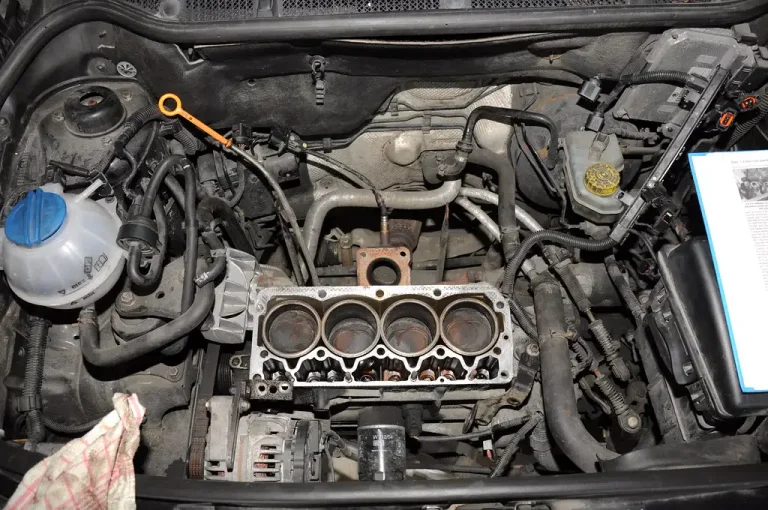
Muffler vs resonator: what’s the difference in noise?
A muffler mainly lowers overall exhaust volume. A resonator mainly trims specific tones and cabin drone. If the exhaust is too loud, change the muffler. If the steady-speed boom is the problem, start with the resonator. Pick the wrong part and you can spend money without fixing the noise you hate. This guide shows how to tell the two parts apart by symptom.
Muffler vs resonator: what’s the real difference?


The difference is direct. A muffler lowers overall exhaust noise, while a resonator is tuned to cancel or soften specific frequencies, especially the low-frequency drone that makes cruising tiring. Choose the wrong part and the car may sound different without solving the complaint.
| Decision factor | Muffler | resonator: what’s the difference | Winner |
|---|---|---|---|
| Main job | Reduces overall exhaust noise | Targets specific frequencies and drone | Tie |
| Best symptom | Too much overall volume | Highway drone, cabin boom, harsh tone | Depends on symptom |
| Typical location | Near the end of the system, before the tailpipe | Usually between the catalytic converter and the muffler | resonator: what’s the difference |
| Sound effect | Broad reduction in loudness | Sharper change in tone and drone control | Depends on goal |
| Performance tradeoff | Can add backpressure depending on design | Usually minimal impact on performance | resonator: what’s the difference |
Main job
The muffler is the broad noise reducer. British English often calls the same part a silencer, and the build usually uses chambers, baffles, absorptive material, and shell damping. A resonator is a tuning device, not the main volume control.
That difference matters because exhaust pulse waves do not all act the same way. Sound reduction comes from wave cancellation and chamber tuning, so a part can remove one annoying band and still leave the rest of the exhaust clearly audible.
Best symptom
If the complaint is general loudness, the muffler is usually the first part to change. If the complaint is a steady-speed drone or boom that sits in the cabin at a certain road speed, the resonator is often the better first move.
Typical location
Many exhaust systems contain a resonator and at least one muffler. The resonator is typically located between the catalytic converter and the muffler, while the muffler is usually at the end of the exhaust system, just before the tailpipe. That placement is not random; it changes which pulse waves each part has to work with.
The catalytic converter sits upstream of both parts in many layouts. The tailpipe is the final outlet after the muffler, so a rear muffler usually has the last word on what reaches the street.
Sound effect
A muffler changes overall volume and tone together. A resonator usually changes tone first, then the amount of cabin drone if the frequencies line up with the system’s problem area.
Four-cylinder engines produce a different pulse pattern than six-cylinder engines. A four-cylinder engine will have four high-pressure exhaust pulses per operating cycle, and that pulse spacing often makes certain droning notes more obvious at steady cruise. A six-cylinder engine will emit six high-pressure pulses per operating cycle, which can shift the tone and make a different kind of resonance show up. (en.wikipedia.org)
Performance tradeoff
Backpressure is restriction in the exhaust flow path, and it can affect engine efficiency and sound. Some muffler designs can impart exhaust backpressure in the 1 to 1.5-psi range, while some aftermarket mufflers claim to increase output and/or reduce fuel consumption by slightly reduced back pressure.
That claim is not the same as a guaranteed power gain. Sound changes are common; measurable performance changes are vehicle-specific and often smaller than people expect. A resonator usually has minimal impact on performance, which is why it is often the cleaner fix for drone complaints.
📊 Some muffler designs can impart exhaust backpressure in the 1 to 1.5-psi range. Source: Resonator vs Muffler: What’s the difference?.
What does a resonator do compared with a muffler?
A resonator reduces low-frequency droning noise and targets specific frequencies. A muffler reduces overall exhaust noise more broadly. If you hate a humming, booming cabin note at cruise, the resonator is aimed at that problem. If the whole car is simply too loud, the muffler is the stronger tool.
Resonator basics: drone control and frequency tuning
Exhaust drone is a low-frequency sustained noise, commonly around 30-60hz, and it is often the problem resonators are meant to address. The resonator’s job is to cancel or soften that band through chamber tuning and wave cancellation, not to silence the entire exhaust.
Muffler basics: chambers, baffles, and total sound reduction
A muffler works by forcing exhaust through chambers and baffles so the pressure pulses lose energy before they exit. That design makes it the main part for reducing overall exhaust volume. It may also reshape the tone, but broad noise reduction is its primary role.
How exhaust pulse waves and wave cancellation matter
Exhaust pulse waves travel through the pipes as pressure changes. If the length, chamber shape, and volume are set correctly, some waves cancel or weaken each other. Resonators are usually tuned for a narrower target, while mufflers are designed for a wider range of noise control.
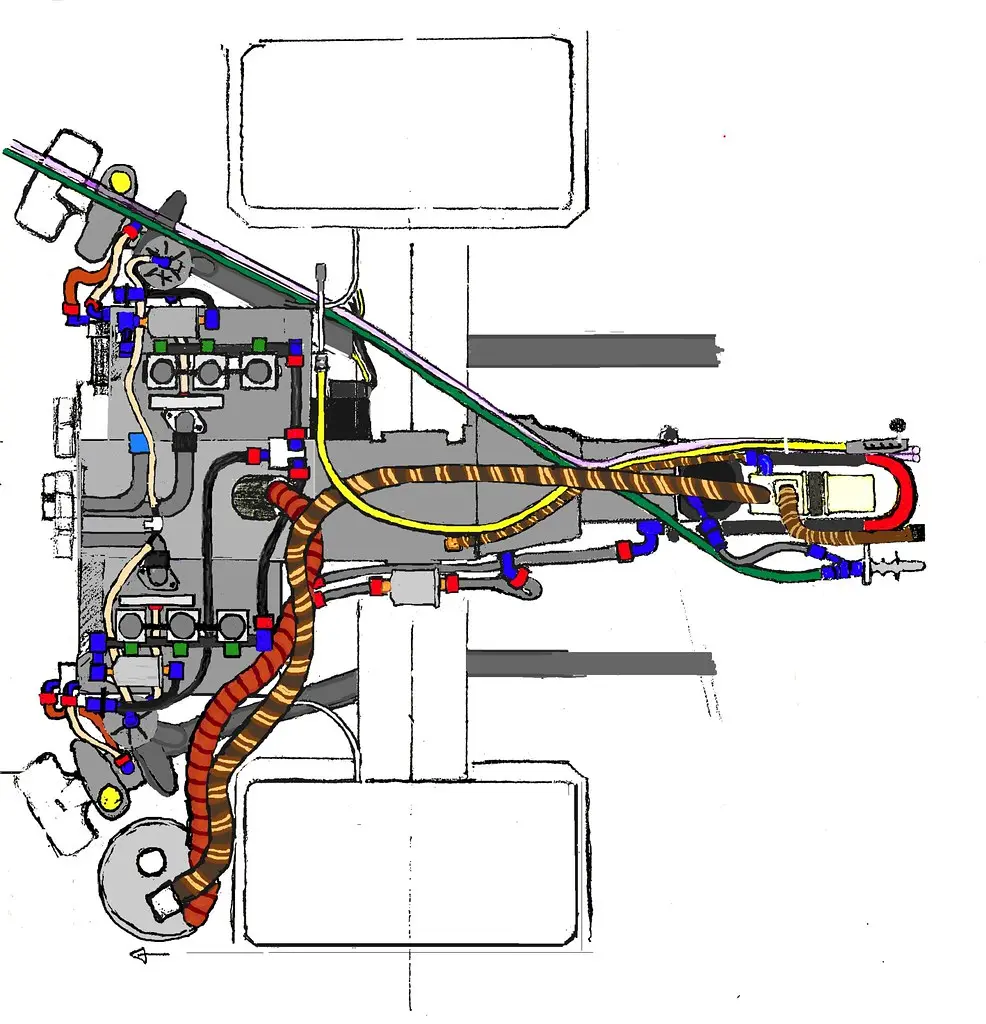
Where are the resonator and muffler located in the exhaust system?
The resonator is usually between the catalytic converter and the muffler, and the muffler is usually near the end of the exhaust system before the tailpipe. That layout matters because location changes which pressure pulses each part can intercept, reflect, and cancel.
A resonator closer to the catalytic converter sees the earlier part of the exhaust signal. A muffler near the tailpipe handles the last stage before sound exits, so it has a bigger effect on overall loudness.
Catalytic converter to resonator to muffler to tailpipe
In a typical layout, exhaust leaves the engine, passes through the catalytic converter, then a resonator and muffler, and finally exits through the tailpipe. Not every car follows this exact order, but it is common enough to use as a quick inspection guide.
How to spot a deleted or modified setup
- Look under the car and trace the exhaust from the catalytic converter rearward.
- Find the largest canister near the rear axle or rear bumper; that is often the muffler.
- Look for a smaller inline chamber ahead of it; that is often the resonator.
- If there is straight pipe where one of those parts should be, you may be looking at an aftermarket exhaust delete.
- Listen for a louder, harsher note or extra drone at highway speed, which often follows a resonator delete or muffler delete.
A common first-timer mistake is assuming any round exhaust can is a muffler. Some resonators look similar, but the location tells the story. The rear-most sound can is usually the muffler; the earlier one is often the resonator.
Which part causes drone, the muffler or resonator?
Exhaust drone is usually the resonator’s problem to solve, not the muffler’s. A muffler can contribute to drone if its design leaves a strong frequency band untouched, but resonators are the part most often added to target that low, steady cabin boom around highway speed.
What exhaust drone sounds like in the cabin
Drone feels like a sustained hum or boom that rises at a certain speed and sits there. It is not the same as a sharp exhaust bark on acceleration. If the noise is worst in the cabin at steady cruise, that points to a frequency problem more than a simple loudness problem.
Why resonators are usually the first fix for highway drone
Because resonators are tuned to a narrower band, they are often the cleaner fix when the complaint is one specific bad frequency. That makes them useful on systems that sound fine in town but turn tiring at 65 mph or 70 mph.
Why a muffler can still be part of the drone problem
A muffler that is too small, too open, or damaged may leave too much low-frequency energy in the system. In that case, the resonator may help, but the rear muffler can still be the source of excess cabin noise. The symptom tells you which part to inspect first.
Use this symptom-to-fix table before you buy anything
Match the complaint to the part that usually fixes it first. That keeps you from buying the wrong component, especially when the real issue is tone or cabin resonance rather than total volume.
| Symptom | Recommended first change | Why | Caution |
|---|---|---|---|
| Highway drone | Resonator | Targets low-frequency sustained noise around 30-60hz | Check for damaged hangers, leaks, or an overly open muffler too |
| Raspy idle | Resonator or a different muffler design | Rasp is usually a tone issue, not just volume | On some engines, a resonator delete makes rasp worse |
| Too much overall volume | Muffler | Broad noise reduction is the muffler’s main job | Expect some tone change as well |
| Unwanted cabin boom | Resonator first, then inspect the rear muffler | Boom usually tracks a narrow frequency band in the cabin | Cabin boom can also come from leaks or poor pipe routing |
Suppose a four-cylinder sedan drones hard at 2,000 rpm on the freeway. A resonator change is the smarter first step than a straight muffler swap, because the cabin complaint is frequency-specific. Picture a V6 coupe that sounds fine at cruise but is simply too loud leaving a neighborhood; that points more clearly to the muffler.
Choose muffler if… / Choose resonator if…
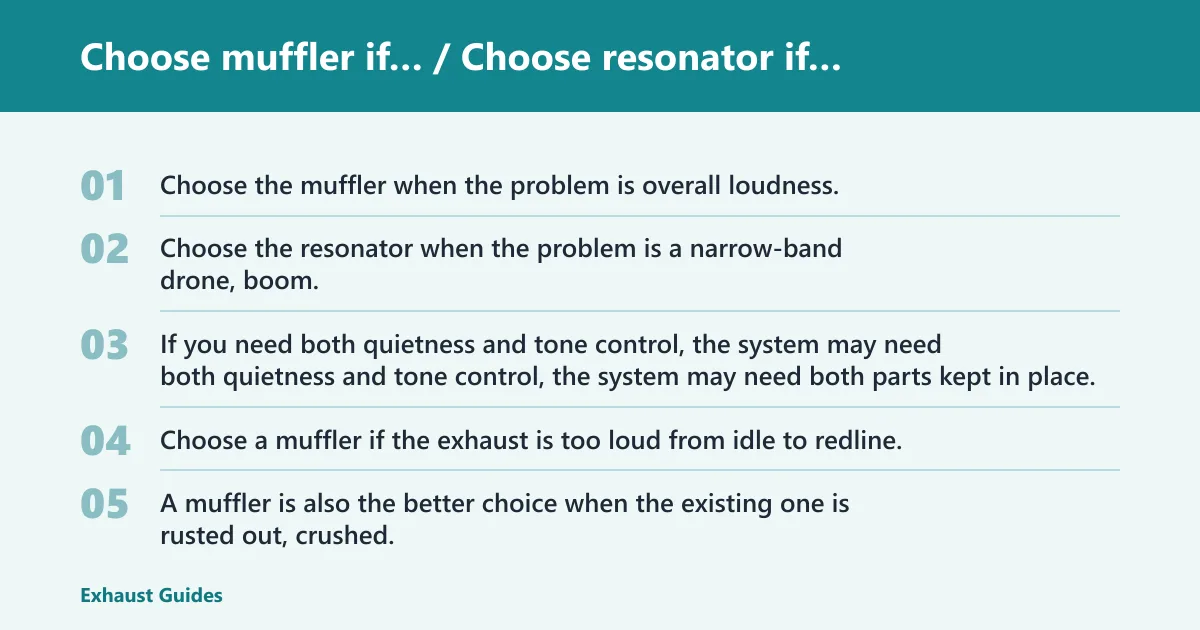
Choose the muffler when the problem is overall loudness. Choose the resonator when the problem is a narrow-band drone, boom, or harshness that shows up at a certain engine speed or road speed. If you need both quietness and tone control, the system may need both parts kept in place.
Choose muffler if…
Choose a muffler if the exhaust is too loud from idle to redline, if you want a calmer cold start, or if the rear of the car is simply broadcasting too much sound. A muffler is also the better choice when the existing one is rusted out, crushed, or leaking at the shell or seams.
Choose resonator if…
Choose a resonator if the car is acceptable around town but gets annoying at one cruising speed. Choose it if you hear a metallic rasp after an exhaust change, or if the system is loud in a narrow band but not across the whole rev range.
When you should keep both parts
Keep both when the car needs broad volume control plus frequency cleanup. Many systems contain both for a reason: the muffler handles the overall noise floor, and the resonator cleans up the bad note that survives. Removing one part often exposes the weakness the other was covering.
When neither part is the real fix
If the exhaust leaks, the hangers are broken, or the pipe is hitting the body, a new muffler or resonator will not solve the noise. A cabin boom can also come from drone created by pipe length or engine speed, so the correct fix may be sealing, re-hanging, or changing the system layout rather than deleting parts.
What happens if you delete the resonator or muffler?
A resonator delete usually makes the exhaust louder in a narrow sense and often changes tone or drone more than total volume. A muffler delete usually makes the car noticeably louder overall and can change cabin noise, backpressure, and exhaust behavior. Neither delete is a universal upgrade.
Will a resonator delete make my car louder?
Yes, but not always by a huge amount. A resonator delete often changes the note first and the volume second, so the bigger effect may be more rasp, more drone, or a harsher cabin tone rather than a dramatic jump in decibels across every driving condition.
Will a muffler delete affect performance?
It can, but the effect is not guaranteed to be positive or negative. Removing the muffler changes backpressure and the way exhaust pulse waves reflect through the system, which may alter exhaust scavenging. In street use, the louder sound is usually the immediate change, while power changes are vehicle-specific.
Can a resonator replace a muffler?
Usually, no. A resonator is not designed to do the full noise-reduction job of a muffler, and using it alone often leaves the car louder than most street drivers want. It may work as a temporary or specialized setup, but it is not a normal substitute for a muffler.
Should I replace a rusted-out resonator or muffler?
Yes, if the part is rusted through, leaking, or physically failing, replacement is usually the right move before any sound-mod choice. A rusted resonator or muffler can change sound, increase drone, and create exhaust leaks that distort the diagnosis. Fix the failed part first, then decide whether the sound still needs tuning.
If only one component is rotten, replace that component with a like-for-like part before making bigger changes. If both are near failure, that is the moment to decide whether you want stock quiet, less drone, or a deeper performance-style tone.
Frequently asked questions
muffler vs resonator difference
A muffler reduces overall exhaust noise, while a resonator targets specific frequencies that cause drone or harshness. If the whole exhaust is too loud, the muffler is usually the first fix. If the sound is tolerable except for a steady cabin boom, the resonator is usually the better starting point.
What does a resonator do compared with a muffler?
A resonator tunes out a narrow sound problem, especially low-frequency drone. A muffler works more broadly, cutting total exhaust volume with chambers and baffles. Think of the resonator as a frequency corrector and the muffler as the main loudness control.
Do I need both a resonator and a muffler?
Many exhaust systems use both because they solve different problems. The resonator cleans up specific tones, and the muffler lowers overall volume. If you remove one, the other may not fully cover the noise you dislike, especially on a car that drones at highway speed.
Where is the resonator located in the exhaust system?
The resonator is typically located between the catalytic converter and the muffler. That placement helps it work on the exhaust pulse waves before they reach the rear sound control section. Some systems vary, but that mid-pipe location is common.
Where is the muffler located in the exhaust system?
The muffler is usually at the end of the exhaust system, just before the tailpipe. Because it sits near the outlet, it has a strong effect on the final sound that leaves the car. That is why muffler changes are often the biggest volume changes.
Which one causes drone, the muffler or resonator?
Drone is usually the resonator’s problem to solve, but a muffler can contribute if its design leaves a strong frequency untouched. The real issue is the system’s response to exhaust pulse waves, not one part by itself. If the cabin boom happens at one steady speed, start with the resonator and inspect the muffler next.
Should I replace a rusted-out resonator or muffler?
Replace the failed part first. A rusted-out muffler usually means more overall volume, while a rusted resonator often brings back drone or rasp. After the leak is fixed, you can decide whether the new part should stay stock or be tuned for a different sound goal.