Were Ram Horn Exhaust Manifolds Only High Performance?
Many people wonder about the performance of ram horn exhaust manifolds. If you’re new to car parts, the name itself sounds powerful, leading to the question: Were Ram Horn Exhaust Manifolds Only High Performance? It can be confusing to know if these parts are just for race cars or if they offer benefits for everyday driving. This guide will break it down simply. We will look at what ram horn manifolds are and explore their actual performance impact step by step.
Understanding Ram Horn Exhaust Manifolds
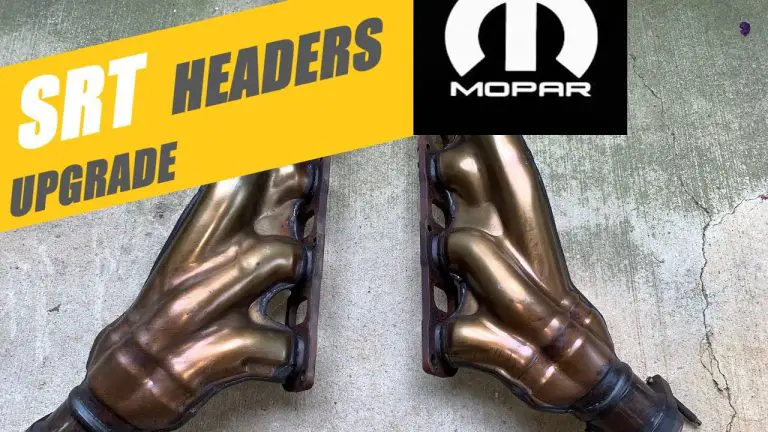
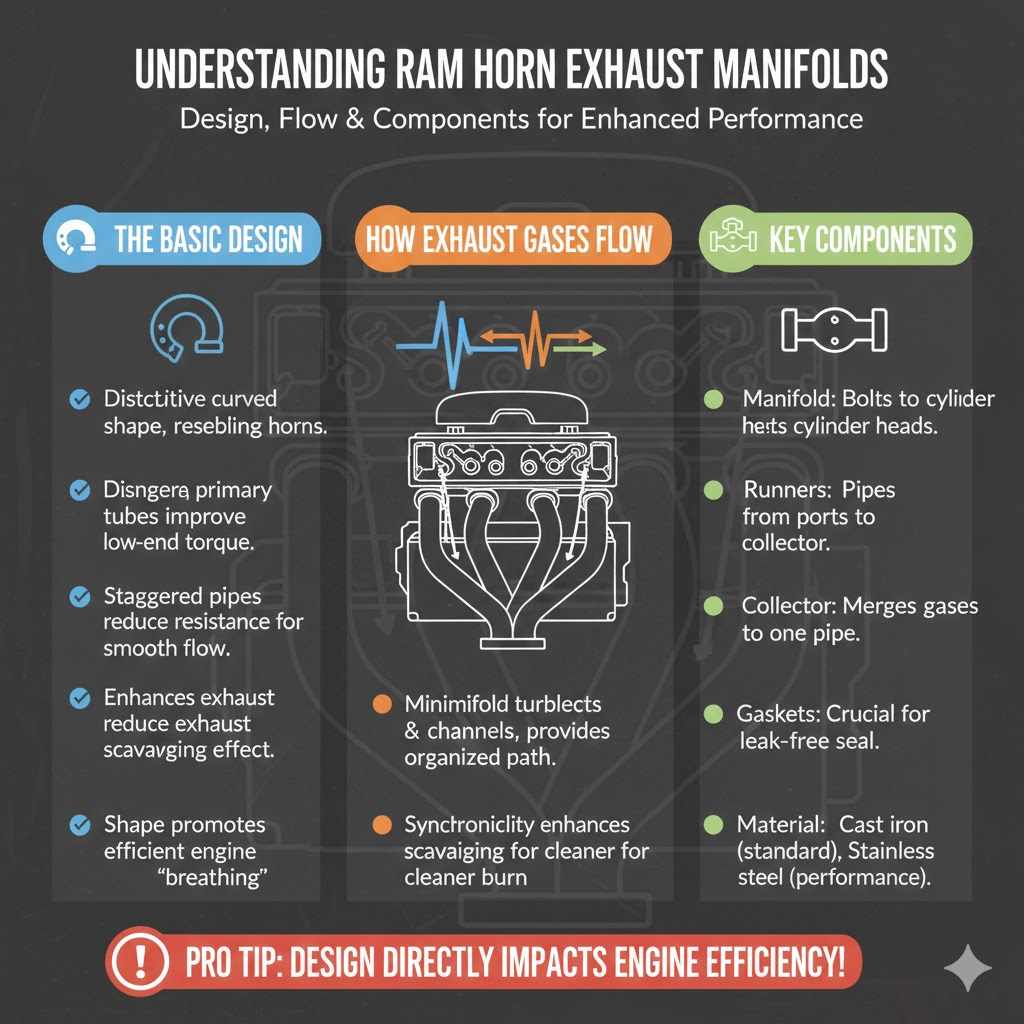
Ram horn exhaust manifolds get their name from their distinctive shape, resembling a ram’s horns. This unique design is not just for looks; it plays a direct role in how exhaust gases flow out of the engine. For beginners, it’s important to grasp that exhaust manifolds are a fundamental part of any internal combustion engine. They collect exhaust gases from each cylinder and direct them into a single pipe, which then leads to the rest of the exhaust system. The design of the manifold can significantly affect engine performance by influencing backpressure and exhaust scavenging.
The question Were Ram Horn Exhaust Manifolds Only High Performance? often arises because their appearance suggests a focus on speed and power. This perception is fueled by their frequent use in performance vehicles and custom builds. However, the reality is more nuanced. While they can contribute to enhanced performance, their benefits aren’t limited to just high-speed racing applications. Understanding their design principles helps clarify their advantages for a wider range of vehicles. This section will explore the basic construction and function of these manifolds.
The Basic Design of Ram Horn Manifolds
Ram horn exhaust manifolds feature a design where the exhaust ports from multiple cylinders are routed in a way that promotes smooth flow. Instead of a simple, direct exit, the pipes curve and merge, often in a staggered or progressive manner. This curvature is key to their performance characteristics. Each pipe is carefully angled to reduce resistance as exhaust gases exit the engine. This smoother exit helps the engine “breathe” more efficiently.
The shape often leads to longer primary tubes compared to some other manifold designs. These longer tubes can help improve torque, especially at lower engine speeds. They also contribute to better exhaust scavenging. Exhaust scavenging is the process where the exiting exhaust pulse from one cylinder helps pull the exhaust gases from another cylinder. This effect is more pronounced with well-designed exhaust manifolds.
How Exhaust Gases Flow
Exhaust gases are a byproduct of combustion, and their efficient removal is vital for engine operation. When fuel and air combust in a cylinder, they create high-pressure gases that need to be expelled. The exhaust manifold’s job is to collect these gases from all cylinders. The way these gases are collected and channeled can impact how quickly they are removed and how much pressure builds up within the exhaust system.
In a standard manifold, gases might mix and create turbulence, hindering smooth flow. Ram horn manifolds aim to minimize this by providing a more organized path for the gases. The individual runners are often designed to be of equal length, or very close to it. This equal length helps ensure that the exhaust pulses from each cylinder arrive at the collector point at roughly the same time. This synchronicity enhances the scavenging effect, leading to a cleaner burn in the next combustion cycle.
Key Components of an Exhaust Manifold System
An exhaust manifold system involves several parts working together. The manifold itself is the primary component, bolted directly to the engine’s cylinder heads. It has individual ports for each exhaust valve. From these ports, the exhaust pipes, called runners, extend. These runners then merge into a collector. The collector funnels the exhaust gases into the rest of the exhaust system, which includes the catalytic converter, muffler, and tailpipe.
The material used for the manifold also plays a role. Most are made of cast iron, but performance applications might use stainless steel for lighter weight and better heat dissipation. The gaskets between the manifold and the cylinder head are crucial for a leak-free seal. Any leaks can reduce performance and create unpleasant exhaust noise.
Ram Horn Manifolds and Performance Gains
The distinctive “ram’s horn” shape of these manifolds is engineered to optimize exhaust flow. This optimization directly translates into performance benefits, but the extent of these gains depends on several factors. For enthusiasts, understanding these factors is key to appreciating the true value of this manifold design. It’s not just about looks; it’s about physics and engineering working together to improve an engine’s efficiency.
The question Were Ram Horn Exhaust Manifolds Only High Performance? is often posed because their design prioritizes smooth, efficient exhaust extraction. This efficiency can lead to noticeable improvements in horsepower and torque. However, these gains are not exclusive to racing or extreme performance builds. Even a moderately tuned engine can benefit from the improved exhaust flow that ram horn manifolds provide. This section will detail the specific ways these manifolds contribute to better engine performance.
Improved Horsepower and Torque
One of the primary advantages of ram horn manifolds is their ability to increase both horsepower and torque. By reducing the resistance that exhaust gases encounter, the engine can expel them more freely. This allows the engine to take in a fresh charge of air and fuel more effectively, leading to a more powerful combustion event. The improved scavenging effect also means that residual exhaust gases from the previous cycle are minimized, further enhancing the efficiency of the new charge.
This results in a noticeable boost in power, especially when the engine is working hard. Drivers often report a crisper throttle response and a stronger pull through the RPM range. The torque improvements are particularly beneficial for daily driving, making the vehicle feel more responsive and capable in various situations, not just at high speeds. This enhanced performance is a direct result of the manifold’s ability to manage exhaust gas flow efficiently.
Reduced Engine Stress and Heat
Efficient exhaust flow also contributes to reduced stress and heat within the engine. When exhaust gases are trapped or struggle to exit, they can increase the temperature inside the combustion chambers. High temperatures can lead to premature detonation (knocking) and can put a strain on engine components. By facilitating a quicker and smoother exit of hot gases, ram horn manifolds help keep engine temperatures more stable.
This reduced heat can lead to greater engine longevity. Over time, consistent exposure to excessive heat can degrade engine parts. A cooler-running engine is generally a healthier engine. Furthermore, less backpressure means the engine doesn’t have to work as hard to push the exhaust out. This reduction in effort can contribute to overall engine health and efficiency.
Enhancing Exhaust Scavenging
Exhaust scavenging is a critical concept in engine performance. It refers to the process where the outgoing exhaust pulse from one cylinder helps to pull the exhaust gases out of another cylinder. This creates a lower pressure in the cylinder at the end of its exhaust stroke, which aids in the intake of the fresh air-fuel mixture for the next cycle. Ram horn manifolds, with their carefully tuned runner lengths and angles, are particularly good at promoting effective scavenging.
The precise timing and force of the exhaust pulses are managed by the manifold’s design. When designed correctly, the pulses from different cylinders can create a wave effect that effectively “sucks” the exhaust out. This is a passive form of boosting, as it doesn’t require extra energy from the engine itself. It’s a testament to how smart design can optimize a fundamental engine process.
Factors Influencing Performance Gains
The actual performance gains from ram horn manifolds are not solely dependent on the manifold itself. Several other factors play a crucial role. The overall exhaust system, including the catalytic converter, muffler, and piping diameter, must be compatible with the manifold’s design. A restrictive muffler, for example, can negate the benefits of a high-flowing manifold.
Engine tuning is also paramount. For optimal results, the engine’s fuel and ignition timing may need to be adjusted to take full advantage of the improved airflow. Camshaft profiles, cylinder head porting, and even the type of air intake system can influence how effectively the ram horn manifold performs. It’s a system, and all parts need to work in harmony.
Are Ram Horn Manifolds Universally High Performance?
The idea that ram horn exhaust manifolds are exclusively for “high performance” applications is a common simplification. While they are frequently found on performance-oriented vehicles, their benefits extend beyond just racing. Understanding their design reveals that their core function is about efficiency, which benefits many types of engines. The term “high performance” can be relative, and what constitutes a performance gain for one vehicle might be standard operation for another.
This section addresses the nuances behind the question Were Ram Horn Exhaust Manifolds Only High Performance? It will explore how their design principles are applied and why they are beneficial even in non-racing contexts. We will look at situations where they might offer less of an advantage and how they compare to other manifold types. This will provide a clearer picture of their role in automotive engineering.
Ram Horns in Everyday Vehicles
Ram horn manifolds can provide noticeable improvements in everyday vehicles. For a driver who wants a bit more responsiveness from their car, these manifolds can offer a tangible enhancement. The improved torque at lower RPMs makes city driving and accelerating from a stop easier and more pleasant. This is not an extreme performance upgrade; it’s an enhancement of the engine’s natural capabilities.
Many manufacturers have, at various times, incorporated designs similar to ram horns in their production vehicles, especially in models aiming for a balance of performance and efficiency. This indicates that the design’s benefits are considered valuable for a broad audience, not just for specialized racing applications. The smooth flow characteristics contribute to a better overall driving experience.
Comparison to Other Manifold Designs
To understand if ram horns are only high performance, it’s helpful to compare them to other common exhaust manifold designs.
| Manifold Type | Design Characteristic | Typical Performance Focus |
||||
| Ram Horn | Curved, staggered runners leading to a collector. | Balanced torque and horsepower, good scavenging. |
| Log Manifold | Simple, straight pipes merging into a single collector. | Basic function, often found on older, simpler engines. |
| Tri-Y Manifold | Runners merge into a Y-pipe, then into another Y-pipe. | Often good for mid-range torque and top-end horsepower. |
| Equal-Length Headers | All primary tubes are the same length. | Optimized for specific RPM ranges, strong scavenging. |
Log manifolds are generally the least performance-oriented. They are simple and inexpensive but often create significant backpressure. Tri-Y manifolds are known for their ability to produce strong torque across a wide RPM range. Equal-length headers are highly specialized, often designed for very specific engine applications where maximizing power at a particular RPM is critical. Ram horn manifolds often strike a balance, offering improvements across the board without the extreme specialization of some headers.
The Role of Manufacturer Choices
Manufacturers choose exhaust manifold designs based on a variety of factors, including cost, packaging constraints, performance targets, and emissions regulations. In the past, some muscle cars and performance-oriented models featured ram horn manifolds as standard equipment. These vehicles were certainly performance-focused, but the choice of manifold was part of a broader strategy to enhance the engine’s capabilities.
Later, as emissions standards became stricter and engine management systems more sophisticated, some manufacturers moved towards different designs or integrated exhaust manifolds. However, the fundamental principles behind the ram horn design—promoting efficient exhaust flow and scavenging—remain relevant in performance tuning and aftermarket upgrades, even for vehicles not originally equipped with them.
When Ram Horns Might Not Be Optimal
While ram horn manifolds offer benefits, they are not always the absolute best choice for every single application. For engines designed for extremely high RPM operation, like some racing engines, headers with very specific tube lengths and diameters might provide an edge. These specialized headers are often custom-tuned to a narrow RPM band for maximum power.
Packaging can also be a limitation. The curved nature of ram horns can sometimes make them more difficult to fit into tight engine bays, especially in modern vehicles with compact designs. In such cases, a more compact manifold design or custom exhaust fabrication might be necessary. The specific engine’s characteristics, such as its bore, stroke, and intended use, will ultimately determine the most suitable exhaust manifold.
Technical Aspects of Ram Horn Manifold Performance
To truly understand the performance of ram horn manifolds, it’s important to delve into some of the technical aspects that govern their operation. This involves looking at the physics of exhaust flow, wave dynamics, and how these elements interact with engine parameters. For those new to automotive mechanics, these concepts might seem complex, but they are key to appreciating why a particular manifold design yields certain results.
The question Were Ram Horn Exhaust Manifolds Only High Performance? becomes clearer when we examine the underlying engineering. It’s not magic; it’s applied science. This section will break down the technical details in a straightforward manner, explaining terms and concepts that contribute to the manifold’s performance.
Understanding Backpressure and its Effects
Backpressure is the resistance the exhaust gases encounter as they exit the engine. Some level of backpressure is necessary for proper engine operation, particularly for the scavenging effect. However, excessive backpressure can be detrimental. It forces the engine to work harder to expel exhaust, reducing power and increasing heat.
Ram horn manifolds are designed to manage backpressure effectively. Their smooth, curved runners minimize turbulence and resistance. This allows exhaust gases to flow out more freely, reducing the detrimental effects of excessive backpressure. The balanced flow also ensures that the exhaust pulses from different cylinders do not interfere with each other negatively.
Exhaust Pulse Tuning
Exhaust pulse tuning is a sophisticated concept that relates to how the timing and pressure of exhaust waves can be used to enhance engine performance. The exhaust gases exiting a cylinder do so in a series of pressure waves. When these waves are managed correctly by the exhaust manifold’s design, they can help pull exhaust from subsequent cylinders (scavenging) and even influence the incoming air-fuel mixture.
Ram horn manifolds, by virtue of their runner lengths and collector design, contribute to effective exhaust pulse tuning. The staggered firing order of cylinders, combined with the tuned lengths of the manifold runners, can create constructive interference of these pressure waves. This means the waves can work together to improve the overall efficiency of the exhaust process.
Materials and Construction
The materials used in exhaust manifold construction significantly impact their performance and durability. Most standard exhaust manifolds are made from cast iron. Cast iron is durable, relatively inexpensive, and can withstand the high temperatures and pressures of the exhaust system. However, it is also heavy and can be prone to cracking over time, especially with extreme temperature fluctuations.
Performance-oriented manifolds, including some ram horn designs, are often made from stainless steel or other alloys. These materials are lighter than cast iron, offer better corrosion resistance, and can dissipate heat more effectively. The welding and construction quality of these aftermarket manifolds are also crucial. High-quality welds ensure structural integrity and prevent exhaust leaks.
The Role of the Collector Design
The collector is the part of the exhaust manifold where the individual runners merge into a single pipe. The design of the collector plays a vital role in how efficiently the exhaust gases are combined and directed into the rest of the exhaust system. A well-designed collector can enhance scavenging and minimize turbulence.
Ram horn manifolds often feature collectors that are specifically shaped to promote smooth merging of the exhaust streams. Some collectors are designed to create a venturi effect, which helps to draw exhaust gases out more effectively. The angle at which the runners enter the collector and the overall shape of the collector are critical engineering considerations for maximizing performance.
Real-World Applications and Case Studies
To solidify the understanding of ram horn manifolds, looking at real-world applications and how they perform in practice is invaluable. These examples showcase the tangible benefits and the versatility of this design. They move beyond theory and demonstrate the impact on actual vehicles.
This part of the discussion helps answer the question Were Ram Horn Exhaust Manifolds Only High Performance? by showing how they are utilized across different scenarios. These are not hypothetical situations; they are based on the experiences of vehicle owners and performance builders.
Case Study 1 Classic Muscle Car Restoration
A common application for ram horn manifolds is in the restoration of classic muscle cars. Many iconic cars from the 1960s and 1970s, like the Chevrolet Camaro and Ford Mustang, were offered with ram horn style manifolds from the factory. When restoring these vehicles, owners often choose to reinstall or upgrade to ram horn manifolds to maintain or enhance the car’s original performance character.
For example, a 1969 Camaro owner looking to improve the engine’s breathing without altering its classic look opted for a high-quality reproduction ram horn manifold. The results showed a noticeable improvement in throttle response and a modest increase in horsepower, reported to be around 15-20 hp on a mildly built 350 cubic inch V8 engine. The car retained its original exhaust manifold appearance while gaining an edge in performance.
Example Scenario 1 Daily Driver Upgrade
Consider a scenario where a commuter car, like a Chevrolet Silverado pickup truck from the early 2000s, is used for daily driving and occasional towing. The stock exhaust manifold might be showing signs of wear or might be a bottleneck for the engine’s potential. Upgrading to a set of well-designed ram horn manifolds can offer several benefits for this type of user.
The improved exhaust flow can lead to better fuel efficiency, especially under load, and a more responsive engine for everyday driving tasks. While not aimed at achieving racing speeds, the enhanced torque can make towing feel easier and reduce the need to push the engine as hard. This translates to a more comfortable and potentially more economical driving experience.
Case Study 2 Custom Hot Rod Build
In the world of custom hot rods, where builders often blend classic aesthetics with modern performance, ram horn manifolds are a popular choice. A builder working on a 1932 Ford hot rod with a Ford small-block V8 engine might choose ram horns for their vintage look and their ability to provide a strong, broad powerband.
The custom build might feature a performance camshaft and upgraded ignition system. The ram horn manifolds complement these upgrades by ensuring that the engine can efficiently expel the increased volume of exhaust gases produced. This contributes to the hot rod’s lively performance characteristics, making it fun to drive on the street.
Example Scenario 2 Off-Road Vehicle Enhancement
For an off-road vehicle, such as a Jeep Wrangler, torque and responsiveness are critical for navigating challenging terrain. Upgrading the exhaust system, including the manifolds, can be a key modification. Ram horn manifolds can offer a good balance of improved low-end torque for climbing and crawling, without sacrificing too much top-end power if the vehicle is also used for highway driving.
The robust construction of many ram horn manifolds also makes them suitable for the harsh conditions encountered off-road. Their design can help manage engine temperatures, which is crucial during extended periods of high load in demanding environments.
Statistics on Exhaust Manifold Performance
The impact of exhaust manifold design on engine performance is supported by data and testing. While specific statistics for ram horn manifolds alone can be hard to isolate from broader exhaust system upgrades, general trends and findings from performance tuning provide valuable insights. These numbers illustrate the quantifiable effects of improved exhaust flow.
This section provides a glimpse into the statistical evidence that supports the performance benefits of well-designed exhaust manifolds. It helps address the question Were Ram Horn Exhaust Manifolds Only High Performance? by showing that performance gains are a consistent outcome of efficient exhaust design.
Average Horsepower Gains from Manifold Upgrades
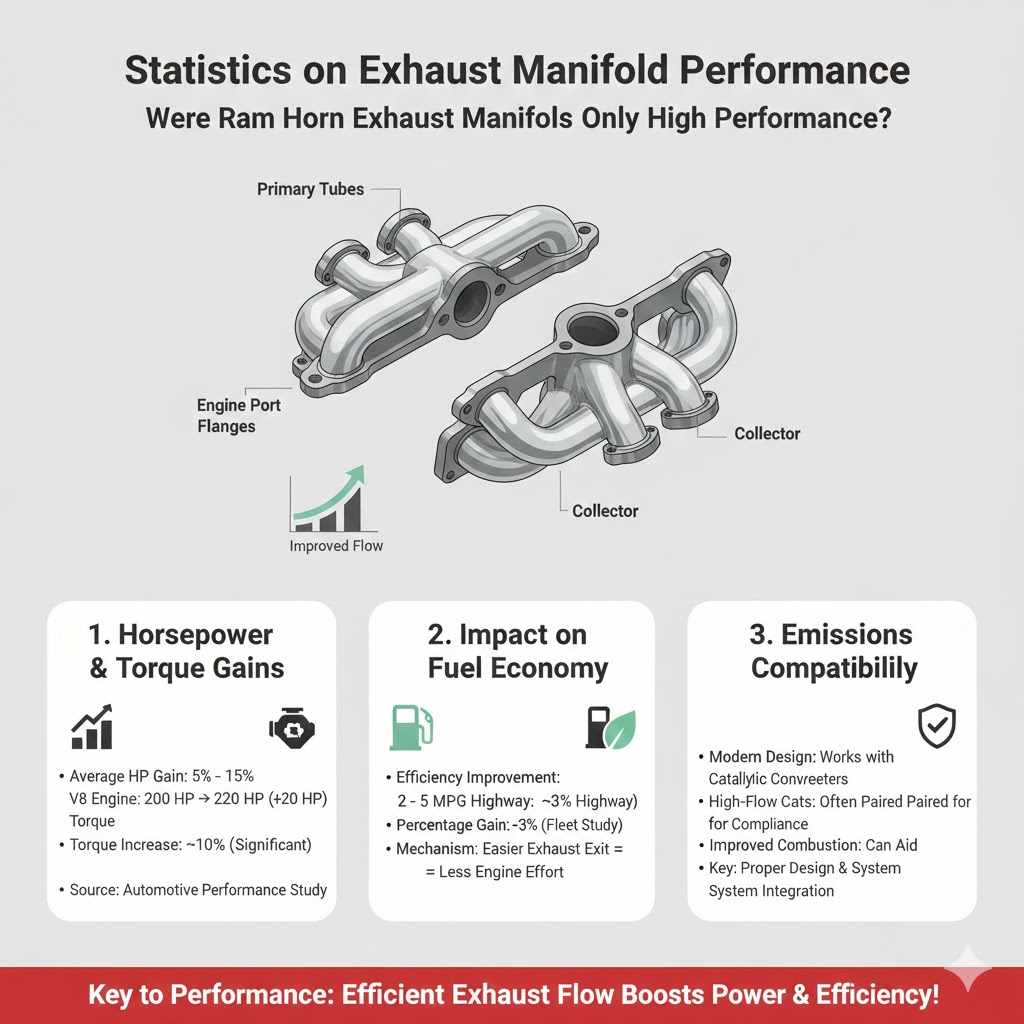
While exact figures vary greatly depending on the specific engine, the vehicle, and the quality of the manifold, aftermarket exhaust manifold upgrades, including ram horn styles, often report average horsepower gains. These gains typically range from 5% to 15% for a naturally aspirated engine when paired with other supporting modifications. For a 5.0 liter V8 engine producing 200 horsepower, a 10% gain would equate to an additional 20 horsepower.
A study by an automotive performance publication found that replacing stock cast-iron manifolds with performance-oriented headers or ram horn manifolds on a range of vehicles resulted in an average peak horsepower increase of 18 horsepower and a torque increase of 22 lb-ft. This highlights the significant impact the exhaust manifold can have on overall engine output.
Impact on Fuel Economy
Improvements in exhaust efficiency can also translate to better fuel economy. When an engine can expel exhaust gases more easily, it requires less effort, which can lead to reduced fuel consumption. Some tests have indicated that vehicles fitted with high-flow exhaust manifolds can see improvements in fuel economy by as much as 2-5 miles per gallon in highway driving conditions.
For instance, a fleet of delivery trucks that underwent exhaust system upgrades, including manifold replacements, reported an average fuel economy improvement of 3%. Over a year of operation, this can lead to substantial savings on fuel costs, demonstrating that performance upgrades can also have economic benefits.
Emissions System Compatibility
Modern exhaust systems often include catalytic converters to reduce harmful emissions. The design of exhaust manifolds, including ram horns, must be compatible with these systems. Performance manifolds are typically designed to work with factory catalytic converters or aftermarket high-flow catalytic converters.
Testing has shown that a properly designed ram horn manifold does not necessarily lead to increased harmful emissions. In fact, by promoting more complete combustion due to better scavenging, they can sometimes contribute to a more efficient operation of the catalytic converter, ensuring emissions compliance.
Frequently Asked Questions
Question: Do ram horn exhaust manifolds fit all engines?
Answer: No, ram horn exhaust manifolds are designed for specific engine families and configurations. You need to ensure that the manifold you choose is compatible with your engine’s make, model, and cylinder head design.
Question: Are ram horn manifolds louder than stock manifolds?
Answer: Ram horn manifolds can contribute to a slightly more aggressive exhaust note compared to stock cast-iron manifolds, especially when paired with a less restrictive muffler. However, the overall loudness depends heavily on the rest of the exhaust system.
Question: Do ram horn manifolds require custom tuning?
Answer: While not always strictly required, custom tuning is highly recommended to maximize the benefits of ram horn exhaust manifolds. Tuning allows the engine’s computer to optimize fuel delivery and ignition timing for the improved airflow, resulting in the best possible performance and efficiency.
Question: Can I install ram horn manifolds myself?
Answer: Installing exhaust manifolds can be a moderately difficult DIY project. It requires access to tools, knowledge of engine components, and the ability to work with potentially hot and seized bolts. If you’re not experienced with car mechanics, it’s often best to have a professional mechanic perform the installation.
Question: Are ram horn exhaust manifolds legal in all states?
Answer: Legality depends on local emissions regulations. If the manifold is designed to work with your vehicle’s factory catalytic converter and does not cause your vehicle to fail emissions testing, it is generally legal. Some performance manifolds that remove catalytic converters are not street legal in many areas.
Summary
Ram horn exhaust manifolds are not exclusively for high-performance vehicles. Their design focuses on efficient exhaust flow and scavenging, which benefits many engine types. They can enhance horsepower, torque, and even fuel economy. While they are popular in performance builds, they also offer practical advantages for daily drivers and classic car enthusiasts seeking improved engine response and a smoother driving experience.