Do Catalytic Converters Restrict Performance?
Yes. A healthy stock catalytic converter usually adds only a little measurable restriction. Real power loss shows up when the converter is clogged, overheated, melted, or too small for the engine’s airflow. Ignore that, and you can lose horsepower, drive exhaust heat up, and turn a simple fault into an expensive emissions repair. This guide separates normal restriction from failure and shows when a high-flow converter makes sense.
What a catalytic converter actually changes


A catalytic converter cleans exhaust gases by turning carbon monoxide, hydrocarbons, and nitrogen oxides into less harmful compounds. It also sits in the exhaust stream, so substrate layout, cell density, and placement can change flow resistance. That does not mean every converter becomes a major choke point.
Ceramic vs. metallic substrates
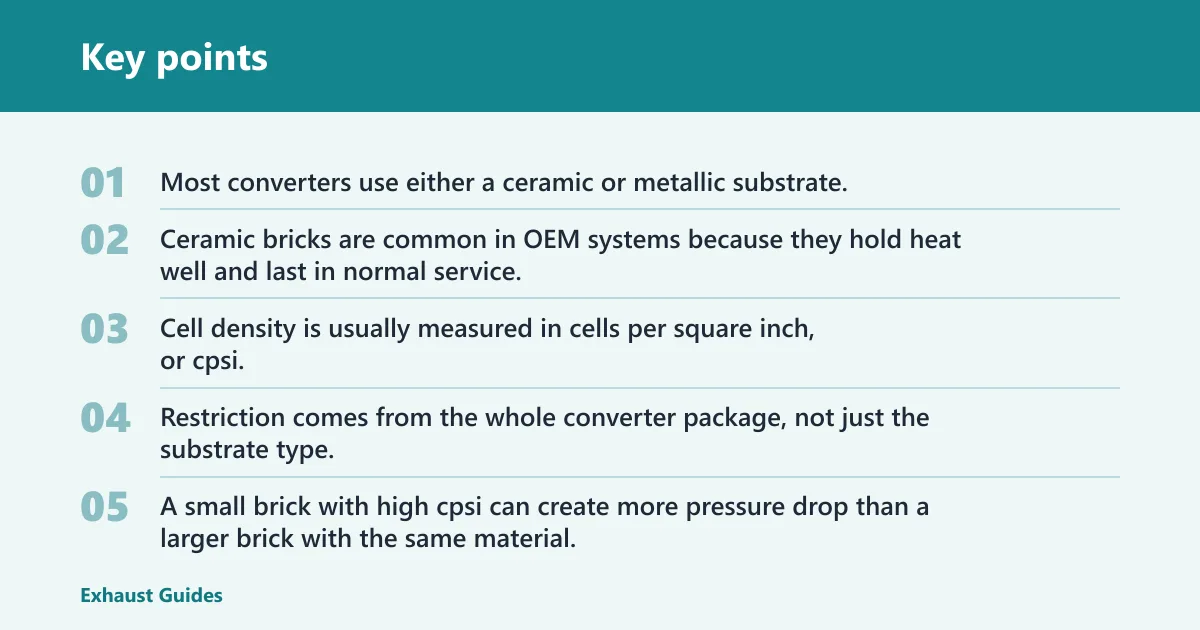
Most converters use either a ceramic or metallic substrate. Ceramic bricks are common in OEM systems because they hold heat well and last in normal service. Metallic substrates warm up quickly and often flow better for the same size, but the final result still depends on cell density, brick size, and canning design.
Cell density is usually measured in cells per square inch, or cpsi. Higher cpsi can improve surface area for emissions cleanup, but it can also raise restriction if the brick is small or the exhaust volume is high. Lower cpsi often flows better, especially in modified systems, but emissions performance and compliance can change with that choice.
Cell density, brick size, and flow
Restriction comes from the whole converter package, not just the substrate type. A small brick with high cpsi can create more pressure drop than a larger brick with the same material. Aging, soot loading, melting, and broken substrate pieces can raise backpressure far beyond what a healthy part produces.
Location matters too. Close-coupled converters sit near the exhaust manifold or turbo outlet and light off quickly. Underfloor converters sit farther back and often have more room. Some turbo engines integrate the catalyst in the downpipe, where exhaust energy and heat are highest, so that design can change both emissions control and flow.
Do catalytic converters restrict performance?
Yes, but usually only a little when the converter is healthy and sized for the engine. A stock converter is built to meet emissions and durability targets, and on many mild builds it is not the first part that limits output. Real restriction becomes a performance problem when flow demand rises past what the converter can pass cleanly.
Why a healthy stock converter usually is not the main bottleneck
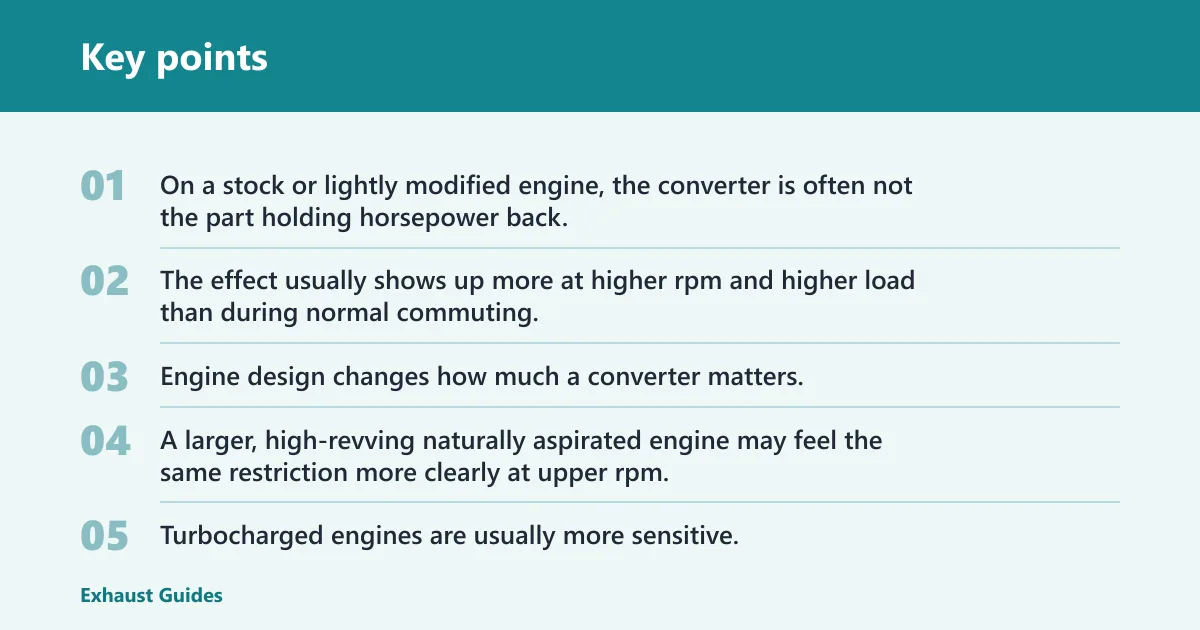
Many owners assume the converter is the biggest restriction because it sits in the exhaust path and contains a dense substrate. In practice, the exhaust manifold, turbine housing on turbo engines, resonators, mufflers, and pipe diameter can matter as much or more. On a stock or lightly modified engine, the converter is often not the part holding horsepower back.
That said, a converter that is too small for the engine, or a system with a very dense brick, can limit top-end flow. The effect usually shows up more at higher rpm and higher load than during normal commuting.
Why restriction matters more on some engines than others
Engine design changes how much a converter matters. A naturally aspirated engine can tolerate some added backpressure, especially if it is small-displacement or tuned for low and midrange torque. A larger, high-revving naturally aspirated engine may feel the same restriction more clearly at upper rpm.
Turbocharged engines are usually more sensitive. The turbine needs exhaust energy to spool, and any downstream restriction raises pressure in the exhaust system. That can affect boost response, cylinder scavenging, and exhaust temperature more than it would on a naturally aspirated setup.
How engine speed changes the feel of restriction
Restriction often feels mild at low rpm and worse as engine speed climbs. That happens because exhaust volume rises quickly with rpm and load. A converter that passes enough gas at cruise may become a bottleneck near redline, where horsepower is made.
Torque and horsepower can also change differently. Low-rpm torque loss may feel subtle, while high-rpm horsepower loss is easier to notice because the engine stops pulling cleanly near the top end. The exact result depends on the engine, cam timing, displacement, and the rest of the exhaust.
Exhaust backpressure and engine type
Backpressure is the pressure drop across the exhaust system. Some pressure drop is normal, but excessive pressure drop means the engine must push harder to move spent gases out. That can increase pumping losses and reduce the power available at the wheels.
Naturally aspirated engines
In a naturally aspirated engine, modest exhaust restriction usually causes modest gains or losses rather than dramatic ones. The effect depends on displacement, rev range, and how much the engine already relies on exhaust flow at high rpm. Many street engines see only a small change unless the converter is damaged or undersized.
Turbocharged engines
Turbocharged engines often react more strongly because the turbo uses exhaust energy to spin the turbine. A restricted converter can slow spool, raise turbine inlet pressure, and increase heat. On these engines, a freer-flowing converter can improve response if the rest of the setup supports it.
Horsepower versus torque
Restriction usually hurts horsepower first because horsepower is tied to airflow at higher rpm. Torque can feel softer too, but the change may be smaller and harder to separate from tuning or transmission behavior. A converter issue is more convincing when the engine pulls normally down low and falls flat as speed rises.
How to spot a failing converter
A failing converter does not always announce itself with one obvious sign. Look for a mix of heat, drivability changes, and diagnostic clues. A check engine light alone does not prove the converter is bad, and a P0420 or P0430 code can point to catalyst efficiency rather than outright blockage.
Melting and clogging
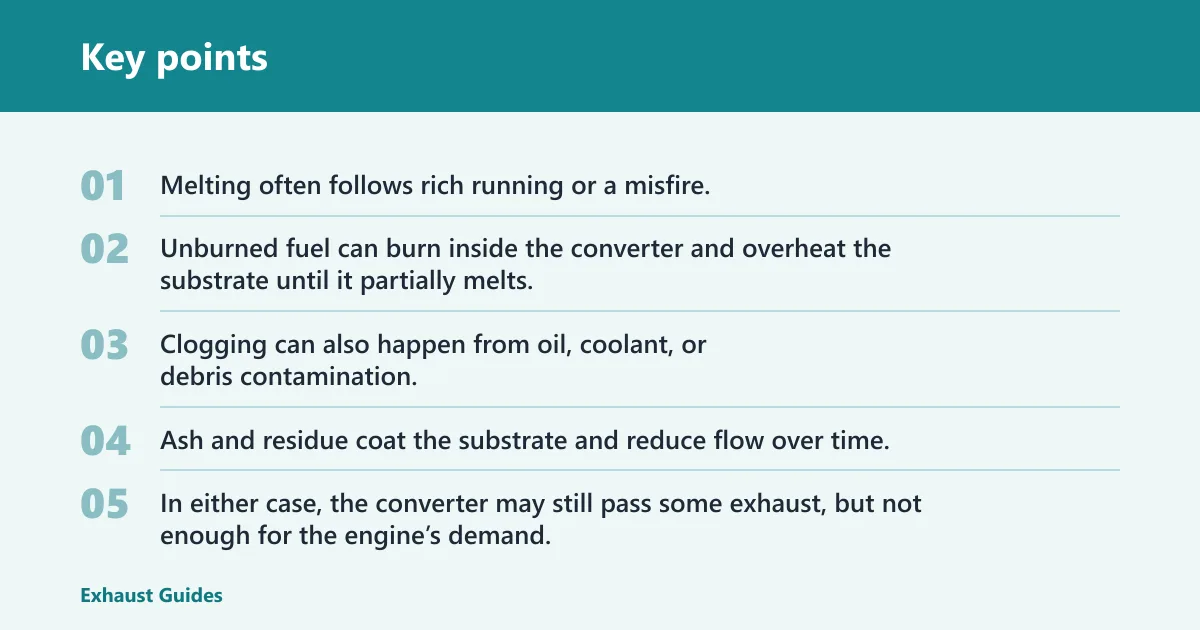
Melting often follows rich running or a misfire. Unburned fuel can burn inside the converter and overheat the substrate until it partially melts. That can narrow the passages and raise backpressure fast enough to cause a clear loss of power, especially at higher load.
Clogging can also happen from oil, coolant, or debris contamination. Ash and residue coat the substrate and reduce flow over time. In either case, the converter may still pass some exhaust, but not enough for the engine’s demand.
Substrate breakage and thermal shock
Impact damage can crack the substrate, and thermal shock can break it as well. A sudden splash of cold water on a very hot converter can stress the brick, and so can repeated heat cycles on an already weakened part. Loose pieces can move and block flow intermittently, which makes the symptom pattern irregular.
OBD-II clues: P0420, P0430, and readiness monitors
P0420 and P0430 usually indicate the catalyst is not storing oxygen or cleaning exhaust as expected. They do not automatically mean the converter is plugged. Readiness monitors matter too, because a recent battery disconnect, tune change, or repaired fault can delay emissions testing even if the converter itself is fine.
Say your four-cylinder shows P0420, but it also has a rough idle and a misfire counter on cylinder 2. The converter may be reporting the damage caused by the misfire, not causing the misfire itself. Fix the upstream issue first.
When is the converter the real problem?
The converter is the real problem when the symptoms point to flow loss at the converter itself, not just catalyst efficiency failure. Normal stock converters usually do not need replacement for power reasons alone. A partially clogged converter, however, can create a clear load-related restriction, while an upstream fault can mimic the same symptoms.
Normal stock converter
A normal stock converter is often the wrong place to look first on a mild engine. If the vehicle idles well, revs cleanly in neutral, and pulls without a sharp high-rpm drop-off, the converter may be doing its job. In that case, exhaust restriction is usually not the main complaint.
Partially clogged converter
A partially clogged converter often creates a pattern of normal cold starts, worsening power as heat and load rise, and weak top-end pull. On a turbo engine, you may also see slower spool or higher-than-usual exhaust backpressure. This is the point where replacement or a lower-restriction unit can make sense.
Upstream misfire or fueling issue
An upstream misfire or fueling issue can imitate a clogged converter and can also damage one. Rich running, injector problems, ignition faults, vacuum leaks, and sensor errors can all change exhaust composition. If the root cause stays active, a new converter can fail again.
Unrelated exhaust restriction
Sometimes the converter gets blamed for a restriction caused elsewhere. A crushed pipe, collapsed muffler, stuck exhaust flap, or bad turbo component can all raise backpressure. If the converter is replaced without checking the rest of the system, the real fault may remain.
Catalytic converter decision matrix
Use this matrix to sort common cases before buying parts. It separates normal converter behavior from clogging, upstream engine faults, and other exhaust restrictions. That keeps the diagnosis tied to the symptom pattern, not just the presence of a code.
| Engine type | Typical symptoms | Likely diagnosis path | High-flow converter worth considering? |
|---|---|---|---|
| Stock naturally aspirated engine | Normal idle, modest top-end pull, no heat spike, no strong rpm-related power loss | Check for misfire, fueling issues, and exhaust dents before blaming the converter | Usually no, unless the current unit is damaged or the engine has real airflow changes |
| Modified naturally aspirated engine | Pulls well low down, falls flat near redline, no obvious CEL | Confirm exhaust diameter, muffler flow, and converter size against airflow demand | Maybe, if the setup has higher airflow and the converter is a known choke point |
| Turbocharged street engine | Slow spool, rising exhaust heat, weaker midrange under boost | Check turbine outlet, downpipe, converter size, and boost control before replacement | Often yes on modified setups, but emissions and local rules still matter |
| Engine with P0420 or P0430 only | CEL present, but drivability is normal and no clear power loss | Inspect sensors, exhaust leaks, and catalyst efficiency data first | Usually no, because the code alone does not prove restriction |
| Engine with rough running and power loss | Misfire, fuel smell, poor acceleration, possible sulfur or heat odor | Fix misfire or fueling fault first, then retest converter health | Not until the upstream fault is solved |
| High-mileage vehicle with sudden loss of power | Loss gets worse with throttle, may recover after cooldown | Check for melting, clogging, or broken substrate in the converter and the rest of the exhaust | Only if the original converter is undersized or replaced as part of a legal, compliant upgrade |
- Check for engine faults first. Read OBD-II codes and look for misfire, fuel trim, or oxygen sensor issues before replacing the converter. A converter often fails because the engine ran badly first.
- Confirm the symptom pattern. Note whether the power loss gets worse with rpm, load, or heat. A true restriction usually shows up under hard acceleration more than at idle.
- Inspect the exhaust path. Look for dents, crushed pipes, loose heat shields, exhaust leaks, and damaged mufflers. Any of these can mimic a converter problem.
- Compare engine demand. If the engine has been modified for more airflow, the original converter may no longer be a good match. A higher-flow unit can make sense only after the rest of the system is verified.
A common first-timer mistake is blaming the catalytic converter for sluggish acceleration in a stock sedan when a clogged air filter and weak fuel pressure are the real causes. If the misfire remains, the new converter may not survive long. Fix the cause, then decide whether the converter is still the bottleneck.
Frequently asked questions
Does a catalytic converter affect performance?
Yes, but the effect depends on the converter’s condition, size, and the engine’s airflow demand. A healthy stock unit usually causes little noticeable loss on a normal street engine. A clogged, melted, or undersized converter can reduce horsepower, slow turbo spool, and raise exhaust heat.
Are catalytic converters necessary?
For street use, yes in most places. They reduce harmful emissions by converting CO, HC, and NOx, and they are part of the vehicle’s required emissions system. Removing one can create legal and inspection problems, and it can also trigger readiness and catalyst-efficiency faults.
Does a catalytic converter wear out?
Yes. A converter can age from heat cycles, contamination, oil burning, coolant intrusion, misfires, and physical damage. Some units last a very long time if the engine runs cleanly. Others fail early when the engine is rich, misfiring, or leaking coolant into the exhaust stream.
When a catalytic converter needs replacing
Replacement makes sense when the converter is clogged, melted, broken internally, or clearly unable to pass exhaust without creating a power loss. A P0420 or P0430 code alone is not enough. You need a symptom pattern, failed emissions data, or physical evidence of damage.
Are aftermarket catalytic converters good?
Some are, but quality varies a lot. A high-flow catalytic converter can reduce restriction and help modified engines, but emissions compliance may change depending on the design and local rules. For a stock vehicle, a direct-fit OEM-style part is often the safer choice.
Can I eliminate the catalytic converter?
Not for street use in many places. Deleting it can be illegal, can trigger emissions faults, and can create inspection problems. It may also worsen noise and heat management. If flow is the concern, a compliant high-flow converter is the better path.