Why Does My Garage Smell Like Exhaust After Parking?
A brief exhaust smell for about 5 to 15 minutes after parking can be normal in an attached garage, but a strong odor that lingers, gets worse, or appears with the engine running should be inspected promptly. Ignoring it can mean carbon monoxide exposure, trapped fumes, or a leak that only shows up when hot parts cool. This article explains heat soak, airflow, parking position, and the signs that separate normal residual odor from a problem.
How heat soak and trapped air create exhaust odors


Most of the time, the smell comes from hot exhaust parts continuing to give off odor after shutdown, then collecting in a garage that does not clear air quickly enough. An attached garage, a still day, a rear-facing parking position, or a small leak can make that odor noticeable even when the engine seemed normal on the road.
Heat soak after shutdown
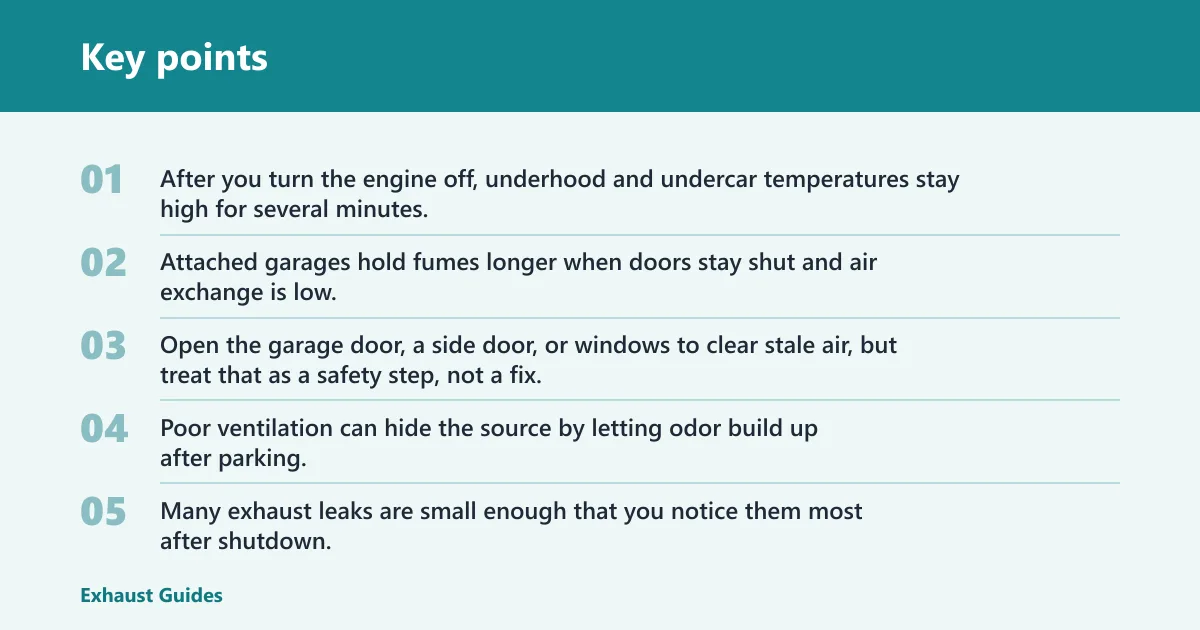
After you turn the engine off, underhood and undercar temperatures stay high for several minutes. That heat soak can make a tiny exhaust leak smell stronger because hot metal expands, then contracts as it cools, and fumes can escape more easily at the manifold, gasket, flex pipe, clamp, resonator, muffler, or tailpipe.
A short drive can make this more noticeable. If the exhaust system never reaches full operating temperature, residue and moisture may remain in places that odor can later escape from as the car sits.
Why attached garages trap odor
Attached garages hold fumes longer when doors stay shut and air exchange is low. Open the garage door, a side door, or windows to clear stale air, but treat that as a safety step, not a fix. Poor ventilation can hide the source by letting odor build up after parking.
Detached garages can still hold fumes, but attached spaces matter more because odor can move toward the house through shared walls, ceiling gaps, or a house door left open.
Why the smell may appear only after you park
Many exhaust leaks are small enough that you notice them most after shutdown. While driving, airflow under the car can carry fumes away; once the car stops, the plume can rise, swirl, and settle near the rear bumper, the garage floor, or the wall behind the vehicle.
Parking position matters. A car parked too close to a wall, with the tailpipe aimed into a corner, can trap fumes more easily than the same car parked with more open space behind it.
Is an exhaust smell in the garage dangerous?
Exhaust smell in a garage should be treated as a safety issue because exhaust may contain carbon monoxide, which is odorless and toxic. Risk rises in enclosed or attached garages, especially if the smell is strong, the engine was recently running, or anyone has headache, dizziness, nausea, or unusual fatigue.
When to leave the area
If the odor is strong, if anyone feels ill, or if the smell appears while the engine is running, leave the garage and get fresh air first. Open doors and windows on the way out if that can be done without delaying your exit. Do not keep the engine idling in a closed garage.
If symptoms do not clear quickly after leaving the area, seek urgent medical help. Carbon monoxide exposure can worsen fast, and the gas cannot be smelled directly.
When to ventilate and stop using the car
Ventilation can lower the immediate hazard, but it does not fix a leak. If the smell returns after the garage is aired out, or if it appears every time you park, stop using the vehicle until the exhaust system is inspected. A persistent odor after shutdown is not a condition to ignore and monitor for days.
Exhaust odor diagnosis matrix
This table helps you sort timing, odor character, garage conditions, and the most likely source. Use it to decide whether you can wait for a scheduled inspection or should inspect now.
| Smell timing | Odor character | Garage type | Likely source | Next check | Safe to wait vs inspect now |
|---|---|---|---|---|---|
| 5 to 15 minutes after parking | Hot, sooty, or chemical | Attached garage with closed door | Small exhaust leak or trapped fumes | Inspect manifold, gasket, flex pipe, clamp, resonator, muffler, and tailpipe | Wait briefly only if weak and fading; inspect soon if repeatable |
| Immediately after shutdown, then stronger as it cools | Hot exhaust odor | Any garage, worse in still air | Heat soak exposing a leak | Check for leaks that open when metal rocks or contracts | Inspect now if the odor is strong or enters the house |
| While the engine is running or idling | Sharp exhaust odor | Attached or enclosed garage | Exhaust leak or blocked outlet | Check tailpipe, undercar pipes, and nearby body seals | Inspect now |
| After a short trip, then fades slowly | Exhaust odor, sometimes slightly sulfur-like | Garage with poor air exchange | Poor ventilation or a catalytic converter issue | Ventilate, then inspect for leak points if the smell repeats | Wait only if the odor disappears quickly and does not return |
| After parking with HVAC set to outside air | Odor seems to enter cabin or house | Attached garage | HVAC intake recirculation path or exterior fumes drifting toward intake | Check fresh-air intake setting and blower mode | Inspect now if fumes enter the cabin repeatedly |
| Any time, especially after refueling | Sharp gasoline smell | Any garage | Fuel leak | Inspect fuel lines, injectors, and nearby wet spots | Inspect now |
What parts should you check first?
Start with the most likely leak points, then move outward. Exhaust leaks can occur at the manifold, gasket, flex pipe, clamp, resonator, muffler, or tailpipe. A small leak can smell strong after shutdown, and engine movement or heat soak can make it easier for fumes to escape.
Under-hood and under-car leak points
Look for soot tracks, rust holes, loose clamps, cracked joints, and damaged hangers. A manifold or gasket leak often leaves dark staining near the engine bay. Flex pipe damage can be small but noisy or smell-heavy. Under the car, a resonator or muffler leak may show up only after the system warms and expands.
If the engine rocks when revved or shut off, a marginal joint may open briefly. That can make the leak smell worse after parking than while cruising.
Check the tailpipe area. Make sure the outlet is not blocked by snow, debris, luggage, a trailer accessory, or a tight wall behind the vehicle. A blocked outlet can trap fumes and push them toward the garage instead of away from it.
Inspect visible exhaust joints. Look along the manifold area, gasket line, flex pipe, clamps, resonator, muffler, and tailpipe for soot or rust trails. Any dark streak near a joint is a useful clue because escaping exhaust often leaves a visible mark.
Check for fuel odor too. If the smell is sharp and volatile like raw gasoline, do not assume it is exhaust. Inspect fuel lines, injectors, and any damp area near the engine or under the car, because a fuel leak can mimic an exhaust smell in a garage.
Suppose a sedan smells strongly of hot exhaust only after it backs into a one-car attached garage and shuts off. The tailpipe points toward the garage wall, and the smell fades when the car is pulled farther out. That pattern points first to airflow and tailpipe direction, then to a small exhaust leak if the odor still returns.
Could the smell be coming from airflow, not a leak?
Yes. Airflow can create or intensify the smell even when the exhaust system is intact. Garage ventilation, parking position, still air, rear seals, and cabin intake paths can all move fumes around. If the odor changes when the car is parked differently, airflow belongs high on the checklist.
Garage ventilation and air exchange
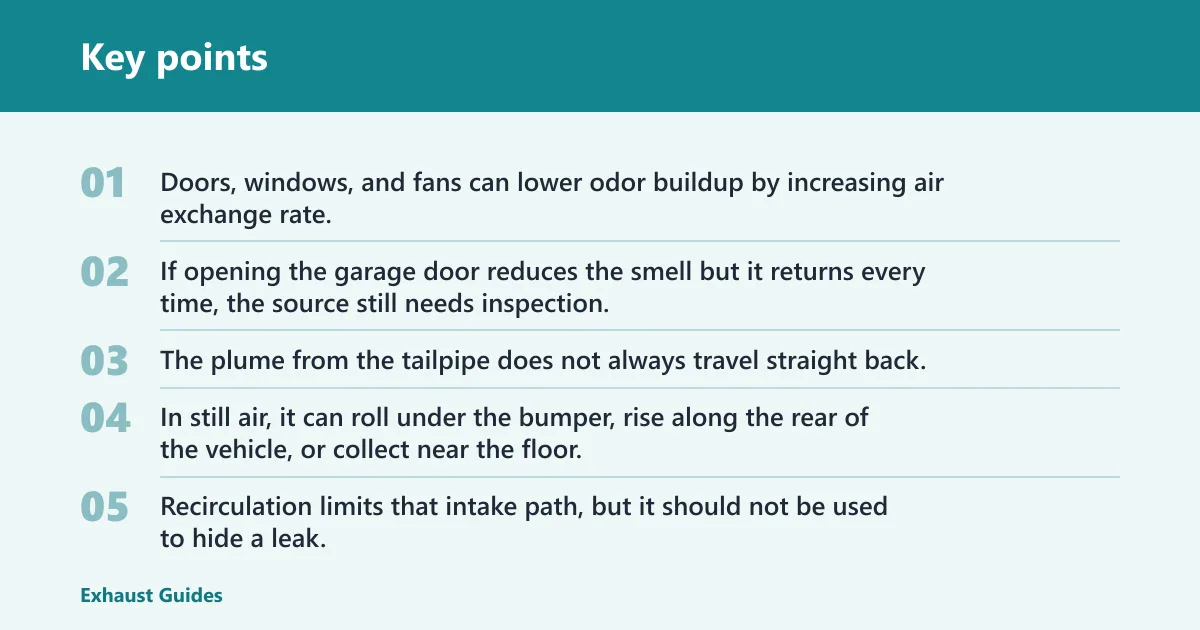
Doors, windows, and fans can lower odor buildup by increasing air exchange rate. That helps the garage clear fumes faster after parking. It does not solve a leak, though. If opening the garage door reduces the smell but it returns every time, the source still needs inspection.
Parking position and exhaust plume direction
The plume from the tailpipe does not always travel straight back. In still air, it can roll under the bumper, rise along the rear of the vehicle, or collect near the floor. A car parked nose-in versus backed in may change where the fumes settle, which is why the smell can seem stronger in one spot than another.
Rear seals and cabin intake paths
Rear liftgate seals, trunk seals, and hatch seals can draw fumes into the vehicle body if exhaust collects behind the car. Cabin fresh-air intakes can also pull odor toward the passenger area, especially with the blower on and the system set to outside air. Recirculation limits that intake path, but it should not be used to hide a leak.
A common first-timer mistake is assuming that an odor in the house means the garage door leaked. In some cases, the car’s HVAC intake or a loose rear seal is pulling fumes into the cabin first, then the odor moves indoors when the doors open.
Why does the smell get worse after I shut the car off?
The smell can intensify after shutdown because heat soak changes how exhaust parts behave. Metal continues to radiate heat, pressure and airflow patterns change, and a tiny leak may become more noticeable once the engine stops pushing fumes through the system. Short trips can make this effect more obvious.
Short trips and partially warmed exhaust systems
On short trips, the exhaust system may not fully dry out or stabilize at temperature. Moisture, residue, and heat cycling can leave a stronger odor after parking than during the drive. If the smell appears on every short trip but not on longer highway drives, that timing pattern matters.
Catalytic converter odor changes
A catalytic converter can change exhaust odor if it is inefficient or damaged, and the smell may become sharper, sour, or unusual. Still, a converter is usually not the first explanation when the odor appears only after parking. If the smell starts after shutdown and then fades, airflow and a small leak are more common first checks.
How do I tell if the smell is from exhaust or gasoline?
Exhaust odor is usually hot, sooty, or chemical, while gasoline odor is sharper, more volatile, and often easier to notice as raw fuel. That distinction matters because a gasoline smell can point to a fuel leak, not an exhaust leak. Both need inspection, but they are not the same problem.
What fuel leaks can mimic
Fuel leaks can spread through a garage quickly and may seem like exhaust because the odor is strongest near the car after shutdown. Check fuel lines, injector areas, connections, and damp spots under the vehicle. If the smell is strongest right after refueling or when parked hot, fuel system parts deserve attention.
How to separate the two odors
Stand back from the car and notice the character of the smell. Exhaust usually feels hotter and less sharp. Gasoline smells more like raw fuel and tends to jump out even in small amounts. If the odor makes your eyes sting or your clothes smell like fuel, do not treat it as a simple exhaust issue.
Frequently asked questions
Why does my garage smell like exhaust after parking?
The most common reasons are heat soak, a small exhaust leak, or fumes trapped by poor garage airflow. Attached garages hold odor longer, especially when the tailpipe points toward a wall or the car parks in still air. If the smell repeats, inspect the exhaust system and ventilation path.
Why does my car smell like exhaust after I turn it off?
After shutdown, hot exhaust parts can release odor as they cool, and a small leak can become more noticeable when the engine stops pushing air through the system. If the smell is brief and fading, airflow may be the main factor. If it is strong or persistent, inspect the exhaust.
What parts should I check first for exhaust smell after parking?
Start with the manifold, gasket, flex pipe, clamps, resonator, muffler, and tailpipe. Then check for soot marks, loose hangers, or blocked outlets. If the odor is sharp and gasoline-like instead of hot and sooty, inspect fuel lines and injector areas as a separate problem.
How do I tell if the smell is coming from the car or the garage?
Change one thing at a time. Open the garage door, move the car farther from the wall, and try a different parking direction. If the smell drops sharply, airflow is part of the cause. If it still returns in the same pattern, the car likely has a leak or HVAC intake issue.
Could a garage exhaust smell be from gasoline instead?
Yes. Gasoline odor is sharper and more volatile than exhaust odor, and it can come from fuel lines, injectors, or a spill near the car. Because fuel leaks can also create a strong garage smell after parking, they need their own inspection rather than being treated as an exhaust problem.