Horsepower Calculator: Which Formula Fits?
Use horsepower = torque × rpm ÷ 5252 for imperial torque, horsepower = watts ÷ 746 for electric power, and for quarter-mile traps or elapsed time use a drag-race estimate rather than a drivetrain formula. Get the inputs wrong, and the answer can miss by a wide margin, which can mislead tuning, part selection, and power comparisons. This guide shows which horsepower calculator formula fits torque, watts, trap speed, or motor specs, plus where each estimate breaks down.
How is this calculated?
Press Calculate to see the math with your numbers.
Horsepower calculator decision table
Start with the input you actually have. That keeps you from forcing a torque formula onto a watt reading, or treating a wheel-dyno number like a crankshaft number. The right calculator depends on the measurement source, the unit system, and whether you need engine power, motor power, or a racing estimate.
| Starting input | Best formula | Required units | Common mistake | Confidence level |
|---|---|---|---|---|
| Torque and engine speed | HP = Torque × RPM ÷ 5252 | Torque in lb-ft, RPM in revolutions per minute | Using N·m without converting, or using torque from the wrong gear | High for steady-state engine math |
| Watts or kilowatts | HP = Watts ÷ 745.7; kW × 1.341 | Watts or kilowatts | Mixing mechanical horsepower with metric horsepower or electrical horsepower | High for clean power readings |
| Electric motor specs | Use volts × amps × efficiency × power factor, then convert to horsepower | Voltage, current, efficiency, power factor | Ignoring power factor on AC motors | Medium, because nameplate and load differ |
| Drag strip trap speed and weight | Quarter-mile horsepower estimate from trap speed and vehicle weight | Vehicle weight and trap speed | Treating the estimate like a dyno result | Medium to low, useful for comparison |
| Wheel dyno reading | Estimate crank horsepower by adding drivetrain loss | Wheel horsepower plus drivetrain type | Assuming wheel horsepower equals crank horsepower | Medium, with transmission-specific error |
| Naturally aspirated engine at altitude | Apply altitude correction after the base engine estimate | Elevation and engine type | Applying the same correction to boosted engines | Medium for rough comparison |
What is horsepower?
Mechanical horsepower is a power unit equal to 550 foot-pounds per second, and it is approximately 745.7 watts. That is the common engine unit on Imperial-style specs, dynos, and many vehicle listings. It is a unit of power, not torque.
Why horsepower has more than one definition
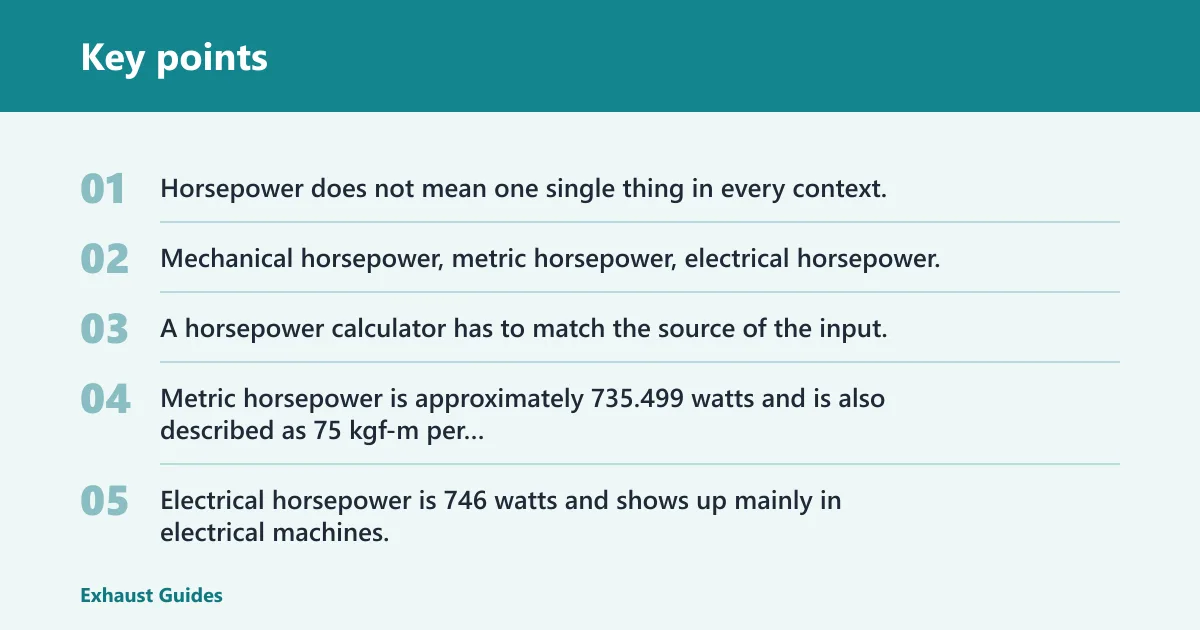
Horsepower does not mean one single thing in every context. Mechanical horsepower, metric horsepower, electrical horsepower, and boiler horsepower use different reference values, so the number changes with the system and the application. A horsepower calculator has to match the source of the input.
Metric horsepower is approximately 735.499 watts and is also described as 75 kgf-m per second. Electrical horsepower is 746 watts and shows up mainly in electrical machines. Boiler horsepower is approximately 9,809.5 watts and is tied to boiler output, not engine crankshaft output.
How do you calculate horsepower from torque and RPM?
Use HP = Torque × RPM ÷ 5252 when torque is in lb-ft and engine speed is in revolutions per minute. That formula gives mechanical horsepower from imperial torque values. If your torque is in N·m, convert it first before using the constant.
The 5252 constant and units
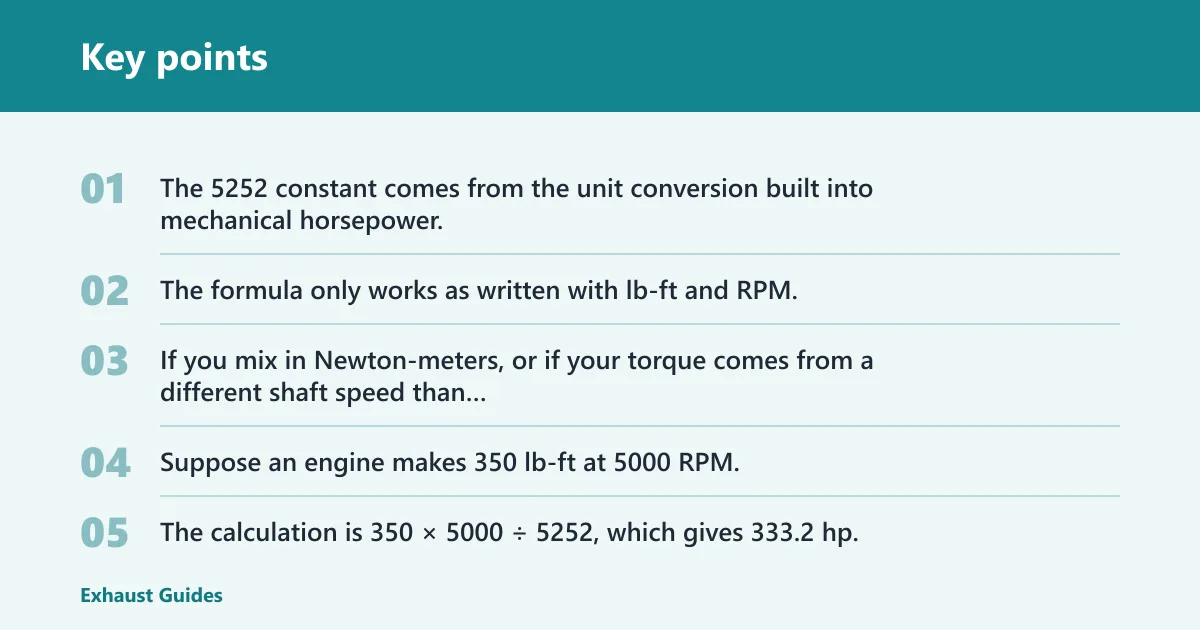
The 5252 constant comes from the unit conversion built into mechanical horsepower, and it links lb-ft, rpm, and the 33,000 foot-pounds-per-minute definition. The formula only works as written with lb-ft and RPM. If you mix in Newton-meters, or if your torque comes from a different shaft speed than the one you want to evaluate, the result will be wrong.
Suppose an engine makes 350 lb-ft at 5000 RPM. The calculation is 350 × 5000 ÷ 5252, which gives 333.2 hp. That is a straightforward example of the basic engine formula and shows why the torque point and the RPM point must match.
How much horsepower do I have from my torque and RPM?
Use the same formula, then check whether the result describes crank horsepower at the engine or wheel horsepower at the tires. A torque number from an engine dyno and a torque number from a chassis dyno are not interchangeable without drivetrain context. If you compare them directly, you will overstate or understate the real output.
A common first-timer mistake is reading peak torque from one RPM point and peak horsepower from another, then assuming both belong in the same line. They may not. The formula is exact for the inputs you give it, but the inputs still have to describe the same operating point.
How do you convert watts or kilowatts to horsepower?
For mechanical horsepower, a common conversion is HP = Watts ÷ 745.7. If the value is in kilowatts, multiply by 1.341 to get mechanical horsepower. That is the cleanest route for electric heaters, motors, pumps, and any device listed in SI power units.
Watts to horsepower on mixed unit labels
Some equipment labels use watts, some use kilowatts, and some use electrical horsepower. Do not treat them as identical. Those are close enough to confuse people and different enough to matter.
If a motor label says 2.2 kW, the mechanical horsepower equivalent is 2.2 × 1.341, or about 2.95 hp. If a catalog lists 3 metric horsepower, that is not the same as 3 mechanical horsepower. The numbers are near each other, but the definitions are different.
Electrical horsepower inputs
For an electric motor, a more complete estimate starts with voltage and current, then accounts for efficiency and power factor. That matters because the electrical input is not all converted into shaft power. AC motors especially can look stronger on paper than they are at the shaft if power factor is ignored.
That makes this calculator mode useful, but not exact. Nameplate output, load condition, and control method all change the answer. For a quick estimate, use the listed electrical inputs and then convert the resulting watts to horsepower.
How do drivetrain losses change horsepower?
Drivetrain loss explains why wheel horsepower reads lower than crank horsepower. A manual transmission often loses about 15%, while an automatic often loses 18–22%. Those are useful ranges for estimates, not universal constants.
Wheel horsepower vs crank horsepower
Wheel horsepower is what the chassis dyno measures at the tires. Crank horsepower is what the engine produces before the transmission, differential, and other drivetrain parts absorb power. If you use a wheel number as if it were a crank number, your comparison will be off.
Say your car makes 300 wheel horsepower with a manual transmission. A rough crank estimate at 15% loss would be about 353 hp. The point is not to create a perfect correction. The point is to avoid comparing a wheel reading to a crank spec as if they were the same unit of measurement.
Why dyno numbers change
Dyno results change with gearing, tire pressure, tie-down method, correction factor, and drivetrain setup. That is why two runs from different shops can disagree even when the engine did not change. Wheel horsepower is still useful, but only if you keep the test conditions in view.
How accurate are engine and drag racing estimates?
Quarter-mile horsepower estimates are useful for rough comparisons, not for replacing a dyno sheet. They use trap speed and vehicle weight to back into an estimated output. That makes them valuable for drag racing, where elapsed time and trap speed often tell you more than a single dyno pull.
Quarter-mile horsepower from trap speed
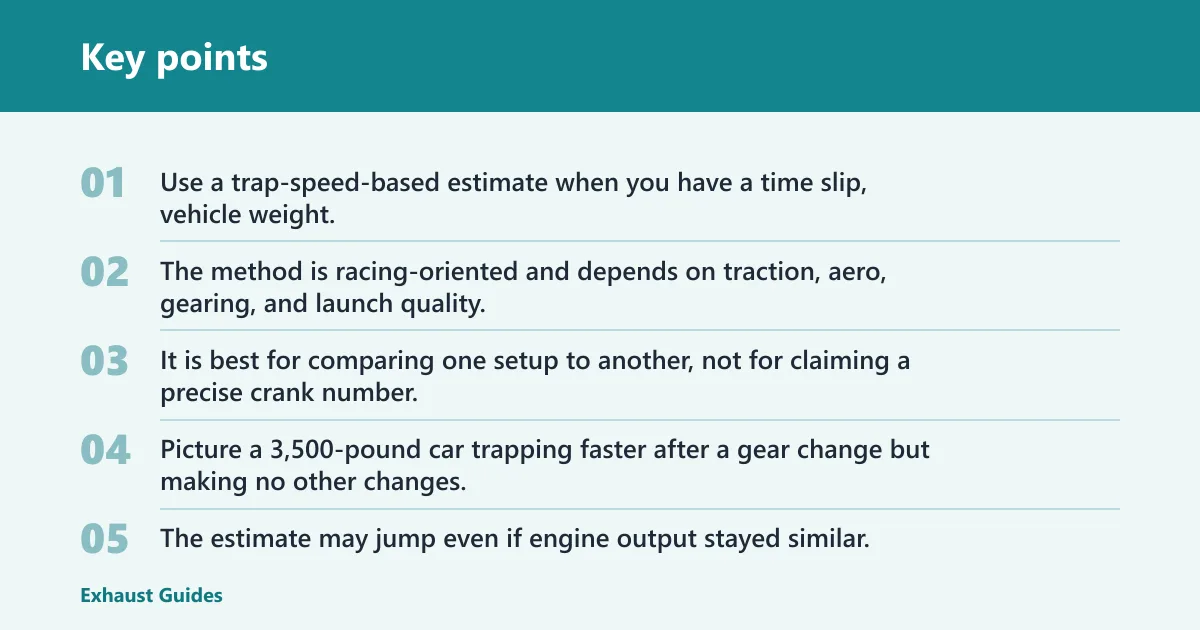
Use a trap-speed-based estimate when you have a time slip, vehicle weight, and finish-line speed. The method is racing-oriented and depends on traction, aero, gearing, and launch quality. It is best for comparing one setup to another, not for claiming a precise crank number.
Picture a 3,500-pound car trapping faster after a gear change but making no other changes. The estimate may jump even if engine output stayed similar, because trap speed reflects how the whole car accelerates. That is why the method can be informative and still miss the exact dyno number.
Altitude correction for naturally aspirated engines
Naturally aspirated engines lose about 3% per 1,000 feet of elevation, so altitude can make a sea-level horsepower number look optimistic. At 5,280 feet in Denver, a 400 HP engine at sea level makes roughly 340 HP according to the cited rule of thumb. Boosted engines are less affected, though they are not immune to altitude.
This matters when a dyno sheet and a street result disagree. A naturally aspirated engine that looks healthy at sea level can feel soft at altitude, while a turbo or supercharged setup may hold power better because boost helps offset the thin air. Do not apply the same correction to both.
Why quarter-mile estimates can mislead
Quarter-mile formulas do not know tire slip, converter behavior, or how well the car hooks on the launch. They also do not distinguish between a strong top-end pull and a weak midrange. Use them as a drag-race estimate, not as a substitute for a measured dyno result.
What horsepower calculator do I need for my car or engine?
Pick the calculator based on the input you already have. If you know torque and RPM, use the torque formula. If you know watts or kilowatts, use the power conversion. If you have a time slip, use a trap-speed estimate. If you have wheel horsepower, apply drivetrain loss only as a rough correction back to crank horsepower.
- Identify the source of the number: torque, watts, dyno, or time slip.
- Check the unit: lb-ft, N·m, watts, kW, PS, or hp.
- Choose the matching formula, not the one that looks closest.
- Apply drivetrain loss only when converting wheel horsepower to crank horsepower.
- Use altitude correction only for naturally aspirated engine comparisons.
- Treat drag-race estimates as approximate and compare them to similar cars.
Horsepower calculator decisions go wrong in a simple way: start with the answer you want, then force the wrong input into it. The calculator should follow the data, not the other way around.
Frequently asked questions
How do I calculate my horsepower?
Use the formula that matches your input. For torque in lb-ft and RPM, use HP = Torque × RPM ÷ 5252. For electrical power, use HP = Watts ÷ 745.7. For quarter-mile results, use a drag-race estimate based on trap speed and vehicle weight instead of a drivetrain formula.
What is the horsepower formula?
The common mechanical formula is HP = Torque × RPM ÷ 5252. For power in watts, use HP = Watts ÷ 745.7. Metric horsepower, electrical horsepower, and boiler horsepower use different watt equivalents, so the formula changes with the type of horsepower you mean.
How do I estimate horsepower from a quarter-mile time slip?
Use trap speed and vehicle weight for a drag-race estimate. That gives a rough horsepower figure that is useful for comparison, but it is not a dyno measurement. Tire grip, gearing, aero, and launch quality all affect the result, so treat it as approximate.
How do I convert watts to horsepower?
Divide watts by 745.7 to get mechanical horsepower. If the number is in kilowatts, multiply by 1.341 first or use the same conversion directly. Do not confuse mechanical horsepower with metric horsepower or electrical horsepower, which use slightly different watt values.
How do drivetrain losses change wheel horsepower vs crank horsepower?
Wheel horsepower is lower because the transmission, differential, and related parts absorb power before it reaches the tires. A manual transmission often loses about 15%, while an automatic often loses 18–22%. That correction is useful, but it is still an estimate rather than a universal constant.