
Skoda Yeti Egr Valve Replacement Cost
A Skoda Yeti EGR valve replacement in the UK is typically a few hundred pounds, but the total depends on whether you fit aftermarket or OE hardware, who does the labour, and whether diagnostics uncover related intake or DPF issues. Cleaning can be enough if the valve is sticking with soot rather than suffering an electrical or actuator fault. If the fault is ignored, the result can be rough running, limp mode, higher emissions, and an emissions-related MOT failure risk if the warning light or fault status affects the test outcome (DVSA MOT inspection rules; EGR’s NOx-reduction function under Euro emissions control).
Typical UK EGR valve replacement costs

- Reads and clears engine fault codes
- Works with most OBD2 vehicles
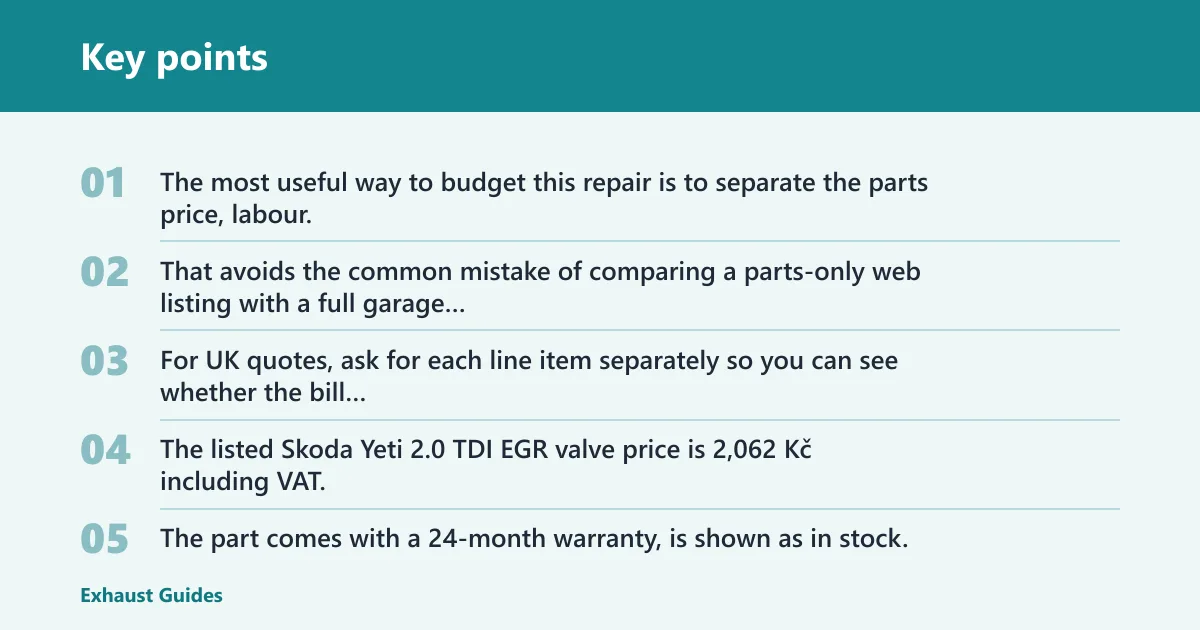
The most useful way to budget this repair is to separate the parts price, labour, diagnostics, consumables, and VAT. That avoids the common mistake of comparing a parts-only web listing with a full garage invoice. For UK quotes, ask for each line item separately so you can see whether the bill reflects an aftermarket valve, an OE-spec valve, independent labour, or dealer labour.
| Cost item | Low estimate | High estimate | What it covers |
|---|---|---|---|
| Aftermarket part | £70 | £180 | Pattern replacement valve from an independent parts supplier |
| OE part | £180 | £320 | OE-spec valve supplied through a dealer or OE channel |
| Independent-garage labour | £120 | £240 | Typically about 1.5 to 2.5 hours, depending on access and related strip-down |
| Dealer labour | £220 | £400 | Higher franchised main-dealer labour rates for the same job time |
| Diagnostic fee | £30 | £90 | Fault-code readout, live-data checks, and post-repair code clearing |
| Consumables | £10 | £45 | Gaskets, seals, clamps, bolts if required, and cleaning materials |
| VAT assumption | 20% | 20% | Applied to taxable parts and labour on a UK retail garage invoice |
| Total low-to-high estimate | £300 | £850 | Parts, labour, diagnosis, consumables, and VAT combined |
The listed Skoda Yeti 2.0 TDI EGR valve price is 2,062 Kč including VAT. The part comes with a 24-month warranty, is shown as in stock, and offers a 14-day return option. The manufacturer reference is SKV 14SKV085.
Dealer and aftermarket pricing do not mean the same thing. OE parts tend to cost more than pattern parts, while dealer labour usually costs more than an independent workshop. That is why a Yeti quote can look much higher than a parts listing alone, even when the underlying repair is straightforward.
Fitment matrix for the Yeti diesel
Fitment is not broad enough to treat every Yeti diesel as interchangeable. The safest order is the one matched to the VIN and engine code, because emissions hardware can change with power output, model year, and revision level. The table below covers the diesel variants readers are most likely to compare, but if the car has had engine, intake, or emissions work before, verify by VIN and engine code before buying.
| Engine code / variant | Output | Years | Likely cross-reference numbers | Fitment note |
|---|---|---|---|---|
| CAYC 1.6 TDI | 77 kW / 105 hp | Approx. 2009-2013 | Different EGR family than the 2.0 TDI listed here | Do not assume interchangeability; verify by VIN/engine code |
| CFHC 2.0 TDI | 103 kW / 140 hp | Approx. 2009-2013 | 03G131501, 03G131501P, 03L131501K, 03L131501P | Confirmed listing for 2.0 TDI 4×4 103kW/140hp from 05.2009 onward |
| CFFB 2.0 TDI | 81 kW / 110 hp | Approx. 2009-2012 | Revision-dependent; cross-check against chassis and emissions spec | Verify by VIN/engine code before ordering |
| Other Yeti diesel engine codes | Varies | Varies | Part number revision may differ by emission setup | Use VIN, engine code, and old part number as the final check |
What the EGR valve does
An EGR valve reduces NOx by recirculating exhaust gas into the intake, lowering peak combustion temperature and helping the engine meet emissions targets. On a diesel like the Yeti, soot and carbon can accumulate in the valve and its passages, causing sticky movement, restricted flow, and fault codes. Typical symptoms include rough idle, hesitant low-speed running, warning lights, and a check engine light that remains on until the fault memory is cleared and the underlying issue is fixed (Euro emissions function; EGR fault logic).
Why carbon buildup causes faults
Carbon is the common failure path because the valve is exposed to exhaust soot, heat, and repeated opening and closing. If the pintle or bypass flap does not move freely, the engine can receive the wrong amount of recirculated gas at idle or light load. That often shows up as hesitation, unstable idle, low-speed shuddering, and repeat EGR-related codes.
On a Yeti that starts idling roughly after short trips and shows an EGR flow fault, the next step is to distinguish soot sticking from a genuine hardware failure. If the valve still moves freely and live data suggests restricted flow, cleaning may restore operation. If the actuator is dead, the position feedback is implausible, or the fault returns quickly, replacement is the more durable repair.
Which Yeti engines use this valve?
The confirmed listing is for the 2.0 TDI 4×4 103kW/140hp from 05.2009 onward. That matters because Yeti diesel variants differ by engine code, emissions equipment, and part-number revision. A part chosen only by badge or model year can miss the correct revision, so the VIN and engine code are the decisive identifiers.
Engine-code checks before ordering
Use the engine code from the vehicle data sticker, service book, or a scan report, then compare it with the parts catalogue and the old valve’s part number. If the car has had prior engine, intake, or emissions work, check what is actually fitted now rather than assuming the original catalogue entry still applies.
For example, a 2012 Yeti 2.0 TDI 4×4 may already carry one of the listed cross-reference numbers, but the exact revision still matters. A VIN check is the best way to avoid ordering a valve that looks right on paper but does not match the connector, pipe layout, or calibration of the car in front of you.
Part numbers and fitment cross-reference
The listed cross-references are 03G131501, 03G131501P, 03L131501K, and 03L131501P. The page also lists VW 03G131501, 03G131501P, 03L131501E, and 03L131501G. Those revisions matter because EGR valves are commonly updated, and a suffix change can indicate a different supplier, internal calibration, or packaging revision.
How to confirm the correct replacement
- Read the engine code from the car, not just the badge.
- Match that code to the listed output, here 103 kW / 140 hp.
- Compare the old valve’s number with the cross-reference list.
- Check connector shape, pipe layout, and mounting points.
- Confirm whether a gasket kit is included or must be bought separately.
A part can be listed for a Yeti and still miss the right revision. That is why the engine code and VIN check come first, while the number on the box comes second. For broader diagnosis, it also helps to compare EGR faults with DPF loading and boost-control symptoms, because one failing system can trigger another.
What drives the replacement cost
The valve itself is still the biggest cost driver, but labour and access can move the bill quickly. A straightforward swap may only need the valve, one gasket, and a code reset. A stuck fastener, damaged electrical connector, or adjacent pipework that needs to come off can add time and consumables.
Dealer price versus aftermarket price
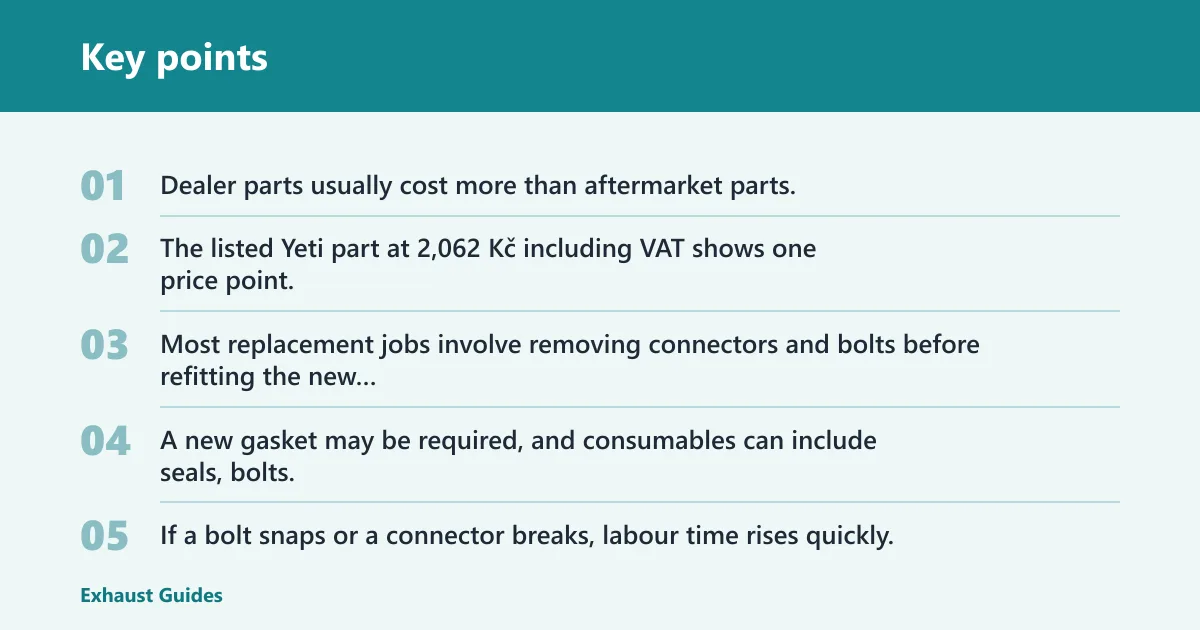
Dealer parts usually cost more than aftermarket parts, but the gap depends on the exact revision number and whether the item is supplied as OE or OEM-equivalent. The listed Yeti part at 2,062 Kč including VAT shows one price point, while UK aftermarket and OE pricing typically sit much higher once the job is fully priced with labour and tax.
Labor time and extra risks
Most replacement jobs involve removing connectors and bolts before refitting the new valve. A new gasket may be required, and consumables can include seals, bolts, or cleaning materials if the intake face needs preparation. If a bolt snaps or a connector breaks, labour time rises quickly. If the EGR is linked with DPF soot loading or repeated boost-control faults, diagnosis may take longer than the physical swap.
For a garage quote, ask for the parts line, the labour hours, the diagnostic charge, and the gasket line separately. That is the only way to compare one quote with another without guessing what is hidden inside a flat price.
Should you clean or replace it?
Cleaning is usually worth trying when the valve is sticking from soot, the motor still works, and the fault is not tied to an electrical failure or a damaged position sensor. Replacement makes more sense when the fault returns after cleaning, the valve is electrically dead, or the mechanism is so worn that carbon removal will only buy a short reprieve. As a rule, if the same fault comes back within a short drive cycle or a few days of normal use, the repair is no longer cost-effective.
Cleaning-vs-replacement checklist
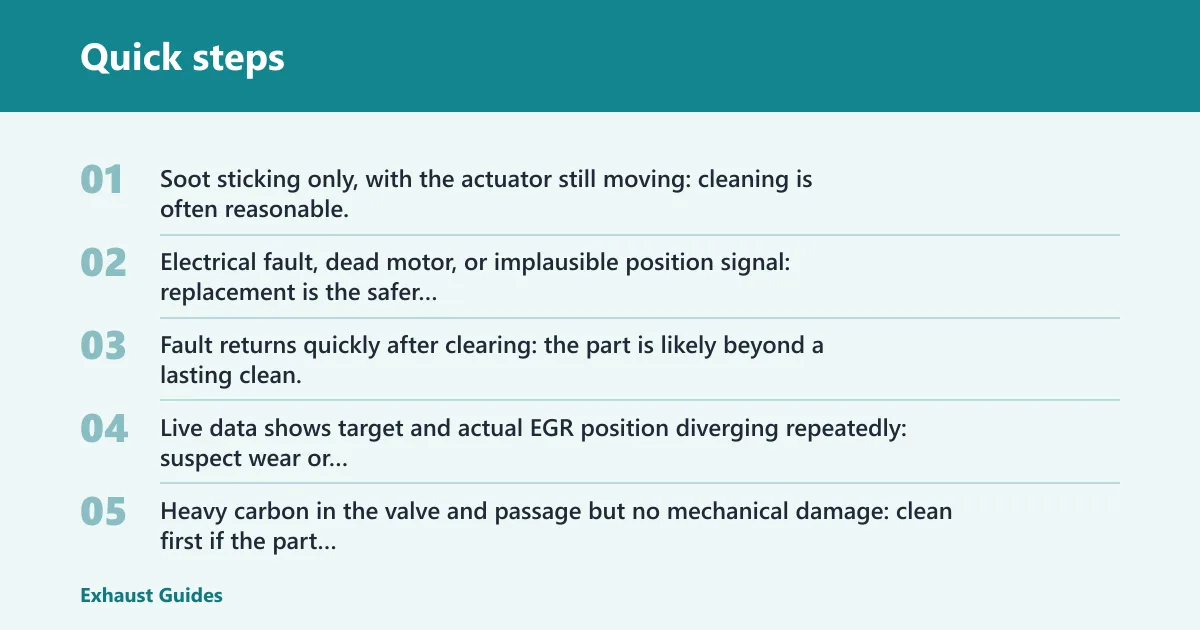
- Soot sticking only, with the actuator still moving: cleaning is often reasonable.
- Electrical fault, dead motor, or implausible position signal: replacement is the safer route.
- Fault returns quickly after clearing: the part is likely beyond a lasting clean.
- Live data shows target and actual EGR position diverging repeatedly: suspect wear or actuator failure.
- Heavy carbon in the valve and passage but no mechanical damage: clean first if the part is otherwise sound.
- Repeat DPF or intake faults alongside EGR faults: diagnose the system interaction before buying parts.
When cleaning is enough
Cleaning is the better call when the symptoms are mild, the scan points to flow restriction rather than a dead actuator, and the intake area is not badly worn. It is also the lower-cost choice when the job is simple enough that you can inspect the valve before ordering a new one.
When replacement is the safer choice
Replacement is usually justified if the fault code comes back after cleaning, the engine light returns quickly, or the valve is visibly damaged. Repeated faults matter because they point to a part that is no longer reliable, and chasing the same code twice can cost more than fitting the correct replacement once.
Does an EGR replacement need fault-code clearing?
Yes. The stored fault codes should be cleared after the repair, and many vehicles will keep the warning lamp on until the scan tool has erased the memory and the control unit has seen a successful restart or drive cycle. In other words, fitting the valve is not the final step; clearing the codes is part of the job (fault-memory reset and readiness logic).
What to check after refit
- Confirm every connector is fully seated.
- Check the gasket joint for leaks or soot traces.
- Clear the stored codes with a scan tool.
- Start the engine and watch idle quality.
- Recheck for returning fault codes after a short drive.
Can you drive with a failing EGR valve? Often yes for a short distance, but it is not a good long-term plan. A failing valve can cause rough running, higher emissions, and limp mode, and a car with a persistent warning light may fail inspection depending on the fault and the test outcome rules.
Frequently asked questions
Is an EGR valve expensive to replace?
It can be, because the total is not just the valve. A Yeti owner may pay for the part, labour, a diagnostic scan, gaskets, and VAT, which is why a garage bill can land in the £300 to £850 range even when the part itself looks modest.
How much does an EGR valve cost to replace?
For a Skoda Yeti, a sensible budget is about £300 to £850 at a UK garage, with dealer pricing often at the higher end. The parts line alone can sit far below that, but the final bill usually includes labour, diagnosis, sealing items, and tax.
Why would an EGR valve need to be replaced?
Replacement is usually needed when carbon buildup makes the valve stick so badly that cleaning no longer holds, or when the electrical side fails. Warning signs include rough idle, poor running, a check engine light, and fault codes that keep returning after cleaning.
What does a Skoda Yeti EGR valve cost?
The listed Skoda Yeti 2.0 TDI EGR valve price is 2,062 Kč including VAT. That part comes with a 24-month warranty, is shown as in stock, and carries a 14-day return option.
Where is the Skoda Yeti EGR valve located?
On the Yeti diesel, the EGR valve sits on the engine side of the intake and exhaust gas route, where it can be reached only after removing nearby covers, connectors, and bolts. Exact access depends on the engine code and layout, so the intake side should be inspected before ordering parts.
Does an EGR valve replacement need fault-code clearing?
Yes. After fitting, the stored codes should be cleared, or the check engine light may stay on. A scan tool should be used to clear the fault memory, then the car should be checked again for fresh codes or live symptoms after the repair.

