Straight Pipe vs Muffler
Choose a muffler delete if you want the simplest loud exhaust for off-road or track use; choose a full straight pipe only if you accept major drone, likely emissions trouble, poor street manners, and the need to follow local noise laws and protect your hearing. Get it wrong and you can fail inspections, attract tickets, and hate long drives. This guide compares what each setup removes, how that affects emissions legality, and which one is tolerable for daily use.
| Factor | straight pipe | muffler | Winner |
|---|---|---|---|
| Parts removed | Muffler and resonator; sometimes the catalytic converter too. | Muffler only; the rest of the system usually stays in place. | muffler |
| Sound | Loudest option, with 85–95 dB at idle and 105–120+ dB at wide-open throttle. | Louder than stock, often 78–85 dB at idle, but usually less extreme. | straight pipe |
| Drone risk | Highest, especially at steady highway throttle. | Lower than straight pipe, but still possible if the resonator stays out of the system. | muffler |
| Emissions and inspection risk | High if the catalytic converter is removed. | Lower if the catalytic converter remains, though noise rules can still be a problem. | muffler |
| Daily-driving comfort | Poor for long commutes and highway use. | More tolerable, but not always pleasant. | muffler |
| Likelihood of regret | High for street-driven cars. | Moderate, especially if you want a cheap louder setup without deleting every sound-smoothing part. | muffler |
What each setup removes
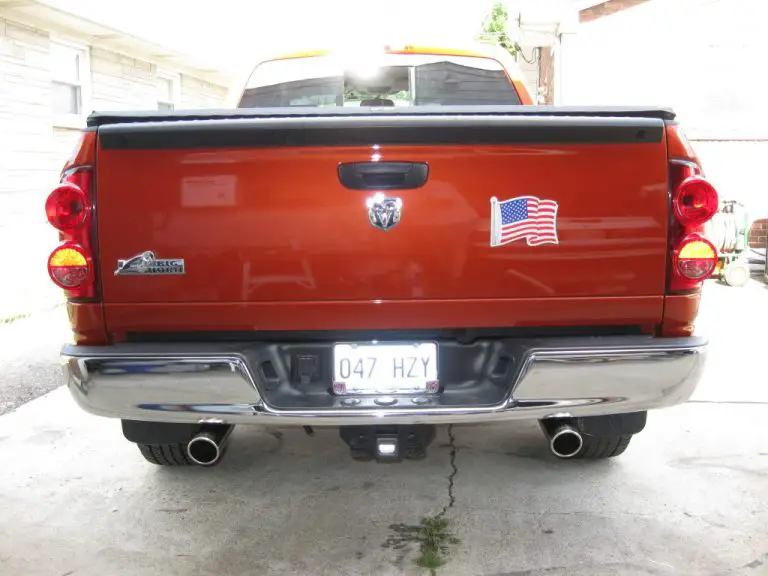
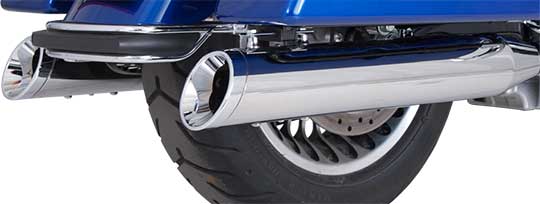
A muffler delete replaces the muffler with a straight section of pipe and usually keeps the catalytic converter, often the resonator too. A straight pipe removes more of the system, commonly the muffler and resonator, and may also remove the catalytic converter. That extra deletion is why the two setups are not the same problem in law or in daily use.
Muffler delete parts map
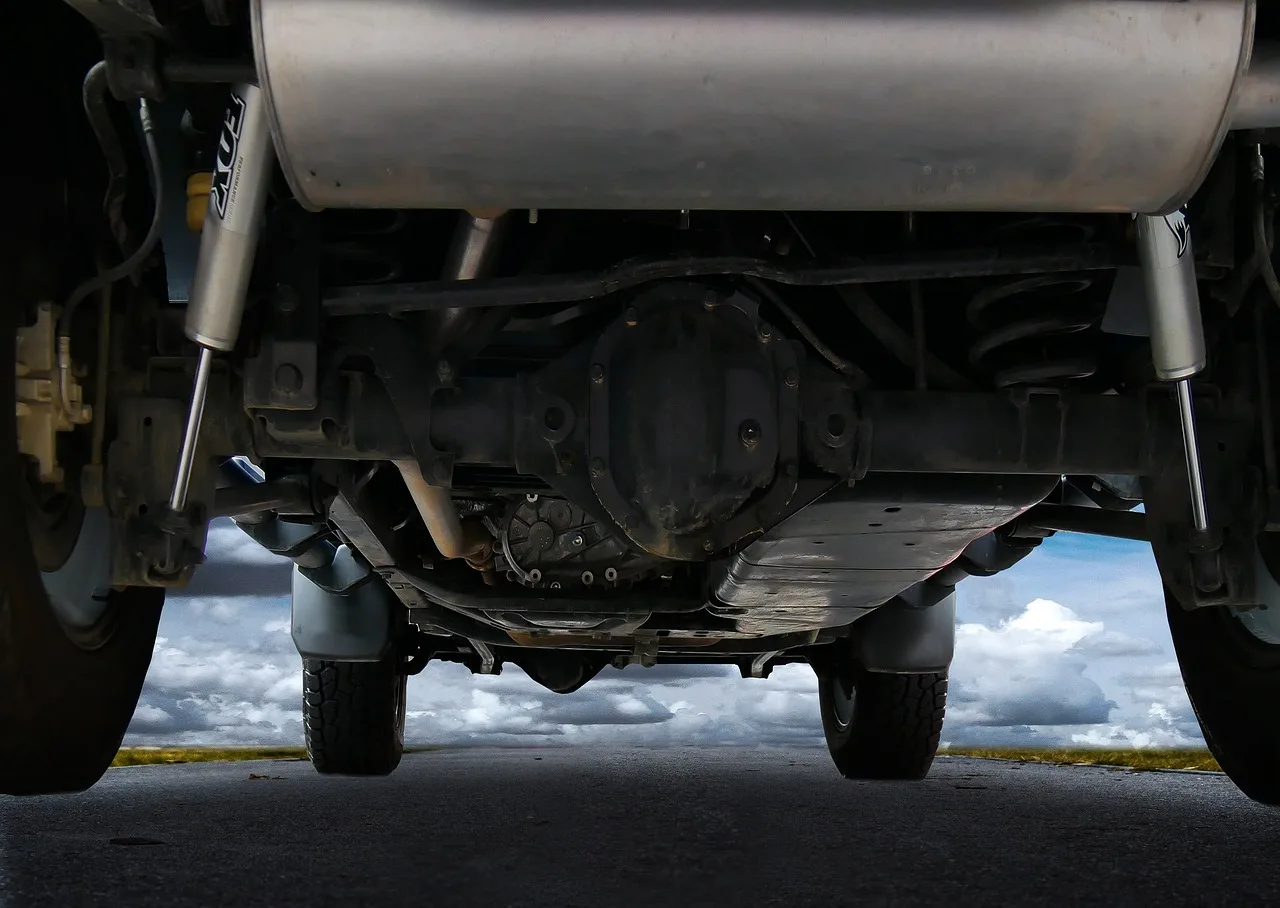
Start with the stock exhaust layout: catalytic converter, resonator, and muffler. A muffler delete keeps the catalytic converter in place and swaps out the muffler for pipe, so the exhaust path is shorter and less restricted, but not fully bare. That usually leaves enough sound control to avoid the harshest tone changes, though the result still depends on engine layout and resonator design.
Straight pipe parts map
A straight pipe is the more extreme change. It can remove the muffler and resonator, and some versions remove the catalytic converter too. That makes the exhaust path uninterrupted and is why this setup is the loudest option in the comparison.
Where the catalytic converter and resonator fit
The catalytic converter is an emissions-control part, so its removal is a separate legal and environmental issue from removing a muffler. The resonator is a sound-smoothing part. When it comes out, rasp and cabin drone usually get worse, even if the car is not much louder at idle.
How do they sound?
Sound is not only about how loud the car is at idle. Compare idle, steady cruising, and wide-open throttle separately, because a setup that sounds exciting in a parking lot can be tiring at 70 mph. Straight pipe is louder at every stage, and a muffler delete can still sound bad if the remaining system has poor resonance control.
Idle and cold start
The listed muffler-delete range is 78–85 dB at idle, while the straight-pipe range is 85–95 dB at idle. That gap matters in neighborhoods, garages, and shared parking. Cold starts tend to be the first place the difference is obvious, because both setups remove some sound control before the engine settles down.
Say your turbo sedan idles near a row of apartments at 6:30 a.m. A muffler delete may be enough to draw attention, but a straight pipe is far more likely to sound sharp and intrusive before the car even leaves the driveway.
Cruising and drone
Drone is the cabin resonance you feel during steady-throttle highway driving. It is the daily-driving problem most owners regret later. Straight pipe has the higher risk because the resonator may be gone too, and that leaves fewer parts to cancel the frequencies that settle into the cabin.
A common first-timer mistake is to judge the exhaust only by throttle blips in a parking lot. That misses the real issue: a car can sound fine for a short drive and then become tiring after about 20 minutes at the same speed.
Wide-open-throttle volume
The straight-pipe wide-open-throttle range is listed as 105–120+ dB, which puts it in a much more aggressive class than a muffler delete. That level can be loud enough to warrant hearing protection and may violate local noise ordinances or track rules, so it is not something to treat casually. The louder result is the main reason people choose it for track-only use.
Rasp, tone, and resonance
Removing the resonator often increases rasp, especially on four-cylinder engines and some V6 layouts. That makes the exhaust sound thinner and less controlled, even if the total volume is what the owner wanted. A muffler delete can therefore sound worse than stock without sounding better in the way many drivers expect.
Is straight pipe better than a muffler?
No, not as a general answer. Straight pipe usually reduces restriction more than a muffler delete, but that does not automatically mean better real-world results. On many cars, the extra sound, drone, emissions risk, and possible need for tuning outweigh the small performance upside.
Backpressure and restriction
Backpressure is the exhaust restriction people talk about in performance claims. A straight pipe generally reduces that restriction more than a muffler delete because it removes more parts from the flow path. The catch is that real gains depend on the full exhaust design, pipe diameter, engine type, and whether the car still has a resonator or catalytic converter.
Horsepower claims by setup
One competitor claim says a muffler delete can add about 5 horsepower, while straight piping can add about 10 horsepower. Treat those as rough average estimates from that claim, not a promise or a universal result. On a stock street car, those gains are often small enough that sound, legality, and drivability matter more than the number.
When tuning matters
Tuning becomes more relevant after major exhaust changes, especially when restrictions are removed beyond the muffler. A muffler delete alone may not require tuning, but a straight pipe that removes the catalytic converter or changes flow a lot can affect how the engine runs and whether warning lights appear. That is why more extreme changes deserve more caution.
What are the legality and emissions risks?
Do not treat this as one legal question. Muffler rules and emissions rules are different. A muffler delete may run afoul of noise laws even if the catalytic converter stays, while straight pipe can create both noise trouble and emissions trouble if it removes the catalyst.
Muffler rules versus emissions rules
Muffler removal mainly affects sound compliance. Emissions compliance depends much more on whether the catalytic converter is still present and working. That is why the same exhaust change can be a minor issue in one state or province and a bigger problem in another, depending on inspection rules and local enforcement.
Catalytic converter removal
Catalytic converter removal is a separate issue from muffler removal. If a straight pipe deletes the converter, the car is far more likely to fail an emissions test and may trigger inspection problems even before testing begins. That risk does not apply in the same way to a basic muffler delete that leaves the catalyst alone.
Inspection failure and CEL risk
Inspection checklists usually care about what remains under the car, not the owner’s intent. If the catalytic converter is missing, damaged, or obviously bypassed, failure is a real possibility. Check-engine lights are also more likely when emissions hardware is removed or the engine control system sees flow it does not expect.
- Confirm whether the catalytic converter is still installed.
- Check whether the resonator is still present.
- Inspect for a muffler replacement or straight-through pipe section.
- Look for exhaust leaks, cut welds, or obvious bypass hardware.
- Verify whether any warning light is on before an emissions test.
- Ask whether the local inspection checks noise, emissions, or both.
Exhaust decision table
This is the part that matters most for ownership. The best choice changes with vehicle type and how you drive it. A turbo daily driver has different tolerances than a naturally aspirated weekend car, and both differ from a track-only build that never sees traffic.
| Vehicle situation | straight pipe | muffler | Best alternative | Sound | Drone risk | Emissions risk | Likely ownership regret |
|---|---|---|---|---|---|---|---|
| Turbo daily driver | Usually too loud and too likely to drone | Possible, but often still harsh under boost | Resonated cat-back or mild axle-back | straight pipe | straight pipe | straight pipe | straight pipe |
| Naturally aspirated daily driver | Often tiring on the highway | Usually the more tolerable of the two | Keep the resonator or use a resonated delete only | straight pipe | straight pipe | muffler | straight pipe |
| Weekend car | Acceptable if you can live with noise and possible inspection trouble | Often the smarter compromise | Resonator-back or track-only exhaust with swap-back parts | straight pipe | straight pipe | muffler | straight pipe |
| Track-only car | Reasonable if rules allow it | Works, but usually not the goal | Whatever meets track sound limits and class rules | straight pipe | straight pipe | muffler | muffler |
Turbo daily driver
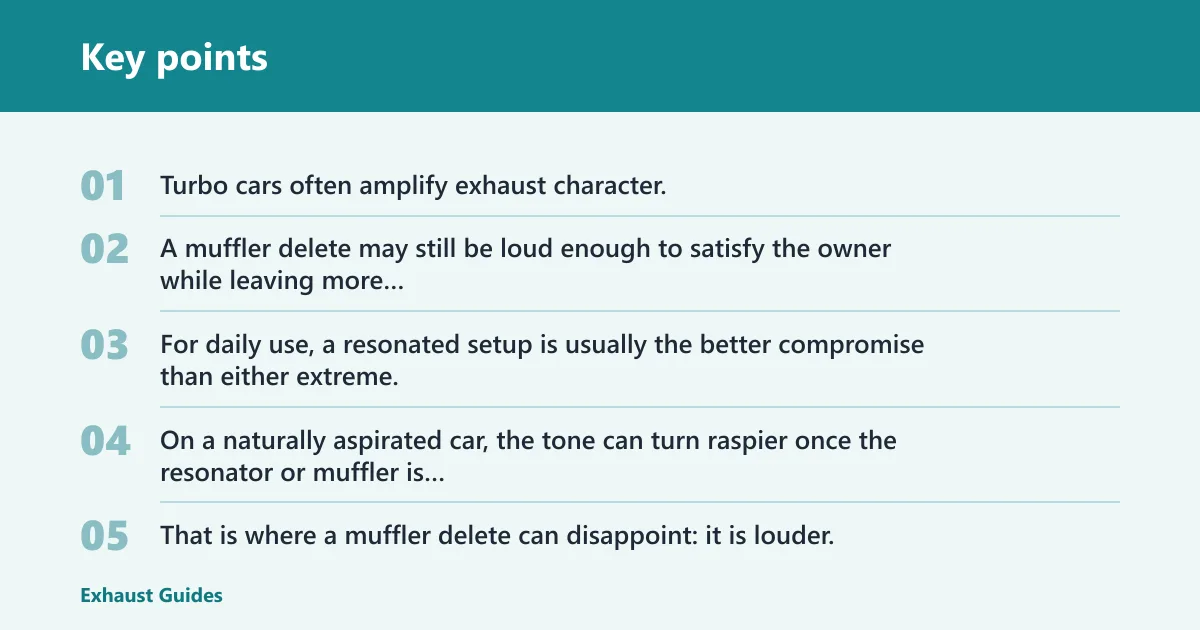
Turbo cars often amplify exhaust character, which can make a straight pipe feel even harsher than expected. A muffler delete may still be loud enough to satisfy the owner while leaving more structure in the system. For daily use, a resonated setup is usually the better compromise than either extreme, especially where local sound rules are strict.
Naturally aspirated daily driver
On a naturally aspirated car, the tone can turn raspier once the resonator or muffler is removed. That is where a muffler delete can disappoint: it is louder, but not always better sounding. If the car is a commuter, keeping the resonator often preserves some comfort and may be the more practical choice in places with tight noise limits.
Weekend car
A weekend car gives you more freedom, but the wrong setup still gets old fast on long drives. If the car still sees public roads, a muffler delete is usually easier to live with than a straight pipe. If you want to swap back for inspections, choose parts that make that reversal simple.
Track-only car
Track-only use changes the priorities. Noise may be acceptable if the venue allows it, and emissions equipment may be irrelevant on private property or off-road settings. Even then, think about local sound limits and whether the car still needs tuning after the change.
Suppose a weekend coupe loses its muffler but keeps the catalytic converter and resonator. The idle gets louder, but the car still stays civil on a 40-minute drive home. Remove the resonator too, and the same car may become far more tiring without adding much usable speed.
Choose straight pipe if… / Choose muffler if…
Choose straight pipe if the car is track-only, noise is the point, and you accept higher drone, more inspection risk, and possible emissions trouble. Choose muffler if you want the simpler louder option for a street-driven car, especially if you care about keeping the catalytic converter and reducing the chance of a bad highway experience.
Choose straight pipe if…
You want the loudest setup in this comparison. You do not need quiet cruising. You are prepared for possible emissions issues if the catalytic converter comes out, and you are willing to deal with tuning if the engine management complains after the change.
Choose muffler if…
You want more sound without stripping the whole system. You still drive on public roads. You care about keeping the resonator or catalytic converter in place, or at least about lowering the chance that the car becomes exhausting to live with.
Why a resonated setup may be smarter
A resonated setup often gives the cleaner middle ground. It keeps more tone control than a bare pipe and can cut the rasp that makes some exhausts sound cheap. For many drivers, that is the point where the sound is noticeable without becoming a problem.
When to keep the stock exhaust
Keep the stock exhaust if inspection rules are strict, the car is a commuter, or you already know you dislike cabin drone. Stock systems include the catalytic converter, resonator, and muffler for a reason: they balance sound, emissions compliance, and livability better than most deletes.


Frequently asked questions
Straight pipe vs muffler delete
In this guide, a muffler delete means removing only the muffler, while a straight pipe usually removes more of the exhaust path and may also remove the catalytic converter. That makes straight pipe the more extreme choice. For most street cars, the legal and comfort risks rise much faster with straight pipe.
Straight pipe vs muffler delete sound
Straight pipe is louder, especially at wide-open throttle, where it can reach 105–120+ dB in the cited range. A muffler delete is still loud, with an idle range of 78–85 dB, but it usually keeps more tone control. The difference is often biggest on cruise and cold start.
Straight pipe vs muffler comparison
The main comparison is not just volume. Straight pipe removes more restriction and carries more risk of drone, emissions trouble, and inspection failure. A muffler delete is usually the simpler first step if you want more sound but still need the car to behave like a street car.
Straight pipe vs exhaust
“Straight pipe” usually means deleting major parts of the exhaust path rather than just changing one section. If the catalytic converter is removed too, the issue moves beyond noise and into emissions compliance. That is why the term matters: it signals a much more aggressive setup than a normal exhaust swap.
Straight pipe vs exhaust delete
When people say “exhaust delete,” they are often using an imprecise umbrella term rather than a precise technical one. In practice, that phrase may refer to a setup that removes the muffler, resonator, and sometimes the catalytic converter. That is why inspection and emissions checks become so important.