
Do Larger Exhaust Tips Make a Car Louder?
Usually no: a larger exhaust tip can make the rear note seem slightly deeper, but it rarely makes the car louder by itself. Bad fitment can rattle, leak, or leave you paying for a part that changes nothing. This guide maps when tip diameter changes perceived tone, when it does not, and when it creates drone or fitment trouble.
Do larger exhaust tips make a car louder?



Usually only a little. On a typical vehicle, tips do not dramatically increase volume, and standard slip-on tips usually have little effect on sound. A larger opening can change how sound waves spread at the rear of the car, so the note may seem fuller or deeper even when true loudness barely changes.
The reason is location. The exhaust tip sits near the end of the system, after the muffler and resonator. If you want a real jump in loudness, you usually need a less restrictive muffler, a resonator change, or a cat-back exhaust instead of a tip alone.
What the tip can and cannot do
An exhaust tip is usually a cosmetic add-on at the tailpipe exit. It may come in slip-on or welded styles, and common materials include stainless steel, chrome-plated steel, and carbon fiber. Shape matters a little. Rolled-edge, angle-cut, dual-wall, and resonated designs can change the way the rear of the exhaust sounds, but they rarely create a major decibel gain on their own.
Think of it as a small change in projection, not a replacement for the parts that actually control loudness. Backpressure, muffler restriction, and resonator tuning influence the exhaust note far more than the tip alone.
Exhaust tip decision table
This table gives the practical path first: what a larger tip is likely to change, and which part usually matters more if your goal is more volume.
| Stock setup | Likely sound change from a larger tip | Best next mod if the goal is more volume |
|---|---|---|
| Stock muffler | Small change in rear tone; may seem a little fuller, but loudness change is usually minor | Muffler swap or cat-back exhaust |
| Performance muffler | Small tone shift; the tip may change projection more than loudness | Resonator change or cat-back exhaust |
| Resonated exhaust | Little change in volume; may slightly alter the high-frequency edge | Resonator deletion or different muffler |
| Turbo car | Often very small effect, since the turbo already alters exhaust sound before the tailpipe | Cat-back exhaust tuned for the model |
| Diesel truck | Minor rear-end tone change; may sound deeper, not much louder | Muffler or full exhaust change |
| Dual-exit setups | Can change how sound is spread at the rear, but the main volume still comes from the rest of the system | Cat-back or muffler change matched to both exits |
What changes the sound more than a tip?
Mufflers, resonators, and the main exhaust piping change sound far more than a tip. Aftermarket exhaust sound usually comes from a less restrictive muffler, not the pipe alone. If you want more volume, that is where the change usually starts.
Muffler design and restriction
The muffler is the main component controlling exhaust loudness. More restrictive designs reduce noise, while straight-through or performance mufflers change volume more than tips. Removing the muffler is often called a muffler delete, and it usually changes sound much more than a tip swap.
Resonator tuning and deletion
A resonator tunes specific frequencies in the exhaust note. Its deletion or change affects sound more than a tip, especially if you are trying to remove a specific drone band or sharpen the tone. On louder setups, resonator changes are often paired with muffler changes.
Cat-back exhaust changes
A cat-back exhaust replaces the system from the catalytic converter to the tailpipe. That is a common upgrade for a real sound change because it changes both flow and exhaust character. Compared with a tip, a cat-back can alter volume, pitch, and how the exhaust exits the rear of the car.
How tip size changes tone and projection
A larger tip can make the note seem fuller or deeper, but the effect is usually modest relative to stock. Tip diameter can slightly alter how sound waves spread, so the driver may notice a different rear-end feel without a meaningful jump in actual loudness.
Why a larger opening can sound fuller
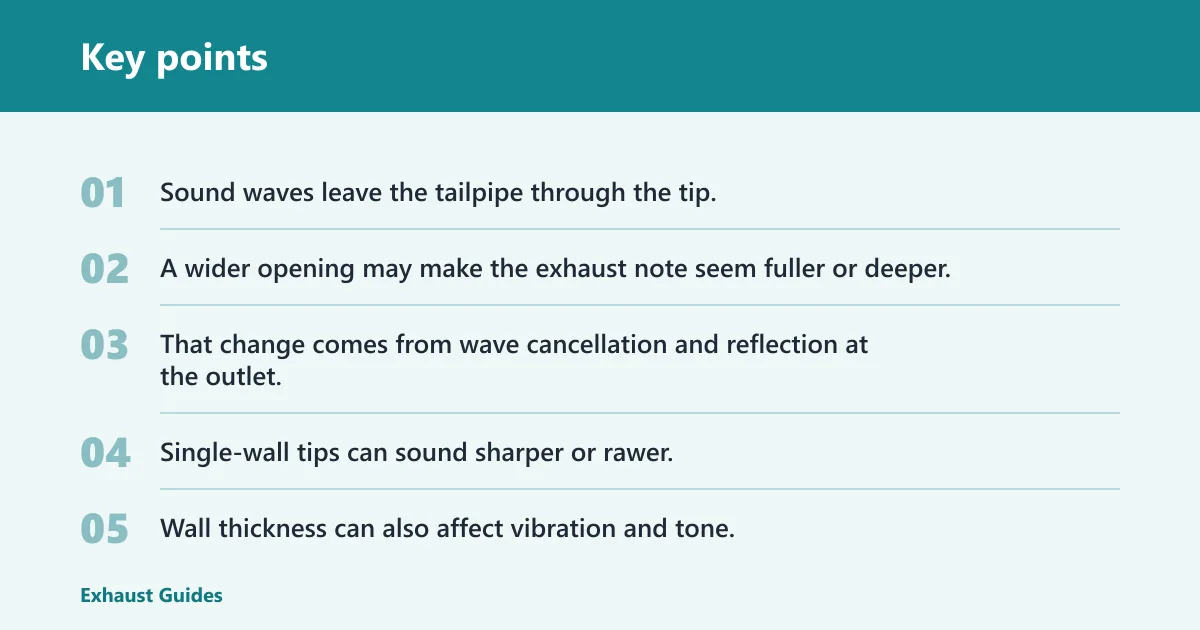
Sound waves leave the tailpipe through the tip, and longer or wider passages can alter how those waves reflect and spread. A wider opening may make the exhaust note seem fuller or deeper. That change comes from wave cancellation and reflection at the outlet, not from the tip creating new exhaust energy.
Tip wall design matters too. Single-wall tips can sound sharper or rawer, while dual-wall tips can sound smoother or slightly quieter. Wall thickness can also affect vibration and tone, which is why one tip may feel more aggressive at idle while another simply changes the rear look.
When a resonated tip helps
A resonated exhaust tip contains an internal chamber or mesh. It may slightly deepen tone or reduce harsh frequencies, but it does not create a dramatic volume increase. If the goal is to smooth a raspy edge without going much louder, that style can make sense.
Do resonated exhaust tips make a difference? Yes, but the difference is usually tonal. They are more useful when you want to soften a buzzy tailpipe note than when you want a clear loudness jump.
Common sound changes by vehicle type
Turbo cars often react less to a tip swap because the turbo already shapes exhaust sound before it reaches the rear of the car. Diesel trucks can seem deeper with a larger outlet, but the change is usually limited unless the muffler or resonator also changes. Dual-exit setups may spread the note differently across both outlets, which can change how loud the exhaust seems from behind the car.
Suppose a small four-cylinder has a stock muffler, and you fit a larger dual-wall tip on the same tailpipe. The rear note may sound a little rounder at idle, but cruise loudness is likely to stay close to stock. Now change only the muffler to a straight-through design, and the sound shift is far easier to hear.
Will a bigger tip change fitment?
Yes, and fitment is the first thing to check. Inlet size, outlet size, tailpipe diameter, length, bumper clearance, and valance shape all matter before you think about sound. A tip that looks right in photos can sit too far out, sit too deep, or vibrate against the bumper.
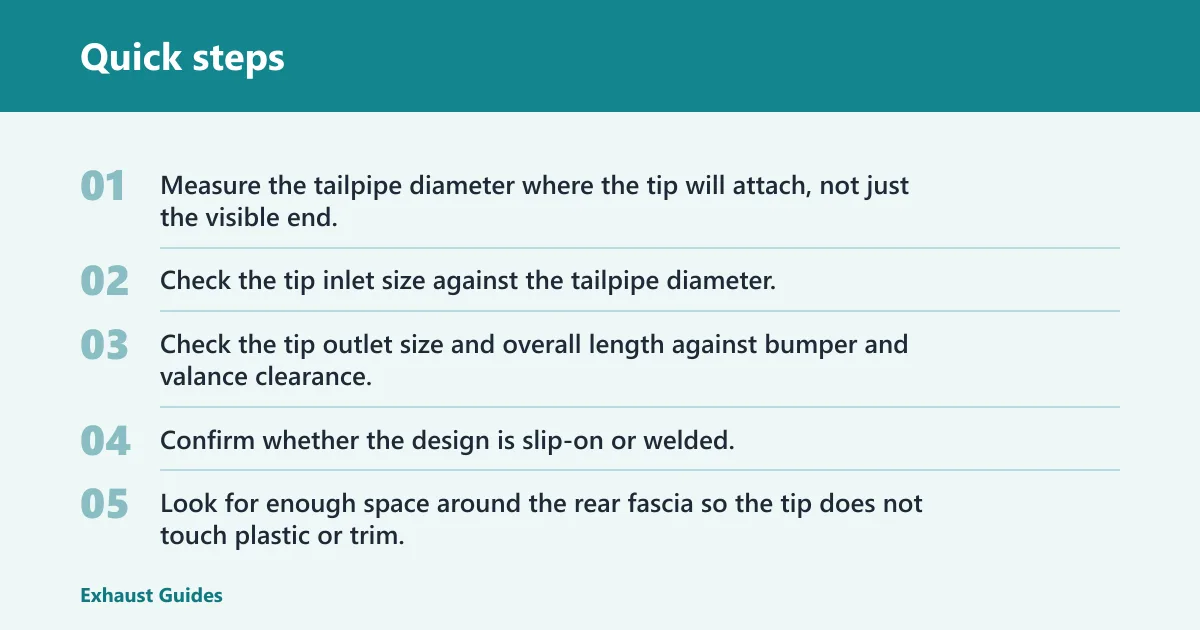
Fitment checks before you buy
- Measure the tailpipe diameter where the tip will attach, not just the visible end.
- Check the tip inlet size against the tailpipe diameter.
- Check the tip outlet size and overall length against bumper and valance clearance.
- Confirm whether the design is slip-on or welded.
- Look for enough space around the rear fascia so the tip does not touch plastic or trim.
Slip-on tips usually clamp over the tailpipe, so the inlet has to match closely enough for a secure fit. Welded tips need the right pipe size and a clean mounting position. If the inlet is wrong, the tip may leak, rattle, or sit crooked even before you start the car.
A common first-timer mistake is choosing a much larger outlet because it looks more aggressive, then finding out the bumper cutout is tight. Picture a sedan with a short rear valance: a long, angle-cut tip may stick out too far and look awkward, while a shorter dual-wall design clears cleanly and changes the tone less dramatically.
When fitment problems create worse sound
Bad fitment can make the exhaust sound worse instead of better. A loose clamp can buzz, a tip that touches the bumper can rattle, and poor alignment can create an uneven exhaust pulse at the rear. If the tip changes nothing except the look, the money was spent on appearance rather than acoustics.
When a larger tip is worth it
A larger tip is worth it when you want a small change in rear tone, a cleaner finish, or a different visual style and you already like the rest of the exhaust. It is also reasonable if you want a slightly deeper rear note without opening up the whole system.
If you want real volume, start elsewhere. A tip swap is mostly a styling choice on many cars, especially when the stock muffler is still in place. If the exhaust is already resonated and quiet, a bigger tip is unlikely to turn it into a loud setup.
When to skip the tip and change the muffler first
If your goal is noticeable loudness, go to the muffler first. Mufflers have a much larger effect on loudness than tips, and straight-through or performance mufflers usually change volume more than a cosmetic outlet piece. If the exhaust is still too quiet after that, then look at the resonator or the rest of the system.
What exhaust changes actually make a car louder? Usually a muffler swap, a resonator change, or a cat-back exhaust. Those parts alter restriction and wave behavior in a way a tip cannot match.
What exhaust changes actually make a car louder?
The best path depends on how much louder you want the car to be and how much change you can tolerate in drone and tone. A muffler swap is usually the first real step. A resonator change comes next if you want to shift the frequency mix. A cat-back is the cleanest way to change the system from front to rear.
System choices by goal
If you drive a turbo car and want a sharper note, a cat-back built for that platform usually gives a bigger result than a larger tip. If you drive a diesel truck, the gain from a larger tip alone is usually modest, so the muffler and main piping matter more. If you have a dual-exit setup, both outlets should be considered together so the final tone stays balanced.
There is also a backpressure tradeoff. Less restriction can increase loudness, but too much or too little backpressure can affect performance. That is why the loudest option is not always the best option for the car.
Check the manufacturer’s listing for your model before buying any tip, muffler, or cat-back, and follow the vehicle and product manual for installation. If the work involves lifting, never work under a vehicle held only by a jack. Check local laws on exhaust noise and fitment before modifying the rear system.
Frequently asked questions
Do bigger exhaust tips make a car louder?
Usually only slightly. A bigger tip can make the rear note seem fuller or deeper, but on a typical vehicle it does not dramatically increase volume. The muffler and resonator still do most of the acoustic work, so the sound change is usually modest unless the rest of the system changes too.
Will a larger exhaust tip make my car louder?
It may change the tone more than the loudness. A larger outlet can alter sound wave spread and make the exhaust seem more open at the rear, but the true volume increase is usually small. If you want a clear jump, the muffler or cat-back is the better target.
Do resonated exhaust tips make a difference?
Yes, but the difference is mostly tonal. A resonated tip can slightly deepen the note or reduce harsh frequencies, which may make the exhaust sound smoother from behind. It is not a substitute for a muffler change if your main goal is more volume.
Will a bigger tip change tone more than volume?
In most cases, yes. A larger tip can change how the sound projects at the tailpipe and may make the note seem fuller or deeper. That is different from a real loudness jump, which usually comes from the muffler, resonator, or a cat-back exhaust.
Do exhaust tips make a car louder without changing the muffler?
Only a little, if at all. Standard slip-on tips usually have little effect on sound, and even a larger one tends to make a modest tonal shift rather than a major volume increase. If the muffler stays stock, the exhaust note will usually stay close to stock too.