
Exhaust Leak Noise vs Normal Exhaust Noise
If the sound gets louder under acceleration, changes with engine load, or hisses or ticks from under the car, suspect an exhaust leak; a normal exhaust note stays steady and comes from the tailpipe. A leak can waste fuel, may trigger warning lights, and can let hot exhaust gases or carbon monoxide escape where they should not. This guide shows how to compare sound, location, and driving conditions so you can tell normal exhaust noise from leak noise.
| Decision factor | Exhaust Leak Noise | Normal Exhaust Noise | Winner |
|---|---|---|---|
| Sound pattern | Ticking, popping, hissing, sputtering, or rumbling that changes with load | Steady exhaust tone, often deeper on performance systems or turbo cars | Normal Exhaust Noise |
| Source location | Front of engine, underbody, or rear section depending on the leak point | Tailpipe area, with sound exiting the rear as designed | Normal Exhaust Noise |
| Driving condition | Often loudest on cold start, under acceleration, or during deceleration | Predictable across idle, cruise, and light throttle | Normal Exhaust Noise |
| Safety concern | Possible carbon monoxide, heat damage, and emissions trouble | Low concern if the system is otherwise intact | Normal Exhaust Noise |
Sound comparison and triage
The strongest clue is not volume alone. It is the pattern: where the sound comes from, when it changes, and whether the car is under load. A leak usually follows engine demand. Normal exhaust noise usually follows the tailpipe.
Sound pattern
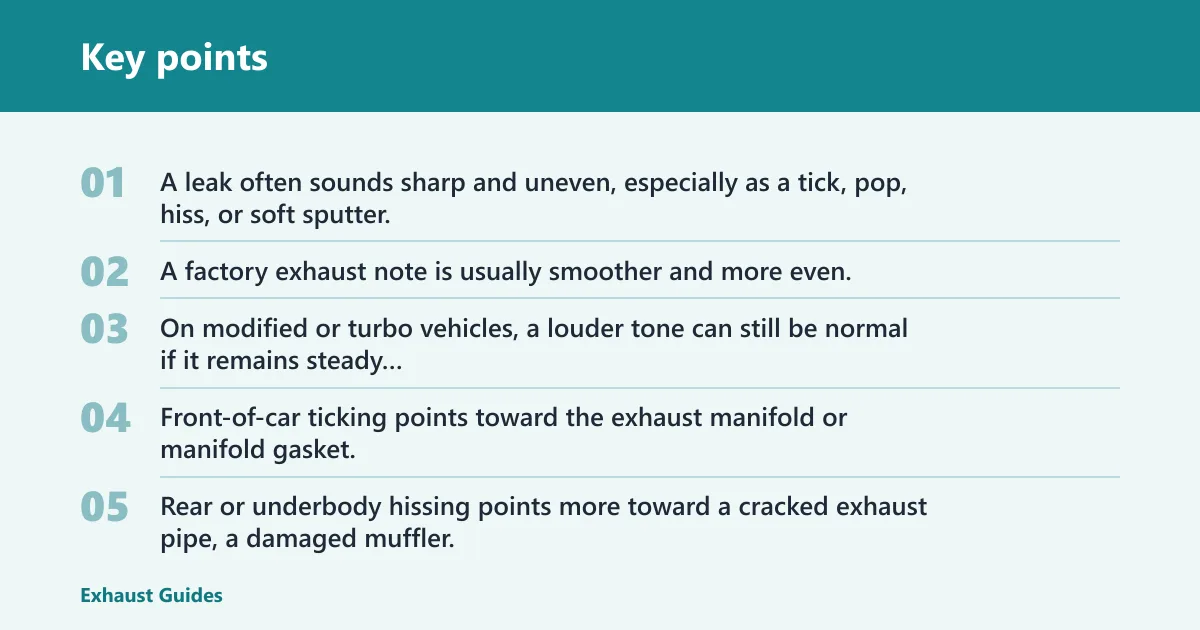
A leak often sounds sharp and uneven, especially as a tick, pop, hiss, or soft sputter. A factory exhaust note is usually smoother and more even. On modified or turbo vehicles, a louder tone can still be normal if it remains steady and stays tied to the tailpipe area.
Source location
Front-of-car ticking points toward the exhaust manifold or manifold gasket, which seal the manifold to the engine block. Rear or underbody hissing points more toward a cracked exhaust pipe, a damaged muffler, or another leak farther back in the system. The system runs from the exhaust manifold at the engine all the way to the tailpipe.
Driving condition
Listen at cold start, hot idle, light acceleration, steady cruise, and deceleration. A leak often changes with those conditions. Normal exhaust noise stays more consistent, even if the car has a sporty tone.
| Engine state | Sound character | Likely location | Common false positive | Urgency rating |
|---|---|---|---|---|
| Cold start idle | Ticking or popping that is loud for the first minute, then eases | Exhaust manifold or manifold gasket near the front of the engine | Valvetrain or lifter noise | Inspect soon |
| Hot idle | Quieter ticking, or a faint hiss that remains at idle | Front manifold area or an underbody seam | Normal injector noise or belt noise | Inspect soon |
| Light acceleration | Ticking, popping, or a sharper hiss that grows with throttle | Manifold, pipe crack, or muffler seam | Turbo whistle on turbo cars | Inspect soon |
| Steady cruise | Drone, hiss, or a sound that becomes more obvious at speed | Rear exhaust pipe, muffler, or tail section | Normal performance-exhaust tone | Inspect soon |
| Deceleration | Popping or burbling that sharpens when lifting off the throttle | Exhaust leak near the manifold or a rear section with a crack | Sport exhaust overrun sound | Inspect soon |
| Cabin smell case | Exhaust odor, burning smell, or gas smell inside the cabin | Leak near the firewall or beneath the floor | Outside air entering through vents | Stop and inspect now |
What a normal exhaust sounds like
Normal exhaust noise is usually a steady background tone that comes from the rear of the vehicle. It may be quiet on a sedan or deeper on a truck, turbo car, or performance system. The key is consistency: the tone should not turn into sharp ticking, a sudden hiss, or a sound that tracks engine load unusually closely.
Factory exhaust tone
Factory systems are tuned to sound even across idle, cruise, and light throttle. You may hear more volume on cold mornings, but the character should stay smooth. If the sound is coming from the tailpipe and not from the front or floor, that leans toward normal behavior.
Performance exhaust tone
A modified exhaust can be louder than stock without being damaged. A deeper rumble or a more present drone is not the same as a leak. What matters is whether the tone is stable and expected for that setup, rather than a sharp sound that appears only when the throttle opens.
Turbo whistle and other normal sounds
Turbo cars can add a whistle that rises with boost. That can be mistaken for a leak because it changes with rpm, but it usually has a cleaner, more consistent pitch and is tied to turbo operation rather than a broken seam. Belt or pulley noise and valvetrain noise can also be mistaken for exhaust trouble if you listen only once.
What does an exhaust leak sound like?
An exhaust leak usually sounds uneven and tied to one spot. Near the engine, it often becomes a tick or pop. Farther back, it tends to turn into hissing, sputtering, or a rumble from under the car. If the sound grows louder with acceleration, that is a strong leak clue.
Ticking and popping near the engine
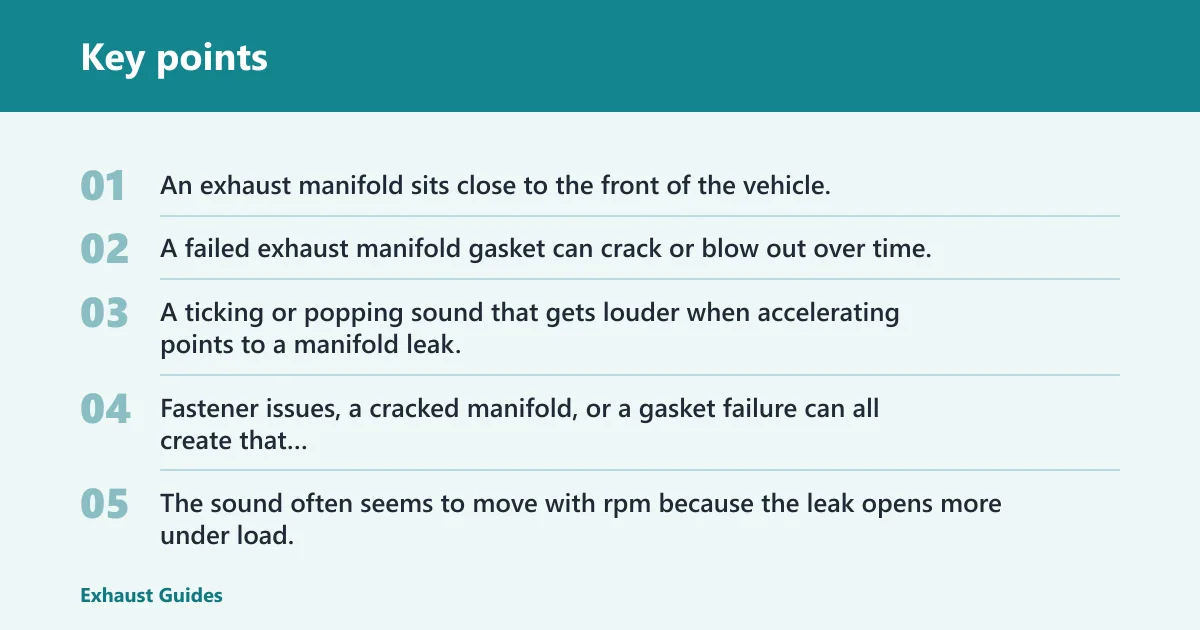
An exhaust manifold sits close to the front of the vehicle, so a leak there is often loudest when the engine first starts. A failed exhaust manifold gasket can crack or blow out over time, and a manifold leak may quiet down slightly after the engine reaches operating temperature. That heat-cycle behavior is a big clue.
A ticking or popping sound that gets louder when accelerating points to a manifold leak. Fastener issues, a cracked manifold, or a gasket failure can all create that front-of-engine tick. The sound often seems to move with rpm because the leak opens more under load.
Hissing, sputtering, or rumbling under the car
Leaks farther back in the system can sound like rumbling, hissing, or sputtering. A cracked pipe or failing muffler are common rear-exhaust culprits. If the noise seems to come from beneath the floor or rear seat area, the leak is more likely underbody or rear section damage than a front manifold problem.
Say your compact sedan sounds normal at idle, then starts hissing from the passenger-side floor when you pull away from a stop. That pattern points more toward an underbody pipe crack than a tailpipe-only noise, because the sound changes with load and appears away from the rear outlet.
Why the sound changes with rpm
Higher rpm and load can push more exhaust gas through a leak point, so the noise may become more obvious. That is why a leak can seem faint at idle and loud under acceleration. Normal exhaust tone can also get louder with throttle, but it should not shift from a smooth note into a sharp tick or hiss.
Why does my car tick on cold start?
Cold-start ticking is one of the most common signs of a front exhaust leak. An exhaust manifold leak is often loudest when the engine first starts, then fades a bit as metal parts expand. If the tick is strongest near the front of the engine bay, the manifold area is the first place to suspect.
Exhaust manifold gasket leaks
The exhaust manifold gasket seals the manifold to the engine block. Heat cycles can make it crack or blow out, especially on older engines and vehicles that see repeated temperature swings. Because the seal opens more before everything warms up, the leak is often loudest on cold start.
Manifold cracks and fastener issues
The manifold itself can crack, and loose or damaged fasteners can let exhaust escape. That can sound like a metallic tick or sharp pop from the front of the vehicle. If the sound changes when you accelerate, the manifold area climbs higher on the list.
Heat expansion after startup
As the exhaust warms, metal expands and small gaps can narrow. That is why the noise may quiet down slightly after the engine reaches operating temperature. Quieting is not proof that the problem is gone. It often means the leak is still there, just harder to hear.
Is hissing under the car normal?
Hissing under the car is not normal if it is new, louder than usual, or tied to acceleration. Rear-exhaust leaks often sound like hiss, rumble, or sputter rather than a front-end tick. If the sound seems to come from the floor or rear underside, inspect the pipe, muffler, and tail section.
Exhaust pipe cracks and corrosion
An exhaust pipe can crack or corrode, which is a common source of underbody leaks. Rust and corrosion from moisture and road salt are common causes, and Ohio winters are especially hard on exhaust systems because of road salt and moisture. Older rust-belt cars deserve extra suspicion here.
Muffler damage and rear leaks
A muffler can fail with rust or physical damage. When that happens, the noise often becomes a rumble or hiss farther back in the vehicle. Rear leaks are easier to confuse with a louder-than-usual exhaust note, especially on trucks and modified cars.
Tailpipe openings versus actual leaks
The tailpipe itself is supposed to let exhaust out, so noise at the outlet is not automatically a problem. The question is whether the sound is concentrated at the opening or whether it is escaping from a seam, hole, or crack upstream. If the noise is stronger under the floor or near a rusted seam, that is a leak clue.
False positives that mimic a leak
Not every odd engine noise comes from the exhaust. Lifter noise, belt noise, turbo whistle, and normal performance-exhaust tone can all sound suspicious at first. The fix is to match the sound with location and driving condition instead of reacting to volume alone.
Lifter or valvetrain noise
Lifter noise is often a fast tick from the top of the engine, not from the exhaust path. It usually follows engine speed closely and does not shift toward the floor or rear of the car. If the sound is clearly under the hood but not tied to exhaust flow, it may not be a leak.
Belt or pulley noise
A belt or pulley can squeal, chirp, or grind and be mistaken for an exhaust problem. Those noises often change with accessory load and can be present even when the car is stationary. An exhaust leak usually changes with engine load and is easier to place along the exhaust route.
Turbo and boost-related sounds
Turbo whistle rises with boost and can be mistaken for a leak by drivers who are hearing it for the first time. On turbo cars, a normal whistle can coexist with a real leak, so the sound alone is not enough. Use source location and whether the note is steady or sharp to separate the two.
Can an exhaust leak trigger codes or smell?
Yes. A leak can affect oxygen sensor readings, trigger the check engine light, and create a burning or exhaust smell. Carbon monoxide is odorless and colorless, so smell is not a reliable safety screen by itself. If the leak is near the firewall or beneath the floor, cabin entry is a real concern.
Oxygen sensor readings
An oxygen sensor reads exhaust flow, so a leak near the sensor can skew readings. That can cause oxygen sensor codes or make the engine control system react to the wrong mixture data. The problem may show up as drivability complaints or a warning light before the leak sounds severe.
Check engine light and P0420
The check engine light may come on with P0420 or oxygen sensor codes. A catalytic converter sits in the exhaust stream, so leaks can interfere with the readings that help the system judge catalyst efficiency. The light does not prove a leak by itself, but it is a strong reason to inspect sooner.
Carbon monoxide and cabin odor
Carbon monoxide is odorless and colorless, which makes cabin intrusion especially dangerous. A burning smell can come from exhaust contacting heat-sensitive materials, and exhaust leaks near the firewall or beneath the floor can seep into the passenger compartment. If you smell exhaust inside, treat it as urgent.
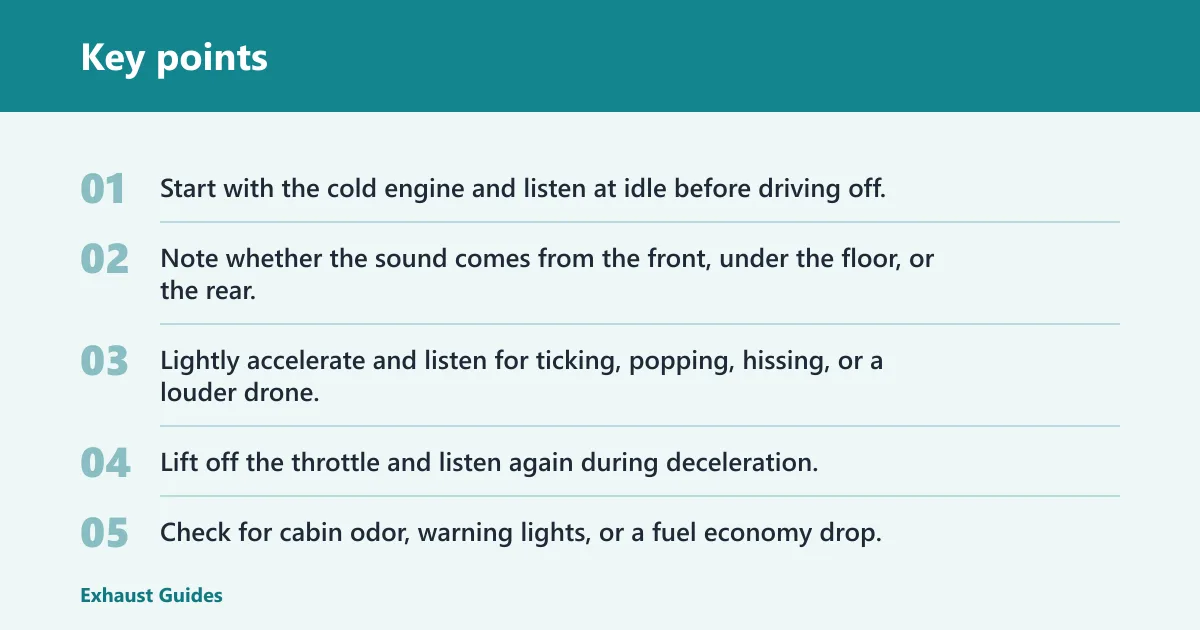
- Start with the cold engine and listen at idle before driving off.
- Note whether the sound comes from the front, under the floor, or the rear.
- Lightly accelerate and listen for ticking, popping, hissing, or a louder drone.
- Lift off the throttle and listen again during deceleration.
- Check for cabin odor, warning lights, or a fuel economy drop.
- If the sound is louder under load or the cabin smells like exhaust, arrange inspection soon.
- If exhaust smell enters the cabin or you feel unwell, stop driving and get help right away.
Choose exhaust Leak Noise if…
Choose Exhaust Leak Noise if the sound gets louder with acceleration, shifts from front to rear location clues, or shows up as ticking, popping, hissing, or sputtering. That choice also fits if you have cabin exhaust odor, a burning smell, a check engine light with oxygen sensor codes, or a P0420-related concern.
Choose Normal exhaust Noise if…
Choose Normal Exhaust Noise if the tone is steady, expected for your vehicle, and stays centered at the tailpipe area. That is especially likely on turbo cars, trucks, or modified exhaust systems that are known to sound deeper or louder without any sharp tick, hiss, or smell.

- Built-in air pump needs no external air source
- Covers EVAP, vacuum, intake, and low-pressure turbo leaks
- Produces smoke quickly for leak tracing
Frequently asked questions
How can I tell if my exhaust noise is normal or a leak?
Compare three things: sound pattern, source location, and driving condition. Normal exhaust noise is steady and comes from the rear outlet. A leak usually changes with acceleration, sounds sharper or rougher, and often seems to come from the front manifold area or from under the floor.
What does an exhaust leak sound like compared with normal exhaust noise?
An exhaust leak often sounds like ticking, popping, hissing, sputtering, or a rough rumble. Normal exhaust noise is smoother and more even. If the sound becomes louder under throttle or moves away from the tailpipe and toward the engine bay or underbody, suspect a leak.
Why does my car make a ticking noise on cold start?
A ticking noise on cold start often points to an exhaust manifold leak or a manifold gasket that has cracked or blown out. These leaks are often loudest when the engine first starts and may quiet down slightly once the metal heats up and expands.
Is hissing under the car normal or an exhaust leak?
Hissing under the car is not normal if it is new or louder than usual. It often points to a cracked exhaust pipe, muffler damage, or another rear exhaust leak. If the hiss changes with throttle or comes from the floor area, inspect it soon.
Can an exhaust leak cause a burning smell or gas smell in the cabin?
Yes. Exhaust contacting heat-sensitive materials can cause a burning smell, and leaks near the firewall or beneath the floor can seep into the passenger compartment. Carbon monoxide is odorless and colorless, so any exhaust smell inside the cabin deserves prompt attention.
Should I keep driving if the exhaust sounds louder than usual?
If the sound is only a mild change and there is no cabin odor, warning light, or drivability problem, drive only far enough to arrange inspection soon. If the exhaust smell enters the cabin, the noise is suddenly much louder, or you feel ill, stop driving and get help right away.