Diesel Exhaust Fluid vs Diesel Exhaust System Problems
Treat a DEF issue as likely when codes point to fluid level, fluid quality, or SCR dosing, and suspect Diesel Exhaust System Problems when you see soot, DPF, NOx, temperature-control, or repeated sensor codes. Misdiagnosis can mean wasted parts, repeated derates, and a no-start countdown turning into a tow. This guide shows how to separate the two by symptoms, fault codes, and visible evidence.
| Decision factor | Diesel Exhaust Fluid | Diesel Exhaust System Problems | Winner |
|---|---|---|---|
| Typical first fix | Top off with clean, sealed DEF or replace suspect fluid. | Scan codes and inspect sensors, pump, injector, wiring, or catalyst. | Diesel Exhaust Fluid |
| Cost to start diagnosis | Low. A level check and refill are the cheapest steps. | Moderate. Diagnosis usually needs a scan tool and physical inspection. | Diesel Exhaust Fluid |
| Best fit when warnings appear after a long interval | Often the cause if the tank is low or fluid has frozen. | More likely if the warning returns right after refill. | Diesel Exhaust Fluid |
| Best fit when power is reduced and codes keep returning | Possible, but less likely after the tank is full. | More likely because the ECU may be reacting to sensor or dosing faults. | Diesel Exhaust System Problems |
| Physical evidence | Low fluid, frozen tank, or clean white crystals from dried DEF. | Soot, damaged wiring, failed heater, clogged injector, or bad sensor data. | Diesel Exhaust System Problems |
| Risk if ignored | Shutdown countdown, reduced power, or no-start behavior. | Repeated derate, failed regeneration, emissions faults, or catalyst damage. | Tie |
Why the table resolves this way
Fluid problems are cheaper and faster to check first. DEF is a 32.5% urea and 67.5% deionized water solution, so a low tank, frozen tank, or contaminated refill can trigger warnings before any hardware fails.
System faults win once the warning returns after a correct refill or the vehicle shows soot, regen problems, or sensor codes. At that point, the issue usually sits in the SCR loop: the ECU, NOx sensors, pump, injector, heater, wiring, or catalyst.
The risk row stays tied because both paths can stop the truck. Low DEF can trigger warnings and limit engine power, and a real exhaust-system fault can do the same through derate logic and stored fault codes.
What the system is doing
The SCR system converts NOx into nitrogen and water vapor by injecting DEF into the exhaust stream. The ECU monitors fluid level, injection timing, and sensor feedback, then adjusts dosing based on what the NOx sensors report before and after the catalyst.
That feedback loop matters. If the ECU sees bad level data, poor dosing pressure, or a sensor signal that does not match exhaust conditions, it can store faults and switch to warnings or reduced power mode.
What does a DEF warning usually mean?
A DEF warning usually means the ECU has seen low fluid, poor fluid quality, or a dosing problem that could keep the SCR system from cleaning exhaust properly. Start by checking the tank level and the message wording before replacing parts, because low DEF can trigger warnings, power limits, and countdown behavior.
Low level warnings
Running out of DEF can trigger warnings and limit engine power. Some vehicles can enter derating or limiting engine performance if DEF is critically low, so a low-level message deserves a quick refill check before anything else.
DEF consumption is about 2–3% of diesel consumption, so repeated low-level warnings often point to a basic refill issue rather than a failed catalyst. If the tank is low and the message clears after refilling, the problem was likely fluid level, not a major exhaust fault.
Quality warnings
Quality warnings are different from low-level alerts. They can point to contaminated fluid, non-dedicated refill equipment, or fluid that has started to degrade from air exposure or evaporation.
Say your dash shows a DEF quality warning two days after a refill, and the tank is full. That pattern fits contaminated fluid, a bad sensor reading, or a dosing fault better than simple low fluid.
Countdown and power reduction
A low-DEF countdown is not a nuisance message to ignore. The system can reduce power or prevent starting if the condition persists, so the warning should be treated as urgent until the tank level and fault codes are verified.
How do you tell frozen DEF from failure?
Frozen DEF can look like a fault because DEF freezes at 12°F (-11°C), but cold-weather freeze is often normal behavior. Many systems are built to thaw after a cold soak, so a winter warning does not automatically mean the pump, heater, or catalyst has failed.
Normal freeze and thaw behavior
When DEF freezes, the system should thaw it once the engine and tank heater bring temperatures up. If the warning clears after warm-up and the tank reads normally afterward, that points to cold-soak freeze rather than a hard component failure.
White crystal deposits can also appear where water evaporates from DEF. Those deposits are a clue, but they are not the same thing as a frozen tank. Crystals point more toward drying, seepage, or poor storage than toward normal winter freeze.
When cold weather points to a heater or control fault
If the tank stays frozen well after warm-up, or if cold weather warnings repeat in mild conditions, the heater or temperature-control circuit deserves inspection. The heater helps thaw frozen DEF, and the ECU relies on temperature feedback to know whether dosing can resume.
A persistent cold-weather message after the cabin, engine, and exhaust have warmed suggests a system fault rather than normal freeze behavior. That is the point to scan codes and inspect the heater circuit, not to keep topping off fluid.
Diesel exhaust fluid vs diesel exhaust system problems triage table
Use the symptom column first. Then match what you see to the most likely check and urgency. If the table points to a system fault, do not keep guessing with top-offs alone.
| Symptom | Likely DEF issue | Likely exhaust-system issue | First check | Urgency |
|---|---|---|---|---|
| Low DEF warning | Tank is low | Level sensor fault if tank is full | Check tank level and cap seal | High |
| Frozen DEF message in freezing weather | Frozen fluid | Heater or temperature-control fault if it never thaws | Let the system warm up, then recheck | Medium |
| White crystal deposits around cap, injector, or lines | Crystallization from air exposure or evaporation | Injector seepage or dosing leak | Look for dried white residue | Medium |
| Warning returns after refill | Contaminated refill or bad level reading | NOx sensor, pump, wiring, or ECU issue | Read stored codes | High |
| Limp mode | Critically low DEF | Persistent SCR, sensor, or dosing fault | Scan codes and confirm fluid level | High |
| Check-engine light with DEF warning | Possible low or poor-quality DEF | Common with NOx, heater, or injector faults | Scan ECM and SCR codes | High |
| No-start countdown | Tank critically low | Severe SCR fault if fluid is full | Refill immediately, then scan | Critical |
| Poor regen | Indirect effect from bad dosing or contaminated DEF | DPF, SCR, or sensor fault | Check codes for DPF and NOx | High |
| Service Exhaust Fluid System warning | Low fluid or bad fluid quality | Faulty NOx sensor or dosing system | Read fault memory | High |
| Repeated warnings after a clean refill | Cross-contamination or wrong fluid | Sensor, pump, or ECU fault | Inspect refill method and scan tool data | High |
| Slow throttle response with warning lamp | Critically low tank | Derate from SCR fault | Check level and code history | High |
| Strong ammonia or exhaust odor after dosing event | Overfill or poor-quality fluid | Injector or catalyst efficiency fault | Inspect injector area and codes | Medium |
How to use urgency
High means check fluid, then scan codes without delay. Critical means stop treating it as a routine warning, because a no-start countdown can leave the vehicle parked until the fault is resolved.
Suppose a delivery truck shows a low-DEF message on Monday, then a no-start countdown on Wednesday after a refill. That pattern points away from simple level loss and toward a sensor, pump, or ECU issue that needs diagnosis before the truck is used again.
Symptoms that point to a real exhaust fault
Repeated warnings after refill, along with white crystal deposits, poor regen, limp mode, and a check-engine light, can point away from a simple fluid shortage. Once the tank is full and the message comes back, the most likely problem is in the sensor, pump, injector, wiring, or ECU feedback loop.
Repeated warnings after refill
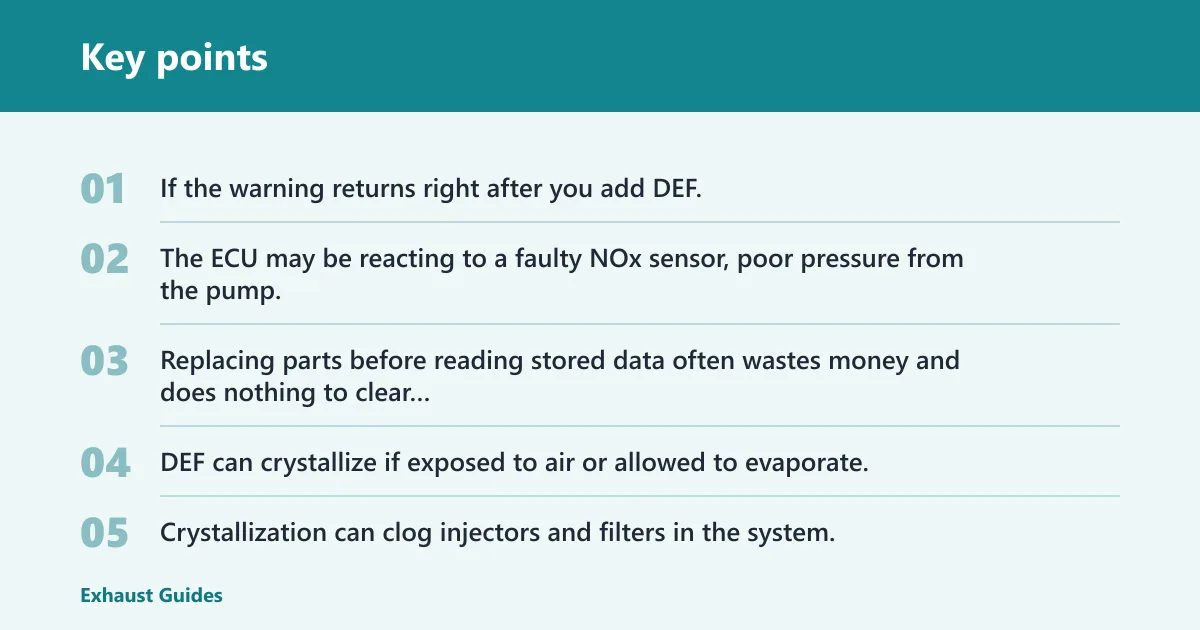
If the warning returns right after you add DEF, the fluid level is no longer the main suspect. The ECU may be reacting to a faulty NOx sensor, poor pressure from the pump, a wiring fault, or a software issue that keeps the warning active.
That is the point to scan fault codes. Replacing parts before reading stored data often wastes money and does nothing to clear the root cause.
White crystal deposits
DEF can crystallize if exposed to air or allowed to evaporate, and white deposits around fittings or the injector are a common clue. Crystallization can clog injectors and filters in the system, so visible deposits deserve inspection, not just a refill.
Contamination can come from dirt, fuel, water, or cross-contamination. API-certified DEF is often the preferred refill choice, since clean fluid may lower the chance of injector and sensor problems from poor handling.
Poor regen, limp mode, and check-engine light
Poor regeneration and limp mode usually mean the fault has moved beyond a simple fluid issue. A failed SCR component, a bad NOx sensor, or a loss of dosing pressure can keep the system from meeting emissions targets and force the ECU to limit power.
Can a bad DEF sensor cause limp mode? Yes. A faulty NOx sensor can trigger the Service Exhaust Fluid System warning, and the ECU can use that bad feedback to enter reduced power mode even when the tank is full.
Can a bad sensor cause limp mode?
Yes. A bad NOx sensor can trigger the Service Exhaust Fluid System warning, and bad readings can make the ECU think dosing or catalyst performance is wrong. That can lead to derate, reduced power, or repeated warnings even when DEF level and fluid quality are fine.
NOx sensor faults
NOx sensors monitor exhaust gases before and after the catalyst. If the reading is biased, slow, or missing, the ECU may command the wrong amount of DEF or assume the SCR system is not working correctly.
The result can look like a fluid problem from the cab. The cure is different, though: a scan tool should confirm the code history, sensor response, and whether the fault follows the sensor or stays with the system.
ECU fault logic and derate behavior
The ECU does not wait for a breakdown before it acts. It watches level, temperature, injection timing, and sensor feedback, and it can reduce power when those inputs do not line up with expected SCR performance.
That is why a truck can limp even after a refill. The ECU may still be seeing stale or implausible sensor data, or it may have stored a fault that requires reset or recalibration after the repair.
What a scan tool can confirm
A scan tool can separate level faults from sensor, pump, and heater faults by reading stored codes and live data. It can also show whether the system is commanding dosing, whether pressure is present, and whether a sensor is reporting a believable exhaust condition.
What fails in the DEF system?
Three parts commonly fail enough to matter in diagnosis: the pump, the injector or dosing module, and the tank heater or temperature-control circuit. Each one creates a different symptom pattern, which is why a warning light alone is not enough to call the whole exhaust system bad.
Pump and pressure loss
The DEF pump delivers fluid from the tank to the injector under pressure. If the pump loses pressure, the system cannot inject fluid into the exhaust stream, and the ECU may flag a dosing fault or a persistent warning.
Wear, crystallization blockage, and electrical faults can all cause pressure loss. If the tank is full and the warning persists, pump pressure is one of the first hardware items to inspect.
Injector or dosing module clogging
The injector meters DEF into the exhaust stream. If it clogs with crystals or contamination, dosing becomes poor and SCR efficiency drops, which can trigger derate or repeated emissions codes.
This is the kind of fault that often hides behind a simple warning lamp. The tank may look fine, but the injector may not be spraying the right amount at the right time.
Tank heater and temperature control
The heater helps thaw frozen DEF and restore normal dosing after a cold soak. If cold-weather warnings last longer than expected, or if the tank stays frozen in conditions where thawing should already have occurred, the heater circuit or temperature sensor should be checked.
Do not treat every winter warning as a broken heater. Normal freeze-thaw behavior is built into the system, so the key question is whether the fault clears after the vehicle warms up.
Clean DEF and prevention steps
Keep DEF clean, sealed, and properly stored. Use dedicated funnels and containers so dirt, fuel, and water do not enter the tank, because contamination from non-dedicated equipment can damage the SCR system and create repeated warnings.
How to avoid contamination
- Use only clean, sealed containers for refills.
- Keep fuel cans, oil jugs, and DEF tools separate.
- Close the cap promptly after filling.
- Wipe spills before they dry into crystals.
- Use API-certified DEF for top-offs and refills.
Clean handling matters more than add-on fixes. Once DEF is contaminated or badly crystallized, the repair path usually shifts from refilling to diagnosis and parts cleaning or replacement.
Storage and handling basics
Store DEF where temperature swings and open air exposure are limited. Crystallization is more likely when fluid sits exposed, and white deposits can form as water evaporates from the solution.
A common first-timer mistake is pouring DEF from a dirty jug that once held another fluid. That can create a problem that looks like a pump failure, yet the root cause is contamination at the refill step.
Choose Diesel Exhaust fluid if…
Choose Diesel Exhaust Fluid if the warning is new, the tank is low, the message appears after a freeze, or the fluid may be contaminated. This is the lower-cost path first, because a level check, refill, and visual inspection can solve the issue before parts are replaced.
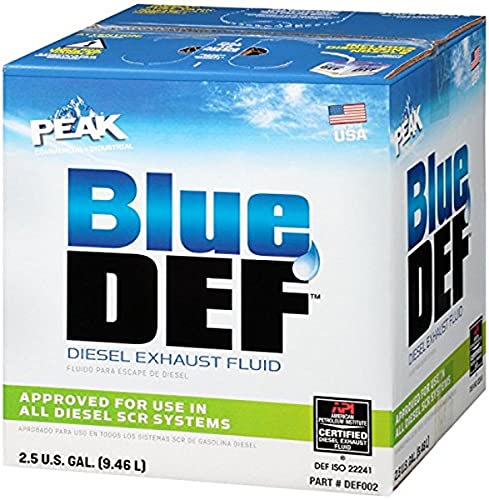
- Helps top off low DEF tanks
- Longer intervals between refills
- Supports SCR NOx reduction
Choose Diesel Exhaust System Problems if…
Choose Diesel Exhaust System Problems if the warning returns after a proper refill, the truck shows limp mode, a check-engine light, poor regen, or repeated codes tied to NOx, pump pressure, heater control, or the ECU. That pattern calls for a scan tool and component diagnosis, not another bottle of fluid.
Frequently asked questions
What’s the difference between a DEF problem and a diesel exhaust system problem?
A DEF problem is usually about fluid level, fluid quality, or freeze-thaw behavior. A diesel exhaust system problem usually involves the pump, injector, NOx sensors, heater, wiring, ECU logic, or catalyst performance. The easiest separator is whether the warning clears after a correct refill and thaw period.
Can I drive with a DEF fault code?
You may be able to drive briefly, but you should not ignore it. DEF-related faults can trigger reduced power, derate, or a no-start countdown. If the code returns after a refill or the truck enters limp mode, scan it before continuing normal use.
How do I know if my DEF is contaminated or frozen?
Frozen DEF usually appears during cold-soak weather and should thaw as the system warms. Contaminated DEF is more likely if the warning returns after a refill, if the fluid was poured from non-dedicated equipment, or if you see unusual residue, haze, or odor around the fill area.
Can crystallized DEF damage the SCR system?
Yes. Crystallization can clog injectors and filters, and white deposits can interfere with dosing and sensor behavior. If crystals are present, the system should be inspected rather than simply topped off, because repeated crystallization can keep the warning active.
What causes a Service Exhaust Fluid System warning?
Common causes include low DEF, bad fluid quality, a faulty NOx sensor, pump pressure loss, injector clogging, heater faults, or ECU logic that sees implausible feedback. If the message appears again after a refill, the problem is usually beyond simple fluid level.
Why does my diesel lose power when the DEF light comes on?
The ECU can reduce power when DEF is critically low or when a fault threatens emissions control. That derate behavior protects the system and can happen before a no-start countdown begins. A level check and code scan are the right next steps, in that order.