Best Exhaust Repair Kits for Trucks (2026): We Compared
For a truck flex-pipe leak that is under about 1/8 inch on intact tubing, a clamp-on repair sleeve or wrap kit is a common repair choice; if the pipe is split, oval, or badly deteriorated, replace the flex section, and if heat damage is severe, a weld-free clamp kit is usually only a temporary fix. The wrong kit can trigger loud exhaust leaks, failed inspections, cabin fumes, and extra damage to hangers or adjacent pipe. This guide compares kit types by leak size, pipe condition, and whether you need a short-term repair or a permanent, weld-free fix.
Quick comparison
| Product | Badge | Best for | Price | ||
|---|---|---|---|---|---|
 |
ZEONHAK 2 Pack 3 x 8 Inch Stainless Steel Heavy DutyZEONHAK | Our pick | 3 x 8 Inch · Stainless Steel · 2 Pack | $29.49
Price as of 16 Oct 2026
|
View |
 |
2PCS 2" Split Exhaust Flange Repair Kit for Exhaust SystemBvcurdw | Budget pick | 2 Inch · Galvanized Carbon Steel · 2 Pack | $17.99
Price as of 16 Oct 2026
|
View |
The choice is simple: wrap and paste products seal leaks, while replacement tubing restores the flex section itself. For trucks, the right pick depends on whether the pipe still has sound metal, enough straight-pipe room for a clamp or splice, and whether the repair must hold long enough to pass inspection or last as a permanent fix.
Pipe diameter, leak size, and clamp room matter more than brand name here. A product that matches the leak but misses the pipe size, or leaves no room for clamps, will fail fast.
How we chose
This comparison favors damage type coverage, fitment realism, install difficulty, heat rating and cure time, and whether the fix is temporary or intended as a lasting repair. It also weighs truck-specific issues such as vibration, rust exposure, and limited room near the flex section.
Products that only seal joints score differently from products that replace tubing. That split matters on trucks, where flex sections often sit close to catalytic converters, hangers, and welded transitions.
J-B Weld ExhaustWeld repair wrap: best for sealing leaks
- Made of high-quality and heavy-duty stainless steel
- Double braided structure provides excellent tightness
- Suitable for the exhaust system of trucks and vehicles
Pick this when the flex pipe is still structurally sound and the problem is a leak, crack, or seam seep rather than a crushed or rotten section. J-B Weld ExhaustWeld is a 2 in x 72 in repair wrap, and its job is sealing, not rebuilding damaged tubing.
Its published heat limit is up to 1100°F once fully cured. With heat, it takes about 20 minutes to cure; without heat, it sets in 20 minutes and cures in 2 hours. That makes it the better choice when you need a wrap that can return the truck to service faster than a paste-only repair.
The drawback is the same as the strength: it is a seal-focused solution. If the braid is separated, the pipe is split wide open, or the metal around the leak is rotted through, the wrap is only a short-term hold at best.
Where this wrap belongs
Use it on small leaks in intact pipe, minor seam cracks, and localized holes where the surrounding metal still supports the repair. It also fits the common truck case where the flex section leaks but does not yet sag, collapse, or separate at the bellows.
A common first-timer mistake is wrapping over rust that flakes under the bandage. The wrap may hide the leak for a while, but the damaged metal keeps moving underneath it.
J-B Weld MufflerSeal: best for pinholes and joints
- Split design allows clamping around the pipe easily
- Carbon steel build with a galvanized coating resists rust
- No welding required for the installation process
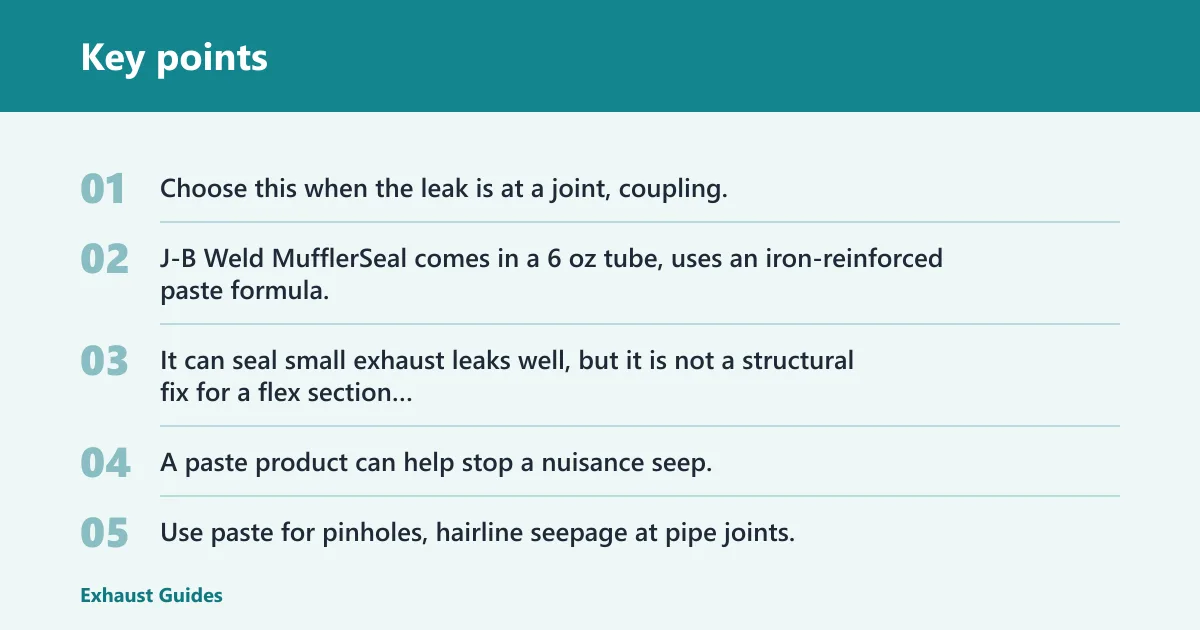
Choose this when the leak is at a joint, coupling, or pinhole and the pipe still has enough solid metal for paste to bond. J-B Weld MufflerSeal comes in a 6 oz tube, uses an iron-reinforced paste formula, resists up to 700°F, and can take up to 24 hours to harden on its own.
That slower hardening time is the trade-off. It can seal small exhaust leaks well, but it is not a structural fix for a flex section that is split, crushed, or rotten along the braid or bellows.
The limit is clear on trucks. A paste product can help stop a nuisance seep, but it does not replace tubing or restore flexibility where the flex section has failed.
When paste makes sense
Use paste for pinholes, hairline seepage at pipe joints, and small leaks where clamping or wrapping needs a sealing assist. It is most useful when the metal surface is still stable and the repair can cure without immediate abuse.
If the leak is a gap, a tear, or a separated section, paste is the wrong tool. That kind of damage calls for replacement tubing or, at minimum, a temporary weld-free patch only long enough to plan the real repair.
Do you need welding for a universal flex pipe kit?
Sometimes no, but do not count on that. A universal flex pipe kit may clamp into place on a compatible setup, yet many trucks still need cutting, fabrication, or welding to match diameter, length, hanger position, and the available straight-pipe room.
The deciding factor is not the box label. It is whether the truck’s existing pipe gives the new section enough clean, straight engagement for a secure install.
When a clamp is enough
A clamp can be enough when the pipe ends are sound, the diameter matches, and the installation has enough straight pipe on both sides of the flex section for a proper clamp bite. That is also where an included U-bolt clamp matters: it helps secure universal flex tubing without welding the joint immediately.
Clamp-on fitment still depends on the pipe being round, not badly corroded, and not too short at the repair area. If the section is thin or distorted, the clamp may seal poorly and slip under vibration.
When fabrication or welding is still needed
Fabrication or welding becomes likely when the truck has an odd offset, insufficient straight-pipe room, mismatched diameter, or rust damage that prevents a clean clamp seat. Walker’s flex tubing may require fabrication or welding depending on the setup, and that warning is the right one to follow.
Say your truck has a flex leak plus flaking pipe for several inches on one side. A clamp kit will not restore enough sound metal for a lasting repair, so the safer path is to cut back to healthy pipe or replace the section.
Walker Exhaust Universal Exhaust Flex Pipe 36326: best for replacement tubing
This is the better choice when the flex section itself needs replacement instead of sealing. Walker Exhaust Universal Exhaust Flex Pipe 36326 has a 2.5 in ID, is 18 inches long, uses aluminized flex tubing, and includes a U-bolt clamp.
That U-bolt clamp matters because it gives the kit a way to secure the universal tubing to an existing pipe without immediately welding every setup. It is useful for fitment flexibility, but it does not erase the need to measure correctly or to fabricate around the truck’s actual exhaust layout.
The drawback is also the point: universal fit still takes work. Walker’s kit may require fabrication or welding depending on the setup, so it is not the easiest path for a driveway patch if the truck has limited access or heavy corrosion.
Why universal fit still needs measuring
Universal flex parts are only universal within limits. If the inside diameter does not match, if the 18-inch length is wrong for the cutout, or if the truck lacks enough straight pipe, the install gets harder fast.
That is why replacement tubing is the right answer only after measurement, not before it. A bad fit can turn a simple exhaust repair into a cut-and-rework job.
Flex pipe decision table
This table shows the practical split between sealing and replacement on a truck. Use it as a decision aid before you buy anything.
| Damage type | Pipe condition | Required tools | Install difficulty | Cure/weld needs | Expected durability | When to replace instead of patch |
|---|---|---|---|---|---|---|
| Small leak in flex braid or seam | Pipe is round and metal is still sound | Wrap kit, basic hand tools, cleaning supplies | Low to moderate | Heat cure or air cure, depending on product | Better for temporary-to-medium sealing than structural repair | Replace if the crack grows, the braid separates, or rust starts to flake through |
| Pinhole at a joint or coupling | Joint area is intact, with no collapse | Paste, applicator, cleaning supplies | Low | Up to 24 hours to harden for paste products | Good for small seals if the joint stays stable | Replace if the joint is loose, warped, or leaking from multiple spots |
| Split flex section or separated braid | Structural damage is present | Replacement tubing, cutter, clamp or welding setup | Moderate to high | May need fabrication or welding | Best path for a lasting repair | Patch only as a temporary stopgap, then replace the section |
| Rotten adjacent pipe | Corrosion extends beyond the flex section | Cutting tools, replacement pipe, fabrication or welding gear | High | Weld or fabricated fit often needed | Patching is poor because the surrounding metal keeps failing | Replace when the pipe cannot hold a clamp or wrap securely |
Fitment checklist
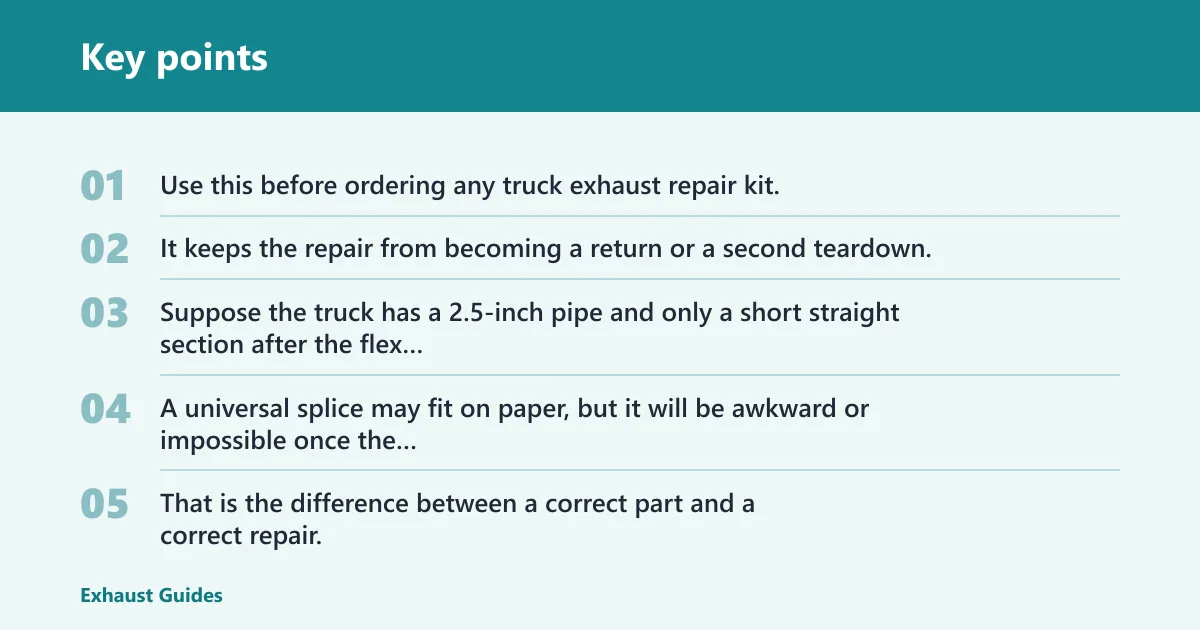
Use this before ordering any truck exhaust repair kit. It keeps the repair from becoming a return or a second teardown.
| Check | What to measure | Why it matters |
|---|---|---|
| Inside diameter | Measure the pipe’s ID where the kit will clamp or slide | The repair part must match the exhaust size or it will not seal properly |
| Overall length | Measure the damaged section from cut line to cut line | Replacement tubing must cover the full failed section without forcing a bad overlap |
| Available straight-pipe room | Check how much straight pipe exists on both sides of the leak | Clamp-on repairs and universal flex kits need enough straight section to hold securely |
Suppose the truck has a 2.5-inch pipe and only a short straight section after the flex joint. A universal splice may fit on paper, but it will be awkward or impossible once the hanger, bend, and clamp space are counted.
That is the difference between a correct part and a correct repair. The part must fit the exhaust layout, not just the diameter printed on the box.
Choose J-B Weld ExhaustWeld if… / Choose J-B Weld MufflerSeal if… / Choose Walker Exhaust Universal Exhaust Flex Pipe 36326 if…
Choose J-B Weld ExhaustWeld if the flex pipe leaks but is still structurally sound, the repair needs a wrap, and you want a seal-focused fix that can tolerate high exhaust heat after cure. Choose J-B Weld MufflerSeal if the problem is a pinhole or joint seep and you can allow up to 24 hours to harden.
Choose Walker Exhaust Universal Exhaust Flex Pipe 36326 if the flex section itself has failed and you want replacement tubing rather than a patch. Its 2.5 in ID, 18-inch length, aluminized build, and included U-bolt clamp make sense only after measurement confirms the fit.
Do not buy a wrap for rotten pipe, do not buy paste for a split braid, and do not buy universal tubing without checking diameter, length, and straight-pipe room first. Temporary repairs can also carry inspection or emissions risk if the leak is large or the pipe is structurally damaged.
Which one should you buy?
For a small leak on intact tubing, the wrap is the best first buy because it seals the leak fast and handles higher heat once cured. For a joint leak or pinhole, the paste is enough if the metal is stable and the truck can sit while it hardens.
For damaged tubing, the replacement section is the right call. If the flex is split, collapsed, or rusted through, patching wastes time and usually leaves the truck with the same leak.
Cost and labor matter too. A wrap or paste repair usually keeps material and install needs lower, while replacement tubing can cost more in parts and labor because it may require cutting, fabrication, or welding. A shop visit may be the better option if access is poor or the pipe is heavily corroded.
Frequently asked questions
What is the best exhaust flex pipe repair kit for trucks?
The best kit depends on the damage. For a small leak on intact tubing, J-B Weld ExhaustWeld is the stronger fit because it is a wrap, cures with heat, and is rated for up to 1100°F once fully cured. For split, rotten, or collapsed flex sections, replacement tubing is the safer choice.
Can I use a wrap kit on a flex pipe leak?
Yes, if the leak is small and the pipe is still structurally sound. Wrap kits are for sealing leaks, not rebuilding failed tubing. They work best on minor cracks, seam seepage, and limited holes where the metal around the leak still holds shape.
Do I need welding to install a universal flex pipe repair kit?
Not always. A U-bolt clamp can secure some universal setups, including the Walker kit, but many trucks still need fabrication or welding because of diameter, length, rust, or limited straight-pipe room. If the pipe is short or damaged near the joint, welding becomes more likely.
What size flex pipe repair kit fits my truck?
Match the inside diameter, the overall length, and the available straight-pipe room. A kit like the Walker 36326 uses a 2.5 in ID and is 18 inches long, so it only fits trucks with compatible dimensions and enough clean pipe for the clamp or splice.
How long does exhaust repair wrap take to cure?
J-B Weld ExhaustWeld takes about 20 minutes to cure with heat. Without heat, it sets in 20 minutes and cures in 2 hours. Cure time matters because a repair that is not fully cured can fail early, especially on a truck that sees heat and vibration right away.
When should I replace the flex pipe instead of patching it?
Replace it when the flex section is split, oval, collapsed, or rotten through, or when corrosion reaches the adjacent pipe. Patch products are for leaks and pinholes, not structural failure. A large leak or a damaged section can also create inspection or emissions risk until the pipe is replaced.
What temperature can exhaust repair products withstand?
Temperature limits vary by product. J-B Weld ExhaustWeld is rated up to 1100°F once fully cured, while J-B Weld MufflerSeal resists up to 700°F. The right choice depends on the repair location, the cure method, and whether the product is sealing a leak or replacing tubing.