How to Tell If Exhaust Smoke Is From Condensation
White vapor from the tailpipe is usually condensation if it appears only on a cold start, fades within 1 to 2 minutes, and stops once the exhaust warms up. Miss persistent white smoke, and you can overlook coolant loss, engine damage, or a leak that worsens fast. This guide shows the quick check for normal steam and the red flags that mean it is not condensation.
Condensation or fault?
Use timing first, not color. Thin white vapor on a cold or humid start is often water vapor from combustion and exhaust moisture, while white smoke that keeps going after warm-up is a fault sign until proven otherwise.
The fast rule is simple: vapor that vanishes quickly, does not drift far, and stops as the engine reaches temperature is usually normal. White exhaust that stays thick, has a sweet smell, or continues under acceleration should be checked.
Steam and smoke can look alike for a few seconds, but they behave differently. Steam from condensation is usually thin, translucent, and short-lived; smoke lingers, hangs in the air, and often looks denser or more colored.
Thickness and how it lingers
The most common white plume from an exhaust on a cold start is water vapour, not true smoke. Moisture condenses inside the exhaust system, then should clear quickly instead of hanging behind the bumper.
If the plume stays visible in the air for more than a brief moment, or keeps returning after the engine has warmed up, treat it as suspicious. Harmless condensation is usually a light cloud, not a persistent plume.
Smell clues
Odor matters because condensation usually has little or no smell. A sweet smell points toward coolant burning in the cylinders, while an oily smell suggests oil contamination or another engine problem rather than plain water vapor.
If the smell changes with throttle, temperature, or load, that detail is useful. Timing plus odor is more reliable than color alone.
Tailpipe drip and weather clues
Cold mornings and humid weather make condensation more likely, and a wet tailpipe can drip water during the first minutes after startup. That is normal when the vapor clears as the engine warms.
Short trips matter too. Repeated drives that never get the exhaust fully hot can leave moisture behind, so condensation can recur and even contribute to rust over time.
Why cold starts make white vapor
White smoke or condensation is often emitted when the weather is cold. When a cold engine is started, water vapour can create condensation within the exhaust system, especially on the first start of the day, in wet weather, or after short journeys that never fully heat the exhaust.
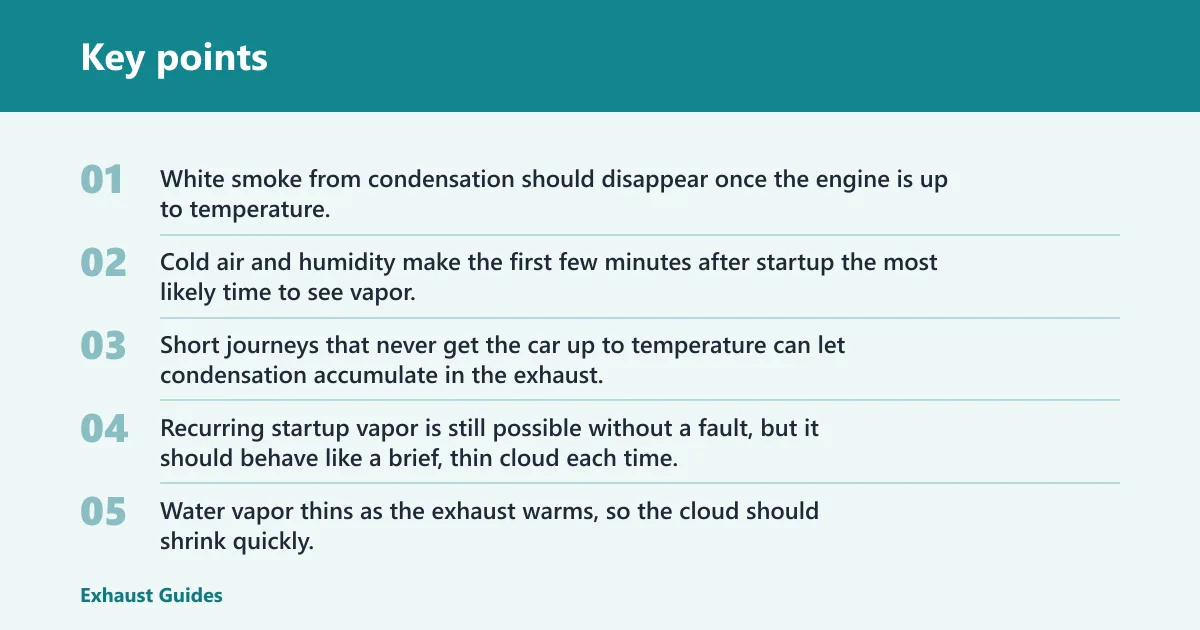
That trapped moisture should burn off as the engine reaches operating temperature. White smoke from condensation should disappear once the engine is up to temperature.
Cold mornings and humid air
Cold air and humidity make the first few minutes after startup the most likely time to see vapor. The exhaust system starts colder than the exhaust gases, so water condenses inside it until heat drives the moisture out.
Short trips that leave moisture behind
Short journeys that never get the car up to temperature can let condensation accumulate in the exhaust. Hybrid driving can show the same pattern because the engine may cycle on and off before the exhaust stays hot long enough to clear moisture completely.
That is why the same car can puff white vapor on several cold starts in a row. Recurring startup vapor is still possible without a fault, but it should behave like a brief, thin cloud each time.
Why the vapor fades as the engine warms
Water vapor thins as the exhaust warms, so the cloud should shrink quickly. Thin white vapor at cold start only, clearing in 1 to 2 minutes, is listed as normal condensation.
FixMyCar describes this as water vapour evaporating as the engine warms up. If the cloud is gone by the time the engine reaches temperature, that behavior fits condensation far better than a coolant leak.
What if the white smoke stays after warm-up?
Persistent white smoke after warm-up is not what condensation does. If it keeps coming once the engine is at operating temperature, coolant may be entering the cylinders through a blown head gasket, a cracked head, or a cracked block.
That pattern matters because coolant loss and overheating can follow. Persistent white smoke with a sweet smell is treated as coolant burning in the cylinders.
Symptoms that point beyond condensation
Look for more than the cloud itself. Overheating, low coolant, rough running, power loss, and white smoke that continues under acceleration all point away from normal exhaust moisture.
A blown head gasket is a common serious cause. A crack in the head or block can create the same warning pattern and needs prompt diagnosis.
Two-minute check before you drive
Use this quick sequence before deciding whether to drive. It checks duration, smell, coolant level, and warm-up behavior in about two minutes, which is often faster and more useful than looking at color alone.
-
Watch the first minute.
Start the car cold and look at the exhaust for 60 seconds. Thin white vapor that appears only at cold start and begins fading within 1 to 2 minutes fits condensation. -
Check the air behind it.
Notice whether the vapor vanishes quickly or hangs in the air. Vapor that disappears quickly is water, while lingering clouds are smoke. -
Smell near the tailpipe.
A sweet smell is a warning sign for coolant. An oily smell points away from simple condensation and toward another engine issue. -
Look at the coolant level.
Check the reservoir only when the engine is cool enough to do so safely. Low coolant, especially with persistent white smoke, moves the problem out of the normal-condensation category. -
Wait for warm-up.
Let the engine reach operating temperature. If the vapor stops as the engine warms, that is normal; if it continues, treat it as a fault until diagnosed.
What the smell and coolant level mean
Smell and coolant level are the quickest clues after timing. Sweet odor plus falling coolant points strongly toward coolant entering the combustion chamber, while an oily smell suggests a different fault path that still needs inspection.
Sweet smell
A sweet smell with persistent white smoke is a warning sign, not a normal exhaust scent. It fits coolant burning in the cylinders and can happen with a blown head gasket, a cracked head, or a cracked block.
Oily smell
An oily smell suggests oil is being burned or carried into the exhaust stream. That is not condensation, and it deserves diagnosis even if the check engine light is off.
Low coolant or overheating
Coolant loss changes the risk level fast. If the reservoir is low, the temperature gauge climbs, or the engine overheats, do not assume the vapor is harmless just because it started on a cold morning.
Picture a car that gives a thin white puff for 30 seconds on a damp 40-degree morning, then clears by the time the idle settles. That pattern fits condensation. Now picture the same car still pushing a thick white cloud after about 10 minutes of driving, with the coolant reservoir down by about a half-inch. That is a fault pattern, not normal steam.
Borderline cases: thin white-blue puffs
Borderline puffs are the ones that confuse drivers most. A thin white-blue puff after the car sits, especially with no check engine light, can still be a warning if it repeats under cold revs or keeps returning after warm-up.
The question is not whether the cloud is bright white or slightly blue. The question is whether it is brief and tied to cold start, or repeated and tied to throttle, heat, or coolant loss.
No check engine light
A missing warning light does not clear the engine. Coolant leaks, early head gasket failures, and small cracks can produce white smoke before the computer sets a fault code.
Cold-rev puff after the car sits
A common first-timer mistake is to rev a cold engine and see a puff that looks worse than the idle vapor. If that puff is thin, brief, and gone within the first 1 to 2 minutes, it can still be condensation. If the puff repeats every time you rev it cold, treat that as a fault pattern.
When to treat it as a fault
Move from “probably condensation” to “needs diagnosis” if the puff persists after warm-up, smells sweet or oily, returns under acceleration, or comes with coolant loss. Those signs override the normal cold-start explanation.
Condensation or fault decision table

Use this table as a one-page check before you drive. If more than one fault column fits, do not keep treating the vapor as normal condensation.
| When it appears | Thickness | Smell | How long it lasts | Coolant level | Next action |
|---|---|---|---|---|---|
| Cold start only, first start of the day, humid or cold weather | Thin, translucent | Little or none | Clears in 1 to 2 minutes and fades as the engine warms | Normal | Usually condensation; keep watching until warm-up is complete |
| Cold start with repeated puffs after brief revs | Thin to slightly blue-white | Usually mild; may be sweet or oily if faulty | Returns each time the engine is revved cold | Check carefully | Borderline; repeat the check after warm-up and inspect coolant level |
| Warm engine or continued driving | Thick or persistent | Sweet or oily | Stays visible or grows under acceleration | Low or dropping | Fault likely; stop driving if overheating or rough running appears |
Yes/no rule for cold-start vapor: If it appears only on startup, stays thin, and clears within 1 to 2 minutes, it is usually condensation. If it persists after warm-up, move to fault diagnosis.
Yes/no rule for borderline white-blue puffs: If the puff happens only during a cold rev and then stops, keep watching. If it repeats on every cold rev or continues warm, treat it as a fault.
Yes/no rule for warm-engine smoke: If white smoke is still present after the engine is at operating temperature, it is not normal condensation.
When should you stop driving?
Stop driving if white smoke keeps coming from the exhaust and the engine is overheating, losing coolant, running rough, or losing power. Persistent smoke under acceleration is especially concerning because it often means coolant is entering the cylinders under load.
That combination can turn a small leak into engine damage quickly. If the temperature gauge climbs or the coolant level drops while the smoke continues, do not keep testing it on the road.
Frequently asked questions
Is white exhaust smoke just condensation?
Not always. White exhaust vapor is usually condensation if it appears only on a cold start, stays thin, and disappears within 1 to 2 minutes. If it lingers after warm-up, smells sweet, or gets thicker under acceleration, it is more likely a fault.
How can I tell if exhaust smoke is steam or real smoke?
Watch how it behaves. Steam from condensation is thin and translucent, vanishes quickly, and does not drift far from the bumper. Real smoke lingers in the air, looks thicker, and often has a sweet or oily smell.
Why is there white smoke from my exhaust when it’s cold?
Cold weather makes exhaust condensation more likely. Water vapour can build inside the exhaust system during a cold start, especially after short trips or damp weather. If the vapor clears as the engine warms up, that is usually normal.
How long should condensation smoke last from the exhaust?
Normal cold-start vapor should clear quickly, often within 1 to 2 minutes. If it continues after the engine reaches operating temperature, or keeps returning during driving, it is no longer behaving like harmless condensation.
Does exhaust smoke that disappears after warm-up mean it’s normal?
Usually, yes. White smoke from condensation should disappear once the engine is up to temperature. If the vapor stops when warm and there is no coolant loss, overheating, or sweet smell, the pattern fits normal exhaust moisture.
What makes exhaust smoke dangerous to keep driving?
Overheating, low coolant, rough running, power loss, and persistent white smoke under acceleration are the main warnings. Those signs can mean coolant is entering the cylinders, often from a blown head gasket, a cracked head, or a cracked block.
How do I diagnose exhaust smoke with no check engine light?
Use timing, smell, and coolant level instead of waiting for a warning light. A no-CEL car can still have a coolant leak or head gasket problem, especially if the smoke continues after warm-up or gets worse under throttle.