Diesel Exhaust Sensor Failure Symptoms and Causes
Diesel exhaust sensor failure symptoms and causes usually show up as a fault code plus bad data. Before replacing a sensor, check power, ground, wiring continuity, connector condition, and exhaust leaks. Guessing wrong can waste money, trigger repeat limp mode, and leave an aftertreatment fault unresolved. This guide separates true sensor failure from harness damage, contamination, DEF issues, and DPF or SCR problems.
What symptoms point to sensor trouble?


Bad diesel exhaust sensor symptoms usually include an emissions warning lamp, SCR-related fault codes, fixed or implausible live data, repeated regen complaints, or a torque or speed inducement. Those signs call for diagnosis, not proof. The fault may sit in the sensor, the wiring, the exhaust stream, or the aftertreatment hardware around it.
NOx sensor symptoms
A failing NOx sensor may trigger an emissions warning and SCR-related diagnostic trouble codes. It may also show implausible or fixed readings, and the SCR system may respond with incorrect DEF dosing. Because upstream and downstream NOx sensors have different roles, the same complaint can mean different things depending on which sensor reports bad data.
Upstream NOx feedback helps the control system judge engine-out emissions and dosing strategy. Downstream NOx feedback helps check how well the SCR system is cleaning the exhaust. If either signal is flatlined, slow, or stuck at one value, suspect the sensor first, but do not skip exhaust leak checks and wiring checks.
EGT and pressure sensor symptoms
EGT sensor faults often show up as regen behavior that changes without a clear reason, aftertreatment codes, or a system that will not complete or hold a regeneration. Pressure sensor faults often track with soot load estimates, DPF restriction, or regen frequency. Those complaints can point to the sensor, but they can also come from a plugged DOC or DPF.
A pressure sensor that reads too low or too high can distort soot load estimates. That can make regen happen too often, too rarely, or at the wrong time. On many trucks, the complaint looks like a sensor problem because the control system is acting on bad input.
Driveability vs emissions severity
Prioritize symptoms by severity. A warning lamp with normal driving usually ranks below a derate, a speed limit, or a truck that cannot complete a regen. If the vehicle is in inducement, or the fault returns immediately after clearing, stop treating it as a minor nuisance and move to diagnosis by sensor type, wiring, and exhaust condition.
If a work truck sets an emissions lamp and the idle speed stays normal, but the scan tool shows one NOx value fixed at 0 ppm during a hot cruise, that is often a stronger clue than the lamp alone. That is a stronger clue than the lamp alone. The next question is whether the sensor is dead, the connector is damaged, or an exhaust leak is changing what the sensor sees.
Diesel exhaust sensor symptom matrix
This matrix helps match the complaint to the most likely sensor family, the non-sensor causes that often fool people, and the first test that should come before replacement. Use it with freeze-frame data, live readings, and a visual inspection. A code tells you where the control unit found a problem, not which part is guilty.
| Symptom | Likely sensor type | Common non-sensor causes | First test | Replace now vs keep diagnosing |
|---|---|---|---|---|
| Emissions lamp with SCR-related code and no obvious drivability issue | NOx sensor | DEF quality issue, SCR dosing problem, exhaust leak, wiring fault | Capture freeze-frame data and related codes, then compare upstream and downstream live NOx values | Keep diagnosing unless the sensor signal is fixed, implausible, or dead after power and ground checks |
| Fixed or implausible live reading from one sensor | NOx or EGT sensor | Open or shorted wiring, connector corrosion, moisture intrusion, heat damage | Check power, ground, and communication integrity; wiggle-test the wiring near heat shields and bends | Replace only after wiring and connector faults are ruled out |
| Regens too often, or regen will not complete | EGT or pressure sensor | DPF soot load, DOC restriction, failed regen strategy, exhaust leak | Check soot load estimate, differential pressure behavior, and EGT rise during commanded regen | Keep diagnosing if the DPF or DOC shows restriction or if regen logic does not match sensor data |
| High backpressure, short regen intervals, or repeated regen after short drives | Pressure sensor | DOC face-plugging, oil fouling, DPF ash loading, exhaust restriction | Inspect the DOC and DPF for restriction and compare pressure readings at idle and raised idle | Do not replace the sensor first if restriction is present |
| Derate with SCR fault and odd DEF dosing behavior | NOx sensor | DEF quality, dosing valve issue, SCR catalyst performance, wiring fault | Verify DEF quality and compare upstream and downstream NOx behavior during operation | Keep diagnosing unless the sensor output is clearly wrong after system checks |
| False sensor symptoms after recent regen, oil consumption, or soot loading | DOC or DPF-related false symptoms | DOC face-plugged, oil-fouled, heat-damaged, DPF restriction, poor regen history | Inspect the DOC and DPF condition, then review regen frequency and soot history | Fix the aftertreatment fault first if restriction or fouling is present |
What causes diesel exhaust sensors to fail?
Heat, soot, oil, coolant, moisture, and wiring damage are the main causes. Exhaust sensors work in a harsh environment, so the failure may be electrical, chemical, or mechanical. A sensor can fail outright, but it can also be forced to report bad data because the exhaust stream or wiring around it is compromised.
Heat, soot, oil, and coolant contamination
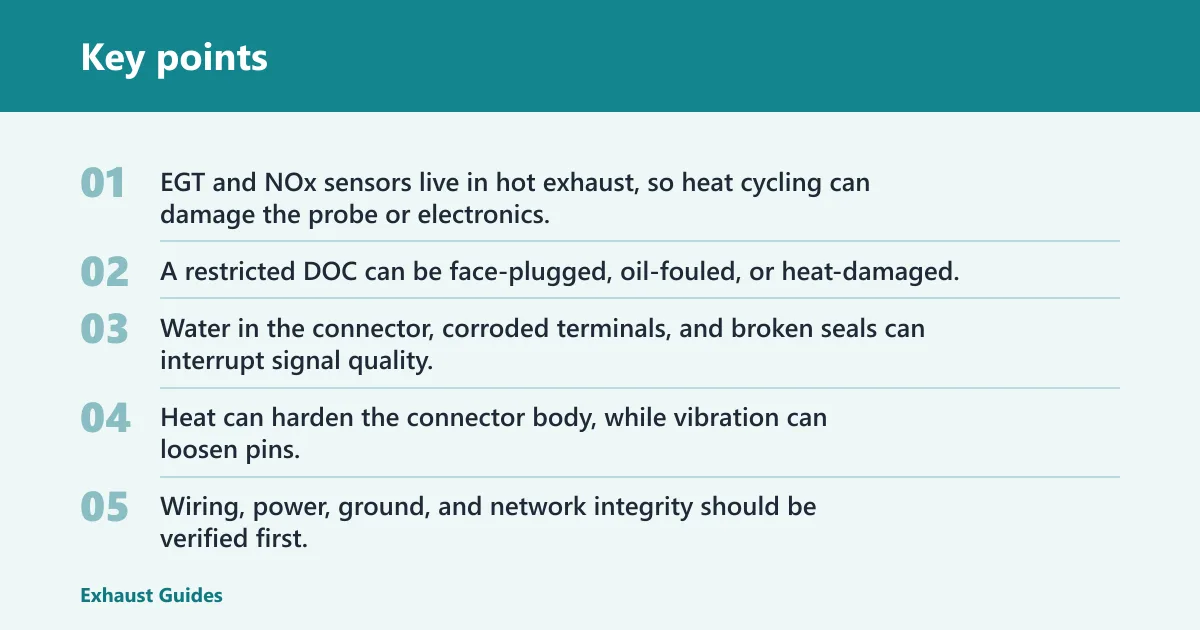
EGT and NOx sensors live in hot exhaust, so heat cycling can damage the probe or electronics. Soot can coat the sensing element, oil can foul the DOC or DPF and distort readings upstream of the sensor, and coolant contamination can leave deposits that change how the sensor reacts. These problems often create repeat faults after a new sensor is installed if the source remains.
A restricted DOC can be face-plugged, oil-fouled, or heat-damaged. Because the DOC sits early in the aftertreatment chain, restriction there can create higher exhaust backpressure and shorter DPF regen cycles. That makes a downstream sensor look guilty when the real issue is airflow through the catalyst.
Moisture intrusion and connector damage
Water in the connector, corroded terminals, and broken seals can interrupt signal quality. Heat can harden the connector body, while vibration can loosen pins. The result may be an intermittent code, a reading that drops out only when the truck is hot, or a fault that returns after a rain event or wash.
Wiring, power, ground, and network integrity should be verified first. A sensor with good internal parts still cannot report correctly if its feed, ground, or CAN path is unstable.
Exhaust leaks and restriction effects
Exhaust leaks can distort gas measurements before the sensor sees the real stream. A leak upstream of a NOx sensor or EGT sensor can pull in outside air and skew the reading. Restriction can have the opposite effect by trapping heat and raising backpressure, which changes sensor behavior and aftertreatment control strategy.
Suppose a pickup idles well but sets an SCR code after a tow. If the upstream clamp leaks and the downstream NOx value swings wildly while the harness looks intact, the leak is a stronger suspect than the sensor itself. Replace the sensor only after the exhaust path is sealed and the readings still do not make sense.
How do you tell sensor, wiring, or exhaust leak?
Use freeze-frame data, live readings, and a physical inspection in that order. A fault code is a starting point, not proof of a bad sensor. If the code appeared under a certain load, temperature, or road speed, freeze-frame data helps confirm whether the complaint matches the conditions that the control module recorded.
- Capture freeze-frame data. Record all related codes before clearing anything. That preserves the fault context and often shows whether the complaint happened during regen, high load, idle, or after a failed DEF event.
- Compare live readings. Look for a sensor that is stuck, flat, or implausible compared with the other sensor in the system. Upstream and downstream NOx sensors do different jobs, so compare them in the correct order and under the same operating condition.
- Check power and ground. Probe the connector for supply voltage, ground quality, and reference stability. A weak ground or missing feed can mimic a dead sensor and can set repeat codes even when the sensor element is fine.
- Inspect the wiring. Follow the wire path for heat damage, chafing, crushed sections, oily contamination, and broken locking tabs. Pay close attention near brackets, shields, and points where vibration can wear through insulation.
- Inspect for exhaust leaks. Check joints, clamps, flex sections, and sensor bungs before replacing the part. Exhaust leaks can distort gas measurements, so a clean sensor on a leaking pipe still reports bad data.
Can a fault code prove the sensor is bad? No. It only proves the control system saw a problem in that circuit or that data stream. A code near a NOx sensor, EGT sensor, or pressure sensor should push you toward a structured check, not an immediate parts order.
Why does regen or derate keep returning?
Repeated regen or derate usually means the aftertreatment system is reacting to a real condition, a false sensor input, or both. DPF soot load estimates matter because they steer regen timing. If the estimate is wrong, the truck may regen too often or fail to finish. If the fault grows severe enough, the system may protect itself with a torque or speed inducement.
DPF soot load and DOC restriction
A restricted DOC can shorten DPF regen cycles, raise backpressure, and change exhaust temperature behavior. That can make EGT and pressure sensors appear faulty because the control logic sees abnormal heat or flow. A DPF with heavy soot or ash loading can do the same thing without any sensor failure at all.
SCR feedback and DEF quality
SCR systems use NOx sensor data to judge dosing and catalyst performance. If DEF quality is poor, dosing behavior may change, and the system may set SCR-related codes even though the sensor itself is still working. That is why DEF quality belongs in the diagnosis, not in a separate bucket.
False symptoms from related faults
When a truck keeps going into regen or derate, look for the source of the wrong input. A bad NOx sensor, a bad harness, a plugged DOC, a restricted DPF, or poor DEF can all create the same complaint. The repair should match the failed link, not the first part that looks easy to change.
A common first-timer mistake is replacing the downstream NOx sensor because the dash says SCR fault, then discovering the upstream sensor had been stuck and the DEF dosing was off. The symptom was real. The first replacement was not.
What should you check before replacing it?
Before replacement, verify the code context, the live data, the wiring, and the exhaust path. Check DEF quality and catalyst performance if the complaint involves SCR behavior. Make sure the sensor type matches the location, because upstream and downstream sensors are not interchangeable in function and are often not interchangeable in fitment.
- Record codes and freeze-frame. Save all codes first, then note engine load, temperature, and speed. Clearing the fault too early can erase the clue that separates a sensor issue from a system issue.
- Inspect the exhaust path. Check for leaks, restriction, soot streaks, and damaged heat shields. Look hard at the DOC and DPF if regen behavior changed, because those parts can create false sensor symptoms.
- Verify the electrical circuit. Test power, ground, and communication lines before condemning the sensor. Repair any chafed wire, corroded pin, bent terminal, or poor connector seal first.
- Confirm sensor role. Make sure the replacement matches the upstream or downstream position and the correct sensor family. NOx sensors can include both a sensing probe and an electronic control module, so the part design matters.
- Check DEF and dosing. If the complaint involves SCR, confirm DEF quality and look at dosing strategy and catalyst response. A sensor can report accurately while the system still misdoses because another fault changed the control logic.
Frequently asked questions
What are the symptoms of a bad diesel exhaust sensor?
Common symptoms include an emissions warning lamp, SCR-related codes, fixed or implausible readings, repeat regen complaints, and in some cases torque or speed inducement. Those symptoms are not proof by themselves. They can also come from wiring faults, exhaust leaks, DEF issues, or DOC and DPF restriction.
Can a fault code prove the sensor is bad?
No. A fault code is only a starting point that tells you where the control system saw a problem. The correct next steps are to capture freeze-frame data, inspect the harness and connector, verify power and ground, and check for exhaust leaks or aftertreatment faults that can mimic sensor failure.
Are upstream and downstream sensors the same?
No. Upstream and downstream NOx sensors have different roles, and that difference matters in diagnosis. Upstream data helps the SCR system decide how much DEF to use, while downstream data shows how well the system cleaned the exhaust. Fitment and control logic may also differ.
Can oil, soot, or coolant cause sensor problems?
Yes. Soot can foul sensing surfaces, oil can load the DOC or DPF and change the exhaust conditions the sensor sees, and coolant contamination can leave deposits or create abnormal readings. These issues can produce repeat faults even if the sensor itself is replaced, so the contamination source must be found.
How do I know if the problem is in the aftertreatment system instead of the sensor?
Look for restriction, failed regen behavior, odd soot load estimates, DOC damage, DPF loading, or incorrect DEF dosing. If the sensor output changes as expected but the system still derates or regens repeatedly, the fault may be in the DOC, DPF, SCR hardware, or dosing strategy rather than the sensor alone.