Engine Displacement Calculator: Bore, Stroke, CC
Engine displacement equals π/4 × bore² × stroke × cylinders. Keep bore and stroke in the same unit, then convert 1,000 cc = 1 liter and 16.387 cc = 1 cubic inch. Mixing units or the wrong cylinder count can skew tuning, parts selection, and legal class checks. This guide shows how to calculate, convert, and sanity-check car and motorcycle displacement.
Displacement is the swept volume of the pistons across all cylinders. It measures size, not power. A smaller engine can make more power than a larger one if the rest of the build changes, so use displacement for sizing, comparison, and parts matching, not as a stand-alone performance score.
You will see the same size reported as cubic centimeters, cubic inches, or liters. Those units all describe the same volume. Omni Calculator notes that engine capacity is a volume based on the cylinder and piston system, and Inch Calculator notes that displacement is also known as swept volume.
How is this calculated?
Press Calculate to see the math with your numbers.
How do you calculate engine displacement?
Use bore, stroke, and cylinder count in one unit system. The standard relationship is displacement = π/4 × bore² × stroke × cylinders, which matches the form given by Inch Calculator and Omni Calculator. Bore is squared, so one wrong number changes the result quickly.
A worked example
Suppose you have a single-cylinder engine with a 70 mm bore and a 58 mm stroke. Calculate bore² first: 70 × 70 = 4,900. Then multiply by stroke and π/4. The result is about 223.5 cc, or about 13.6 cubic inches.
That same formula works for one cylinder or many. If the engine has four cylinders with the same bore and stroke, multiply the single-cylinder volume by 4. CSGNetwork also notes that displacement can be calculated from bore, stroke, and number of cylinders.
How to enter the numbers into a calculator
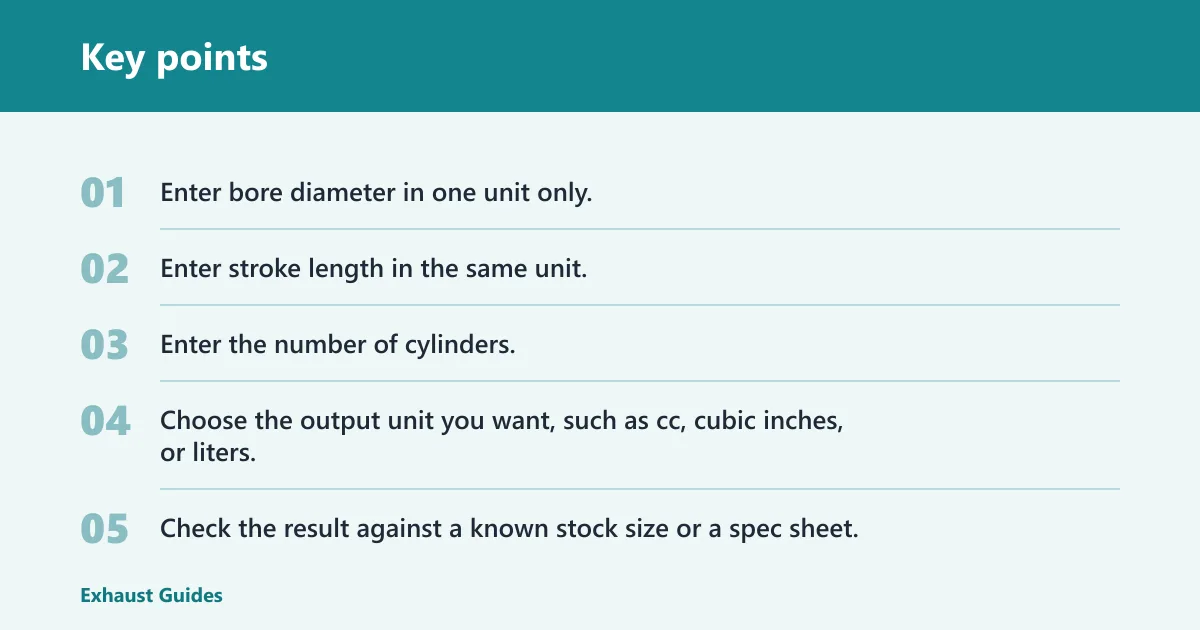
- Enter bore diameter in one unit only.
- Enter stroke length in the same unit.
- Enter the number of cylinders.
- Choose the output unit you want, such as cc, cubic inches, or liters.
- Check the result against a known stock size or a spec sheet.
Many calculators accept mm, cm, or inches for bore and stroke. That helps, but only if both dimensions use the same unit before you calculate. A calculator cannot fix mixed inputs such as a 3.5-inch bore and a 90 mm stroke unless it converts them first.
Why unit mixups change the answer
The most common failure mode is simple: bore and stroke are entered in different units. Since the formula squares bore, a unit mismatch can push the answer far from reality. If the result looks too small or too large, unit handling is the first thing to check.
Keep bore and stroke in one unit
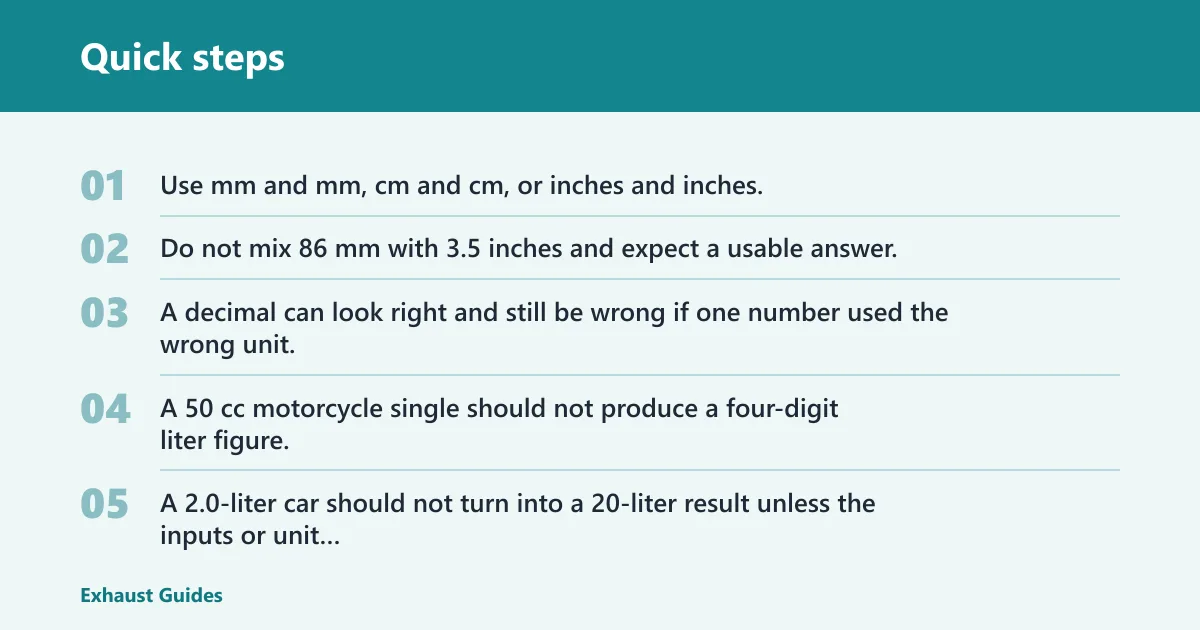
Use mm and mm, cm and cm, or inches and inches. Do not mix 86 mm with 3.5 inches and expect a usable answer. A decimal can look right and still be wrong if one number used the wrong unit.
Quick checks help. A 50 cc motorcycle single should not produce a four-digit liter figure. A 2.0-liter car should not turn into a 20-liter result unless the inputs or unit conversions are off.
What goes wrong with mixed units
Say your bore is 84 mm and your stroke is 3.31 inches. If you treat both as inches, the result will be wildly inflated. If you convert 3.31 inches to 84.074 mm first, the calculation returns a believable size. The math is fine; the unit handling was the problem.
Small-bore motorcycles deserve the same care. A 47 mm single-cylinder engine is common in small-displacement bikes, but entering 47 cm by mistake would create a number so large it is obviously wrong. Always sanity-check the output against the type of engine you expect.
What do bore, stroke, and cylinders mean?
Bore is the cylinder diameter used in the displacement formula. Stroke is the piston travel from bottom dead center to top dead center. Cylinder count is the multiplier that turns one cylinder’s swept volume into total engine displacement.
Bore diameter
Bore diameter is the width of each cylinder. Because bore is squared in the formula, a small change matters. An overbore that adds even a fraction of a millimeter changes the final displacement, which is why builders track machining changes closely.
Stroke length
Stroke length is the distance the piston travels inside the cylinder. The same source describes stroke length as the distance traveled by the piston inside a cylinder. Longer stroke usually increases displacement if bore and cylinder count stay the same.
Number of cylinders
Number of cylinders is the simplest part of the formula, but it still matters. A single-cylinder motorcycle, a twin, an inline-four, and a V8 can share the same bore and stroke dimensions yet have very different total displacement because the cylinder count is different.
Displacement conversion table
The table below shows six common setups with bore, stroke, cylinder count, and the same result in cubic centimeters, cubic inches, and liters. It also gives a plain sanity check so you can tell whether the number fits a stock motorcycle, a stock car, or a modified build.
| Bore | Stroke | Cylinders | cc | cu in | liters | Sanity check |
|---|---|---|---|---|---|---|
| 50 mm | 50 mm | 1 | 98.2 | 6.0 | 0.098 | Realistic for a small stock motorcycle single |
| 74 mm | 54 mm | 2 | 465.7 | 28.4 | 0.466 | Realistic for a stock motorcycle twin |
| 86 mm | 86 mm | 4 | 1998.6 | 122.0 | 1.999 | Realistic for a stock 2.0-liter car engine |
| 90.5 mm | 86 mm | 4 | 2211.8 | 135.0 | 2.212 | Realistic for a stock or mildly modified car build |
| 99 mm | 92 mm | 8 | 5647.0 | 344.8 | 5.647 | Realistic for a modified V8 build |
| 81 mm | 77 mm | 6 | 2376.8 | 145.0 | 2.377 | Realistic for a stock or modified six-cylinder car |
These are not power claims. They are volume checks. A 1.999-liter engine can still be tuned very differently from another 2.0-liter engine, and a modified build can measure larger than the factory badge on the cover suggests.
How do you convert cubic inches to liters?
To convert cubic inches to liters, multiply cubic inches by 0.016387. Inch Calculator gives that conversion factor directly. If you start with cc, divide by 1,000 to get liters, or divide by 16.387 to get cubic inches.
The inch-to-liter conversion
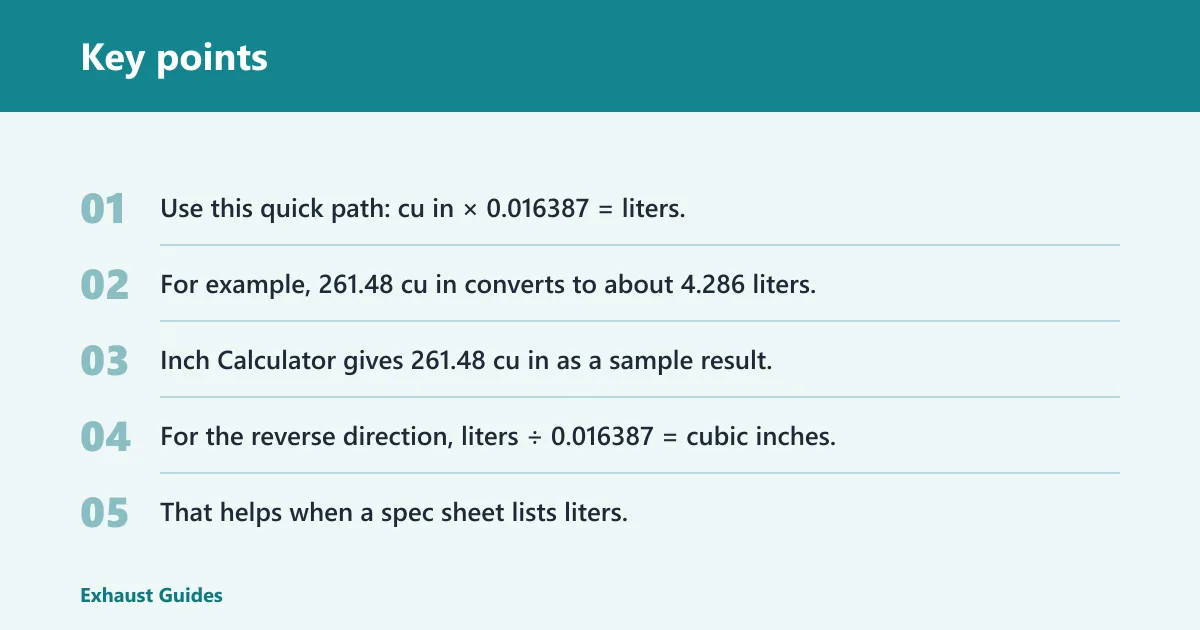
Use this quick path: cu in × 0.016387 = liters. For example, 261.48 cu in converts to about 4.286 liters. The same source gives 261.48 cu in as a sample result, which makes a useful check value for the formula.
For the reverse direction, liters ÷ 0.016387 = cubic inches. That helps when a spec sheet lists liters, but a parts catalog or class rule uses cubic inches instead.
Converting cc to cubic inches
Use cc ÷ 16.387 = cu in. That one-step conversion matters when a motorcycle spec sheet lists cc, but a carburetor, cam chart, or racing class rule uses cubic inches. The unit shift is small enough to miss by eye and large enough to matter in parts selection.
The same source states a typical Formula One race car engine is 1600 cc or 1.6 L. That Formula One engine is about 98 cubic inches. The unit changes, but the engine size does not.
When each unit shows up
CC is common on motorcycles and many international spec sheets. Cubic inches appear often in automotive and engine-builder contexts. Liters are common for larger engines and for model naming, especially when a full displacement number is easier to read than a long cc figure.
Can you calculate bore from displacement?
Yes, calculators can work in reverse from displacement, cylinders, and stroke to estimate bore. That reverse calculation helps with sizing, but it is only an estimate until you check wall thickness, head clearance, gasket size, and machining limits. CSGNetwork and Omni Calculator both note reverse-style options.
Reverse calculation inputs
The reverse version uses the same formula, rearranged to solve for bore. If displacement, stroke, and cylinder count are known, bore can be estimated as the square root of four times displacement divided by π, stroke, and cylinders. The units still have to match.
Use the measured or planned displacement in one unit system first. If the engine is listed in liters, convert to cc or cubic inches before solving, then convert the answer back to the unit you want.
Why the result is not a full build spec
Reverse calculation gives a mathematical size, not a complete cylinder design. A bore that looks correct on paper may be unusable if the cylinder walls are too thin or the head cannot clear the larger diameter. That is why reverse results need a build check, not blind trust.
Picture a 2.5-liter four-cylinder project where the math returns a very large bore. If the block cannot safely accept that diameter, the number is only a target, not a practical specification. Real parts limits come first.
Common mistakes that give wrong answers
Wrong answers usually come from unit handling, cylinder count, or using the wrong displacement figure. Check those three things before you assume the calculator is wrong. Most bad results are input errors, not formula errors.
Mixing units in the formula
This is the biggest error. Keep bore and stroke in the same unit, then convert after the calculation if needed. If a calculator accepts inches, mm, and cm, enter only one unit system at a time.
Forgetting to multiply by cylinder count
A single-cylinder result is not the engine’s total displacement unless the engine has one cylinder. If the engine has two, four, six, or eight cylinders, multiply the per-cylinder volume by that count. CSGNetwork includes cylinder count for that reason.
Using advertised size instead of measured size
Advertised displacement can differ from actual measured displacement after overbore, stroker parts, or other machining changes. The badge on the valve cover or the model name on the fairing may not match the measured result after a rebuild.
A common first-timer mistake is reading “2.0” on a spec sheet and assuming every engine in that family measures the same after modifications. If the bore was increased or the stroke changed, the actual displacement can move away from the factory number.
Frequently asked questions
How is engine displacement calculated?
Engine displacement is calculated with π/4 × bore² × stroke × cylinders. Bore and stroke must use the same unit, and the cylinder count multiplies the single-cylinder volume. The answer can be shown in cc, cubic inches, or liters after you convert the final result.
How do I calculate engine displacement from bore and stroke?
Measure bore diameter and stroke length, keep both in the same unit, square the bore, multiply by stroke, multiply by cylinder count, and then multiply by π/4. That gives total swept volume. If you want cc, use millimeters or convert the final result from cubic millimeters to cc.
How do I convert engine displacement from cubic inches to liters?
Multiply cubic inches by 0.016387 to get liters. If you already have cubic centimeters, divide by 1,000 instead. This helps when a parts catalog or spec sheet uses cubic inches but you want the result in liters for a quick car or motorcycle comparison.
What does cc mean in an engine?
CC means cubic centimeters, a volume unit used for engine size. It is the same displacement figure you may see in liters or cubic inches. A 1,000 cc engine is 1.0 liter, and a 500 cc engine is 0.5 liter. The unit changes, not the engine’s swept volume.
Can I calculate engine displacement in reverse from cc to bore?
Yes, you can estimate bore from displacement, stroke, and cylinder count by rearranging the formula. Treat the result as a sizing estimate, not a final build spec. Check cylinder wall thickness, gasket clearance, and head design before ordering parts or cutting metal.
How many cubic centimeters is my motorcycle engine?
Use the same formula as any other engine: π/4 × bore² × stroke × cylinders. Many motorcycle calculators handle single-cylinder and small-bore engines without special steps. If your bike is listed in liters or cubic inches, convert the final value to cc so the size is easy to compare.
What is the formula for engine displacement in liters?
Use the standard displacement formula, then convert the final volume to liters. If the answer is in cc, divide by 1,000. If it is in cubic inches, multiply by 0.016387. The formula itself does not change; only the output unit does.
What is the difference between cubic inches and cc for engine size?
They are both volume units for the same engine size. One cubic inch equals 16.387 cc, so cubic inches are larger as a unit and cc numbers look bigger. Use cc for many motorcycles, cubic inches for many automotive and engine-builder contexts, and liters when you want a shorter spec-sheet number.