Are Downpipe and Midpipe the Same
When you’re new to car parts, some terms can sound alike and cause confusion. Many people ask, “Are Downpipe and Midpipe the Same?” This question pops up because both parts are in the exhaust system and connect to the engine’s exhaust manifold. It’s easy to mix them up, but they do different jobs.
Don’t worry if you’re puzzled. This guide will clearly explain the difference in a simple way. We’ll break it down step-by-step to make it easy to grasp.
Understanding Your Car’s Exhaust System
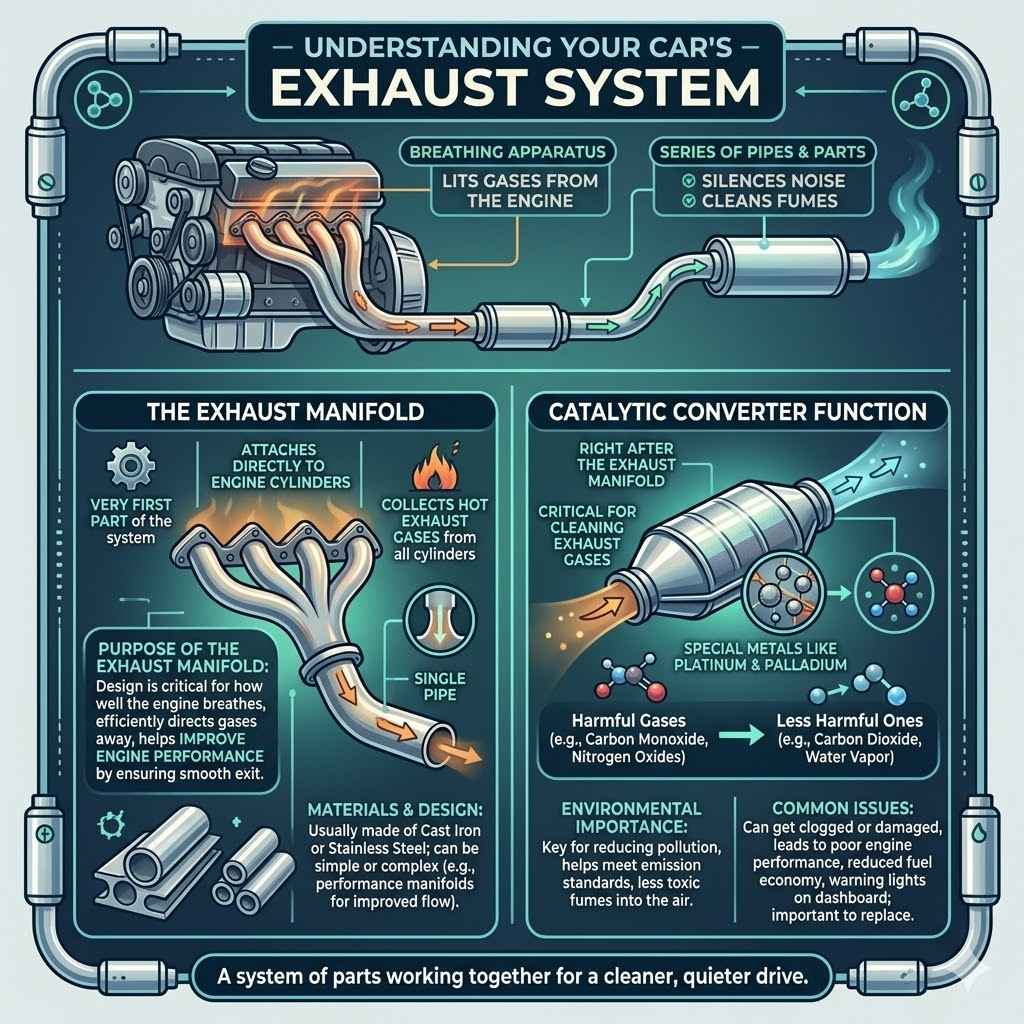
Your car’s exhaust system is like its breathing apparatus, letting out gases from the engine. It’s a series of pipes and parts that work together to silence noise and clean up exhaust fumes. Understanding how these parts work together helps you know why each one is important.
We will look at the main parts and how they connect. This helps clear up the confusion about similar-sounding components.
The Exhaust Manifold
The exhaust manifold is the very first part of the exhaust system. It attaches directly to the engine’s cylinders. Its main job is to collect hot exhaust gases from all the cylinders.
These gases are then funneled into a single pipe.
- Purpose of the Exhaust Manifold: The manifold’s design is important for how well the engine breathes. It helps to direct exhaust gases away from the engine efficiently. A well-designed manifold can also help improve engine performance by making sure exhaust gases exit smoothly.
- Materials and Design: Exhaust manifolds are usually made of cast iron or stainless steel. They can be simple or have complex shapes depending on the engine. Some performance manifolds are made to improve exhaust flow even more.
Catalytic Converter Function
Right after the exhaust manifold, you usually find the catalytic converter. This part is critical for cleaning the exhaust gases. It uses special metals like platinum and palladium to change harmful gases, such as carbon monoxide and nitrogen oxides, into less harmful ones like carbon dioxide and water vapor.
- Environmental Importance: The catalytic converter is a key component for reducing pollution. It helps your car meet emission standards set by governments. Without it, your car would release much more toxic fumes into the air.
- Common Issues: Catalytic converters can sometimes get clogged or damaged. This can lead to poor engine performance, reduced fuel economy, and warning lights on your dashboard. Replacing a faulty catalytic converter is important for both the environment and your car’s health.
The Downpipe Explained
The downpipe is the first section of piping after the exhaust manifold or catalytic converter. Its name comes from the fact that it typically angles downwards from these components. This part plays a role in directing exhaust gases further down the exhaust system.
Knowing its exact location and function is key to understanding exhaust system layouts.
- Location and Connection: The downpipe is usually the shortest pipe in the exhaust system. It connects directly to the catalytic converter or exhaust manifold, depending on the vehicle design. It then leads the gases to the next part of the system.
- Performance Impact: While not as common for everyday drivers to modify, performance downpipes can sometimes improve horsepower. This is because they are often designed with a larger diameter or smoother bends. This allows exhaust gases to flow out of the engine more quickly.
For example, on many turbocharged vehicles, the downpipe is a popular upgrade. This is because it is often the most restrictive part of the exhaust system after the turbocharger. A high-flow downpipe can help the turbo spool up faster and reduce exhaust backpressure.
This leads to noticeable gains in power and throttle response.
What Is The Midpipe
The midpipe comes after the downpipe. It’s the section of the exhaust that runs through the middle of your car. Its main job is to connect the front part of the exhaust to the rear part, which usually includes the muffler.
The midpipe often contains resonators or secondary catalytic converters.
- Role in Muffler System: The midpipe serves as a bridge. It carries exhaust gases from the engine’s front section to the muffler at the back. This continuous pipe allows for a steady flow of gases.
- Resonators and Sound Tuning: Many midpipes include resonators. These are small chambers designed to cancel out certain sound frequencies. Resonators help to reduce unwanted droning or buzzing sounds that can come from the exhaust. This makes the car’s exhaust note quieter and more pleasant.
A common scenario is when a car sounds unusually loud. Sometimes, the midpipe, or a component within it like a resonator, might have a hole or crack. This allows exhaust gases to escape before reaching the muffler, creating a louder, raspier sound.
Fixing this leak is often as simple as replacing a section of the midpipe.
Midpipe versus Resonator
It’s worth noting that sometimes people talk about “resonator pipes” or simply “resonators.” A resonator is a component, while the midpipe is the section of tubing that often houses one or more resonators. The midpipe is the overall pipework, and the resonator is a specific part within it designed for sound control.
Are Downpipe and Midpipe the Same Key Differences
So, are downpipe and midpipe the same? The answer is a clear no. They are distinct parts of your car’s exhaust system, each with its own location and purpose.
Understanding these differences is crucial for anyone wanting to know more about their car.
| Feature | Downpipe | Midpipe |
|---|---|---|
| Location | After exhaust manifold/catalytic converter, angles down | Middle of the exhaust system, runs lengthwise |
| Primary Function | Initial channeling of exhaust gases | Connecting front to rear exhaust, sound tuning |
| Common Components Within | May have a catalytic converter | Often has resonators |
| Typical Length | Shorter | Longer |
- Location is Key: The most obvious difference is where they are on your car. The downpipe is at the very front of the exhaust system, closest to the engine. The midpipe is located further back, as its name suggests, in the middle section of the car.
- Purpose Divergence: While both move exhaust gases, their primary roles differ. The downpipe’s main job is to direct gases from the engine’s immediate vicinity. The midpipe’s role is more about carrying these gases through the vehicle and often fine-tuning the exhaust sound.
- Design Variations: Downpipes are often designed for efficient flow right after the main exhaust components. Midpipes, on the other hand, can be more complex, incorporating features like resonators to manage noise levels. This difference in design reflects their different functions.
Think of it like a water slide. The downpipe is like the first steep drop that gets the water moving fast. The midpipe is like the longer, winding section that guides the water smoothly to the pool at the end, perhaps with some gentle curves to control the flow.
Exhaust System Flow and Pressure
The way exhaust gases move through the system is vital for engine efficiency. The downpipe is the first major pipe that gases enter after leaving the engine or catalytic converter. Its design impacts how quickly gases exit the engine, which is especially important for performance.
The midpipe then takes over, carrying this flow rearward. If the midpipe is too small or has too many restrictions (like a clogged resonator), it can create backpressure. This backpressure can hinder the engine’s ability to expel exhaust gases.
This reduces power and can affect fuel economy.
- Impact on Engine Performance: A well-designed downpipe allows for quicker expulsion of exhaust gases. This helps the engine “breathe” better. A clear and appropriately sized midpipe ensures this good flow continues towards the muffler.
- Sound Management: The midpipe’s role in housing resonators is significant. These components are tuned to reduce specific sound frequencies. This is why the midpipe can have a greater impact on the overall sound of your exhaust than the downpipe alone.
Real-World Scenarios
Consider a sports car enthusiast looking to enhance their vehicle’s sound and performance. They might opt for an aftermarket exhaust system. This often involves replacing the factory downpipe and midpipe.
- Replacing the Downpipe: An aftermarket downpipe might be larger in diameter and have smoother bends. This allows exhaust gases to escape the engine more freely, potentially increasing horsepower and turbo spool speed.
- Upgrading the Midpipe: A new midpipe could be designed to remove or replace restrictive resonators. This further improves exhaust flow and gives the car a deeper, more aggressive exhaust note. The combination of both changes can lead to significant performance and sound improvements.
In this scenario, replacing both the downpipe and midpipe addresses different aspects of the exhaust system. The downpipe focuses on initial gas exit efficiency, while the midpipe handles the longer run and sound tuning.
Modifying Your Exhaust System
When people decide to change their car’s exhaust, they might look at replacing the downpipe or the midpipe, or both. These upgrades are popular for tuning cars to sound better or perform more powerfully. It’s important to know which part you are changing and why.
Performance Exhaust Upgrades
Aftermarket exhaust systems are designed to improve how your car’s engine performs. They often focus on increasing the speed at which exhaust gases leave the engine. This can result in more power and a better engine sound.
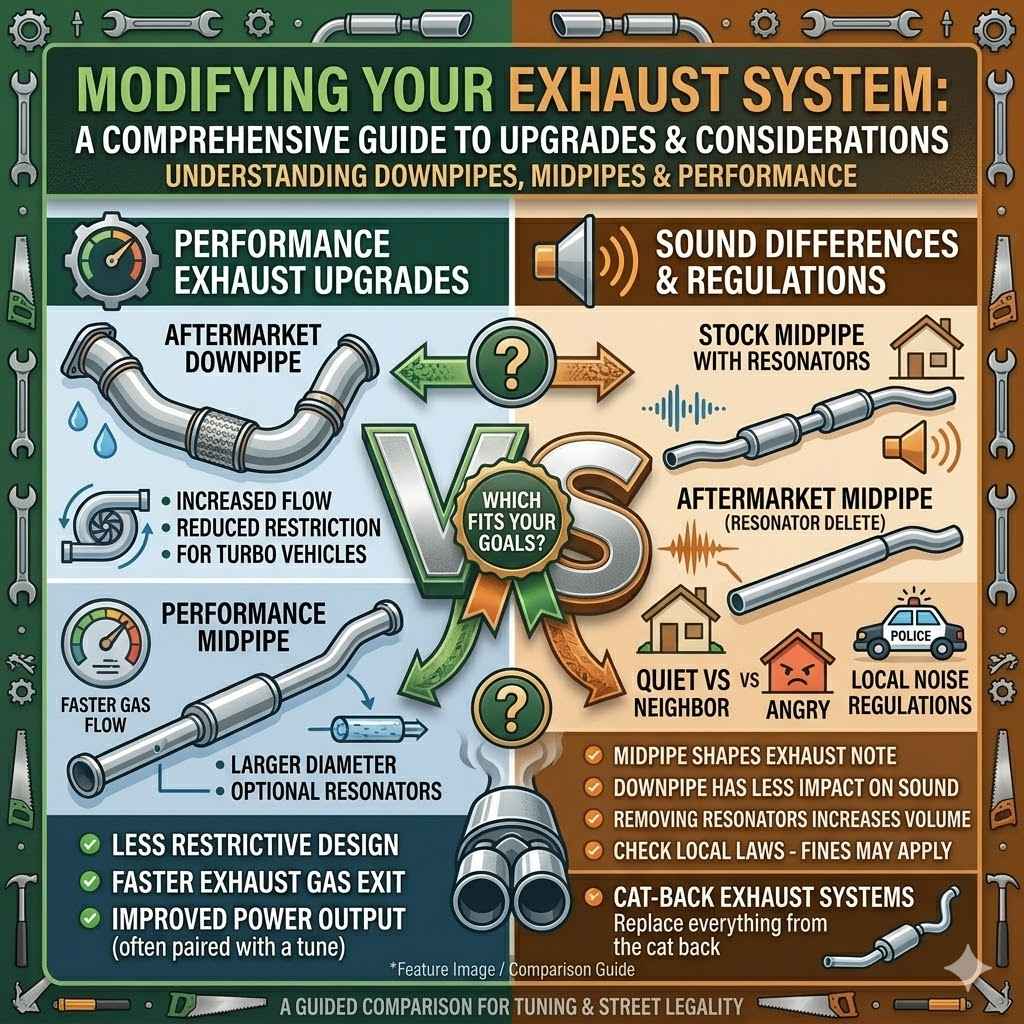
- Aftermarket Downpipes: These are often designed to be less restrictive than stock ones. They might have a larger diameter or a smoother shape. This helps gases exit the engine faster, especially after a turbocharger.
- Cat-Back Exhaust Systems: These systems typically replace everything from the catalytic converter back. This includes the midpipe, muffler, and tailpipe. Replacing these parts can significantly change the sound and performance.
Sound Differences and Regulations
The sound your exhaust makes is a big part of the driving experience for many. The downpipe has less impact on sound than the midpipe because it’s closer to the engine and often has a catalytic converter. The midpipe, with its resonators, plays a much bigger role in shaping the exhaust note.
It is important to be aware of local laws. Some areas have strict rules about how loud a car’s exhaust can be. Modifying your exhaust system without considering these rules can lead to fines or needing to put the original parts back on.
For instance, some modifications might remove the resonators from the midpipe. This usually makes the exhaust much louder. While some drivers prefer this, it can cause issues with noise regulations.
It’s always best to check local laws before making significant exhaust changes.
Frequently Asked Questions
Question: Is the downpipe the same as the exhaust pipe
Answer: No, they are not the same. The downpipe is a specific part of the exhaust system, usually the first section after the exhaust manifold or catalytic converter. The term “exhaust pipe” can refer to any section of the exhaust tubing, including the downpipe and midpipe.
Question: Can a bad midpipe affect engine performance
Answer: Yes, a damaged or blocked midpipe can definitely affect engine performance. If it’s leaking, exhaust gases escape too early. If it’s clogged with rust or debris, it creates backpressure, making the engine work harder and reducing power.
Question: Do all cars have a downpipe and a midpipe
Answer: Most cars with internal combustion engines have a downpipe and a midpipe as part of their exhaust system. However, the exact design and configuration can vary significantly depending on the make, model, and year of the vehicle.
Question: What is the main difference between a downpipe and a catalytic converter
Answer: The downpipe is a pipe that carries exhaust gases. The catalytic converter is a device that cleans these gases. The downpipe often connects directly to the catalytic converter, and the gases pass through the converter to be treated.
Question: How do I know if I need to replace my midpipe
Answer: You might need to replace your midpipe if you hear loud exhaust leaks, a humming or droning sound from the middle of your car, or notice a significant drop in engine power. Visible rust or damage to the pipe is also a sign.
Summary
The downpipe and midpipe are distinct components of your car’s exhaust system. The downpipe starts the process after the engine, while the midpipe extends this flow towards the rear. They serve different functions in gas movement and sound tuning.