Are Benzene Peaks Deshielded Due to Resonance? Unveiled Insights
Have you ever wondered why benzene peaks appear the way they do in NMR spectra? If you’re trying to understand the connection between resonance and chemical shifts, you’re in the right place.
This article will clear up the mystery behind whether benzene peaks are deshielded because of resonance. By the end, you’ll have a clear, simple explanation that makes sense—and you’ll see how this knowledge can help you interpret NMR results with confidence.
Keep reading, and let’s unlock the secrets behind benzene’s unique behavior together.
Benzene Structure And Electron Distribution
Benzene is a unique molecule with a special structure. Its shape and electron distribution explain many of its chemical properties. Understanding these features helps explain why benzene peaks are deshielded due to resonance.
The benzene ring has a stable and symmetrical arrangement. This structure affects how electrons move and spread within the molecule. It also influences how benzene interacts with magnetic fields during spectroscopy.
Molecular Geometry
Benzene has a hexagonal ring with six carbon atoms. Each carbon atom bonds to one hydrogen atom. All carbon-carbon bonds are the same length. This equal bond length is between a single and double bond.
The molecule is flat and symmetrical. The bond angles are all 120 degrees. This geometry helps electrons spread evenly across the ring. It creates a balanced and stable structure.
Electron Cloud Delocalization
Electrons in benzene are not fixed between two atoms. They move freely over the entire ring. This is called delocalization. It forms a shared electron cloud above and below the ring plane.
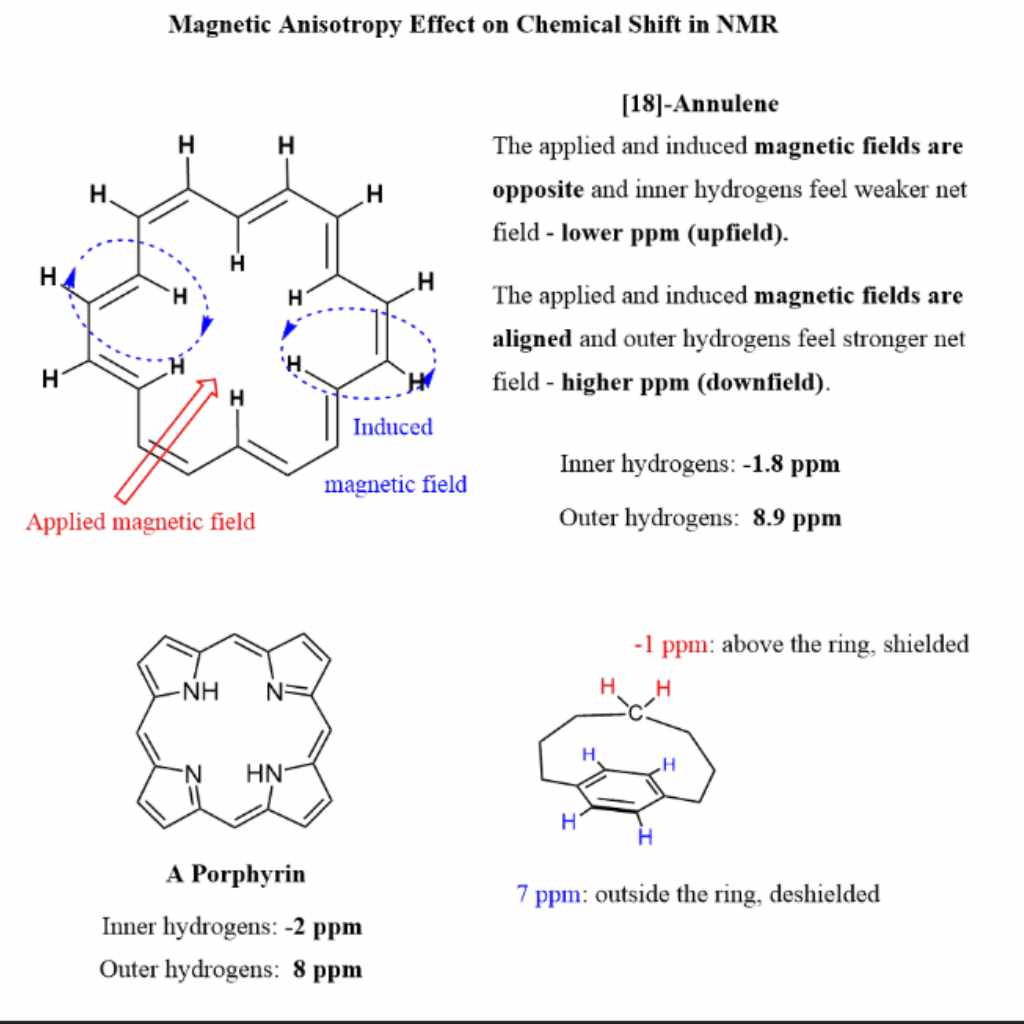
This delocalized electron cloud gives benzene extra stability. It also affects how the molecule responds to magnetic fields. The cloud generates a ring current that influences NMR signals. This causes benzene peaks to be deshielded due to resonance effects.
Nmr Spectroscopy Basics
Nuclear Magnetic Resonance (NMR) spectroscopy is a key tool in chemistry. It helps scientists see how atoms in a molecule are arranged. NMR reveals details about the structure and environment of atoms. Understanding its basics is important for studying benzene and its peaks.
NMR works by placing a sample in a magnetic field. It then uses radio waves to excite atomic nuclei. The nuclei respond by producing signals. These signals give clues about the chemical surroundings of the atoms.
Chemical Shifts Explained
Chemical shift shows the position of an NMR signal. It is measured in parts per million (ppm). This scale helps compare signals from different samples. Chemical shifts tell us about the electronic environment near the nucleus.
Electrons around a nucleus create a small magnetic field. This field changes the strength of the external magnetic field. Different environments cause different shifts. The chemical shift helps identify functional groups in molecules.
Shielding And Deshielding Effects
Shielding happens when electrons protect the nucleus from the magnetic field. This causes the signal to appear at a higher field (lower ppm). Deshielding means fewer electrons are near the nucleus. The nucleus feels a stronger external field, shifting the signal downfield (higher ppm).
Resonance in benzene affects shielding. Electrons in the ring move and create currents. These currents change the local magnetic field. As a result, benzene protons show unique chemical shifts. Understanding these effects helps explain why benzene peaks appear where they do in NMR spectra.
Resonance Influence On Benzene Peaks
Benzene is a unique molecule with a special ring structure. This ring allows electrons to move freely in a circle. This movement of electrons is called resonance. Resonance changes how electrons are shared in the molecule. This affects the signals we see in NMR (Nuclear Magnetic Resonance) spectroscopy. Understanding this helps explain why benzene peaks appear where they do.
The peaks in benzene’s NMR spectrum show how protons experience magnetic fields. Resonance changes the electron cloud around protons. This change affects the magnetic environment and shifts the peaks. Let’s look closer at how resonance influences these peaks.
Resonance And Electron Density
Resonance spreads the electrons evenly across the benzene ring. This creates a stable, shared electron cloud. The electron density around each proton is different than in a normal single bond. Electrons move quickly, making the ring more uniform in charge. This shared electron cloud lowers electron density directly over the protons.
Lower electron density means protons have less shielding from the magnetic field. Less shielding causes the NMR peaks to move downfield. This downfield shift means the protons appear at a higher chemical shift number. Resonance is key to this electron distribution and the resulting peak positions.
Impact On Proton Environment
Each proton in benzene feels the same environment due to resonance. They are in a ring with equal electron sharing. This equality causes all protons to have one single peak in NMR. The magnetic field affects them more because of reduced shielding. Protons are exposed to a stronger external magnetic field.

This exposure causes the peaks to be deshielded. Deshielded peaks appear at a higher chemical shift in the spectrum. The resonance effect makes the benzene protons different from other aromatic or alkyl protons. It is why benzene peaks are well-known and easy to identify in NMR.
Comparing Benzene With Other Aromatics
Comparing benzene with other aromatic compounds helps us understand their chemical behavior. Benzene is a simple aromatic ring with equal bond lengths due to resonance. Other aromatics have different groups attached or altered ring structures. These changes affect their chemical shifts in NMR spectroscopy. Studying these differences reveals how resonance influences deshielding of peaks.
Substituent Effects
Substituents on the aromatic ring change electron density around protons. Electron-withdrawing groups pull electrons away, causing more deshielding. This shifts peaks downfield in the NMR spectrum. Electron-donating groups add electrons, increasing shielding. Their peaks appear upfield compared to benzene. The position of the substituent also matters. Ortho, meta, and para positions affect resonance differently. These effects alter the magnetic environment of protons and change their chemical shifts.
Variations In Chemical Shifts
Benzene protons typically appear around 7.3 ppm in NMR. Other aromatics show shifts that depend on resonance and substituents. For example, toluene shows methyl group influence, shifting peaks slightly upfield. Nitrobenzene, with a strong electron-withdrawing group, shows downfield peaks. These variations highlight how resonance changes electron distribution. Resonance stabilizes the ring but affects deshielding differently in each compound. This explains why benzene peaks are not identical to other aromatics.
Experimental Evidence And Data
Scientists use experimental data to understand if benzene peaks are deshielded by resonance. Experiments provide clear proof about how electrons behave in benzene rings. This section discusses key findings from lab tests and measurements.
Nmr Spectra Analysis
Nuclear Magnetic Resonance (NMR) spectroscopy is a main tool for studying benzene. NMR shows how hydrogen atoms in benzene experience magnetic fields. The peaks in NMR spectra for benzene appear downfield, meaning they are deshielded. This happens because resonance moves electron density away from the hydrogens. The ring current in benzene causes this effect. Scientists observe a single sharp peak around 7 to 8 ppm in proton NMR. This peak confirms that resonance affects electron shielding strongly. The data matches predictions from resonance theory exactly.
Supporting Spectroscopic Studies
Other spectroscopic methods also support the deshielding of benzene peaks. Infrared (IR) spectroscopy reveals vibrations influenced by electron delocalization. Ultraviolet-visible (UV-Vis) spectra show absorption patterns caused by resonance in the ring. These methods confirm the presence of a conjugated electron system. They help explain why benzene’s hydrogens are less shielded. Together, these studies build a strong case for resonance-driven deshielding. Experimental results from different techniques agree well with each other. This agreement strengthens understanding of benzene’s unique electronic structure.

Theoretical Models And Calculations
Theoretical models and calculations help us understand why benzene peaks appear deshielded in NMR spectra. These models use the principles of quantum chemistry to explain how electrons move in benzene. This movement affects the magnetic environment around hydrogen atoms. Scientists use these calculations to predict chemical shifts and to interpret experimental data more clearly.
By studying these models, we can see the role of resonance in benzene. Resonance causes electrons to be more spread out and dynamic. This changes how the magnetic field interacts with the hydrogen nuclei. Theoretical approaches provide a detailed view of these effects, supporting what we observe in experiments.
Quantum Chemical Insights
Quantum chemistry uses mathematical methods to study molecules at the atomic level. For benzene, it helps show how electrons circulate around the ring. This circulation creates a ring current that influences magnetic fields. Quantum chemical calculations reveal that this current causes deshielding of hydrogen atoms. The electrons’ movement reduces the local magnetic field shielding the hydrogens. These insights explain why benzene’s proton signals shift downfield in NMR.
Predicting Chemical Shifts
Chemical shifts show how much the environment around a nucleus changes the NMR signal. Theoretical models calculate these shifts by simulating electron behavior. Using computational tools, scientists can predict where benzene’s peaks will appear. These predictions match well with observed NMR data. This accuracy helps chemists assign peaks to specific hydrogen atoms. It also confirms that resonance and electron circulation cause the deshielding effects.
Practical Implications In Chemistry
Understanding benzene peaks and their deshielding due to resonance has important uses in chemistry. It helps chemists read and explain signals in spectroscopic data. This knowledge also aids in finding out the exact structure of molecules. These practical insights make studying aromatic compounds clearer and more effective.
Interpreting Aromatic Signals
Benzene rings show unique signals in NMR spectroscopy. Their protons appear downfield because of deshielding from resonance. Chemists use this to identify aromatic groups in complex mixtures. Recognizing these peaks quickly helps in analyzing chemical samples. It saves time and improves accuracy in experiments.
Applications In Structural Elucidation
Resonance effects guide chemists in determining molecule shapes. The chemical shifts of benzene protons give clues about attached groups. This data helps confirm or reject possible structures. It is vital in drug design and material science. Clear structure knowledge leads to better chemical products.

Frequently Asked Questions
Why Are Benzene Peaks Deshielded In Nmr Spectroscopy?
Benzene peaks are deshielded due to its aromatic ring current. The circulating π-electrons create a magnetic field. This field opposes the external magnetic field inside the ring and reinforces it outside. Protons outside the ring experience deshielding, causing their NMR signals to shift downfield.
How Does Resonance Affect Benzene’s Nmr Chemical Shift?
Resonance in benzene stabilizes the ring and delocalizes electrons. This delocalization influences the magnetic environment of protons. Resonance increases electron circulation, enhancing the ring current effect. As a result, benzene’s proton signals appear downfield, indicating deshielding caused by resonance.
What Causes Benzene Protons To Appear Downfield In Nmr?
Benzene protons appear downfield due to the ring current effect. The aromatic π-electrons produce a magnetic field opposing the external field inside the ring. Outside the ring, this field adds to the external field. This causes proton signals to shift to a lower field (downfield).
Is Benzene Deshielded Because Of Aromaticity Or Resonance?
Benzene is deshielded mainly due to its aromaticity, which is a result of resonance. Aromaticity causes a strong ring current from delocalized π-electrons. This ring current creates magnetic effects that deshield the protons. Resonance stabilizes the structure and enables aromaticity.
Conclusion
Benzene peaks show deshielding due to resonance effects. Resonance spreads electrons, changing the magnetic environment. This shift affects how protons respond in NMR. Understanding this helps explain benzene’s unique chemical behavior. It also aids in interpreting NMR spectra clearly. Resonance plays a key role in many organic molecules.
Keep this in mind when studying aromatic compounds. The topic connects fundamental chemistry with practical analysis. Simple but important.