Can You Reuse an Old Oxygen Sensor Without Replacing It?
Yes, but only if the sensor is clean, the wiring is intact, and it switches normally on a scan tool. If it is contaminated, the heater has failed, or response is slow, replace it. A bad reuse can leave fuel trims off, turn the check-engine light back on, and waste labor on the same job twice. This guide gives a yes/no decision tree for contamination, response speed, wiring condition, cleaning limits, testing, and when replacement is the better call.
How to inspect and test your current sensor
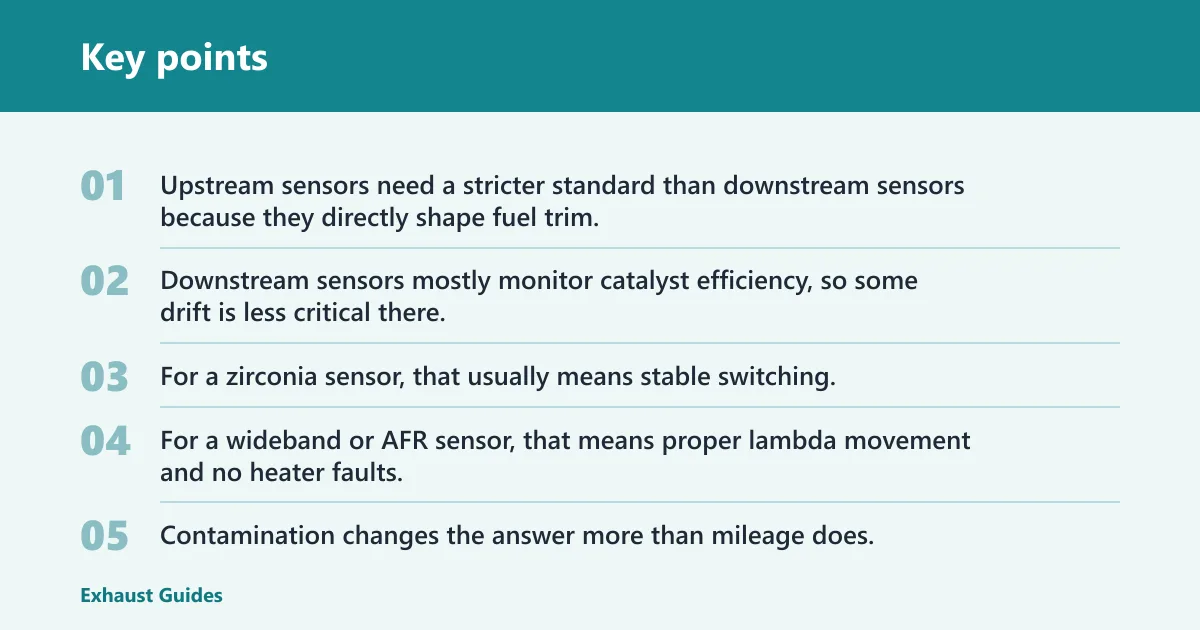


An old oxygen sensor can be reused only when its sensing element is not chemically poisoned, the connector and wiring are sound, the heater checks out, and live data still shows normal switching or lambda control. Upstream sensors need a stricter standard than downstream sensors because they directly shape fuel trim.
Upstream vs. downstream sensors
Upstream sensors sit before the catalytic converter and are used to help the engine control module adjust mixture in real time. Downstream sensors mostly monitor catalyst efficiency, so some drift is less critical there. That difference matters: a reused upstream sensor that has slowed down can create fuel trim errors even if the engine still runs.
When reuse is reasonable
Reuse makes sense when the sensor is physically intact, the threads are clean, the connector locks properly, and scan data shows normal behavior. For a zirconia sensor, that usually means stable switching. For a wideband or AFR sensor, that means proper lambda movement and no heater faults.
When replacement is the safer call
Replace the sensor if it has coolant residue, oil ash, silicone poisoning, burnt wiring, a cracked connector, seized threads, or slow response on live data. If the sensor is electrically alive but chemically tired, cleaning can make it look better for a short time without restoring accuracy.
| Sensor condition | Likely cause | Test to run | Recommended action |
|---|---|---|---|
| Light soot that wipes off | Brief rich running or short-trip carbon buildup | Scan live data for normal switching; verify fuel trims and no heater code | Clean carefully and retest if response is normal |
| Oil-fouled sensor | Excess oil consumption or valve seal wear | Check for oily deposits and monitor switching lag | Replace sensor; fix oil source first |
| Coolant-contaminated sensor | Coolant leak, head gasket issue, or antifreeze ingress | Inspect for white deposits and pull freeze-frame data | Replace sensor; repair coolant leak |
| Slow-response sensor | Aging element, carbon film, or exhaust contamination | Watch switching activity, cross-count behavior, and response lag | Replace if switching is lazy or outside normal pattern |
| Heater-circuit failure | Open heater, broken element, or wiring fault | Measure heater resistance and continuity with a digital multimeter | Replace sensor after verifying power and ground |
| Physically damaged threads/connectors | Seizure, impact, heat damage, or connector breakage | Inspect thread form, terminal fit, and wire insulation | Replace sensor; do not reuse damaged hardware |
What contamination means for reuse
Contamination changes the answer more than mileage does. Oil ash, coolant, silicone, and some additive residues coat the sensing surface and slow oxygen transfer. A sensor can still produce a signal while being too biased or too sluggish to trust.
Say your upstream sensor has a light dry soot film after a rich-start issue, but the connector is clean and the scan tool still shows quick switching. That sensor may be reusable after cleaning. If the same sensor has crusty white deposits from coolant, reuse is a poor bet even if it still produces a voltage.
Oil ash and carbon fouling
Oil ash comes from engine oil burning in the exhaust stream. Carbon fouling usually comes from rich running, misfire, or lots of short trips. Light carbon can sometimes be removed, but oily ash often sticks to the element and returns quickly unless the engine problem is fixed.
Coolant and silicone poisoning
Coolant contamination is one of the clearest replace cases. Antifreeze leaves residues that poison the sensor surface, and silicone from sealants can coat the element in a similar way. These failures are often permanent enough that cleaning only wastes time.
Fuel additive deposits
Some fuel or oil additives leave mineral deposits on the sensing tip. Those deposits can slow response without fully killing the sensor. If live data shows lag or flat spots after the exhaust has been repaired, replacement is often more reliable than repeated cleaning.
How do you test an old O2 sensor?
Test the sensor with live data, heater checks, and code information before deciding to reuse it. A sensor that is physically intact can still be too slow, too biased, or heater-limited to trust. Scan tool data tells you more than visual inspection alone.
Scan tool live data
On a zirconia sensor, look for active switching between lean and rich on upstream units. On a wideband or AFR sensor, watch lambda behavior and commanded versus actual fuel trim movement. Slow cross-counts, delayed reaction to throttle changes, or a flat trace are reuse warnings.
A common first-timer mistake is judging a sensor by one voltage snapshot. The useful question is how it moves over time. A healthy upstream zirconia sensor should usually not stay fixed at one number for long under warm, closed-loop operation.
Multimeter and heater checks
A digital multimeter can confirm heater continuity, supply voltage, and basic circuit integrity. Disconnect the sensor before resistance checks, and do not probe live circuits carelessly. Use the meter to verify that the heater is not open and that the wiring has continuity where the service information calls for it.
- Key off and disconnect. Turn the ignition off, let the exhaust cool, and unplug the sensor. Hot exhaust parts can burn skin, and an unplugged connector gives cleaner meter readings.
- Check heater resistance. Measure resistance across the heater terminals only if the service data identifies them. A reading that is open, or far outside the specified range for that application, points to heater failure.
- Verify continuity. Check continuity from connector to the engine side only as directed by the wiring diagram. A broken wire or corroded terminal can mimic a bad sensor.
- Inspect supply voltage. With the connector reattached, confirm the heater feed and ground strategy using the scan tool and meter together. That separates sensor failure from vehicle-side power or ground problems.
OBD2 codes and freeze-frame data
Codes in the P0130-P0167 family can help narrow the fault. P0130-type and related circuit codes can point to signal problems, while Heater-circuit codes often fall in the P0135-P0167 range, depending on bank and sensor position. Freeze-frame data shows engine load, coolant temperature, and rpm at the moment the fault set.
Look for code patterns, not just the code number. A lean code with weak upstream switching can point to sensor trouble, but it can also come from an exhaust leak or low fuel delivery. Freeze-frame data helps you sort out which came first.
Can oxygen sensors be cleaned and reused?
Sometimes, but cleaning only helps when the problem is surface contamination and not sensor aging or chemical poisoning. Dry soot may come off. Oil ash, coolant residue, and silicone contamination often remain in the sensing layer, which means the sensor may still read wrong after cleaning.
What cleaning can remove
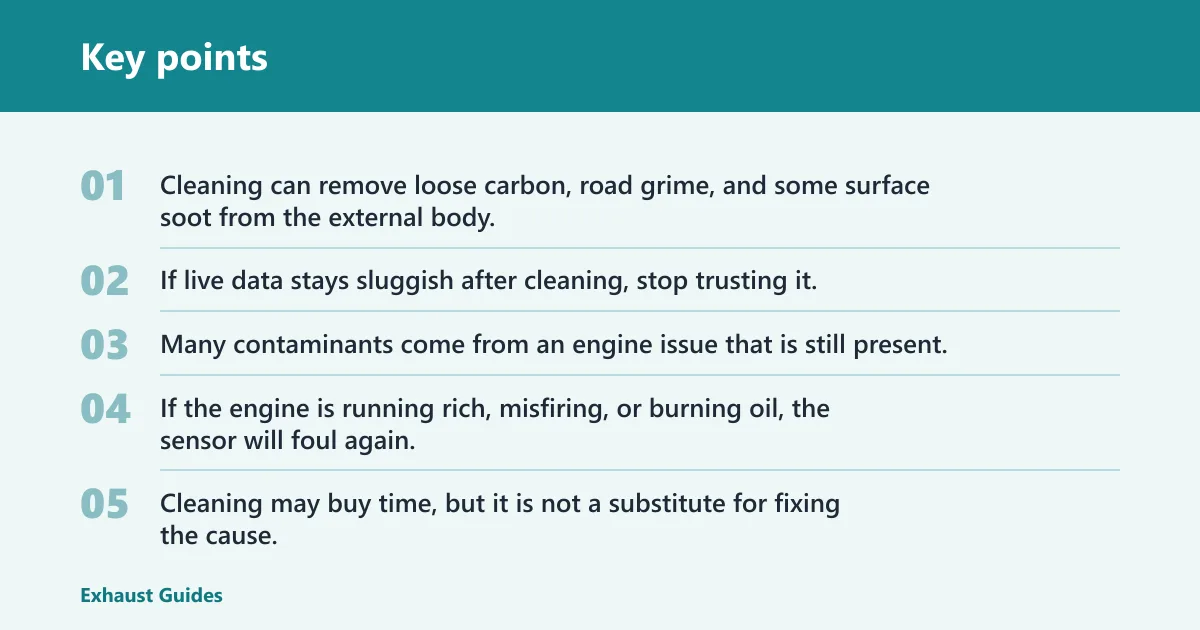
Cleaning can remove loose carbon, road grime, and some surface soot from the external body. That may improve heat transfer around the sensor and let you inspect the element more clearly. It does not restore a worn sensing surface.
What cleaning cannot fix
Cleaning cannot repair a slow heater, broken internal wiring, cracked ceramic, stripped threads, or a contaminated sensing layer. It also cannot restore accuracy if the sensor has already aged past its response window. If live data stays sluggish after cleaning, stop trusting it.
Why cleaning is often temporary
Many contaminants come from an engine issue that is still present. If the engine is running rich, misfiring, or burning oil, the sensor will foul again. Cleaning may buy time, but it is not a substitute for fixing the cause.
Suppose a downstream sensor is coated in dry soot after a brief rich condition, and the heater circuit passes a resistance check. Cleaning may be worth a try there. If the same sensor is upstream and the vehicle has a coolant leak, replacement is the better choice because the chance of a repeat fault is high.
What damage means replace it
Some damage means the sensor is done. Slow response, heater failure, and physical damage are not good candidates for reuse because they affect accuracy, durability, or installation safety. If the part cannot physically or electrically do its job, replacement is the right answer.
Slow response and lazy switching
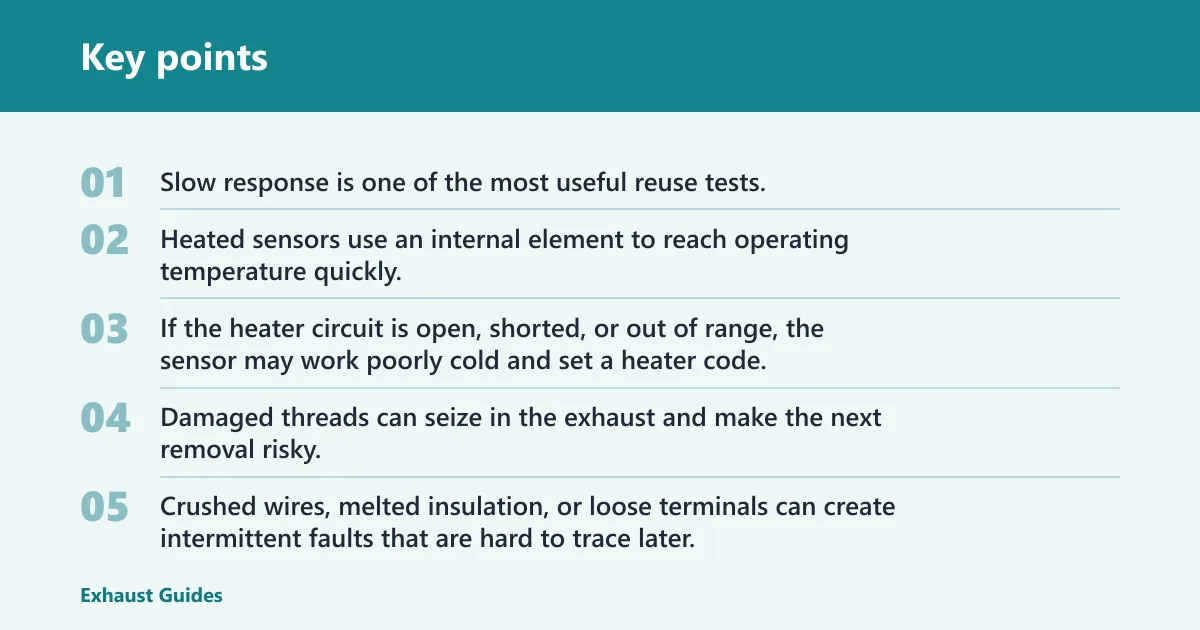
Slow response is one of the most useful reuse tests. If the sensor takes too long to switch after a throttle snap or stays biased while fuel trims drift, it is no longer trustworthy. That matters most on upstream sensors, where fuel control depends on fast feedback.
Heater circuit failure
Heated sensors use an internal element to reach operating temperature quickly. If the heater circuit is open, shorted, or out of range, the sensor may work poorly cold and set a heater code. That failure usually calls for replacement, not reuse.
Thread, wire, and connector damage
Damaged threads can seize in the exhaust and make the next removal risky. Crushed wires, melted insulation, or loose terminals can create intermittent faults that are hard to trace later. A sensor with bad hardware is a bad reuse candidate even if the element still works.
How to compare reuse risk with replacement cost
Reusing a sensor only saves money if the sensor is truly serviceable. If it fails again, you pay for the part twice and often pay labor twice as well. That risk is highest on upstream sensors and on vehicles with difficult access.
Should you reuse it after engine or exhaust work?
Sometimes yes, but only after the repair fixed the cause of contamination or false readings. Exhaust leaks, rich running, misfire, oil burning, and coolant leaks can all damage the sensor before it actually dies. If the root problem remains, reuse is a short-lived fix.
After exhaust repair
If you repaired a cracked manifold, leak, or flex joint and the sensor threads came out clean, reuse may be fine after inspection and testing. Check that no fresh exhaust leak is aimed at the sensor, because fresh leaks can skew readings and mimic a bad sensor.
After rich running or misfire
Rich running and misfire leave carbon on the sensing tip. A sensor that still switches normally after the engine is repaired may be reusable if the contamination is light. If cross-counts are slow or fuel trims stay unstable, replacement is safer.
After oil or coolant contamination
Oil consumption and coolant leaks are harder on oxygen sensors than brief soot exposure. Those contaminants often leave residue that cleaning cannot fully remove. In those cases, replace the sensor after the engine fault is fixed.
Frequently asked questions
Can you reuse an old oxygen sensor?
Yes, but only when the sensor passes live-data testing, the heater circuit checks out, the connector and wiring are intact, and the tip is not chemically poisoned. Upstream sensors need stricter scrutiny than downstream sensors because they directly control fuel mixture.
Can you clean an oxygen sensor without removing it?
Not in a way that is dependable. External spray or solvent may remove surface grime, but it will not clean the sensing element properly, and it can leave residue on nearby parts. For any serious contamination, removal and inspection are safer.
When should oxygen sensors be replaced?
Replace them when the heater circuit fails, the sensor response is slow, the connector or wire is damaged, the threads are ruined, or contamination is from oil, coolant, or silicone. Replace also when scan data shows lazy switching or poor lambda control.
How do you know if an old O2 sensor is still good?
Use live data first. A good upstream sensor should switch or track lambda quickly once the engine is warm, while fuel trims should remain controllable. Then confirm heater continuity and compare any stored codes or freeze-frame data against the symptom.
How long do oxygen sensors usually last?
Many sensors are reported to last well past about 100,000 miles, but mileage alone is a weak guide. Oil burning, coolant leaks, rich operation, misfire, and exhaust leaks can shorten life sooner. Condition and test results matter more than an odometer rule.