
Can You Put Exhaust Tips on a Motorcycle?
Yes, if the exhaust has a round, exposed outlet and the tip matches its outside diameter; no, if the outlet is welded, stepped, or capped by a baffle. A poor fit can cause leaks, bodywork contact, heat damage, or a ticket. This guide covers fitment checks, heat and clearance, sound limits, and install points before you buy.
What determines exhaust tip fitment

- Stainless steel resists rust and deformation
- Universal adapter design
- VIN match help before purchase
Yes, but only when the outlet shape, diameter, and mounting method match the tip. A motorcycle exhaust tip is usually a slip-on decorative or functional end piece, not a universal part. If the pipe is sealed off, stepped, oval, or packed tightly behind bodywork, the answer may be no.
When a tip is a simple add-on
A tip works best on a round, exposed tailpipe with enough straight section for the clamp or hanger. In that case, the tip can be mostly cosmetic, or it can change where hot gas exits and how far it reaches nearby parts.
When the outlet blocks direct fitment
If the outlet is already part of a muffler body, ends in an integrated baffle, or changes diameter right at the exit, a generic tip often may not fit cleanly. People then force the part, which can create vibration, leaks, or finish damage.
When model-specific parts matter
Harley-Davidson fitment is a common case where accessory compatibility matters more than a universal claim. A maker, for example, lists motorcycle exhaust tips in its accessory lineup and says those products fit various Harley-Davidson models.
What has to match before you buy one?
Start with the outlet diameter and shape. Then check how the tip mounts, how far it extends, and whether it points straight back or angles toward a saddlebag, boot, or rear tire. If the bike uses a full exhaust system, you also need to know whether the part is a true tip, a muffler accessory, or a replacement exhaust section.
- Measure the outlet. Check the outside diameter of the tailpipe where the tip will clamp or slide on. If the outlet is not round, match the shape first, because a round tip on a stepped or oval outlet usually leaves gaps or a poor fit.
- Check the mounting method. Look for a clamp-on section, a hanger tab, or a welded joint. The wrong hardware can let the tip move, buzz, or loosen over time, especially on single-cylinder or V-twin bikes with strong pulse vibration.
- Confirm the extension length. Measure how far the tip would stick past the pipe and compare that with nearby parts. A short tip may clear luggage better, while a long one can interfere with saddlebags, passenger pegs, rearsets, or a swingarm under suspension movement.
- Verify legal and heat concerns. Check whether the new end piece changes sound, emission compliance, or exhaust direction in a way your local rules reject. Then make sure the outlet still keeps hot gas away from skin, luggage, and plastic bodywork.
Motorcycle exhaust tip fitment checklist
Use this as a quick yes-or-no screen before you order. If any row looks uncertain, stop and recheck the pipe, the hardware, and the rear-end clearance before installing anything.
| Outlet diameter | Mounting style | Tip length | Nearby-clearance risks | Heat exposure | Legal red flags | Common bike category | Yes/no recommendation |
|---|---|---|---|---|---|---|---|
| Round, matching the tip ID | Clamp-on with correct diameter | Short to moderate | Usually low if straight-back and centered | Lower than a wrapped pipe, but still very hot | Noise increase, altered outlet direction | Harley-Davidson cruiser | Yes, if model fit is listed |
| Round, but stepped or reduced at exit | Clamp may slip; hanger may be needed | Any long extension is risky | Saddlebags, passenger pegs, rear shocks | High near bags or boot contact | Excess projection, sound change | V-twin cruiser with luggage | No, unless a model-specific part exists |
| Oval or hidden behind a muffler body | Often welded or integrated | Not a simple slip-on case | Body panels, tire, rear fender | High near plastics and paint | May be treated as exhaust modification | Sportbike | No for a generic tip |
| Small-diameter outlet | Clamp must match exactly | Very short to preserve clearance | Footpegs, centerstand, side panel | Moderate to high at the exit | Can affect sound test results | Scooter-style layout | Maybe, if the pipe is exposed |
| Any diameter, but with a baffle cap | Usually not a tip-friendly mount | Does not solve the blockage | Rear bodywork and heat shield | Still high, despite the cap | Noise and emissions compliance risk | Street bike with stock muffler | No, unless the system is designed for it |
Will it change sound, heat, or performance?
It can, but the effect depends on the outlet design and the rest of the exhaust. A tip that extends the pipe or narrows the exit can change tone. Heat, leg safety, and emissions compliance matter too, because any exhaust change on a street bike can create a legal or practical issue.
Sound changes from outlet shape
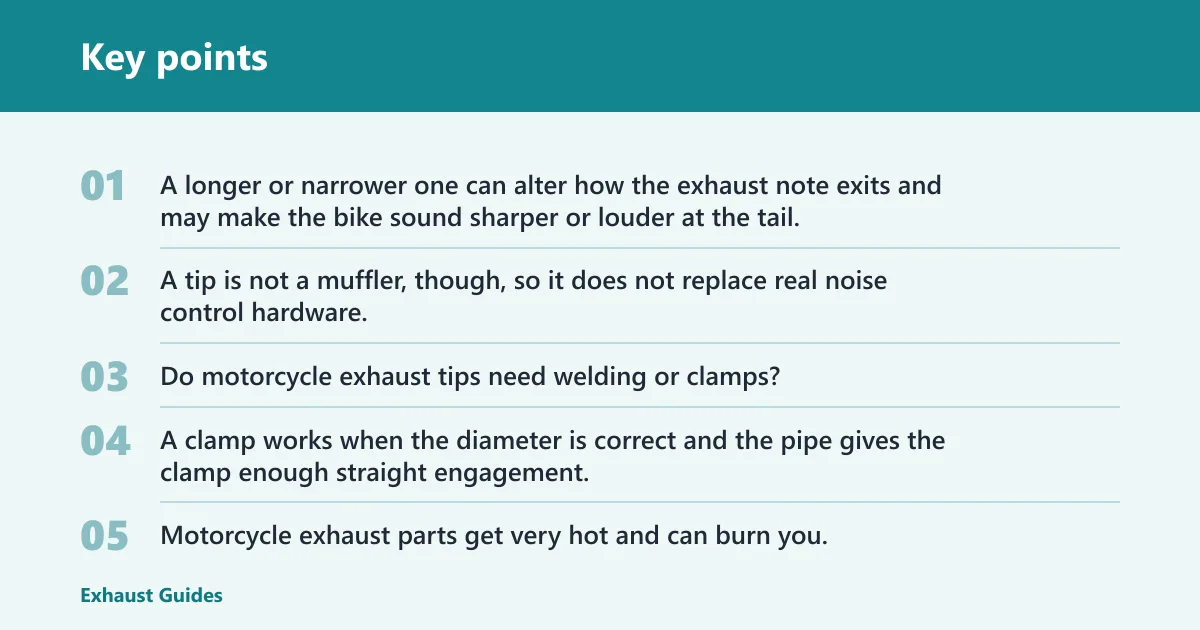
A short decorative tip may do very little. A longer or narrower one can alter how the exhaust note exits and may make the bike sound sharper or louder at the tail. A tip is not a muffler, though, so it does not replace real noise control hardware.
Do motorcycle exhaust tips need welding or clamps? Not always. A clamp works when the diameter is correct and the pipe gives the clamp enough straight engagement. Welding is usually a custom-fabrication choice, not a default requirement, and it becomes the safer answer when the outlet shape or vibration makes a slip-on fit unreliable.
Heat exposure near boots, bags, and bodywork
Motorcycle exhaust parts get very hot and can burn you. Gear Honest says a motorcycle exhaust pipe can go to 700 degrees Fahrenheit near hotter sections of the system, and says the average exhaust temperature can be between 700-1400 degrees Fahrenheit in those hotter areas. That heat can reach boots, pant legs, saddlebag material, and painted panels if the tip points too close.
Picture a cruiser with a tip that extends 2 inches farther than stock and sits beside a hard saddlebag. The pipe may still run correctly, but the new end can send heat closer to the bag edge and leave a scorch mark after a short ride.
Performance and emissions limits on street bikes
Some people claim wrap or outlet changes improve performance, but any real effect depends on the whole setup. The Drive says motorcycle exhaust wrap is mostly aesthetic, though it can protect your leg from burns and may trap moisture and dirt. On street bikes, a change in sound or flow can also raise emissions or inspection concerns.
Do you need clamps, hangers, or welding?
Often yes, at least one of them. Clamp or hanger hardware is a common install need for aftermarket exhaust parts, and it has to match the pipe diameter. If the part vibrates, shifts, or leaks at the joint, the fitment is wrong even if the tip looked close on paper.
- Test the dry fit. Slide or position the tip without tightening fully. Check that it sits square, clears the rear tire and bodywork, and does not force the pipe out of alignment.
- Inspect the contact points. Make sure the clamp grabs clean metal and does not sit on a painted, crimped, or tapered area. A bad contact point lets the part creep and can leave witness marks or exhaust leaks.
- Secure against vibration. Add a hanger or support if the tip would otherwise cantilever too far from the pipe. Vibration is a major failure point on motorcycles because it can loosen hardware and crack thin sections.
- Choose welding only when needed. Use welding or custom fabrication if the outlet is stepped, the angle is fixed, or the tip must be integrated into a larger exhaust change. That route is slower, but it avoids forcing the wrong part into place.
Can you fit one on a Harley or other common bike type?
Yes, but the answer changes by layout. Harley-Davidson fitment is often easier because many aftermarket accessory makers target specific models, yet the wrong tip can still hit saddlebags or sit too close to a passenger peg. Sportbikes and scooters usually have tighter rear clearance and less room for guesswork.

Harley-Davidson fitment and accessory compatibility
For Harley-Davidson motorcycles, model-specific compatibility matters more than a universal claim. Many aftermarket exhaust tips are sold for particular pipe diameters and model families, and the finish matters too. Black, brass, aluminum, and unpolished aluminum are common finish options on accessory parts, while chrome and stainless steel appear often on pipes and mufflers.
Cruiser clearance around saddlebags and passenger pegs
On cruisers, the main issue is rear clearance. A tip that points sideways or sticks out too far can hit saddlebags, soften bag mounts with heat, or contact a passenger peg bracket. The fix is usually a shorter tip, a different angle, or a model-specific part rather than forcing a universal one.
Suppose a cruiser has a 3-inch outlet and a tip that adds about another 4 inches outward. That may look fine in the garage, but if the bag edge sits 1 inch from the pipe at full suspension compression, the setup is a bad fit even before the first long ride.
Sportbike and scooter-style layouts
Sportbike exhausts often tuck under the tail or beside the rear wheel, so a cosmetic tip can run into the swingarm, bodywork, or tire arc. Scooter-style layouts can have a small, short outlet that leaves little room for clamps or long tips. In both cases, a generic product is less likely to work without custom parts.
What materials and finishes should you expect?
Common exhaust parts use stainless steel, chrome, brass, aluminum, or unpolished aluminum. Stainless steel exhaust finish is popular because it resists corrosion and can be polished, but it may discolor or blue-burn with heat. Chrome needs careful cleaning to avoid scratching, and stainless steel cleaners are usually made for chrome or stainless steel finishes.
Cleaning and polishing care
Let the exhaust cool completely before cleaning. KO lightning says stainless steel cleaners are designed for chrome or stainless steel finishes, and says Scotch-Brite pads or steel wool can remove stubborn stains on stainless steel. Use that kind of abrasion carefully, because it can scratch the finish, and if used improperly it can leave residue or contamination on the surface.
Motorcycle exhaust pipe surfaces may need cleaning or polishing over time, especially on chrome or stainless steel. A dirty tip can hide heat marks, while an unpolished aluminum piece can show grime sooner. If the finish is black or brass, use a cleaner that matches the coating so you do not strip the surface.
Exhaust wrap, heat marks, and moisture risk
Exhaust wrap is a heat-management and appearance product, and is often reported in fiberglass composite in 1-inch or 2-inch widths. The Drive says it is mostly aesthetic, though it can help protect your leg from burns. It may also trap moisture, which can accelerate wear on the pipe underneath.
Frequently asked questions
Can you put exhaust tips on a motorcycle?
Yes, if the bike has a round, exposed outlet and the tip matches the outside diameter and mounting style. No, if the outlet is stepped, welded, or capped by a baffle. The fit also has to clear nearby parts and stay within local sound and equipment rules.
Will universal exhaust tips fit any motorcycle?
No. “Universal” only means the part is sold for a range of pipes, not every motorcycle. Outlet diameter, outlet shape, hanger location, and rear clearance all matter, and Harley-Davidson fitment is often more specific than a generic listing suggests.
Do exhaust tips change motorcycle sound or performance?
They can change sound if they alter the outlet length or restriction, but they are not a replacement for a muffler or full exhaust system. Performance changes are usually small and uncertain, and street-bike legality can shift if the modification affects noise or emissions compliance.
Do motorcycle exhaust tips need welding or clamps?
Many use clamps, but only when the diameter and shape match well. Welding is a custom route for awkward angles, stepped outlets, or vibration-prone installs. The wrong hardware can lead to movement, leaks, and premature wear.
Are motorcycle exhaust tips legal on street bikes?
Sometimes, but not everywhere. Local laws may limit noise, outlet position, or exhaust modifications. If the tip makes the bike louder, changes emissions behavior, or extends too far, it can create a compliance problem even if it fits physically.
Can an exhaust tip make a motorcycle too hot to touch?
Yes. Motorcycle exhaust parts can reach very high temperatures, and Gear Honest reports pipe temperatures up to 700 degrees Fahrenheit, with averages between 700-1400 degrees Fahrenheit. A tip can also direct heat toward boots, bags, or bodywork if it sits too close to those areas.
How do I know if an exhaust tip will clear saddlebags or footpegs?
Measure the planned extension and compare it with the nearest fixed parts, then account for suspension movement and passenger load. If the tip will point toward a bag edge or peg bracket, choose a shorter or differently angled part, or skip the install entirely.
Can I put a muffler on a motorcycle instead of an exhaust tip?
Yes, but a muffler is a noise-control component, not the same thing as a cosmetic tip. Fitment depends on diameter and mounting, and a muffler can change sound and emissions behavior far more than a simple tip. It also usually requires more careful installation.
Can you put any exhaust on a motorcycle?
No. You need the correct pipe diameter, mounting points, clearances, and legal compliance for your model. A full exhaust system can change sound, heat, performance, and emissions behavior, so a random part from another bike is rarely a safe choice.
What happens if an exhaust tip points sideways or sticks out too far?
Sideways or oversized projection can push heat toward luggage, boots, or body panels and may create a clearance problem at full suspension travel. It can also draw attention from enforcement if the exhaust exits in a way that breaks local equipment rules or looks unsafe.