Exhaust Leak Symptoms: 7 Warning Signs You Should Not Ignore
Your car is making a strange hissing noise. Or maybe you noticed a burning smell that was not there last week. You are not imagining it — your exhaust system is telling you something is wrong.
An exhaust leak starts small and gets expensive fast. A $150 gasket repair left untreated becomes a $600 manifold replacement. Worse, exhaust fumes inside your cabin are a genuine safety hazard. The sooner you catch it, the better.
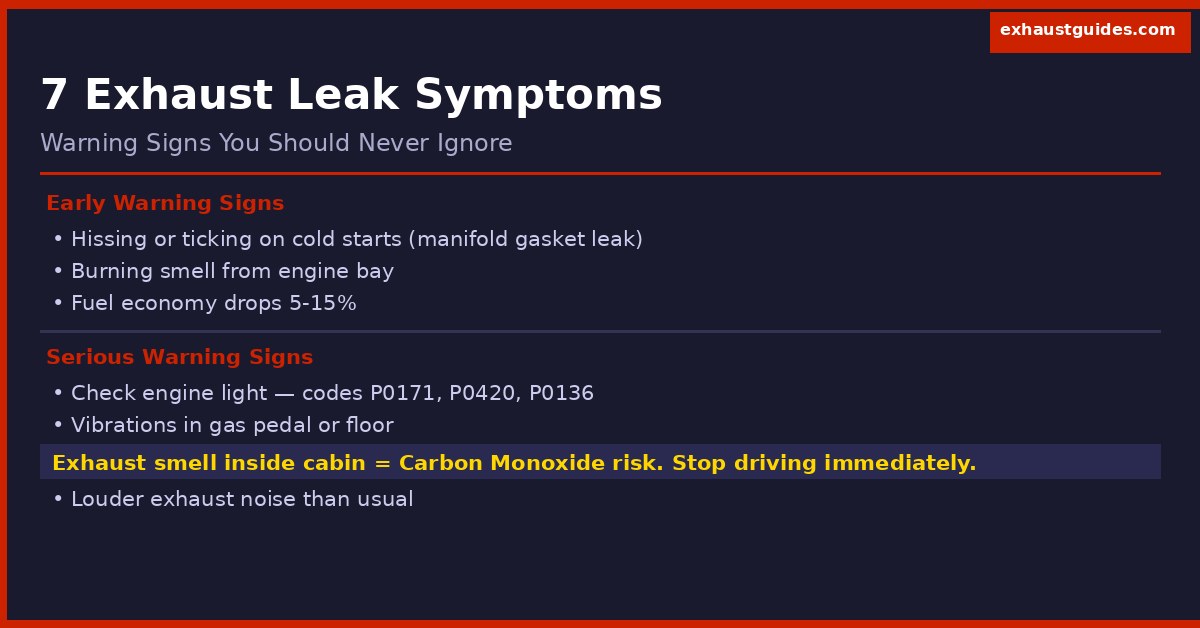
Here are the 7 most common exhaust leak symptoms — and exactly what to do about each one.
1. Hissing or Ticking Noise From the Engine
A ticking or hissing sound loudest on cold starts, then quieting as the engine warms up, almost always points to a leaking exhaust manifold gasket. Hot exhaust gas escapes through a small gap, creating that ticking sound as metal expands and contracts. The noise may fade as the engine heats because metal expands and temporarily seals the gap — but the leak is still there.
Cost to fix: $150–$400 at a shop. Under $60 in parts if you do it yourself.
2. Burning Smell Near the Engine
When exhaust escapes before the catalytic converter, it contacts nearby plastic covers, rubber hoses, and wiring — burning them. This produces a sharp, chemical smell distinct from oil or coolant burning. Beyond the leak itself, burned wiring creates secondary problems like sensor failures that trigger expensive diagnostics.
3. Reduced Fuel Economy
Your car uses oxygen sensors to measure exhaust composition and adjust the fuel mixture. When exhaust leaks before the upstream O2 sensor, outside air enters the exhaust stream. The sensor reads extra oxygen and tells the engine to inject more fuel. Result: the engine runs rich, burns more fuel, and your MPG drops 5–15%.
4. Check Engine Light With O2 Sensor Codes
| Code | Meaning | Common Cause |
|---|---|---|
| P0171 | System too lean (Bank 1) | Exhaust leak before upstream O2 sensor |
| P0174 | System too lean (Bank 2) | Same on V6/V8 rear bank |
| P0136 | O2 sensor malfunction | Sensor damaged by heat from a leak |
| P0420 | Catalyst efficiency low | Exhaust leak causing false readings |
Important: Do not replace oxygen sensors before ruling out a leak. A new sensor on a leaking exhaust will throw the same code within days.
5. Vibrations in the Gas Pedal or Floor
A loose exhaust flange or cracked pipe allows sections of the exhaust to vibrate against the chassis. This transmits as buzzing or shaking through the floorboard or gas pedal — typically at a specific RPM range where resonance is highest.
6. Exhaust Smell Inside the Cabin
This is the most serious symptom. Take action immediately. Exhaust gases inside your vehicle mean carbon monoxide may be entering the cabin. CO is odorless and colorless — the exhaust smell you notice is other gases mixed with it. Open all windows, stop driving the vehicle, and do not use it until the leak is found and fixed.
7. Louder Exhaust Than Usual
If your exhaust suddenly got louder — a deep rumble or drone — you have a hole, crack, or separated joint somewhere. The sound gets worse over time as corrosion expands the gap. Unlike a manifold leak (which ticks), a muffler or pipe hole creates a lower-frequency rumble loudest at idle and on deceleration.
How Much Does an Exhaust Leak Cost to Fix?
| Location | DIY Cost | Shop Cost |
|---|---|---|
| Manifold gasket | $20–$60 | $250–$600 |
| Flex pipe | $30–$80 | $150–$350 |
| Muffler (sealant) | $10–$25 | $80–$200 |
| Pipe section | $40–$100 | $150–$350 |
Frequently Asked Questions
Can I drive with an exhaust leak?
Short distances only — and never with windows up if you smell exhaust inside. Get it fixed within a few days.
Will an exhaust leak cause my car to fail inspection?
Yes, in most states. Both visual inspection and emissions testing will flag a significant exhaust leak. Fix it before your inspection appointment.
Ready to fix it yourself? Our DIY exhaust leak repair guide covers every method with step-by-step instructions and costs.