What Causes Diesel Exhaust Fluid Warnings?
Diesel exhaust fluid warnings usually point to low DEF, poor-quality or contaminated DEF, or a failed SCR-related sensor or dosing part. Ignoring it can lead to reduced power, a no-restart countdown, and a repair bill that may start with diagnostics instead of a simple refill. This guide breaks the warning into low-fluid, bad-fluid, and hardware-failure checks so you can narrow the cause before replacing parts.
What a DEF warning means
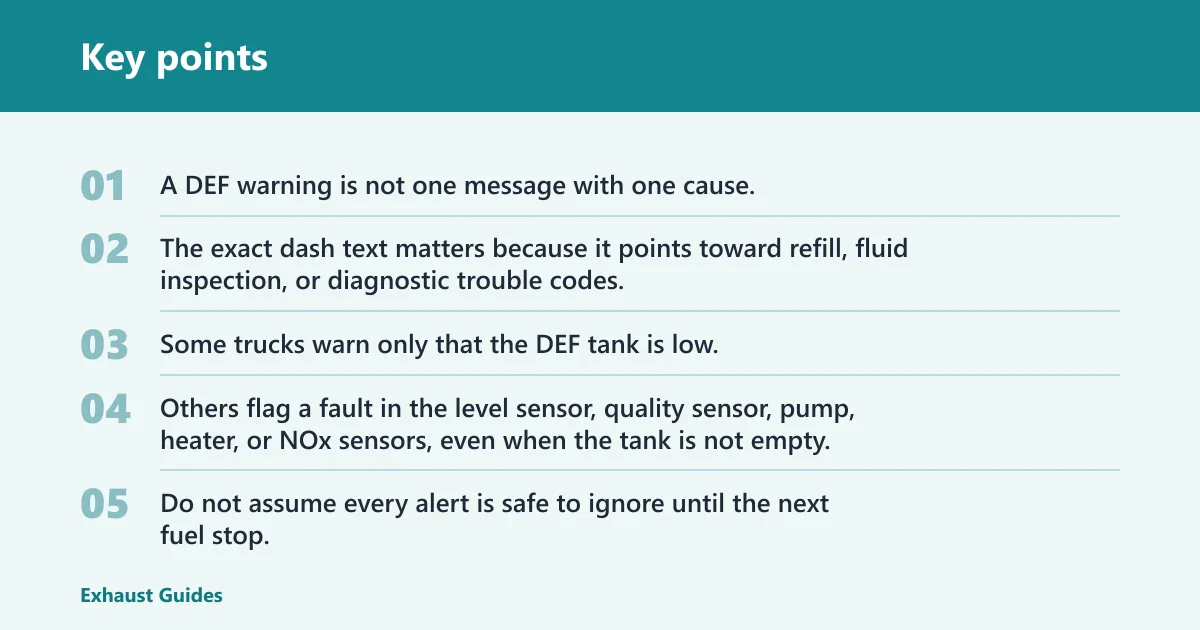


A DEF warning is not one message with one cause. It can be a simple low-fluid alert, a fluid-quality warning, or a system-fault message from the SCR system, which may lead to derate or a no-start countdown if ignored. The exact dash text matters because it points toward refill, fluid inspection, or diagnostic trouble codes.
Low-fluid alerts versus system-fault alerts
Some trucks warn only that the DEF tank is low. Others flag a fault in the level sensor, quality sensor, pump, heater, or NOx sensors, even when the tank is not empty. That difference determines whether you are buying fluid, scanning codes, or arranging service quickly.
How derate and no-start countdowns fit
Many diesel systems keep running after the first warning, but they may reduce power or start a countdown to a no-start condition if the fault stays active. Do not assume every alert is safe to ignore until the next fuel stop. The dash message and countdown status tell you how urgent the problem is.
Why the exact dash message matters
Messages such as “low DEF,” “incorrect DEF detected,” or “service DEF system” do different jobs. A low-level message points to fluid quantity, while quality or system messages often need codes and live data from an OBD-II scan tool. That is why the wording on the cluster matters more than the warning lamp alone.
Why diesel engines use DEF
Diesel engines use DEF in the SCR system to reduce NOx emissions in the exhaust stream. The system injects a measured amount of DEF into hot exhaust, where it helps convert NOx into nitrogen and water. Consumption varies with duty cycle, load, idle time, and how the vehicle is driven.
How SCR systems inject DEF into the exhaust
The SCR system stores DEF in a dedicated tank and meters it through a pump or dosing module into the exhaust aftertreatment path. Sensors watch level, quality, and NOx before and after treatment. If one part reports a problem, the truck may flag a DEF warning even though the tank still has fluid.
Why consumption changes with duty cycle
Heavy towing, stop-and-go work, long idling, and repeated short trips can all change how often DEF is used and how often the system runs its checks. Fleet and work-truck duty cycles often see more warning events because the aftertreatment system may not stay hot long enough for clean operation. Short trips can also allow more residue to form.
Common DEF warning causes
What causes diesel exhaust fluid warnings? The short answer is low DEF, wrong or contaminated DEF, aged fluid, crystallization, or a fault in the SCR hardware or sensors. The hard part is separating those causes, because they can produce similar dash messages.
Low DEF level
A low tank is the simplest cause. The level sensor sees less fluid than expected, and the truck may warn you to refill before it starts a countdown. This warning is common, but it should still be confirmed against the exact message and the tank’s actual level.
Contaminated or wrong DEF
Water, fuel, windshield washer fluid, diesel fuel, or any fluid other than proper urea-based DEF can trigger quality warnings. Contamination can create immediate codes because the SCR system depends on a specific concentration. In many cases, topping off does not fix the problem and a drain-and-refill is needed.
Aged DEF and crystallization
DEF can degrade with heat, contamination, and long storage. Aged fluid may form crystals that can clog passages, stick valves, or foul sensors. Crystallization is a common reason a truck keeps warning even after a refill, especially after leaks or repeated heat cycling.
Sensor, pump, and NOx faults
Level sensors, quality sensors, pumps, dosing modules, and NOx sensors can all fail or drift out of range. The SCR system depends on them as a set, so one bad reading can look like a fluid problem. That is why code scanning matters before any parts are replaced.
DEF diagnostic triage table
This table separates warning message, likely cause, confirmatory check, urgency, and next action. Use it as a first-pass diagnosis tool, not as a substitute for fault codes or service data.
| Warning message | Likely cause | Confirmatory check | Urgency | Next action |
|---|---|---|---|---|
| Low DEF / refill DEF | Tank level is actually low | Check tank level in the manual, dash estimate, or fill neck | Moderate unless countdown has started | Top off with correct DEF and recheck after key cycle |
| Incorrect DEF detected | Wrong fluid or contaminated DEF | Scan codes, inspect fluid history, look for smell, cloudiness, or contamination | High | Stop adding fluid, scan codes, and plan drain/refill if contamination is confirmed |
| DEF quality fault | Weak concentration, aged DEF, or contamination | Check stored codes and live quality data if available | High | Verify fluid source; drain and refill if quality is out of spec |
| Service DEF system / SCR fault | Sensor, pump, heater, or dosing problem | Scan codes, then check live data for level, quality, pump pressure, and NOx readings | High | Do not guess; diagnose the circuit or component named by the code |
| Level sensor fault | Bad sensor, wiring issue, or crystal buildup | Compare dash reading with actual tank condition and scan for level-related codes | Moderate to high | Inspect connector, wiring, and sensor; replace only after confirmation |
| Quality sensor fault | Contamination, aged DEF, or sensor failure | Review quality codes and fluid age/history | High | Test fluid condition; drain and refill if contaminated, then recheck |
| Pump / dosing fault | Electrical fault, leak, pressure loss, or crystal sticking | Scan pump codes and check for leaks, frozen lines, or pressure commands with no response | High | Service soon; dosing failure can trigger derate |
| NOx sensor fault | Upstream or downstream sensor error | Compare upstream and downstream readings in live data | High | Repair the sensor circuit before assuming the DEF tank is at fault |
What should you check first?
Start with the exact dash message, then check DEF level and fluid condition, then scan for stored fault codes. That order prevents wasted parts and helps separate a simple refill from a quality or hardware problem. A warning that repeats after refill is a diagnostic clue, not a reason to guess.
Confirm the dash message. Read the full warning text, any countdown, and any service message before you touch the tank. “Low DEF” means something different from “incorrect DEF detected” or “service exhaust fluid system.”
Check the fluid level. Follow the owner’s manual for the tank check, then inspect the fill neck or tank access point if the truck provides one. If the tank is low, add only the correct DEF from a sealed container or known good pump.
Inspect fluid condition. Look for cloudiness, debris, crystals around the cap, or a strong fuel smell. Those signs point to contamination or crystallization, which can trigger warnings even when the tank is not empty.
Scan the codes. Use an OBD-II or diesel-capable diagnostic scan tool to read stored and pending faults. Live data can show level, quality, and NOx readings, which helps separate a bad sensor from a bad fluid load.
Say your dash shows “low DEF” after a long highway trip and the tank is near empty. Adding the correct fluid may clear the alert after a key cycle. Suppose the same truck then shows “service DEF system” two days later with the tank half full; that points away from simple level and toward a sensor, pump, or quality issue.
Can bad DEF trigger a warning?
Yes. Wrong fluid, water contamination, fuel contamination, or aged DEF can trigger a warning even when the tank is not empty. In many cases the system sees a quality fault, not a level fault, so a top-off alone does not solve it. A contaminated tank often needs drainage and refill.
Wrong fluid or contaminated fluid
DEF is a urea-based diesel emissions fluid, and the SCR system expects a specific concentration. If another fluid is added, or if debris and residue get into the tank, the quality sensor may flag incorrect DEF detected. That code should be taken seriously because it can affect dosing and emissions control.
Water or fuel contamination
Water dilution changes concentration, and fuel contamination can damage components or create immediate quality codes. Both can lead to false-looking level behavior, poor dosing, and repeated warnings. The fix is usually not a simple refill. It is a cleanout, new fluid, and a code check afterward.
When a drain and refill is needed
If contamination is confirmed, draining the tank and refilling with fresh DEF is often the correct move. The truck may still need a scan and a drive cycle afterward so the SCR system can verify the new fluid. If the warning returns, look past the tank and into sensors or dosing hardware.
Which parts can cause repeated warnings?
Repeated warnings usually point to a part that reports bad data or cannot dose correctly. The most common suspects are the DEF level sensor, quality sensor, pump or dosing module, and NOx sensors. Crystals, leaks, wiring faults, or pressure loss can affect any of them.
DEF level sensor faults
The level sensor reports how much fluid is in the tank. It can fail intermittently, misread a partially filled tank, or get confused by contamination and crystal buildup. If the dash level does not match the actual tank condition, the sensor or its wiring deserves attention.
DEF quality sensor faults
The quality sensor checks concentration and contamination. It can trigger incorrect DEF warnings when the fluid is weak, old, dirty, or outside expected range. A failing quality sensor can also blame good fluid, so code history and live data matter before replacement.
Pump or dosing module faults
The pump or dosing module pressurizes and meters DEF into the exhaust. Electrical faults, leaks, pressure problems, and crystal-related sticking can all stop proper dosing. When dosing fails, the system may warn even though the tank is full and the fluid is good.
NOx sensor faults
NOx sensors sit upstream and downstream of the SCR system and verify whether emissions reduction is happening. If one sensor drifts or fails, the truck may think DEF dosing is wrong. That can mimic a DEF problem and cause repeated warnings that look fluid-related but are actually sensor-related.
When should you stop driving or get service?
Stop driving or get service quickly if the warning is tied to a derate, a no-start countdown, or repeated messages that return after refill. A low-level alert can be handled at once, but quality faults, pump faults, and NOx faults can move from warning to shutdown if ignored. The exact message controls the urgency.
Warnings that can lead to derate
If the dash says service DEF system, incorrect DEF detected, or another fault tied to the SCR system, the truck may reduce power. That is more than a reminder. It means the emissions system wants a repair before the countdown reaches the next stage.
Warnings that can lead to no-start
Some trucks will enter a no-start countdown after repeated ignored faults or after running very low on DEF for too long. Once that countdown begins, the problem is no longer a convenience issue. Plan service before the vehicle reaches the shutoff point.
Signs the problem is beyond a top-off
If the warning returns after a proper refill, if the fluid looks contaminated, or if the dash message names quality, pressure, or sensor faults, a top-off is not enough. Scan the codes first, then follow the component named by the fault. Guessing at parts wastes time and money.
Frequently asked questions
What causes diesel exhaust fluid warnings?
Diesel exhaust fluid warnings usually come from low DEF, contaminated or wrong DEF, aged fluid that has degraded, crystallization in the tank or lines, or a fault in the SCR system. The warning message matters because level, quality, pump, and sensor faults are diagnosed differently.
Why do trucks use diesel exhaust fluid?
Trucks use DEF because the SCR system injects it into the exhaust to reduce NOx emissions. The fluid helps the aftertreatment system convert harmful exhaust gases into less harmful compounds. That is why trucks with modern diesel emissions controls carry a dedicated DEF tank.
Does diesel exhaust fluid go bad?
Yes. DEF can degrade with heat, contamination, and long storage. Aged DEF can lose quality and form crystals, which can trigger warnings or clog parts of the SCR system. Fresh, sealed fluid stored correctly is far less likely to cause trouble.
What does the diesel exhaust fluid warning light mean?
The warning light can mean low fluid, poor fluid quality, a sensor fault, or a dosing system problem. Some warnings only ask for a refill, while others can lead to derate or a no-start countdown. The exact dash message is the clue that tells you which.
Can low-quality diesel exhaust fluid trigger a warning?
Yes. Low-quality DEF, contaminated DEF, or DEF diluted by water or mixed with the wrong fluid can trigger a warning even when the tank is not empty. In many cases the issue will not clear until the tank is drained, refilled with correct DEF, and scanned for stored codes.
What should I check first when the DEF warning comes on?
Check the exact dash message first, then verify the DEF level and fluid condition, then scan for fault codes. That sequence separates a simple refill from a quality or component problem. If the warning returns after a proper top-off, stop treating it as a level issue.
Will a DEF warning stop my truck from starting?
It can. Some warnings stay informational at first, but repeated faults or ignored low-DEF alerts can trigger derate and then a no-start countdown. The truck may continue running for a while, but the countdown means service is now time-sensitive.
Can incorrect diesel exhaust fluid detected be fixed without a dealer?
Sometimes, yes, if the problem is limited to contamination and you can safely drain and refill with correct DEF. But if the warning is tied to a level sensor, quality sensor, pump, or NOx sensor fault, you still need code-based diagnosis. Do not replace parts before scanning.