How to Test Corsa Exhaust Performance
Testing your Corsa exhaust performance might sound tricky, especially if you’re new to car mods. You want to know if it’s really doing what it promises, like making your car sound better or perform a little stronger. Many folks wonder where to start, and it can seem like a big task.
But don’t worry, we’re going to break it down into simple steps. We’ll show you the easy way to figure out just how well your Corsa exhaust is working for your vehicle.
Understanding Your Corsa Exhaust Goals
This section is all about what you hope to achieve with your Corsa exhaust system. Many car owners look to upgrade their exhaust for two main reasons sound and performance. Some want a deeper, more aggressive tone, while others are focused on gaining a few extra horsepower or improving throttle response.
Knowing your primary goal helps you focus your testing efforts and evaluate the results more effectively. We’ll explore how to set realistic expectations for what your Corsa exhaust can deliver.
The Sound Factor
The sound a Corsa exhaust produces is often a major selling point. These systems are known for their distinct, performance-oriented sound that many enthusiasts find appealing. They aim to offer a more aggressive tone without excessive drone, which is an annoying, low-frequency hum that can be tiring on long drives.
Deep Tone Versus Drone
A key aspect of exhaust sound is the balance between a desirable tone and the absence of unwanted drone. A good performance exhaust should offer a satisfying growl when you accelerate and a noticeable, but not overwhelming, sound when cruising. Corsa is particularly known for its patented RSC (Reflective Sound Cancellation) technology, designed to combat drone.
Drone is caused by exhaust pulses resonating at certain frequencies, often around 2000-3000 RPM, which can be very irritating inside the cabin. Corsa’s RSC technology uses a sound-channeling principle. It reflects sound waves inside the muffler to cancel out specific frequencies that cause drone.
This means you get the performance sound you want when you step on the gas, but a much quieter, more comfortable experience when you’re just driving normally.
Subjectivity of Sound
It’s important to remember that exhaust sound is highly subjective. What one person finds aggressive and exciting, another might find too loud or raspy. Before testing, consider what kind of sound profile you prefer. Are you after a subtle rumble, a classic muscle car roar, or something modern and refined? Listening to sound clips online of Corsa systems on similar vehicles can help you set expectations.
This subjectivity means there isn’t a single “correct” sound. What matters is whether the exhaust meets your personal preferences. If you bought a Corsa exhaust hoping for a quiet ride, but it’s louder than you like, that’s a performance mismatch for you, even if the technology is working as intended.
Conversely, if you want a loud race car sound, a Corsa system known for drone cancellation might not satisfy that specific desire.
- Comparing to Stock
A great way to test sound performance is by comparing it directly to your car’s original exhaust system. Start your car from a standstill with the stock exhaust, listen to the idle, then rev it a few times. Do the same with the Corsa exhaust installed. Notice the difference in loudness and the character of the sound.This direct comparison highlights the changes. The stock exhaust is typically designed for quiet operation and emissions control, prioritizing comfort over any sporty sound. When you switch to a Corsa exhaust, you’re intentionally moving away from that baseline.The effectiveness of the Corsa system is measured by how well it achieves its intended sound characteristics, such as a more pronounced tone or reduced drone, compared to the muted factory system.
The Performance Angle
Beyond sound, many upgrade their exhaust to improve engine performance. This can mean more horsepower, better torque, or improved throttle response. Corsa exhausts are designed with performance in mind, often featuring larger diameter piping and less restrictive mufflers to help the engine breathe better.
Engine Breathing
A less restrictive exhaust allows exhaust gases to exit the engine more quickly and efficiently. This reduces back pressure, which is the resistance to gas flow. When back pressure is high, the engine has to work harder to push out exhaust, which can rob it of power.
Think of your engine like a person exercising. If they have to exhale against a strong wind, it’s harder to get air in and out. A high-performance exhaust system acts like a clear path for exhaling.
Corsa systems are engineered to minimize this resistance. They use smooth bends and wider pipes so that burnt gases can escape with less effort, allowing the engine to take in a fresh charge of air and fuel more effectively for better combustion and power.
Horsepower and Torque Gains
While exhaust systems alone rarely provide massive horsepower gains, they can contribute to a noticeable improvement, especially when combined with other modifications like cold air intakes or engine tuning. Corsa claims their systems are designed to optimize these gains.
The actual horsepower and torque increases can vary greatly depending on the specific vehicle, the engine, and other modifications. For a typical passenger car, a cat-back Corsa exhaust might add anywhere from 5 to 15 horsepower. This might not sound like much, but it can make a difference in how the car feels, especially in acceleration.
For high-performance vehicles, the gains can be more significant.
Throttle Response
Improved throttle response means the car feels more eager when you press the accelerator. A less restrictive exhaust can help achieve this by reducing the lag time between you pressing the pedal and the engine reacting.
When you stomp on the gas, the engine needs to quickly increase its output. If the exhaust is struggling to get rid of gases, it takes a moment for the engine to rev up. A Corsa exhaust helps by clearing out those gases faster.
This means the engine can respond more immediately to your input, making the car feel more agile and responsive, especially in situations where quick acceleration is needed.

Testing Corsa Exhaust Performance Methods
Now that you know what you’re looking for, let’s talk about how to actually test your Corsa exhaust. We’ll cover practical methods you can use yourself, from simple sound checks to more advanced performance measurements. This section will guide you through the steps to get a clear picture of your exhaust’s effectiveness.
Sound Testing Techniques
Measuring sound can be done with simple tools and careful listening. It’s about objectively evaluating the noise your exhaust makes.
Using a Sound Meter App
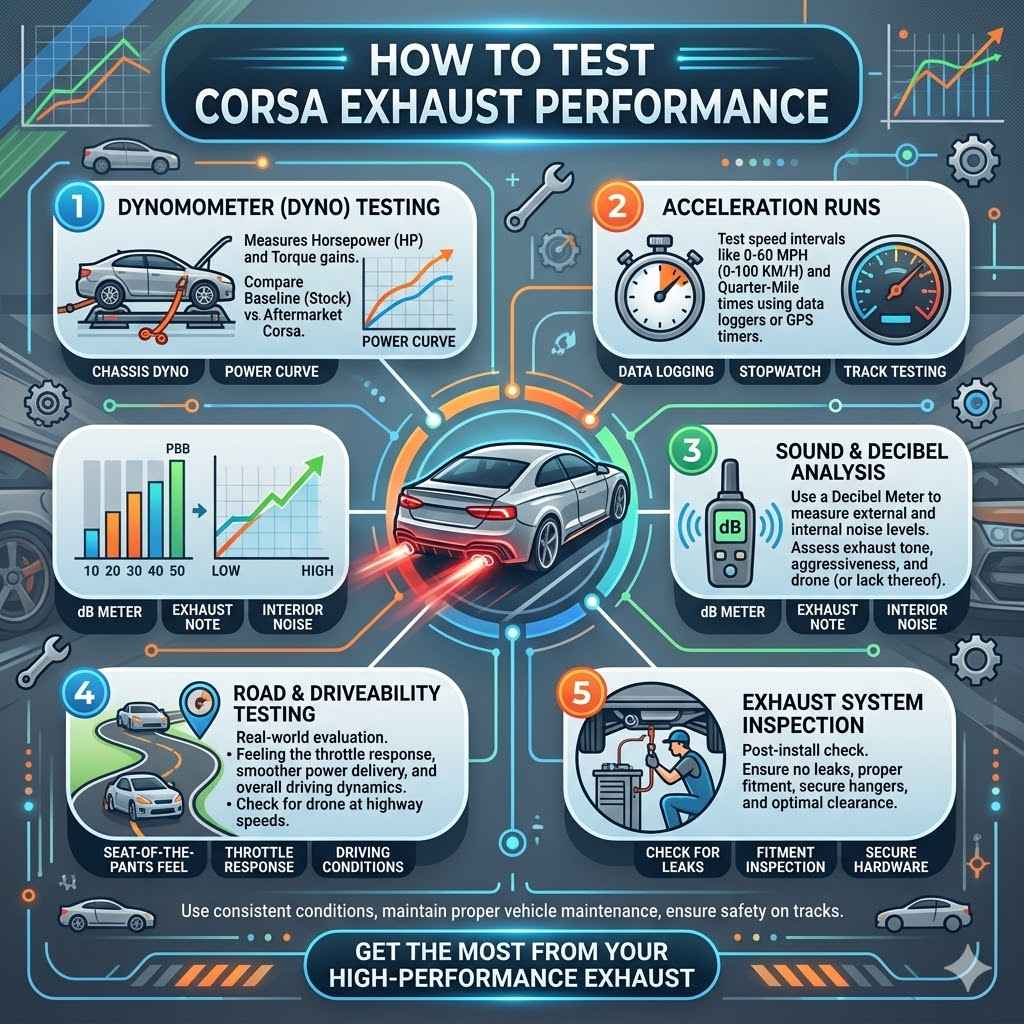
Smartphone apps can provide decibel (dB) readings. While not as precise as professional equipment, they offer a quantifiable way to measure loudness. Record readings at idle, during a steady cruise (e.g., 50 mph), and during acceleration.
A sound meter app essentially turns your phone’s microphone into a device that measures sound pressure levels. You’ll want to position the phone consistently each time you test to get comparable results. Test in a controlled environment, like an open parking lot, away from other noise sources.
Note down the readings for each scenario to see how the Corsa exhaust behaves under different driving conditions.
Listening During Driving
Pay close attention to the exhaust note at various speeds and throttle positions. Does it sound pleasant during normal driving? Is there any annoying drone at highway speeds? Does it sound powerful when you accelerate?
This is the most direct way to assess the sound quality. Drive on different types of roads – city streets, highways, and winding country roads. Specifically, try to maintain speeds that often cause drone in other systems, typically around 2,500 to 3,000 RPM.
Listen for any buzzing, humming, or irritating noises that persist. Also, note how the sound changes as you go from light acceleration to full throttle.
Recording Video and Audio
Record your car from the outside while a friend drives. This allows you to hear the exhaust sound from a perspective you can’t get while driving. You can also record the interior sound to check for cabin noise.
External recordings capture the full auditory experience of the exhaust system. Having someone else drive allows you to be in the passenger seat and listen without the distractions of controlling the vehicle. You can then play back the recordings on good speakers or headphones to analyze the sound more critically.
Comparing these recordings to similar videos of stock exhausts or other aftermarket systems can provide valuable context.
Performance Measurement Tools
To truly gauge performance changes, you’ll need some specialized tools. These help you quantify any gains in power and acceleration.
Dynamometer (Dyno) Testing
A dynamometer measures your car’s horsepower and torque output. This is the most accurate way to see performance gains. You can find shops that offer dyno testing for a fee.
Dynamometers work by using rollers that your car’s wheels drive. The machine applies resistance to these rollers, simulating the load your engine experiences on the road. Sensors measure the force and speed, allowing the equipment to calculate horsepower and torque.
It’s best to do a “baseline” dyno run with your stock exhaust, then another run with the Corsa exhaust installed to see the direct difference.
Performance Tracking Apps and Devices
Devices like OBD-II scanners can connect to your car’s computer and relay data to a smartphone app. Some apps can track 0-60 mph times and other performance metrics.
An OBD-II scanner reads data directly from your car’s onboard diagnostics system. This system monitors various engine parameters. Apps like Torque Pro or DashCommand can display real-time data like engine RPM, speed, throttle position, and can even calculate acceleration times.
While not as precise as a dyno, these tools offer a convenient way to track performance improvements over time.
GPS-Based Performance Meters
Dedicated devices like VBOX or Dragy use GPS to measure acceleration and speed very accurately. They are often used by performance enthusiasts for precise testing.
These devices leverage high-precision GPS signals to track your vehicle’s movement and speed with remarkable accuracy. They are particularly good at measuring acceleration times like 0-60 mph or quarter-mile times. Because they rely on GPS, they work best in open areas with clear sky views, such as race tracks or large, empty parking lots.
The data they provide is highly repeatable and reliable for comparing performance before and after modifications.
Real-World Testing Scenarios
Putting your Corsa exhaust to the test in practical driving situations gives you the most relevant feedback. Here are some common scenarios and how to observe the results.
Scenario 1 City Driving and Stop-and-Go Traffic
In the city, you’ll experience a lot of accelerating from stops and cruising at lower speeds. This is where you can really listen to the idle sound and how the exhaust behaves during moderate acceleration.
- Start your car and let it idle for a minute. Listen to the exhaust note. Is it a pleasant rumble or too quiet?
- Drive through neighborhoods with lower speed limits. Gently accelerate from stop signs and traffic lights. Notice if the sound is aggressive when you give it gas but not overly loud when you’re just cruising.
- Pay attention to any booming or droning sounds that might be present in this lower-speed, stop-and-go environment. Corsa systems are designed to minimize this, so listen carefully for its absence.
- Briefly accelerate to a moderate speed (e.g., 30-40 mph) and then ease off the throttle. Observe how the exhaust sound fades. Is it smooth or does it have any sharp notes?
The goal here is to confirm that the Corsa exhaust provides an enhanced sound without being obnoxious in everyday driving. A good system should sound sporty when you demand it but remain relatively unobtrusive during routine commutes.
Scenario 2 Highway Cruising
Highway driving is where drone is most likely to become an issue. Sustained speeds and RPMs can reveal if the exhaust is comfortable for long trips.
- Get on the highway and accelerate to your typical cruising speed (e.g., 65-70 mph). Set your cruise control.
- Listen for any persistent, low-frequency humming or buzzing sound inside the cabin. This is drone. Try to identify the specific RPM range where it occurs.
- Turn off the radio and minimize other cabin noise to get the clearest sense of the exhaust sound.
- If possible, try varying your speed slightly around the RPM range where drone might occur to see if the sound changes or disappears.
If you can maintain a conversation at highway speeds without straining to hear over exhaust noise, your Corsa system is performing well in this crucial area. The absence of drone is a hallmark of a quality performance exhaust.
Scenario 3 Performance Driving (Optional)
If you have access to a safe place like a track or an autocross event, this is where you can push the exhaust to its limits.
- Perform hard acceleration runs, observing how the exhaust note changes at higher RPMs.
- Listen for any signs of exhaust leaks or unusual noises under heavy load.
- If using a performance meter, record your 0-60 mph or quarter-mile times to quantify any acceleration improvements.
- Compare these results to your baseline performance numbers (if you have them) or to manufacturer claims for your vehicle.
This scenario is for enthusiasts who want to confirm maximum performance output. It allows you to experience the full range of the exhaust’s sound and its impact on acceleration when the engine is working hard.
Interpreting Your Test Results
Once you’ve gathered your data, it’s time to make sense of it all. How do you know if your Corsa exhaust is performing as expected? This section helps you interpret your findings.
Evaluating Sound Quality
Sound is subjective, but there are objective indicators of a good exhaust.
Absence of Unwanted Drone
The most important factor for many is the lack of drone at cruising speeds. If you can drive on the highway comfortably without an irritating hum, your Corsa exhaust is likely meeting a key design goal.
Drone is a common complaint with aftermarket exhausts. It’s a resonant frequency that can make driving unpleasant, especially on longer journeys. Corsa’s advertised technology aims to eliminate this.
If your recordings and listening tests show a clear absence of drone, especially between 2,000 and 3,000 RPM, then the system is successfully delivering on its promise of a refined performance sound.
Pleasing Tone Under Acceleration
When you accelerate, the exhaust should produce a sound that is more engaging and aggressive than stock, but not harsh, tinny, or overly loud. It should sound deep and powerful.
The character of the acceleration sound is what many enthusiasts seek. A well-designed Corsa exhaust will offer a noticeable improvement in tone when you demand power. This sound should feel like it complements the car’s performance, providing an auditory cue to the engine’s effort without being overwhelming.
It’s a balance between a sporty growl and a refined note.
Comparison to Manufacturer Claims
Research what Corsa claims their exhaust sounds like for your specific vehicle model. Does your experience align with their sound clips and descriptions?
Corsa usually provides audio and video samples of their exhaust systems on various cars. These samples are your best reference point. Listen to them critically and compare them to your own recordings and impressions.
Do the tones match? Is the loudness comparable? If your exhaust sounds significantly different from what Corsa advertises for your model, it might indicate an issue or a variation in expectations.
Assessing Performance Gains
Performance metrics provide a more concrete evaluation.
Measurable Horsepower and Torque Increases
If you dyno-tested your car, compare the results to the baseline. Even a modest gain of 5-10 horsepower and torque can be considered a success for a cat-back exhaust.
A dyno sheet will clearly show the power output before and after the exhaust installation. Look for an upward trend in both horsepower and torque curves, especially in the mid-range of RPMs where most driving occurs. These gains, while sometimes small, contribute to a more responsive feel and better overall performance.
Improved Acceleration Times
If you used GPS meters or tracking apps, see if your 0-60 mph or quarter-mile times have decreased. A reduction of even a tenth or two of a second can indicate a performance improvement.
Faster acceleration times are a direct result of the engine producing more power or the exhaust allowing it to use its power more effectively. If your performance meter shows a consistent improvement after installing the Corsa exhaust, it confirms that the system is contributing positively to the car’s acceleration capabilities.
Subjective Feel and Throttle Response
Sometimes, performance gains are felt more than measured. Does the car feel more eager to accelerate? Is the throttle response sharper?
This is about how the car “feels” to drive. A less restrictive exhaust can make the engine feel less strained and more immediate when you press the accelerator. If you notice that your car picks up speed more quickly or feels more responsive, even if the numbers aren’t dramatic, it’s a sign that the Corsa exhaust is contributing to a better driving experience.
Troubleshooting Common Corsa Exhaust Issues
Even with high-quality systems like Corsa, occasional issues can arise. Knowing how to identify and address them is key.
Addressing Unexpected Noise
Sometimes, exhaust systems don’t sound quite right. This section covers common noise complaints.
Rattling Sounds
Rattling can occur if heat shields are loose, exhaust hangers are misaligned, or if there’s internal damage within the muffler. Ensure all components are securely fastened and correctly positioned.
Loose heat shields are a frequent culprit for rattling noises, especially at idle or low RPMs. They are thin metal panels designed to protect other parts of the car from exhaust heat. If they become loose, they can vibrate against the exhaust pipes or other undercarriage components.
Properly tightening or securing these shields can resolve the issue.
Excessive Drone or Raspiness
If you’re experiencing drone or an unpleasant raspiness that wasn’t there before, double-check that the correct Corsa system was installed for your vehicle and that all connections are sealed properly. Sometimes, partial system failure or incorrect installation can affect sound.
Corsa’s drone cancellation technology is quite effective, but it relies on precise engineering and installation. If you’re hearing unexpected drone, it could mean the system is not performing as intended, perhaps due to a manufacturing defect or installation error. A professional inspection might be needed.
Exhaust Leaks
Leaks can occur at exhaust manifold gaskets, mid-pipe connections, or muffler joints. These often produce a hissing or puffing sound and can reduce performance.
Exhaust leaks allow gases to escape before they reach the muffler or tailpipe. This not only creates an undesirable sound but also means that some of the exhaust gas isn’t exiting through the intended path, which can negatively impact performance. Signs of leaks include a ticking sound at idle, a burnt smell, or reduced exhaust flow from the tailpipe.
Performance Discrepancies
If you’re not seeing the performance results you expected, consider these points.
- Installation Quality
Ensure the exhaust was installed correctly. Kinks in pipes, improper hanger placement, or exhaust leaks can all hinder performance.The way an exhaust system is routed and secured is critical. If pipes are crushed or bent too sharply, they can create unwanted restrictions, negating the benefits of a performance system. Proper alignment ensures that the exhaust hangs correctly without rubbing against the chassis or other components. - Other Modifications
Exhaust performance is often linked to other engine components. A stock intake system might become a bottleneck if the exhaust is significantly improved.Think of your engine as a system. For it to perform at its best, all parts need to work together. If you’ve upgraded the exhaust to allow more air flow out, but the intake is still restrictive, the engine can’t “breathe” as effectively. - This is why performance gains are often most pronounced when exhaust, intake, and sometimes tuning are addressed together.
- Realistic Expectations
While Corsa systems offer improvements, they won’t transform a basic car into a race car overnight. Understand the typical gains for your specific vehicle and model.It’s important to set achievable goals. A cat-back exhaust upgrade is typically focused on sound and moderate performance gains. It’s not usually the primary component for massive horsepower increases. - Manufacturers like Corsa provide realistic performance estimates, and it’s wise to align your expectations with these.

Final Thoughts
Testing your Corsa exhaust performance is about listening carefully and measuring realistically. By using simple sound checks and performance tools, you can confirm the improvements. Enjoy the enhanced sound and feel of your upgraded exhaust system.
Frequently Asked Questions
Question: How can I test the sound of my Corsa exhaust without expensive equipment?
Answer: You can use a smartphone app that measures decibels (dB) for a rough idea of loudness. More importantly, simply listen critically while driving in various conditions, focusing on idle, acceleration, and highway speeds, to judge the tone and presence of drone.
Question: What is the best way to measure horsepower gains from my Corsa exhaust?
Answer: The most accurate method is to use a dynamometer (dyno) at a performance shop. This directly measures your car’s power output. Alternatively, GPS-based performance meters can track acceleration improvements like 0-60 mph times.
Question: Is it normal to have some drone with a Corsa exhaust?
Answer: Corsa exhaust systems are specifically designed with drone-cancelling technology to minimize or eliminate unwanted cabin noise at cruising speeds. If you experience significant drone, it’s worth investigating the installation or the specific system for your vehicle.
Question: How soon after installing a Corsa exhaust should I expect to feel performance improvements?
Answer: Some drivers notice improved throttle response immediately. More significant horsepower and torque gains are best confirmed with dyno testing. The exhaust might also need a short break-in period for optimal performance.
Question: What if my Corsa exhaust sounds different from online videos?
Answer: Sound can vary slightly due to vehicle model differences, other modifications, and recording quality. However, if the sound is drastically different, check for proper installation, exhaust leaks, or consider contacting Corsa customer support for advice.