Do All M110 Mercedes Engines Share the Same Manifold?
Figuring out car parts can sometimes feel tricky, especially for new mechanics or hobbyists. You might be looking at your M110 Mercedes engine and wondering, “Do All M110 Mercedes Engines Share the Same Manifold?” This question comes up because many older engines look alike, and it’s easy to assume parts are interchangeable. But a small difference can cause big problems.
This guide will make it super simple, breaking down exactly what you need to know with clear steps. We’ll look at the differences and help you find the right part for your engine.
Understanding M110 Engine Manifold Variations
The M110 engine is a well-regarded power plant from Mercedes-Benz, known for its smooth operation and durability. When it comes to its intake manifold, the question of interchangeability is a common point of confusion. This confusion often stems from the engine’s long production run and the fact that Mercedes-Benz made various updates and modifications over the years. Not all M110 engines are identical, and these differences can significantly impact the intake manifold design.
For those new to working on these vehicles, distinguishing between different manifold versions can be challenging. This section aims to clarify the primary reasons for these variations and set the stage for identifying the correct manifold.
Factors Influencing M110 Manifold Design
Several key factors influenced the design and evolution of the M110 engine’s intake manifold. Mercedes-Benz engineers constantly sought to improve performance, emissions, and fuel efficiency. These ongoing efforts led to changes in manifold geometry, material, and attachment points.
One of the most significant influences was the introduction of fuel injection systems. Early M110 engines were often equipped with carburetors. Later versions transitioned to mechanical fuel injection (MFI) and then electronic fuel injection (EFI). Each of these systems requires a different manifold configuration to properly distribute fuel and air.
Carbureted M110 Intake Manifolds
Carbureted versions of the M110 engine typically featured a simpler intake manifold design. These manifolds were engineered to work with one or two carburetors, delivering a fuel-air mixture to the cylinders. The primary goal was efficient fuel and air delivery to each cylinder port.
The physical layout of these manifolds often differs from fuel-injected models. They might have different mounting points for the carburetor(s) and varying internal runner lengths and diameters. These dimensions are critical for optimizing airflow at different engine speeds, a crucial aspect of carburetor tuning. For example, older European-spec M110s with Zenith carburetors might have a manifold with specific flange designs to accept these units, which differ from Solex or Stromberg carburetors used on other models or in different markets.
Fuel-Injected M110 Intake Manifolds
As emissions regulations tightened and technology advanced, Mercedes-Benz adopted fuel injection for the M110 engine. This transition led to substantial changes in intake manifold design. The manifold had to accommodate fuel injectors, fuel rails, and sensors associated with the injection system.
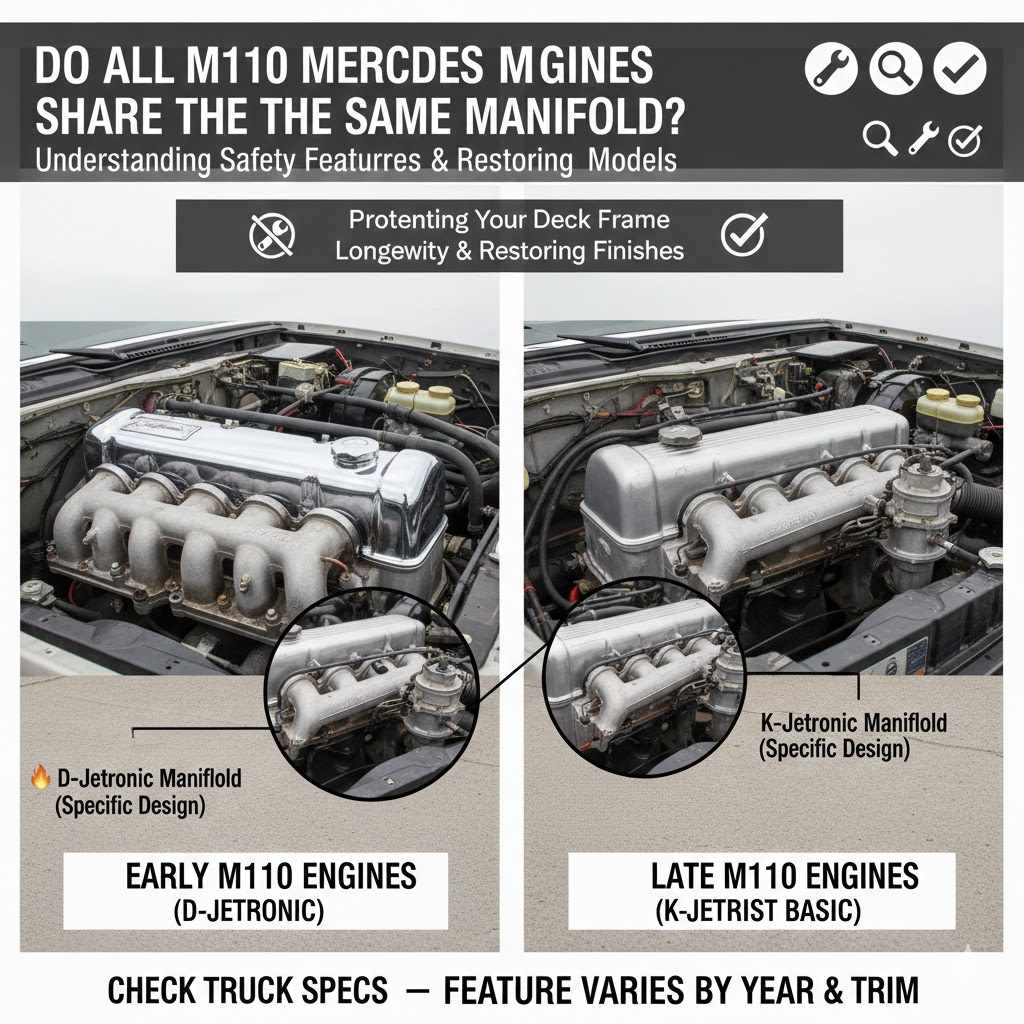
Mechanical fuel injection (MFI) systems, like the Bosch K-Jetronic, required manifolds with specific provisions for fuel distributor mounting and injector lines. Electronic fuel injection (EFI) systems, such as the later Bosch EFi, necessitated even more complex designs, often with integrated sensor bosses and redesigned air passages for smoother airflow and better atomization.
The number of runners and their configuration also changed to optimize fuel delivery and combustion for the EFI system. For instance, an M110 equipped with K-Jetronic would have a manifold with ports for the injector lines to connect to the distributor, while an EFi model might have a manifold with individual injector bosses directly attached.

Identifying Your Specific M110 Engine Manifold
Distinguishing between various M110 intake manifolds requires a close inspection of your engine and its components. Simply knowing you have an M110 engine isn’t enough; you need to identify the specific sub-model or configuration. This section will guide you through the essential steps to correctly identify the manifold fitted to your Mercedes-Benz.
VIN and Engine Code Decoding
Your vehicle’s Vehicle Identification Number (VIN) and engine code are the most reliable sources for identifying specific engine components. These codes contain a wealth of information about the vehicle’s original specifications, including the type of engine and its associated systems.
The VIN can often be decoded to reveal the engine series and sometimes even specific engine options. Mercedes-Benz uses a standardized VIN system, though the exact location and format might vary slightly by model year. Similarly, the engine code, usually found on a plate on the engine block or firewall, provides crucial details about the engine’s type, displacement, and any factory-installed modifications.
For example, the M110 engine itself has variants like the M110.923, M110.924, M110.928, etc., each potentially having different manifold requirements. Checking a Mercedes-Benz technical manual or an online VIN decoder specific to the era of your vehicle can help you ascertain these details.
Engine Tag and Data Plate Analysis
The data plate or tag on your engine is a treasure trove of information. It typically lists the engine number, engine code, build date, and sometimes specific equipment installed. Cross-referencing this information with Mercedes-Benz factory service manuals or specialized parts catalogs is key.
For example, if your engine tag indicates it’s an M110.923, and you know this variant was primarily used with a certain fuel injection system, you can start narrowing down the manifold possibilities. The tag might also have smaller codes that refer to specific component numbers, which can then be looked up in a parts database to confirm manifold compatibility.
Visual Inspection of the Intake Manifold
Beyond codes and numbers, a thorough visual inspection of the intake manifold itself is crucial. Different manifolds have distinct physical characteristics that make them identifiable. This hands-on approach can often confirm what your research suggests.
Look closely at the mounting points for the carburetor or fuel injection system. Note the number and location of fuel injector bosses if it’s a fuel-injected model. The overall shape and curvature of the manifold runners can also be indicative of its specific application. For instance, a manifold designed for a dual-carburetor setup will have a different appearance than one for a single fuel-injection unit. Comparing your manifold’s features against diagrams or photos of known M110 manifold types is highly recommended.
Comparing Manifold Runner Configurations
The internal design of the intake manifold, particularly the length and diameter of the runners, plays a significant role in engine performance. These aspects are often tailored to the specific fuel delivery system and intended use of the engine.
Carbureted manifolds might have simpler, often shorter runners designed for efficient mixture delivery to all cylinders simultaneously. Fuel-injected manifolds, on the other hand, might feature longer or differently shaped runners to optimize airflow dynamics, particularly for precise fuel atomization and distribution from injectors.
Some performance-oriented M110 engines, especially those with aftermarket modifications, might also have custom intake manifolds with significantly altered runner configurations for increased airflow. Understanding these subtle differences can prevent costly mistakes when ordering replacement parts.
Identifying Fuel Injector Ports and Fuel Rails
For fuel-injected M110 engines, the presence and arrangement of fuel injector ports are critical identifying features. These ports are where the injectors are mounted, delivering fuel directly into the intake manifold runners or ports.
If your manifold has bosses for injectors, count them and note their position relative to the cylinder head ports. Also, check for mounting provisions for fuel rails, which hold the injectors. Early MFI systems like K-Jetronic might have a single fuel distributor that feeds lines to individual injectors, so the manifold would have ports for these lines. Later EFI systems might have integrated fuel rail mounting points. A manifold without these features is almost certainly designed for a carbureted engine.
Common M110 Manifold Variations and Their Differences
The M110 engine, produced from the early 1970s to the mid-1980s, saw several iterations that necessitated changes in intake manifold design. Understanding these variations is key to ensuring you select the correct part. This section details some of the most common differences you’ll encounter.
Early Carbureted Models
The initial M110 engines were typically equipped with carburetors, often Zenith or Stromberg units. The intake manifolds for these engines were designed to accommodate these specific carburetor types and their mounting requirements.
These manifolds generally feature a simpler structure compared to their fuel-injected counterparts. They have one or two carburetor mounting flanges and internal passages engineered to distribute the fuel-air mixture efficiently to the cylinder head ports. The runner lengths and diameters were optimized for the performance characteristics of carbureted engines of that era. For example, a manifold for a twin-carburetor setup will have two distinct intake paths from the carburetor mounting area to the cylinder head.
Zenith Carburetor Manifolds
The Zenith carburetors were common on many European Mercedes-Benz models equipped with the M110 engine. The intake manifolds designed for these carburetors have specific flange designs and internal porting to match the Zenith unit’s airflow characteristics.
These manifolds are usually cast iron or aluminum and are relatively straightforward in design. They feature a central intake passage that splits to feed the cylinders. The mounting pattern for the Zenith carburetor is a key visual identifier. You might find specific bracketry or linkage mounting points that are unique to these carbureted systems.
Stromberg Carburetor Manifolds
Stromberg carburetors, while less common on M110s than Zenith, were also used. Manifolds designed for Stromberg units will have a different bolt pattern and potentially different runner dimensions to optimize performance with that specific carburetor.
Visually, you can differentiate them by the shape and size of the carburetor mounting flange. If your engine has a Stromberg carburetor, the manifold will have a matching interface. The internal passages might also be slightly different to ensure proper fuel-air mixture distribution for the Stromberg system.
Transition to Fuel Injection
As Mercedes-Benz moved towards more sophisticated engine management, the M110 engine began incorporating fuel injection systems. This marked a significant evolution in intake manifold design.
These manifolds had to integrate new components like fuel injectors, fuel rails, and sensors. The aim was to provide more precise fuel delivery, leading to better fuel economy and reduced emissions. The physical form and internal routing of the runners also changed to accommodate these new systems.
Bosch K-Jetronic (CIS) Manifolds
The Bosch K-Jetronic, often referred to as Continuous Injection System (CIS), was a popular mechanical fuel injection system used on many M110 engines in the late 1970s and early 1980s. Manifolds for these systems have distinct features.
These intake manifolds have provisions for the fuel distributor to be mounted, typically on top. They also feature ports or bosses to connect fuel lines from the distributor to the individual injectors. The injectors themselves are usually located just before the intake valve in the cylinder head port. The internal runner design is optimized for efficient fuel-air mixture formation prior to combustion. A common characteristic is the presence of threaded ports for fuel lines.
Bosch EFi (Electronic Fuel Injection) Manifolds
Later iterations of the M110 engine, particularly towards the end of its production run, utilized electronic fuel injection (EFI) systems. These systems offered even greater precision and control over fuel delivery.
EFI manifolds are generally more complex than their K-Jetronic predecessors. They typically feature integrated fuel rail mounting points, allowing injectors to be placed directly into the manifold runners or in very close proximity to the intake ports. These manifolds also include bosses for various sensors, such as the throttle position sensor (TPS) and manifold absolute pressure (MAP) sensor.
The runner design might be further refined for optimal airflow and fuel atomization. For instance, an M110.985 engine from the early 1980s would likely use a manifold designed for a specific Bosch EFI system, featuring individual injector bungs and sensor mounts.
Determining the Correct Manifold for Your M110
With the variations in mind, the next step is to confidently select the correct intake manifold for your specific M110 Mercedes engine. This process involves careful cross-referencing and attention to detail to avoid purchasing an incompatible part.
Consulting Mercedes-Benz Parts Catalogs
The most authoritative source for determining the correct part number for your intake manifold is an official Mercedes-Benz parts catalog. These catalogs are designed to list every component used on specific vehicles by model year and engine type.
You will need your vehicle’s exact model designation (e.g., 280E, 280CE) and its production year. Accessing these catalogs can be done through official Mercedes-Benz dealerships, specialized online parts databases that use original Mercedes-Benz part numbers, or by consulting with vintage Mercedes-Benz specialists who maintain comprehensive parts archives. For example, if you have a 1980 Mercedes-Benz 280E with an M110 engine, the catalog will specify the exact manifold part number for that configuration, differentiating it from a 1975 model or a different engine variant.
Using Part Numbers for Verification
Once you have identified a potential intake manifold part number, cross-referencing it is vital. Many aftermarket parts suppliers will list the original Mercedes-Benz part number alongside their own product number.
If you can locate the part number on your existing manifold, this becomes your primary reference point. Even if your current manifold is damaged or missing, using your VIN or engine code to find the original part number in a catalog will give you the definitive correct
Understanding Aftermarket vs. OEM Replacements
When sourcing an intake manifold, you’ll encounter options from Original Equipment Manufacturer (OEM) suppliers and aftermarket manufacturers. Each has its advantages and disadvantages.
OEM parts are made by or for Mercedes-Benz and are guaranteed to fit and function as the original. Aftermarket parts are made by other companies. While often more affordable, their quality and fit can vary. It’s crucial to research the reputation of aftermarket manufacturers when choosing this route. Some aftermarket manifolds are designed for specific performance improvements, which might alter compatibility if not carefully selected.
Performance vs. Stock Replacements
Some M110 owners opt for performance intake manifolds to enhance engine power. These are often designed with larger runners, different plenum volumes, or improved flow dynamics.
If you are replacing a stock manifold, be aware that a performance part might require other modifications to the engine to work correctly. For instance, a larger intake manifold might need a different carburetor or fuel injection system, and potentially changes to the engine’s computer tuning. Always verify that a performance manifold is compatible with your existing engine setup and intended use. If your goal is simply to restore your engine to its original specifications, a stock replacement is the safest and most straightforward option.
Common Pitfalls to Avoid
Several common mistakes can occur when trying to find the correct M110 intake manifold. Being aware of these pitfalls can save you time, money, and frustration.
One of the most frequent errors is assuming that manifolds from visually similar M110 engines are interchangeable. Small differences in porting, mounting points, or sensor provisions can render a manifold incompatible. Another pitfall is purchasing a manifold without verifying its fuel system compatibility; a carbureted manifold will not work with fuel injection and vice-versa. Always double-check that the manifold matches your engine’s fuel delivery system. Also, beware of heavily modified or “universal” manifolds that may require significant fabrication to fit properly.
Installation and Fitment Considerations
Once you have the correct intake manifold, proper installation is paramount for optimal engine performance and reliability. This section covers essential considerations during the installation process.
Preparing the Engine Block and Cylinder Head
Before installing a new intake manifold, it’s crucial to properly prepare the mating surfaces on the engine block (or cylinder head, depending on the engine design) and the manifold itself. Any old gasket material, carbon deposits, or debris must be thoroughly removed.
Using a gasket scraper and a suitable cleaner (like brake cleaner or carburetor cleaner) will ensure a clean, flat surface for the new gasket to seal against. Any imperfections or remaining material can lead to vacuum leaks, poor idling, and reduced engine performance. It is also a good opportunity to inspect the intake ports on the cylinder head for any damage or excessive carbon buildup.
Cleaning and Inspection of Intake Ports
The intake ports on the cylinder head are the gateways for the air-fuel mixture to enter the combustion chambers. Ensuring these are clean and free from obstruction is critical.
While the manifold is off, it’s an excellent time to inspect the condition of these ports. Remove any carbon deposits, which can restrict airflow and affect combustion. You can use a soft wire brush or a dedicated carbon removal tool for this task. Make sure no debris falls into the cylinders; you can stuff clean rags into the ports temporarily if needed.
Gasket Selection and Sealing Techniques
The choice of gasket and proper sealing techniques are vital for preventing vacuum leaks, which can plague an engine and lead to drivability issues.
Use a high-quality intake manifold gasket designed specifically for your M110 engine and manifold type. Some gaskets are multi-piece, while others are single units. Follow the manufacturer’s instructions for installation. If the manifold or cylinder head has rough surfaces, you might consider using a thin bead of high-temperature RTV sealant along with the gasket, but apply it judiciously to avoid squeezing out into the intake ports. Ensure all gasket mating surfaces are clean and dry before application.
Torque Specifications and Tightening Sequence
Properly tightening the intake manifold bolts is crucial. Over-tightening can warp the manifold or strip threads, while under-tightening can lead to vacuum leaks. Always refer to your Mercedes-Benz service manual for the correct torque specifications and the specific tightening sequence for the M110 engine.
The tightening sequence is typically a criss-cross pattern, starting from the center and working outwards. This ensures even pressure distribution across the gasket, promoting a uniform seal. Tighten the bolts in stages, gradually reaching the final torque specification. Re-torquing the bolts after a short period of engine operation (e.g., 50-100 miles) is often recommended, especially with new gaskets, to account for any settling or compression.
Connecting Fuel Lines and Vacuum Hoses
Once the manifold is secured, reconnecting all fuel lines and vacuum hoses requires careful attention to detail. Incorrect connections can lead to fuel leaks, vacuum leaks, or misrouted air.
Ensure each fuel line and vacuum hose is reattached to its correct port or fitting. Many hoses have specific routing paths to avoid heat or rubbing damage. Take photos before disassembly to aid reassembly. For fuel lines, ensure they are securely fastened and that all seals are in good condition to prevent fuel leaks. For vacuum hoses, check for cracks or wear and replace any suspect hoses.
Troubleshooting Common Fitment Issues
If you encounter fitment issues, don’t force the manifold into place. This often indicates an incorrect part or a problem with the mounting surfaces.
First, reconfirm that you have the correct manifold for your engine variant. Compare it visually with known diagrams or photos. Check that all mounting holes align perfectly. If the manifold seems to interfere with other engine components, re-examine the mounting surfaces and look for any obstructions. Sometimes, slight adjustments to bracketry or accessories might be necessary, but significant force usually means something is wrong.

Frequently Asked Questions
Question: Can I use a manifold from a carbureted M110 on a fuel-injected M110?
Answer: No, you generally cannot. Carbureted manifolds lack the necessary provisions for fuel injectors, fuel rails, and associated sensors required by fuel injection systems. Attempting to use one would require significant, often impractical, modifications.
Question: How do I find the engine code for my M110 Mercedes?
Answer: The engine code is usually stamped on a metal plate located on the engine block or firewall. You can also find it on your vehicle’s registration documents or by checking with a Mercedes-Benz dealership using your VIN.
Question: Are all M110 intake manifolds made of aluminum?
Answer: While many later M110 manifolds are aluminum for weight savings, earlier carbureted versions were often made of cast iron. The material can be another indicator of the manifold’s intended application.
Question: What happens if I have a vacuum leak from my intake manifold?
Answer: A vacuum leak can cause rough idling, poor acceleration, increased fuel consumption, and in severe cases, engine misfires or stalling. It disrupts the precise air-fuel mixture needed for efficient combustion.
Question: Where can I find an official Mercedes-Benz parts catalog?
Answer: You can typically access official Mercedes-Benz parts catalogs through their authorized dealerships, specialized online parts retailers that carry OEM parts, or through subscription-based online service information platforms for classic Mercedes-Benz vehicles.
Conclusion
Determining if all M110 Mercedes engines share the same manifold is answered with a clear no. Significant variations exist, primarily driven by the transition from carburetors to different fuel injection systems. Always identify your engine’s specific type, fuel system, and consult official parts catalogs using your VIN or engine code to confirm the correct intake manifold. Careful installation with proper gaskets and torque specifications ensures optimal engine function.
Final Thoughts
The intake manifold on your M110 Mercedes engine is not one-size-fits-all. Variations exist for carbureted and various fuel-injected systems. Pinpointing the exact manifold requires checking your engine’s code and fuel setup. Using official parts guides and verifying part numbers ensures you get the right component. Proper installation with correct gaskets and torque is key for reliable performance.