How To Measure Vance & Hines Exhaust For Harley
Figuring out the right size for your Vance & Hines exhaust on a Harley can seem tricky at first. Many riders, especially those new to customizing their bikes, wonder about the exact measurements. You might be asking yourself, “How do I even start to measure this?” This guide is here to make it super simple.
We’ll walk through each step together so you can confidently get the right fit for your Harley’s new pipes.
Understanding Exhaust Pipe Dimensions For Your Harley
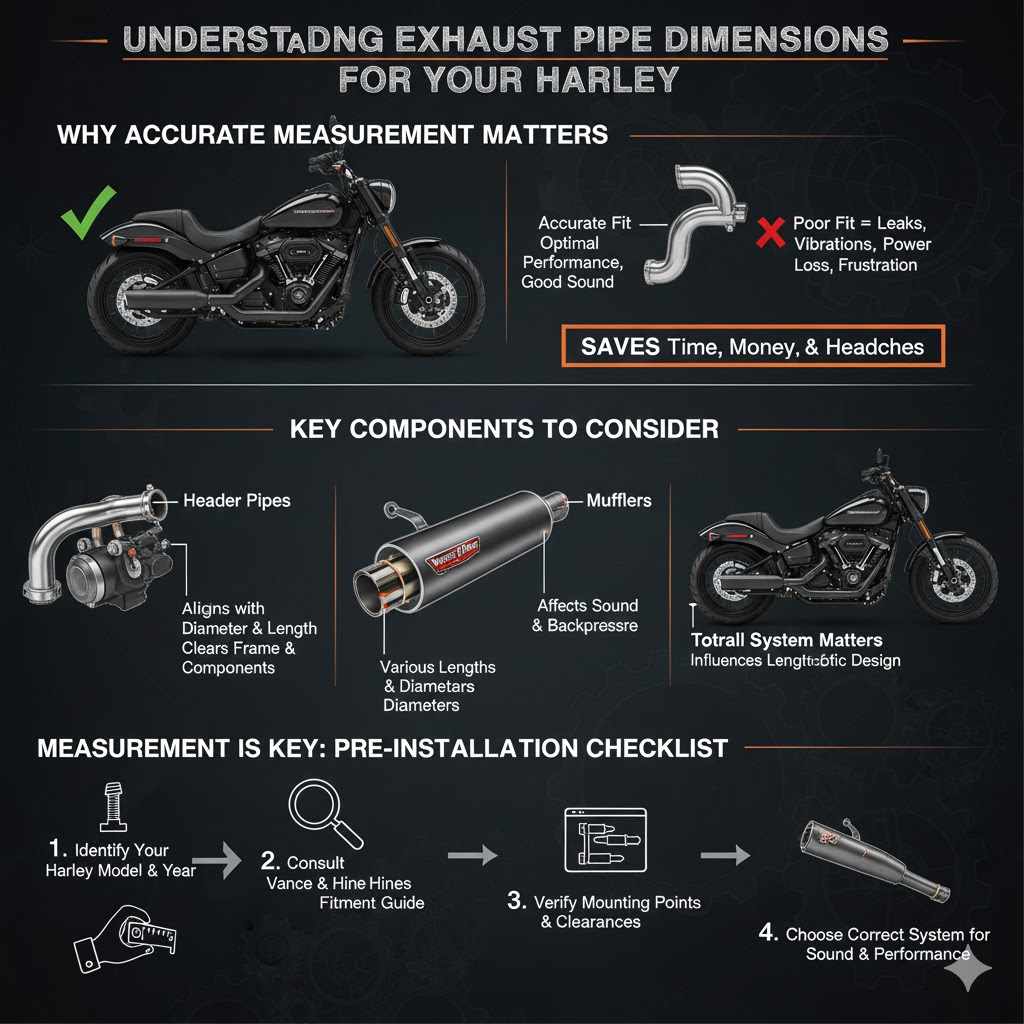
Knowing the correct dimensions for your Vance & Hines exhaust is super important for a good fit and optimal performance on your Harley-Davidson motorcycle. It’s not just about how it looks; it’s also about how it connects to your engine and how the gases flow out. Getting these measurements right means your exhaust system will work as it should, making your bike sound great and run smoothly.
This section breaks down why measuring is key and what basic things you need to think about before you even pick up a measuring tape.
Why Accurate Measurement Matters
When you’re looking to install a new Vance & Hines exhaust on your Harley, accuracy in measurement is everything. A system that’s too long or too short can cause all sorts of problems. It might not mount correctly, leading to leaks or vibrations.
A poorly fitting exhaust can also affect how your engine breathes, hurting its performance and fuel economy. Think of it like buying clothes; if they don’t fit right, they just won’t work well.
For Vance & Hines exhaust systems, there are specific points that need to be measured to ensure compatibility with your Harley model. These aren’t just random numbers; they correspond to the mounting points on your motorcycle’s frame, the exhaust ports on your engine, and the overall space available under your bike. Getting these details correct upfront saves you time, money, and the frustration of dealing with parts that don’t fit.
Key Components to Consider
When you’re thinking about installing a Vance & Hines exhaust on your Harley, there are a few main parts of the exhaust system you’ll need to be aware of. These are the pipes themselves, the mufflers, and the mounting hardware. Each of these has different sizes and shapes that need to match your bike.
- Header Pipes These are the pipes that come directly from your engine. Their diameter and length are critical. They need to perfectly align with your engine’s exhaust ports. If they don’t connect well, you can lose power, and exhaust gases might escape where they shouldn’t. This can cause a loud, unpleasant noise and reduce engine efficiency. The shape also matters, as they need to clear your motorcycle’s frame and other components.
- Mufflers These are the parts that reduce the noise from your engine. They come in various lengths and diameters. The muffler’s size affects both the sound and the backpressure of the exhaust system. Backpressure is important because it helps your engine run efficiently. Vance & Hines makes many different muffler styles, and their dimensions are designed for specific sound profiles and performance gains.
- Overall System Length Beyond individual parts, the total length of the exhaust system is important. This affects how the exhaust gases exit your motorcycle and can influence the overall backpressure. A system that’s too long might create too much backpressure, while one that’s too short might not offer enough. This is why Vance & Hines designs their systems for specific Harley models, ensuring the length is correct.
How To Measure Vance & Hines Exhaust For Harley Components
This is where we get hands-on with your measuring tape. To truly know how to measure Vance & Hines exhaust for Harley motorcycles, you need to focus on specific parts of the existing system and the areas where the new one will go. We’ll go through each step, making sure you have all the tools and know-how.
It’s not complicated, and with a little patience, you’ll have the exact measurements you need.
Measuring Existing Exhaust Pipes
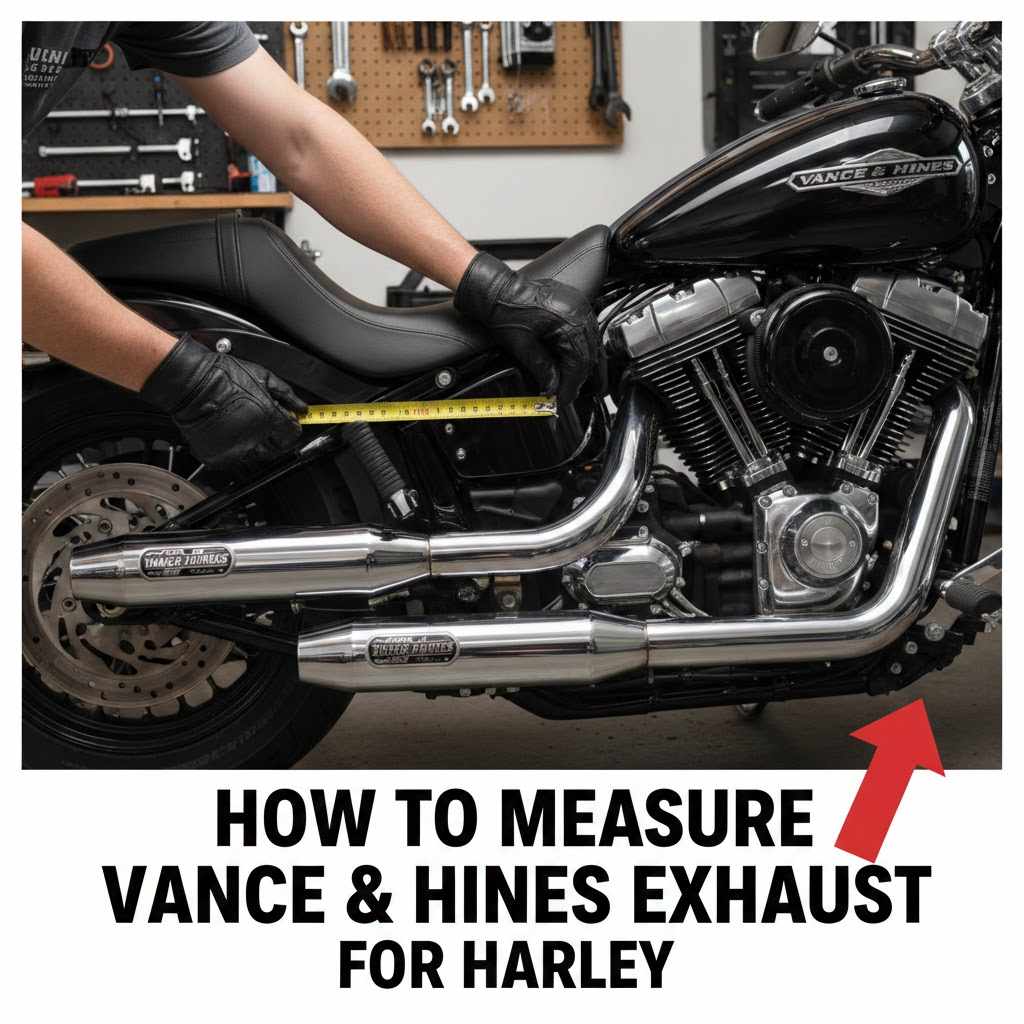
Before you buy a new Vance & Hines exhaust, it’s a good idea to measure your current pipes. This helps you understand the general size range you might be dealing with and gives you a baseline. You’ll need a flexible measuring tape or a string and a ruler for curved parts.
Start by measuring the diameter of your header pipes. These are the pipes that come from the engine. Measure across the widest part of the pipe.
If you have a flexible tape measure, you can wrap it around the outside and read the circumference, then divide by pi (approximately 3.14) to get the diameter. Or, you can measure the straight distance across the opening. Do the same for the muffler section.
Next, measure the length of the entire exhaust system from where it connects to the engine to the very end of the muffler. For curved pipes, lay a string along the curve and then measure the string with a ruler. Note any bends or unusual shapes, as these affect clearance.
Measuring Mounting Points and Clearance
Accurate measurements of your Harley’s mounting points and the clearance around the exhaust area are critical. This ensures the new Vance & Hines system will fit without hitting anything. You’ll need a reliable measuring tape.
Locate the bolts or brackets where your current exhaust system is attached to the motorcycle’s frame or engine. Measure the distance between these points. Also, measure the space available around these areas.
You need to know how much room you have for the new pipes to pass by.
Pay close attention to the ground clearance. You don’t want your new exhaust to be too low, or it could scrape the ground when you lean into a turn or go over a bump. Measure from the lowest point of your current exhaust to the ground.
Also, check for clearance around other parts like your rear tire, shock absorbers, and any saddlebags or accessories you have.
Understanding Vance & Hines Specific Sizing
Vance & Hines provides specific sizing information for their exhaust systems. This isn’t just about general pipe diameter. They often specify measurements like the inlet diameter where the pipe connects to the header, the outlet diameter of the muffler, and the overall length of specific muffler models.
When you’re looking at Vance & Hines products, check their website or product descriptions carefully. They usually list the exact dimensions. For example, they might say a muffler has a 2.5-inch inlet and a 3.5-inch outlet diameter, and is 20 inches long.
This information is vital for matching the exhaust to your Harley’s needs and ensuring a proper fit.
Sometimes, Vance & Hines systems are designed as full systems, meaning they include header pipes and mufflers. In other cases, you might buy mufflers separately to fit existing headers. Knowing whether you need a full system or just mufflers will guide your measurements and purchasing decisions.
Always compare the Vance & Hines specifications to the measurements you’ve taken from your bike.
Using a Measuring Tape Effectively
A standard metal measuring tape is your best friend here. For straight sections, simply extend the tape from one point to another and read the measurement. Make sure the tape is held taut and not sagging.
For curved parts, like the bend of a header pipe or the length of a muffler, it can be a bit trickier. You can use a flexible cloth measuring tape, often used for sewing. Alternatively, you can use a stiff string.
Lay the string along the curve, mark the start and end points, and then straighten the string to measure it against a ruler or your metal tape.
When measuring diameters, you can use the tape measure to go around the circumference of the pipe. Divide this number by approximately 3.14 to get the diameter. Or, if you have digital calipers, they offer the most precise way to measure diameters of pipes and openings.
Step-by-Step Guide to Measuring For Your Harley Exhaust
Let’s put all this knowledge into action with a clear, step-by-step process. This guide will walk you through exactly how to measure Vance & Hines exhaust for Harley needs, ensuring you get the perfect fit. We’ll cover everything from preparing your bike to taking the final measurements.
Preparation Before You Measure
Before you start measuring for your new Vance & Hines exhaust, it’s important to get your Harley ready. Make sure the motorcycle is on a level surface. Use a stable stand to keep it upright and secure.
Allow the exhaust system to cool down completely. Exhaust pipes get extremely hot, and touching them when they are hot can cause serious burns. Safety first!
Ensure you have good lighting so you can see all the details clearly. Have your measuring tools ready, like a flexible measuring tape, a ruler, and perhaps a notebook and pen to jot down your findings.
Measuring Header Pipe Connections
The connection point between the header pipes and your Harley’s engine is crucial. You need to measure the diameter of the exhaust port on the cylinder head.
If your current exhaust is removed, you can directly measure the diameter of the exhaust port opening. If the exhaust is still attached, you might need to measure the outside diameter of the header pipe where it enters the cylinder head.
Also, measure the spacing between the header pipes if your bike has dual exhaust. This spacing needs to match the configuration of the Vance & Hines headers you are considering. Some systems are designed for specific cylinder spacings.
Measuring Muffler Fitment
The mufflers are a very visible part of your exhaust system, and their fitment is key. You’ll want to measure the space where the mufflers will mount.
Measure the diameter of the exhaust pipe that the muffler will slide onto. This is often called the inlet diameter of the muffler. Vance & Hines will specify what size inlet their mufflers have.
Make sure this matches your header pipe’s outlet.
Measure the overall length of the space available for the muffler. This ensures the new Vance & Hines muffler won’t stick out too far or be too short to install properly. Also, check the diameter of the muffler itself.
Vance & Hines offers various styles, and their diameters can differ.
Checking Overall System Clearance
This step ensures that the entire new exhaust system will fit on your bike without hitting anything. It involves looking at the clearances from all angles.
Measure the distance from the exhaust pipes to your rear tire. You need enough space so the exhaust doesn’t vibrate against the tire, especially when the suspension compresses.
Check clearance around the frame, the oil lines, and any brake or clutch cables. Also, consider your footpegs and any floorboards. If you have a kickstand, ensure the exhaust pipe doesn’t interfere with its operation.
Think about how the exhaust curves. Some exhaust designs hug the bike closely, while others sweep out further. You need to make sure that even with the curves, there’s ample space.
Vance & Hines systems are designed with these clearances in mind, but it’s always wise to double-check for your specific model and any modifications you might have.
Recording Your Measurements
Write down all your measurements clearly. Use a notebook or a digital note-taking app. Label each measurement so you know exactly what it refers to, like “Left Header Pipe Diameter,” “Muffler Inlet Size,” or “Ground Clearance.”
It’s also helpful to take photos of the areas you are measuring. This can help you remember details later or when you are comparing exhaust options online. Having precise records of your measurements makes shopping for the right Vance & Hines exhaust much easier and less prone to error.
Comparing Vance & Hines Exhaust Models
Once you have your measurements, you’re ready to start looking at specific Vance & Hines exhaust models. Not all pipes are created equal, and knowing your numbers will help you compare them directly to what Vance & Hines offers for your Harley. This section helps you make sense of the options.
Reading Vance & Hines Product Specifications
Vance & Hines provides detailed specifications for each of their exhaust systems. These are usually found on their website or on the product packaging. You’ll see information about the type of system (full system or slip-on mufflers), the materials used, and, most importantly, the dimensions.
Look for details such as header pipe diameter, muffler length, muffler diameter, and inlet/outlet sizes. They often specify if a system is 50-state legal or designed for specific engine displacements. Comparing these specs directly to your measurements is the best way to confirm fitment.
Full Systems Versus Slip-On Mufflers
Vance & Hines offers both full exhaust systems and slip-on mufflers. A full system replaces everything from the engine ports to the end of the pipes. Slip-on mufflers replace only the rear section of the exhaust, usually attaching to your existing header pipes.
If you’re measuring for a full system, you’ll need to pay attention to header pipe dimensions, their routing, and the overall length. If you’re just getting slip-on mufflers, your main focus will be the outlet diameter of your current header pipes and the inlet diameter of the Vance & Hines mufflers. You also need to ensure the mounting brackets will align correctly.
Consider what you want to achieve. A full system can offer the most significant changes in performance and sound. Slip-ons are often an easier and less expensive way to change the look and sound of your Harley.
Performance and Sound Considerations
The dimensions of an exhaust system directly influence its performance and sound. Larger diameter pipes and longer mufflers generally produce a deeper, more resonant sound. Shorter, wider mufflers might give a more aggressive bark.
Backpressure is a key factor. The shape and length of Vance & Hines pipes are engineered to create the right amount of backpressure for your Harley’s engine. This helps with low-end torque and overall engine performance.
If you measure and get a system that has incorrect backpressure, you could lose power or even damage your engine over time.
Vance & Hines often categorizes their systems by sound level (e.g., quiet, moderate, loud) and performance gains. These are influenced by the internal design of the mufflers and the diameter of the pipes. Understanding your measurement needs helps you choose a system that provides the sound and performance you desire without sacrificing fit.
Sample Scenario Comparison
Let’s say you have a 2010 Harley-Davidson Sportster. You measure your current mufflers and find they are 18 inches long with a 2.25-inch inlet. The header pipe outlet is 2.25 inches.
You also measure the clearance and find you have about 22 inches of space for a new muffler before it gets too close to your fender.
You look at Vance & Hines’ website and see they offer “Shortshots Staggered” in a black finish. Their specs say they have 1.75-inch header pipes and 2.125-inch mufflers with a 1.75-inch inlet and a slash-cut end. The total length is 20 inches.
This system would require replacing the header pipes (a full system).
Alternatively, they have “Ronda” slip-on mufflers. These have a 2.5-inch diameter and are 20 inches long, with a 2.25-inch inlet. This looks like a good candidate because the inlet size matches your header pipe outlet, and the overall length fits within your clearance.
Here’s a quick look at how you might compare:
| Feature | Your Current Mufflers | Vance & Hines Shortshots Staggered (Full System) | Vance & Hines Ronda Mufflers (Slip-On) |
|---|---|---|---|
| Muffler Length | 18 inches | 20 inches (overall system) | 20 inches |
| Muffler Inlet Diameter | 2.25 inches | N/A (full system) | 2.25 inches |
| Space Available | ~22 inches | N/A (full system) | ~22 inches |
| Type | Slip-On | Full System | Slip-On |
Installation Tips and Final Checks
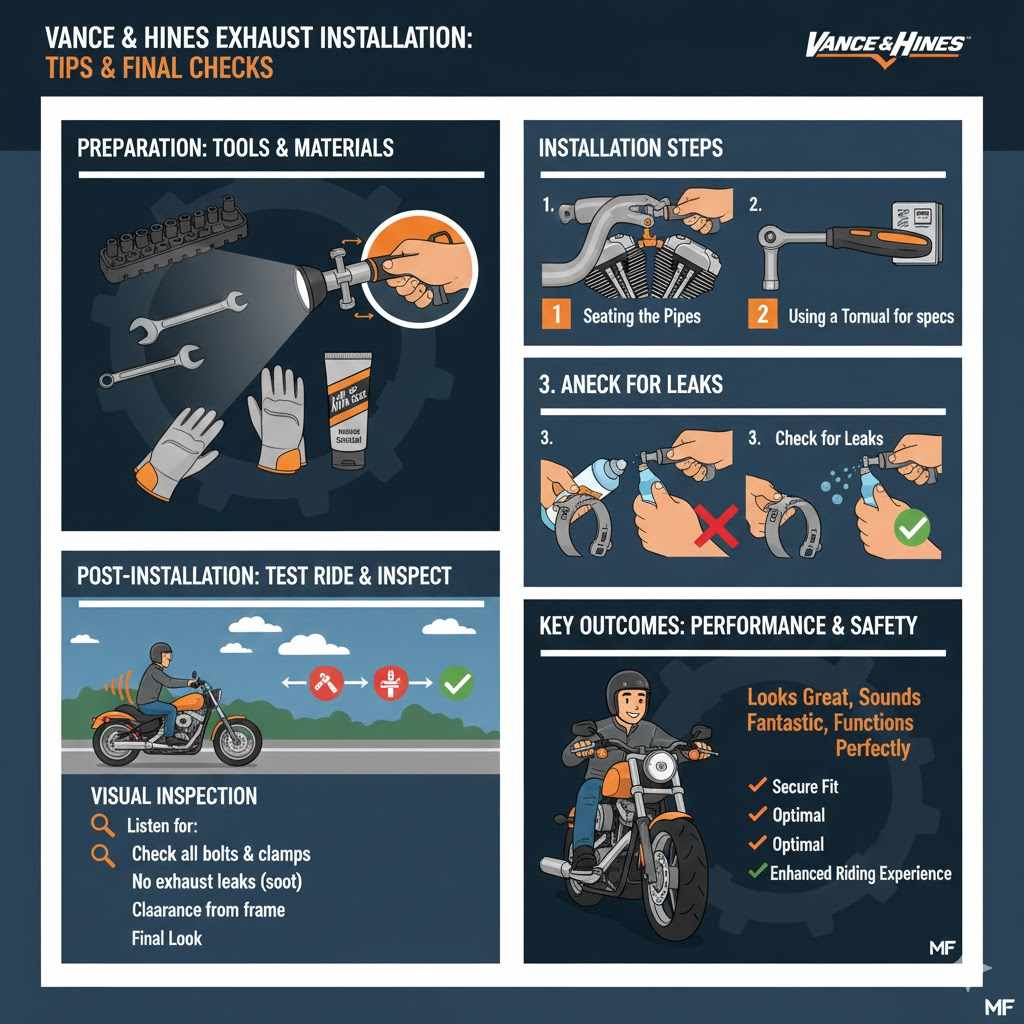
After you’ve chosen and measured for your Vance & Hines exhaust, the installation is the next big step. Even with perfect measurements, a good installation makes all the difference. This section gives you some pointers and final checks to ensure everything goes smoothly.
Gathering Necessary Tools
Before you start installing your new Vance & Hines exhaust, make sure you have all the tools you might need. This includes a socket set with various sizes, wrenches, screwdrivers, and possibly a torque wrench.
You might also need some exhaust sealant or anti-seize compound for the header pipe connections to prevent leaks and make future removal easier. Having a pair of gloves is also a good idea to keep your hands clean and protected. A good flashlight or work light will help you see in tight spots.
Properly Seating the Pipes
When you’re connecting the header pipes to the engine, ensure they are seated properly. Do not overtighten the bolts immediately. Gently snug them up first, so the pipes are aligned correctly.
If you’re installing slip-on mufflers, make sure they slide fully onto the header pipes. Sometimes, a little lubricant or exhaust sealant can help them slide on more easily. Ensure there’s no gap between the header pipe and the muffler inlet.
Using a Torque Wrench
For critical connections, like the bolts that attach the exhaust to the engine or the clamps that hold mufflers in place, using a torque wrench is highly recommended. Over-tightening can strip threads or damage parts, while under-tightening can lead to leaks and rattles.
Vance & Hines usually provides torque specifications in their installation manual. Refer to these specifications to tighten all fasteners to the correct tightness. This ensures a secure and leak-free installation.
The Importance of Test Rides
After installation, take your Harley for a short test ride. Listen for any unusual noises, such as rattling, hissing (indicating leaks), or excessive popping. Check for any vibrations that seem out of the ordinary.
During the test ride, pay attention to how the engine performs. Does it feel strong? Is the sound what you expected?
If you notice any issues, bring the bike back and check all connections, ensuring everything is tight and properly aligned.
Final Inspection After Installation
Once your test ride is complete and you’re satisfied, perform a final visual inspection. Check all bolts and clamps one last time. Look for any signs of exhaust leaks, such as black soot around the connections.
Ensure that the exhaust pipes are not touching any part of the motorcycle that could be damaged by heat. Double-check the ground clearance you measured earlier. A successful installation means your new Vance & Hines exhaust looks great, sounds fantastic, and functions perfectly with your Harley.
Frequently Asked Questions
Question: What are the main tools needed to measure for a Vance & Hines exhaust?
Answer: You will primarily need a flexible measuring tape, a ruler, and a notebook to record your measurements. A string can also be helpful for measuring curved pipes. If you have digital calipers, they can provide very precise diameter measurements.
Question: How do I know if a Vance & Hines exhaust will fit my specific Harley model?
Answer: Always check the Vance & Hines product specifications for your exact Harley model. They list compatibility details. Comparing your own measurements of your bike’s existing exhaust and clearance areas to these specifications is the best way to ensure a proper fit.
Question: Can I install Vance & Hines slip-on mufflers without replacing the header pipes?
Answer: Yes, slip-on mufflers are designed to replace only the rear section of your exhaust system. You will need to ensure the inlet diameter of the Vance & Hines slip-on matches the outlet diameter of your current header pipes.
Question: What happens if my Vance & Hines exhaust is the wrong size?
Answer: An incorrectly sized exhaust can cause performance issues, leaks, vibrations, and may not mount properly. It could also interfere with other parts of your motorcycle, leading to damage. It’s best to measure carefully before purchasing.
Question: How do I measure the diameter of my exhaust pipes accurately?
Answer: You can use a flexible measuring tape to measure the circumference of the pipe and divide by pi (approximately 3.14) to get the diameter. If the pipe is accessible, you can also measure straight across the opening. Digital calipers offer the most precise measurement.
Wrap Up
Now you have a clear understanding of how to measure Vance & Hines exhaust for Harley motorcycles. You know which parts to measure, how to do it accurately, and how to compare those measurements to product specs. You are ready to choose the right exhaust for your bike with confidence, ensuring a great fit and awesome sound.