Do All Ford Super Duty Diesels Have Exhaust Brakes
Many truck owners wonder, Do All Ford Super Duty Diesels Have an Exhaust Brake? This question can seem tricky if you’re new to diesel trucks. It’s easy to get confused by different models and features. We’re here to make it simple.
We’ll walk through exactly what you need to know, step-by-step. Get ready for clear answers and easy-to-understand information that will help you out.
Understanding Ford Super Duty Exhaust Brakes
This section explains what an exhaust brake is and why it’s a useful feature for Ford Super Duty diesel trucks. We’ll look at how it works and what benefits it brings to drivers, especially when hauling heavy loads or going downhill. This will give you a good foundation for understanding the specifics of exhaust brakes on these powerful trucks.
What Is An Exhaust Brake?
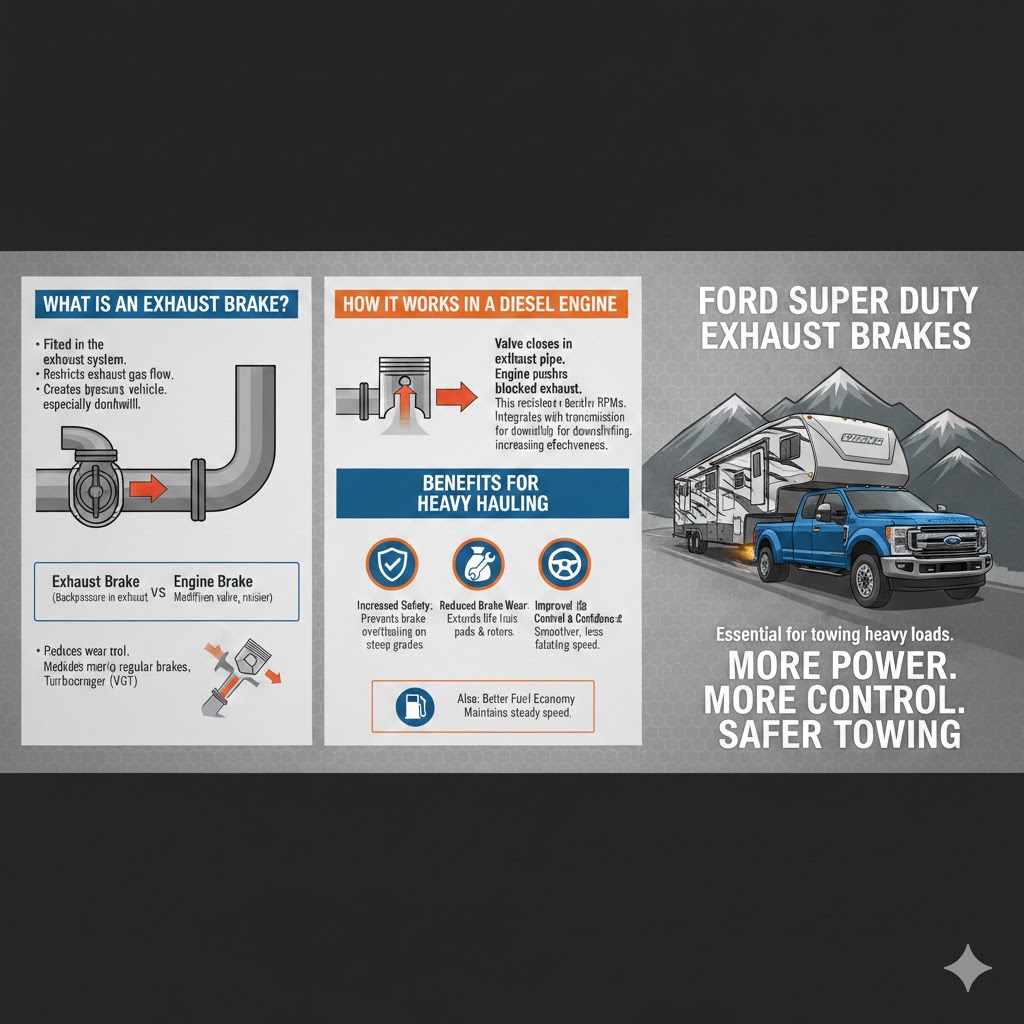
An exhaust brake is a special device fitted into the exhaust system of a diesel engine. Its main job is to help slow down the vehicle. It does this by restricting the flow of exhaust gases.
This creates backpressure in the engine. This backpressure then helps to slow the vehicle’s momentum. It’s like the engine itself is helping to brake.
Think of it like this. When you’re driving a car, you use your foot on the brake pedal to slow down. An exhaust brake adds an extra layer of braking power.
This is especially helpful for heavy trucks. It reduces the wear and tear on your regular brakes. This means your brake pads and rotors last longer.
It also provides more control, particularly on long downhill grades. This can make driving much safer and less stressful.
The exhaust brake is different from an engine brake, often called a “Jake brake.” While both use the engine to slow the vehicle, an exhaust brake works by creating backpressure in the exhaust. A Jake brake, on the other hand, modifies the engine’s valve timing to create a similar braking effect, but often with more noise.
Ford Super Duty trucks, when equipped with a diesel engine and an exhaust brake system, often use a variable geometry turbocharger (VGT) to achieve this function. The VGT can adjust its vanes to create the necessary exhaust restriction. This makes the exhaust brake very effective and integrated into the truck’s overall performance.
How An Exhaust Brake Works In A Diesel Engine
Diesel engines have a natural advantage when it comes to using their own systems for braking. An exhaust brake leverages this. It’s essentially a valve placed in the exhaust pipe, usually just before the muffler or catalytic converter.
When activated, this valve closes off or significantly restricts the exhaust outlet.
When the exhaust outlet is blocked, the engine can’t expel its exhaust gases as easily. This build-up of pressure behind the closed valve creates resistance. This resistance forces the pistons to work harder against the backpressure as they try to push the exhaust out.
This constant effort of the engine to push against the blockage acts as a braking force.
This braking effect is felt through the drivetrain. The wheels are still turning, but the engine is resisting that turning motion. The faster the engine is trying to turn, the stronger the exhaust brake’s resistance becomes.
This is why it’s most effective at higher engine RPMs. It helps to maintain speed on descents without constantly riding the service brakes.
Modern Ford Super Duty trucks often integrate the exhaust brake with the transmission. This means that when the exhaust brake is activated, the transmission might also downshift. This further increases the engine RPMs and therefore the effectiveness of the exhaust brake.
This smart integration makes the truck easier to control and safer to drive.
Benefits Of An Exhaust Brake For Heavy Hauling
For anyone who frequently pulls heavy trailers or hauls significant loads, an exhaust brake is a game-changer. One of the biggest benefits is increased safety. When you’re descending a steep grade with a heavy trailer, your regular brakes can overheat.
Overheated brakes can lose their effectiveness, which is extremely dangerous. An exhaust brake helps prevent this by taking much of the load off the service brakes.
Another major advantage is reduced brake wear. Constantly using your regular brakes to control speed, especially on long descents, wears down your brake pads and rotors much faster. By using the exhaust brake, you significantly extend the life of your braking components.
This saves you money on maintenance and replacements over time. It’s a proactive measure that pays off.
It also offers improved control and confidence. Knowing you have an extra layer of braking power gives you more peace of mind when towing. You can maintain a steady speed more easily, reducing the need for frequent braking and acceleration.
This leads to a smoother, more comfortable ride for both the driver and any passengers. It makes long trips less fatiguing.
Finally, an exhaust brake can also contribute to better fuel economy. While it might seem counterintuitive, by helping you maintain a steady speed and avoid excessive braking and acceleration cycles, you can often achieve more efficient fuel consumption, especially in hilly terrain. Less wasted energy means better mileage.
Which Ford Super Duty Diesels Have Exhaust Brakes
This section directly addresses the core question: Do All Ford Super Duty Diesels Have an Exhaust Brake? We will break down which model years, engine options, and trim levels typically come with this feature. Understanding these distinctions is key to knowing if your specific truck is equipped with this valuable towing aid. We will also discuss how to identify if your truck has one.
Exhaust Brake Availability By Model Year
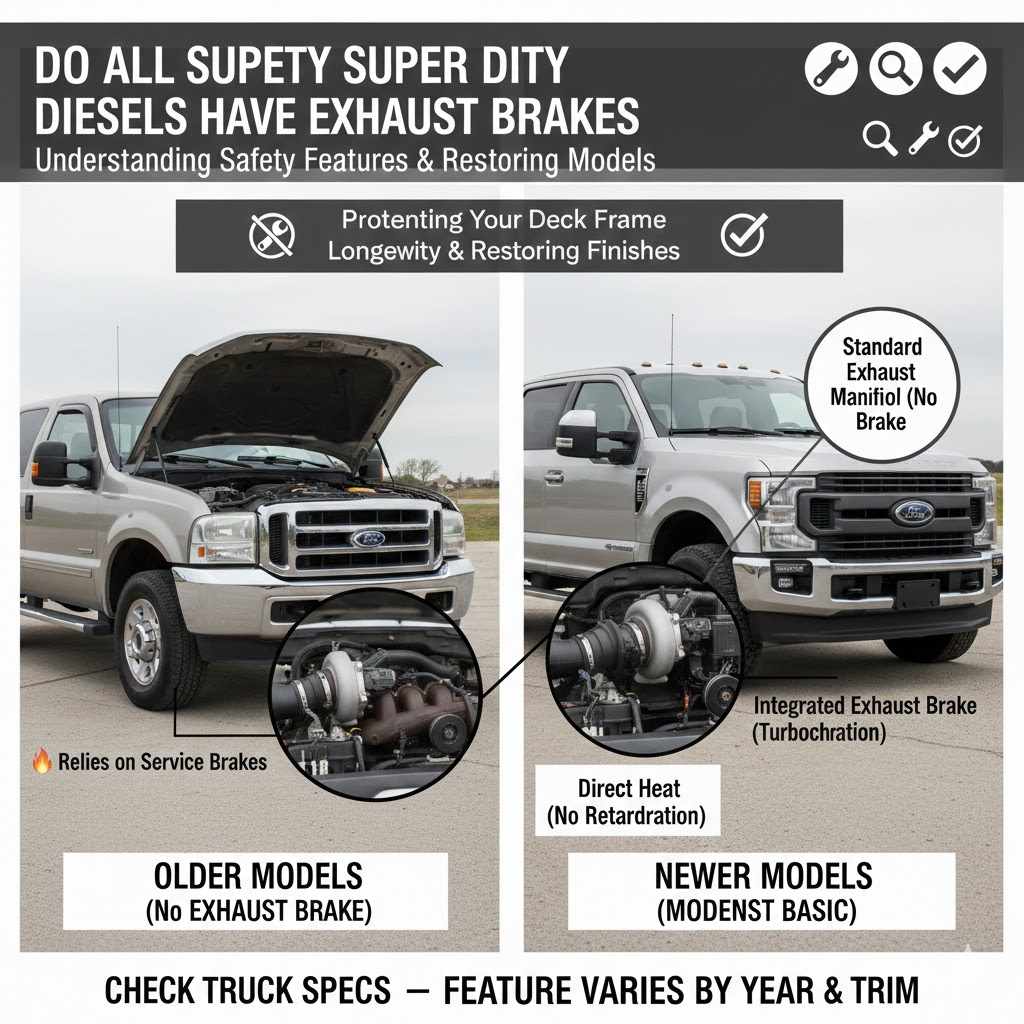
Ford’s Super Duty line has seen many updates over the years. The availability of an integrated exhaust brake has also evolved. For many years, an exhaust brake was not a standard feature across all diesel Super Duty models.
It was often an optional upgrade or part of specific packages.
However, starting around the 2015 model year, Ford began making a more integrated exhaust brake system more commonly available on their Super Duty trucks equipped with the Power Stroke diesel engines. This feature became increasingly standard on higher trim levels and as part of towing packages in subsequent years.
It’s important to note that even within a specific model year, availability could depend on the engine size chosen and the specific options or packages selected at the time of purchase. For instance, a base model might not have it, while a King Ranch or Platinum trim might include it as standard.
For the most current Super Duty models, especially those from 2017 and newer, an exhaust brake is very commonly found on diesel-equipped trucks. Ford has made it a significant part of their towing and hauling capabilities. It’s now considered a standard or highly desirable feature for those who use these trucks for their intended purpose.
When looking at older models, it’s more likely to be an option that was added. Therefore, checking the specific vehicle’s options list or window sticker is the most reliable way to confirm if an exhaust brake was originally factory-equipped.
Engine Options And Exhaust Brake Integration
The availability of an exhaust brake is strongly tied to the engine choice in a Ford Super Duty truck. Specifically, it is almost exclusively found on models equipped with Ford’s Power Stroke diesel engines. Gasoline engines do not typically feature exhaust brakes.
The Power Stroke engine, known for its robust performance and towing capabilities, is the platform upon which Ford has built its exhaust brake systems. The integration is often done using the truck’s Variable Geometry Turbocharger (VGT). The VGT’s ability to change the angle of its vanes allows it to create the necessary backpressure in the exhaust manifold for braking.
When you select a diesel engine, particularly the larger displacement Power Stroke options (like the 6.7L Power Stroke V8), the likelihood of having an exhaust brake option increases significantly. Ford has worked to make this system seamless with the engine’s operation.
In recent model years, Ford has made this feature more standard for diesel engines. For example, a 2020 Ford F-250 or F-350 with the 6.7L Power Stroke diesel is highly likely to have an integrated exhaust brake system. It’s less common to find an exhaust brake on smaller diesel engines or in trucks where the diesel engine was not a primary focus for heavy-duty applications.
So, if you’re looking at a Super Duty with a diesel engine, especially a 6.7L Power Stroke, there’s a very good chance it has an exhaust brake. However, it’s always best to verify the specific vehicle’s configuration.
Identifying If Your Truck Has An Exhaust Brake
Finding out if your Ford Super Duty diesel has an exhaust brake is usually quite straightforward. The most obvious indicator is a physical button or switch on the dashboard. This button typically has an icon depicting an exhaust pipe with some sort of restriction or a wavy line to represent braking.
The location of this button can vary depending on the year and trim level of your truck. It’s commonly found on the dashboard to the left of the steering wheel, or sometimes integrated into the center console. It’s often labeled “Exhaust Brake” or “EB.”
Another way to check is by looking at the truck’s powertrain control module settings, though this is more technical. A simpler method is to check your owner’s manual. Your manual will detail all the features specific to your truck’s configuration, including the exhaust brake system if it’s present.
If you have a button, try pressing it while you’re driving (in a safe environment, of course). You might hear a slight change in the engine’s sound or notice a subtle change in how the truck responds to acceleration or deceleration. Some trucks also display an indicator light on the dashboard when the exhaust brake is engaged.
Finally, a quick VIN (Vehicle Identification Number) lookup can often reveal the original factory options and packages included with your truck. Many online VIN decoders can tell you if the exhaust brake option was selected at the time of manufacturing. This is a very reliable method if you have access to the VIN.
How To Use Your Ford Super Duty Exhaust Brake Effectively
Knowing whether your truck has an exhaust brake is just the first step. This section will teach you how to use it properly. We’ll cover how to activate it, when to use it, and how it interacts with your truck’s transmission.
Effective use means safer driving and better performance, especially when towing.
Activating The Exhaust Brake System
Activating your Ford Super Duty’s exhaust brake is typically a simple process, designed for ease of use by the driver. As mentioned earlier, the primary method is via a dedicated button or switch on the dashboard. This button is usually labeled “EXHAUST BRAKE” or simply “EB.”
When you press this button, you’ll usually see an indicator light illuminate on your instrument cluster, confirming that the system is now active and ready. This light commonly shows an exhaust pipe symbol or a similar graphic.
The exhaust brake system in Ford Super Duty trucks is often designed to be intelligent. This means it might not fully engage until certain conditions are met. For example, it typically requires the vehicle to be in drive and moving at a certain speed.
It also usually won’t engage if you are actively pressing the accelerator pedal, as this would counteract the braking effect.
Many modern Super Duty trucks offer different modes for the exhaust brake. You might have options like “OFF,” “ON,” or even “AUTO.” The “ON” setting will typically keep the exhaust brake engaged whenever you lift your foot off the accelerator, as long as engine conditions are met. The “AUTO” setting often means the exhaust brake will engage automatically when the truck’s computer senses a need for deceleration, such as on a steep downhill grade or when the cruise control is used for engine braking.
Understanding these modes will help you utilize the system to its fullest potential. Always refer to your owner’s manual for the most precise instructions on activating and operating the exhaust brake system specific to your truck’s model year and configuration.
When To Engage The Exhaust Brake
The exhaust brake is a powerful tool, and knowing when to use it is key to maximizing its benefits. The most common and critical time to engage your exhaust brake is when descending hills, especially steep or long grades. This is where it truly shines by preventing your service brakes from overheating.
When you’re going downhill, lift your foot off the accelerator. If the exhaust brake is engaged (in “ON” or “AUTO” mode, depending on your truck’s settings), you will feel the truck start to slow down. This allows you to maintain a safe and controlled speed without constantly applying the brake pedal.
This is crucial for safety, particularly when towing heavy loads.
Another scenario where the exhaust brake is beneficial is in adverse weather conditions. Driving on wet, icy, or snowy roads can reduce traction. Using the exhaust brake can provide a smoother, more controlled deceleration than abrupt braking.
This can help prevent skids and maintain stability.
While it’s primarily for descents, some drivers also find it useful for managing speed in slower traffic or when approaching stop signs. This can help reduce brake wear in stop-and-go situations. However, it’s important not to rely on it solely for stopping the vehicle, as it is not as powerful as your hydraulic service brakes.
Always remember to check your truck’s specific settings and owner’s manual. Some “AUTO” modes will manage engagement for you in many situations, while “ON” requires your manual activation by lifting off the gas.
Exhaust Brake And Transmission Interaction
The seamless interaction between the exhaust brake and the transmission is a hallmark of modern Ford Super Duty trucks. This integration is designed to provide the most effective and smooth deceleration possible. When the exhaust brake is activated and the driver lifts off the accelerator, the truck’s powertrain control module (PCM) often signals the transmission to downshift.
This downshift increases the engine’s revolutions per minute (RPM). Higher RPMs mean the exhaust brake’s resistance becomes more potent, leading to stronger deceleration. For example, if you are in 10th gear and lift off the throttle with the exhaust brake engaged, the transmission might downshift to 8th or even lower, depending on your speed and the braking force required.
This coordinated action ensures that the engine is working at an optimal RPM range to provide maximum braking effect. It also helps keep the vehicle’s speed in check without over-revving the engine to an unsafe level. The PCM constantly monitors engine speed, vehicle speed, and driver input to manage these shifts.
Some drivers may notice a slight hesitation or a noticeable downshift when the exhaust brake is engaged. This is normal behavior and indicates the system is working as intended. The goal is to maintain a steady, controlled descent or deceleration.
Understanding this interaction can help you anticipate the truck’s behavior and use the exhaust brake more confidently. For instance, if you know a downshift is coming, you can be prepared for a slight change in engine sound and feel. This synergy between the exhaust brake and transmission is a key factor in the Super Duty’s capability as a towing and hauling machine.
Troubleshooting Common Exhaust Brake Issues
Even the most reliable systems can sometimes experience minor hiccups. This section will help you identify and address some common issues you might encounter with your Ford Super Duty’s exhaust brake. We’ll cover simple fixes and when it might be time to seek professional help, ensuring your exhaust brake system stays in good working order.
Why Isn’t My Exhaust Brake Working?
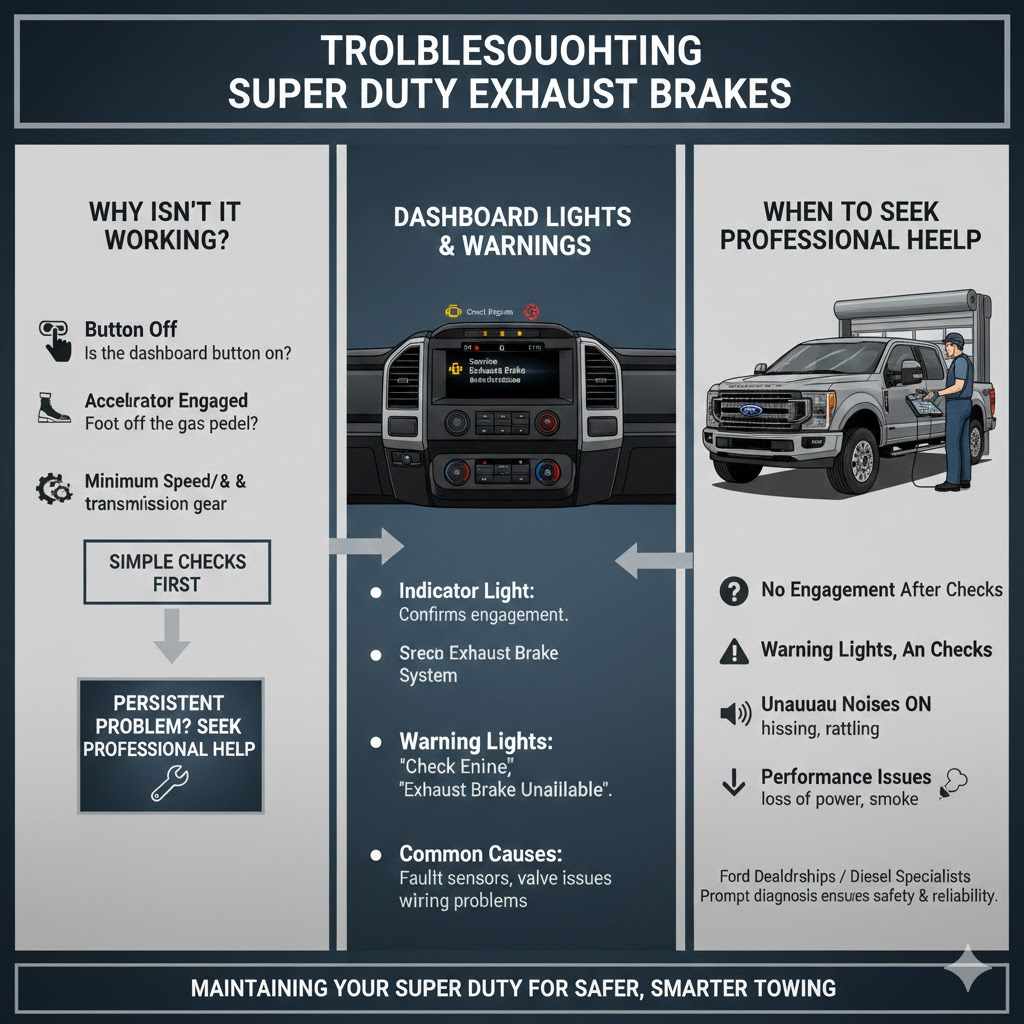
If you find that your exhaust brake isn’t engaging when you expect it to, there are a few common reasons. First, double-check that the exhaust brake button is actually turned on. It’s easy to forget, especially if you don’t use it frequently.
Look for the indicator light on your dashboard.
Next, consider the conditions. As mentioned, exhaust brakes typically won’t engage if you are pressing the accelerator pedal. Make sure you’ve completely lifted your foot off the gas.
Also, some systems require a minimum vehicle speed to activate. If you’re moving too slowly, it might not engage.
Another factor could be the transmission gear selection. While many systems work in most forward gears, some might have limitations. Ensure your transmission is in a suitable gear.
If your truck has different exhaust brake modes (ON, AUTO, OFF), verify you’ve selected the correct mode for the situation.
If none of these simple checks resolve the issue, it’s possible there’s a more technical problem. This could involve a faulty sensor, a problem with the exhaust brake valve itself, or an issue with the truck’s computer system. In such cases, it’s best to consult a qualified mechanic or a Ford dealership service center.
A diagnostic scan of the truck’s onboard computer can often pinpoint the exact fault. Ignoring a non-functional exhaust brake can lead to increased wear on your service brakes and reduced safety, especially when towing.
Dashboard Lights And Warning Messages
When your exhaust brake system is functioning correctly, you’ll typically see a small indicator light on your dashboard confirming its engagement. However, if there’s a problem, your truck’s computer may illuminate a warning light. This could be a general “Check Engine” light or a more specific message related to the powertrain or emissions system.
Some trucks may display a specific message on the driver information center, such as “Exhaust Brake Unavailable” or “Service Exhaust Brake System.” These messages are designed to alert you immediately that something is not right. When you see such a warning, it’s important to pay attention.
The most common cause for these warning lights and messages, beyond a simple button being off, is a fault within the exhaust brake’s control system. This could be related to the electronic actuators that control the exhaust brake valve, pressure sensors, or the wiring harness connecting these components. Over time, these parts can be exposed to heat and vibration, leading to wear or failure.
For example, a faulty sensor might incorrectly report exhaust backpressure, causing the system to shut down or report an error. Similarly, if the physical valve that restricts the exhaust flow becomes stuck or damaged, the system will fail and trigger a warning.
If you encounter any of these dashboard warnings, it’s recommended to get your truck diagnosed by a professional. They have the tools and expertise to read the error codes and identify the precise cause of the malfunction. Continuing to drive with a faulty exhaust brake can sometimes exacerbate the problem or lead to other issues.
When To Seek Professional Help
While many exhaust brake issues can be simple to diagnose, some require specialized knowledge and tools. You should consider seeking professional help if you’ve gone through the basic troubleshooting steps (checking the button, confirming operational conditions, consulting the manual) and the exhaust brake still isn’t working.
Any time a warning light related to the exhaust brake system or the engine comes on, it’s wise to have it checked by a professional technician. These lights indicate that the truck’s computer has detected a fault that could affect performance, emissions, or safety.
If you notice unusual noises when the exhaust brake is supposed to be active, such as loud hissing sounds, rattling, or grinding, this could point to a mechanical problem within the exhaust system or the brake actuator. These are best addressed by someone with mechanical expertise.
Furthermore, if you experience a noticeable loss of power, rough engine running, or increased smoke from the exhaust, these could be related symptoms of an exhaust brake malfunction. These are serious indicators that require immediate professional attention.
Ford dealerships and reputable independent shops that specialize in diesel trucks are well-equipped to handle exhaust brake repairs. They have access to genuine Ford parts, specialized diagnostic equipment, and experienced technicians who understand the intricacies of these systems. It’s better to address these issues promptly to ensure your truck remains safe and reliable for all your towing needs.
Conclusion
Many Ford Super Duty diesels are equipped with an exhaust brake. This feature is common on newer models and often tied to specific engine options and towing packages. Checking for a dashboard button is the easiest way to confirm.
Knowing how and when to use it enhances safety and reduces wear on your truck. If it’s not working, simple checks often solve the problem, but professional help is available when needed.